Limitations of Use
Use of LIVDELZI is not recommended in patients who have or develop decompensated cirrhosis (e.g., ascites, variceal bleeding, hepatic encephalopathy) [see Use in Specific Populations (8.7)].
Common Adverse Reactions
Table 1 presents common adverse reactions that occurred in Trial 1.
Table 1: Common Adverse Reactions Occurring Through Week 52 in Adult Patients with PBC (Trial 1)Included 12 patients (6%) who were intolerant to UDCA and initiated treatment as monotherapy: 8 patients (6%) in the LIVDELZI 10 mg arm and 4 patients (6%) in the placebo arm.
| Adverse Reaction Occurring in greater than or equal to 5% of patients in the LIVDELZI treatment arm and at an incidence greater than or equal to 1% higher than in the placebo arm. | LIVDELZI 10 mg Once Daily
(N=128)
% (n) | PLACEBO
(N=65)
% (n) |
|---|
| Headache | 8% (10) | 3% (2) |
| Abdominal pain | 7% (9) | 2% (1) |
| Nausea | 6% (8) | 5% (3) |
| Abdominal distension | 6% (8) | 3% (2) |
| Dizziness | 5% (6) | 2% (1) |
Fractures
In Trial 1, fractures occurred in 4% (n=5) of LIVDELZI-treated patients compared to no placebo-treated patients. Baseline bone mineral density was not obtained. The median time to fracture after receiving LIVDELZI was 295 days (range: 89–349).
Less Common Adverse Reactions
Additional adverse reactions that occurred more frequently in the LIVDELZI-treated patients compared to placebo, but in less than 5% of patients, included dyspepsia, rash, alopecia, anemia, and cough.
Laboratory Abnormalities
Estimated Glomerular Filtration Rate
In Trial 1, LIVDELZI-treated patients developed decreased estimated glomerular filtration rate (eGFR) (serum creatinine elevations) more frequently compared to placebo-treated patients. Ten percent (n=12) of LIVDELZI-treated patients had a decline in eGFR of at least 25%, compared to 2% (n=1) of placebo-treated patients. None of the patients experienced an eGFR decline of 50% or more. The decline in eGFR stabilized or returned towards baseline with ongoing LIVDELZI treatment. None of the patients required discontinuation of LIVDELZI and there were no clinical findings associated with the observed changes in eGFR.
Risk Summary
There are insufficient data from human pregnancies exposed to LIVDELZI to allow an assessment of a drug-associated risk of major birth defects, miscarriage, or other adverse maternal or fetal outcomes. In animal reproduction studies, no malformations or effects on embryo-fetal survival occurred in pregnant rats or rabbits after seladelpar treatment at exposures of up to 176-times and 49-times the recommended dose based on AUC (area under the plasma concentration-time curve), respectively. Reduction of fetal growth associated with maternal toxicity occurred in pregnant rabbits at 49-times the recommended dose based on AUC, but not at 3-times the recommended dose. In a pre- and postnatal development study in rats with maternal dosing of seladelpar during organogenesis through lactation, postnatal growth and pre-weaning survival of offspring was reduced at 115-times the recommended dose based on AUC, but not at the lower exposure of 16-times the recommended dose (see Data).
The background risks of major birth defects and miscarriage for the indicated population are unknown. All pregnancies have a background risk of birth defect, loss, or other adverse outcomes. In the U.S. general population, the estimated background risk of major birth defects and miscarriage in clinically recognized pregnancies is 2% to 4% and 15% to 20%, respectively.
Report pregnancies to Gilead Sciences, Inc. at 1-800-445-3235.
Data
Animal Data
No effects on embryo-fetal development were observed in pregnant rats treated orally with up to 100 mg/kg/day seladelpar (176-times the recommended dose based on AUC) during the period of organogenesis.
Oral administration of 40 mg/kg/day seladelpar in pregnant rabbits (49-times the recommended dose based on AUC) during organogenesis resulted in reduced fetal body weight, which was likely due to maternal toxicity (i.e., decreases in food consumption, body weight, and gravid uterine weight) and distended stomach. No treatment-related fetal malformations or effects on embryo-fetal survival occurred in rabbits at 49-times the recommended dose. No adverse effects on embryo-fetal development were observed at 10 mg/kg/day (3-times the recommended dose based on AUC).
A pre- and postnatal development study was performed using oral administration of seladelpar at doses of 0 (vehicle), 5, 20, or 100 mg/kg/day in pregnant rats during organogenesis through lactation. Treatment with 5 mg/kg/day or higher (4-times the recommended dose based on AUC) resulted in a dose-dependent reduction in pup body weight during the pre-weaning period. The weight reduction in offspring was associated with delays in developmental milestones (i.e., eye opening and pinna unfolding at 5 mg/kg/day and higher; hair growth and sexual maturity at 100 mg/kg/day). Reduction in pup body weight at 100 mg/kg/day (115-times the recommended dose based on AUC), which continued into the post-weaning maturation period, was associated with a slight decrease in pre-weaning survival and was considered adverse. No adverse effects were found in clinical observations, neurobehavioral assessment, or reproductive performance testing in the offspring of females treated with seladelpar. At 20 mg/kg/day (16-times the recommended dose based on AUC), none of the observed effects in offspring were considered to be adverse.
Risk Summary
There are no data on the presence of seladelpar or its metabolite in either human or animal milk, the effects on the breastfed infant, or the effects on milk production. The developmental and health benefits of breastfeeding should be considered along with the mother's clinical need for LIVDELZI and any potential adverse effects on the breastfed infant from LIVDELZI or from the underlying maternal condition.
Pharmacodynamic Markers
In patients with PBC treated with 10 mg once daily of LIVDELZI (Trial 1), a greater reduction in mean ALP from baseline was observed as early as 1 month after treatment compared to the placebo group and lower ALP was generally maintained through month 12 [see Clinical Studies (14)].
In another study in which patients with PBC were treated with 2, 5, or 10 mg once daily of seladelpar, a dose dependent reduction in mean ALP was observed.
Cardiac Electrophysiology
At 20-times the recommended dose of 10 mg, LIVDELZI did not cause clinically significant QTc interval prolongation.
Absorption
The median time to peak concentration (Tmax) was 1.5 hours for seladelpar.
Effect of Food
No clinically significant differences in seladelpar pharmacokinetics were observed following administration of a high-fat meal in healthy subjects.
Distribution
Seladelpar steady state apparent volume of distribution was approximately 133.2 L. Seladelpar plasma protein binding is greater than 99%.
Elimination
The apparent oral clearance of seladelpar is 12 L/h. Following administration of a single dose of 10 mg seladelpar in healthy subjects, mean elimination half-life was 6 hours for seladelpar. In PBC patients, the half-life range was 3.8 to 6.7 hours for seladelpar.
Metabolism
Seladelpar is primarily metabolized in vitro by CYP2C9 and to a lesser extent by CYP2C8 and CYP3A4, resulting in the three major metabolites: seladelpar sulfoxide (M1), desethyl-seladelpar (M2), and desethyl-seladelpar sulfoxide (M3). The metabolite-to-parent AUC ratios were 0.36, 2.32 and 0.63 for M1, M2 and M3, respectively. Median Tmax for metabolites were 10 hours for M1 and 4 hours for M2 and M3. None of the major metabolites have pharmacological activity.
Excretion
Seladelpar is primarily eliminated in urine as metabolites. Following a single oral dose of 10 mg radiolabeled seladelpar in humans, approximately 73.4% of the dose was recovered in urine (less than 0.01% unchanged) and 19.5% in feces (2.02% unchanged) within 216 hours. Biliary excretion of seladelpar was suggested by an animal study.
Specific Populations
No clinically significant differences in the pharmacokinetics of seladelpar were observed based on age (19 to 79 years old), body mass index (BMI) (17.6 to 45.0 kg/m2), weight (45.8 to 127.5 kg), sex, and race (White, Black, or other).
Patients with Renal Impairment
In subjects with mild (eGFR ≥60 to <90 mL/min/1.73 m2, MDRD), moderate (eGFR ≥30 to <60 mL/min/1.73 m2), and severe (<30 mL/min/1.73 m2 and not on dialysis) renal impairment, the AUCinf of seladelpar was 10% higher, 54% higher, and similar to that in subjects with normal renal function, respectively, after administration of a single 10 mg dose of seladelpar. The difference in Cmax of seladelpar was less than 18% in subjects with renal impairment compared to subjects with normal renal function [see Use in Specific Populations (8.6)]. The pharmacokinetics of seladelpar have not been studied in patients requiring hemodialysis.
Patients with Hepatic Impairment
Hepatic Impairment of various etiologies: Following a single oral dose of 10 mg seladelpar, seladelpar AUC increased 1.1-fold in subjects with mild (Child-Pugh A), 2.5-fold in moderate (Child-Pugh B), and 2.1-fold in severe (Child-Pugh C) hepatic impairment. Seladelpar Cmax increased 1.3-fold in subjects with mild (Child-Pugh A), 5.2-fold in moderate (Child-Pugh B), and 5-fold in severe (Child-Pugh C) hepatic impairment.
Hepatic Impairment in patients with PBC: Compared to PBC patients with mild hepatic impairment (Child-Pugh A) without portal hypertension, seladelpar exposures (Cmax, AUC) were 1.7 to 1.8-fold higher in PBC patients with mild hepatic impairment with portal hypertension and 1.6 to 1.9-fold higher in PBC patients with moderate hepatic impairment (Child-Pugh B) after a single oral dose of 10 mg seladelpar.
Accumulation ratios were less than 1.2-fold in PBC patients with mild hepatic impairment with portal hypertension and PBC patients with moderate hepatic impairment following 10 mg seladelpar once daily dosing for 28 days.
Drug Interaction Studies
Effect of Other Drugs on Seladelpar
In Vitro Studies
Seladelpar is a substrate of CYP2C9, CYP2C8, CYP3A4, and the transporters BCRP, P-gp, and OAT3.
Seladelpar is not a substrate of MATE1, MATE2-K, OAT1, OATP1B1, OATP1B3, OCT1, or OCT2 transporters.
Carbamazepine
Seladelpar AUC0–inf decreased by approximately 44% and Cmax by 24% following administration of a single 10 mg seladelpar dose after carbamazepine 300 mg twice daily for 8 days in healthy subjects. The carbamazepine (CYP3A and CYP2C9 inducer) dose was escalated from 100 mg twice daily for 3 days followed by 200 mg twice daily for 4 days to 300 mg twice daily.
Fluconazole
Seladelpar AUC0–inf increased by 2.4-fold and Cmax by 1.4-fold following concomitant use of a single 10 mg seladelpar dose with 400 mg fluconazole (moderate CYP2C9 and CYP3A4 inhibitor) in healthy subjects.
Cyclosporine
Seladelpar AUC0–inf increased by 2.1-fold and Cmax by 2.9-fold following concomitant use of a single 10 mg seladelpar dose with 600 mg cyclosporine (BCRP inhibitor) in healthy subjects.
Probenecid
Seladelpar AUC0–inf increased by 2-fold and Cmax by 4.69-fold following concomitant use of a single 10 mg seladelpar dose with 500 mg probenecid (OAT3 inhibitor) in healthy subjects.
Strong CYP2C9 inhibitor
Seladelpar AUC0–inf is predicted to increase by 3.7-fold when coadministered with sulphaphenazole (strong CYP2C9 inhibitor).
Quinidine
Seladelpar exposures were not significantly altered when a single dose of 600 mg quinidine (P-gp inhibitor) was coadministered in healthy subjects.
Other Drugs: No clinically significant differences in seladelpar pharmacokinetics were predicted when used concomitantly with strong CYP3A4 inhibitors or CYP2C8 inhibitors.
Effects of Seladelpar on other drugs
In clinical studies, no clinically significant differences in the pharmacokinetics of the following drugs were observed when used concomitantly with seladelpar: tolbutamide (CYP2C9 substrate), midazolam (CYP3A4 substrate), simvastatin (CYP3A4 and OATP substrate), atorvastatin (CYP3A4 and OATP substrate), or rosuvastatin (BCRP and OATP substrate).
In Vitro Studies
Seladelpar and its metabolites (M1, M2, or M3) did not inhibit CYPs 1A2, 2B6, 2C8, 2C19, 2D6, 3A4. Seladelpar did not induce CYP1A2, CYP2B6, or CYP2C8.
Seladelpar and its metabolites (M1, M2, or M3) did not inhibit UGTs.
Seladelpar and its metabolites (M1, M2, or M3) did not inhibit P-gp, MATE1, MATE2-K, OCT1, OCT2, OAT1, and OAT3.
Carcinogenesis
In a 2-year study in CD-1 mice, oral administration of seladelpar produced hepatocellular adenoma or carcinoma at a dose of 5 mg/kg/day in males (6-times the recommended dose based on AUC) and 20 mg/kg/day in females (140-times the recommended dose based on AUC). No tumorigenic effects were observed in female mice at doses of up to 10 mg/kg/day (49-times the recommended dose based on AUC).
In a 2-year study in Sprague-Dawley rats, oral administration of seladelpar produced benign interstitial cell tumors in testes and squamous cell carcinoma of the nonglandular stomach in males at a dose of 30 mg/kg/day (79-times the recommended dose based on AUC). No tumorigenic effects were observed in males at doses of up to 10 mg/kg/day (14-times the recommended dose based on AUC) or in females at doses of up to 30 mg/kg/day (26-times the recommended dose based on AUC).
Mutagenesis
Seladelpar was negative in the in vitro bacterial reverse mutation (Ames) assay, the in vitro mouse lymphoma assay, and the in vivo mouse micronucleus test.
Impairment of Fertility
Seladelpar had no effects on fertility or reproductive function in male and female rats at oral doses of up to 100 mg/kg/day (271-times and 115-times the maximum recommended dose in male and female rats, respectively, based on AUC).
Baseline Demographics and Characteristics
The mean age of patients was 57 (Range: 28 to 75) years; 95% were female; 88% were White, 6% Asian, 2% Black or African American, and 3% American Indian or Alaska Native. Twenty-nine percent of the patients, 23% in the LIVDELZI 10 mg arm and 42% in the placebo arm, identified as Hispanic/Latino. Thirty-two percent of the patients, 38% in the LIVDELZI 10 mg arm and 20% in the placebo arm, were enrolled in the US.
At baseline, 18 (14%) of the LIVDELZI-treated patients and 9 (14%) of the placebo-treated patients met at least one of the following criteria: Fibroscan >16.9kPa; historical biopsy or radiological evidence suggestive of cirrhosis; platelet count < 140,000/µL with at least one additional laboratory finding including serum albumin < 3.5 g/dL, INR > 1.3, or TB > 1-time ULN; or clinical determination of cirrhosis by the investigator.
The mean baseline ALP concentration was 314 (Range: 161 to 786) units per liter (U/L), corresponding to 2.7-times ULN. The mean baseline TB concentration was 0.8 (Range: 0.3 to 1.9) mg/dL and was less than or equal to the ULN in 87% of the patients. Other mean baseline liver biochemistries were 48 (Range: 9 to 115) U/L for ALT and 40 (Range: 16 to 94) U/L for AST.
Biochemical Results
The primary endpoint was biochemical response at Month 12, where biochemical response was defined as achieving ALP less than 1.67-times ULN, an ALP decrease of greater than or equal to 15% from baseline, and TB less than or equal to ULN. ALP normalization (i.e., ALP less than or equal to ULN) at Month 12 was a key secondary endpoint. The ULN for ALP was defined as 116 U/L. The ULN for TB was defined as 1.1 mg/dL.
Table 3 presents results at Month 12 for the percentage of patients who achieved biochemical response, achieved each component of biochemical response, and achieved ALP normalization. LIVDELZI demonstrated greater improvement on biochemical response and ALP normalization at Month 12 compared to placebo. Overall, 87% of patients had a baseline of TB concentration less than or equal to ULN. Therefore, improvement in ALP was the main contributor to the biochemical response rate results at Month 12.
Table 3: Percentage of Adult Patients with PBC Achieving Biochemical Response and ALP Normalization at Month 12 in Trial 1 | LIVDELZI 10 mg Once Daily
(N=128) | Placebo
(N=65) | Treatment Difference
% (95% CI)95% unstratified Miettinen and Nurminen confidence intervals (CIs) are provided. |
|---|
| Biochemical Response Rate, n (%), | 79 (62) | 13 (20) | 42 (28, 53) |
| Components of Biochemical Response | | | |
| ALP less than 1.67-times ULN, n (%) | 84 (66) | 17 (26) | 39 (25, 52) |
| Decrease in ALP of at least 15%, n (%) | 107 (84) | 21 (32) | 51 (37, 63) |
| TB less than or equal to ULN, n (%) | 104 (81) | 50 (77) | 4 (-7, 17) |
| ALP Normalization, n (%) ALP normalization is defined as ALP less than or equal to ULN.
Patients who discontinued treatment prior to Month 12 or who had missing data were considered as non-responders. , | 32 (25) | 0 (0) | 25 (18, 33) |
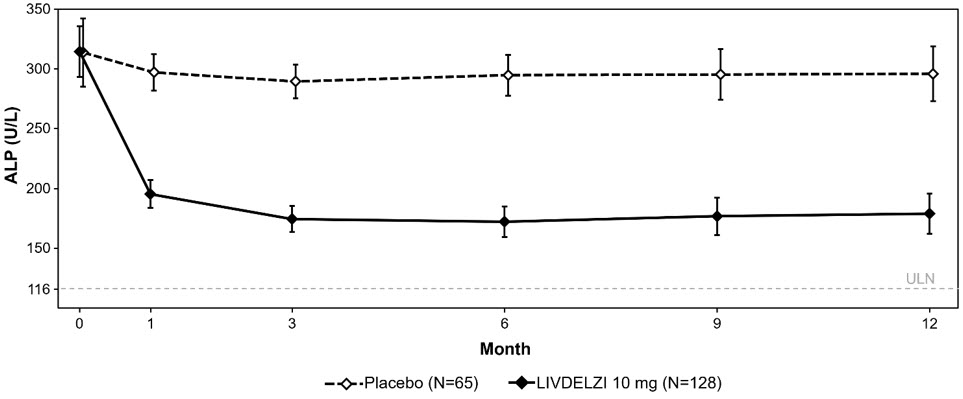
Figure 1 shows the mean (95% CI) levels of ALP over 12 months. There was a trend of lower ALP in LIVDELZI arm compared to placebo arm starting at Month 1 through Month 12.
| Figure 1: Mean Figure 1 presents means and 95% Wald CIs for baseline, and least squares means and corresponding 95% CIs based on a mixed-effect model for repeated measures (MMRM) for Months 1, 3, 6, 9 and 12. The MMRM adjusts for baseline ALP, baseline ALP level (<350 U/L versus ≥350 U/L), baseline pruritus NRS (< 4 versus ≥4), time (in months), treatment arm, treatment-by-baseline ALP interaction, and treatment-by-time interaction. The least squares mean change from baseline in ALP at Month 12 was -134 (-151, -117) U/L and -17 (-40, 6) U/L in the LIVDELZI 10 mg and placebo arms, respectively. ALP in Adult Patients with PBC over 12 Months in Trial 1 |
|
Biochemical response at Month 3 comparing LIVDELZI as a monotherapy to placebo was evaluated in a pooled analysis of a subset of patients from Trial 1 and another randomized, double-blind, placebo-controlled trial in a similar patient population. There was a trend of improvement on biochemical response at Month 3 in the LIVDELZI monotherapy group compared to the placebo group.
Pruritus
A single-item patient-reported outcome (PRO), the pruritus Numerical Rating Scale (NRS), evaluated patients' daily worst itching intensity on an 11-point rating scale with scores ranging from 0 ("no itching") to 10 ("worst itching imaginable") in Trial 1. The pruritus NRS was administered daily in a 14-day run-in period prior to randomization through Month 6.
Table 4 presents the results of the comparison between LIVDELZI and placebo on the key secondary endpoint evaluating the change from baseline in pruritus score at Month 6 in patients with baseline average pruritus scores greater than or equal to 4. The baseline average pruritus score for each patient was calculated by averaging the pruritus NRS scores administered in the run-in period and on Day 1 before treatment initiation. The pruritus scores at Month 6 for each patient were calculated by averaging the pruritus NRS scores within the last week in the month. Patients treated with LIVDELZI demonstrated greater improvement in pruritus compared with placebo.
Table 4: Change from Baseline in Pruritus Score at Month 6 in PBC Patients with Baseline Average Pruritus Score ≥4 in Trial 1 | LIVDELZI 10 mg Once Daily
(N=49) | Placebo
(N=23) |
|---|
| Baseline Average Pruritus Score, Mean (SD) | 6.1 (1.4) | 6.6 (1.4) |
| Change from Baseline in Pruritus Score at Month 6 |
| Mean (SE) | -3.2 (0.3) | -1.7 (0.4) |
| Mean difference vs. Placebo (95% CI) | -1.5 (-2.5, -0.5)
p=0.0051 |
How Supplied
LIVDELZI (seladelpar) capsules are available as 10 mg, light gray opaque body, and a dark blue opaque cap with "CBAY" imprinted on the cap and "10" on the body.
LIVDELZI is packaged in a 75 cc high density polyethylene bottle, closed with a 38 mm polypropylene child resistant cap containing an induction seal.
- 10 mg capsules in a bottle (30 count) (NDC 61958-3301-1).
Fractures
Inform patients that LIVDELZI may increase the risk of bone fractures. Advise patients to call their healthcare provider to report any fractures [see Warnings and Precautions (5.1)].
Liver Test Abnormalities
Instruct patients to report any signs or symptoms of liver-related adverse reactions (e.g., loss of appetite, nausea, increased fatigue, lower extremity edema, abdominal swelling, or jaundice/icterus) to their healthcare provider [see Warnings and Precautions (5.2)].
Biliary Obstruction
Instruct patients to immediately report any signs or symptoms of biliary obstruction (e.g., right upper quadrant pain, jaundice) to their healthcare provider so that LIVDELZI treatment can be interrupted while the patient is being evaluated [see Warnings and Precautions (5.3)].
Pregnancy
Advise patients that there is a pregnancy safety study that captures pregnancy outcomes in women exposed to LIVDELZI during pregnancy, and to report pregnancies and pregnancy outcomes by calling 1-800-445-3235 [see Use in Specific Populations (8.1)].
Distributed by: Gilead Sciences, Inc., Foster City, CA 94404.
LIVDELZI is a trademark of Gilead Sciences, Inc., or its related companies.
Copyright © 2024 Gilead Sciences, Inc. All rights reserved.