YEZTUGO tablets: Each tablet contains 300 mg of lenacapavir (present as 306.8 mg of lenacapavir sodium). The tablets are beige, capsule-shaped, film-coated, and debossed with ‘GSI’ on one side of the tablet and ‘62L’ on the other side of the tablet.
YEZTUGO injection: Each single-dose vial contains 463.5 mg/1.5 mL (309 mg/mL) of lenacapavir (present as 473.1 mg/1.5 mL of lenacapavir sodium). The lenacapavir injectable solution is sterile, preservative-free, clear, and yellow with no visible particles.
Nodules and Indurations Dermatopathology
In a separate clinical trial (CAPELLA) in participants with HIV-1 who received lenacapavir via subcutaneous injection, skin biopsies of injection site nodules or indurations revealed dermatopathological findings of foreign body inflammation or granulomatous response in some participants.
Strong or Moderate CYP3A Inducers
Drugs that are strong or moderate inducers of CYP3A may significantly decrease plasma concentrations of lenacapavir, which may reduce the effectiveness of YEZTUGO. Therefore, dosage modifications (supplemental doses) of YEZTUGO are recommended when initiating strong or moderate CYP3A inducers [see Dosage and Administration (2.5) and Clinical Pharmacology (12.3)].
Combined P-gp, UGT1A1, and Strong CYP3A Inhibitors
Combined P-gp, UGT1A1, and strong CYP3A inhibitors may significantly increase plasma concentrations of YEZTUGO. Concomitant administration of YEZTUGO with these inhibitors is not recommended.
Pregnancy Exposure Registry
There is a pregnancy exposure registry that monitors pregnancy outcomes in individuals exposed to YEZTUGO during pregnancy. Healthcare providers are encouraged to register individuals by calling the Antiretroviral Pregnancy Registry (APR) at 1-800-258-4263.
Risk Summary
Available data from a randomized, controlled trial (PURPOSE 1) with YEZTUGO use during pregnancy have not identified a drug-associated risk for miscarriage, or adverse maternal or fetal outcomes when compared to the active control (see Data). The rate of major birth defects in YEZTUGO-exposed pregnancies did not exceed the background prevalence rates. The risk estimates are imprecise due to small numbers of exposed pregnancies (see Data). There is an increased risk of HIV-1 transmission from the mother to the child during acute HIV-1 infection (see Clinical Considerations). In animal reproduction studies, no adverse developmental effects were observed when lenacapavir was administered to rats and rabbits at exposures (AUC) ≥7 times the exposure in humans at the recommended human dose (RHD) of YEZTUGO (see Data).
The APR has been established to monitor for birth defects following prenatal exposure to antiretrovirals. The APR uses the Metropolitan Atlanta Congenital Defects Program (MACDP) as the U.S. reference population for birth defects in the general population. The background rate for major birth defects is 2.7% in the MACDP. The rate of miscarriage for individual drugs is not reported in the APR. In the U.S. general population, the estimated background risk of miscarriage in clinically recognized pregnancies is 15–20%. The MACDP evaluates mothers and infants from a limited geographic area and does not include outcomes for births that occurred at < 20 weeks gestation.
Clinical Considerations
Disease-associated maternal and/or embryo/fetal risk
Published studies indicate an increased risk of HIV-1 infection during pregnancy and an increased risk of mother to child transmission during acute HIV-1 infection. In women at risk of acquiring HIV-1, consideration should be given to methods to prevent acquisition of HIV-1, including continuing or initiating YEZTUGO for HIV-1 PrEP, during pregnancy.
Data
Human Data
In a randomized, controlled trial in Uganda and South Africa (PURPOSE 1), there were 208 pregnancies exposed to YEZTUGO with known outcomes and 132 deliveries (both live and non-live). In the active control arm of PURPOSE 1, there were 109 pregnancies exposed to TRUVADA with known outcomes and 61 deliveries (both live and non-live). The adverse pregnancy outcomes of spontaneous abortion, stillbirth, preterm birth, and small for gestational age were similar across both treatment groups.
There were two major birth defects in the YEZTUGO arm. Both were ventricular septal defects. This resulted in a rate of major birth defects that fell within the background prevalence rate for major birth defects.
Concentrations of YEZTUGO during each trimester of pregnancy and postpartum were comparable to those in non-pregnant participants [see Clinical Pharmacology (12.3)].
Animal Data
Lenacapavir was administered intravenously to pregnant rabbits (up to 20 mg/kg/day on gestation days (GD) 7 to 19), orally to rats (up to 300 mg/kg/day on GD 6 to 17), and subcutaneously to rats (up to 300 mg/kg on GD 6). No significant toxicological effects on embryo-fetal (rats and rabbits) or pre/postnatal (rats) development were observed at exposures (AUC) approximately 21 times (rats) and 170 times (rabbits) the exposure in humans at the RHD of YEZTUGO.
Risk Summary
Lenacapavir is present in human milk. Lenacapavir was detected at very low levels in infants who were breastfed by individuals who became pregnant while receiving YEZTUGO (see Data). No adverse effects of lenacapavir in breastfed infants have been observed. It is not known if YEZTUGO affects milk production.
In women without HIV-1 infection, the developmental and health benefits of breastfeeding and the mother’s clinical need for YEZTUGO for HIV-1 PrEP should be considered along with any potential adverse effects on the breastfed child from YEZTUGO and the risk of HIV-1 acquisition due to nonadherence and subsequent mother to child transmission.
Data
Human Data
The median lenacapavir concentration in human breast milk to maternal plasma ratio in participants (n=8) who received YEZTUGO was 0.63 (range: 0.29 to 1.90). The median infant-to-mother plasma ratio for lenacapavir in infants (n=10) who were breastfed by individuals receiving YEZTUGO from 0 to less than 13 weeks after delivery was 0.06 (range: 0.01 to 0.20).
YEZTUGO tablets are for oral administration. Each film-coated tablet contains 300 mg of lenacapavir (present as 306.8 mg lenacapavir sodium) and the following inactive ingredients: copovidone, croscarmellose sodium, magnesium stearate, mannitol, microcrystalline cellulose, and poloxamer 407. The tablets are film-coated with a coating material containing iron oxide black, iron oxide red, iron oxide yellow, polyethylene glycol, polyvinyl alcohol, talc, and titanium dioxide.
YEZTUGO injection is for subcutaneous administration. Each single-dose vial contains 463.5 mg/1.5 mL (309 mg/mL) of lenacapavir (present as 473.1 mg/1.5 mL of lenacapavir sodium) as a sterile, preservative-free, clear, yellow solution and the following inactive ingredients: 896.3 mg of polyethylene glycol 300 (as solvent) and water for injection. The apparent pH range of the injection is 9.0-10.2.
The vial stoppers are not made with natural rubber latex.
Cardiac Electrophysiology
At supratherapeutic exposures of lenacapavir (16-fold higher than the therapeutic exposures of YEZTUGO), YEZTUGO does not prolong the QTcF interval to any clinically relevant extent.
Specific Populations
There were no clinically significant differences in the pharmacokinetics of lenacapavir based on age, sex assigned at birth, gender identity, ethnicity, race, body weight, severe renal impairment (creatinine clearance of 15 to less than 30 mL per minute, estimated by Cockroft-Gault method), or moderate hepatic impairment (Child-Pugh Class B). The effect of end-stage renal disease (including dialysis), or severe hepatic impairment (Child-Pugh Class C), on the pharmacokinetics of lenacapavir is unknown. As lenacapavir is greater than 98.5% protein bound, dialysis is not expected to alter exposures of lenacapavir [see Use in Specific Populations (8.6, 8.7)].
Pediatrics
The population PK parameter estimates of YEZTUGO after oral and subcutaneous administration to adolescents (weighing at least 35 kg) are provided in Table 10.
Table 10. Pharmacokinetic Parameters of Lenacapavir Following Oral and Subcutaneous Administration to Adolescent Participants Receiving YEZTUGOParameter
Mean (%CV) | Day 1 to end of Month 6 | Steady State |
|---|
| CV = coefficient of variation |
Cmax
(ng/mL) | 81.4 (50.8) | 90.1 (41.7) |
AUCtau
(h•ng/mL) | 205420 (42.1) | 279630 (39.3) |
Ctrough
(ng/mL) | 29.1 (51.4) | 39.8 (53.7) |
Pregnancy
Changes in lenacapavir exposures during pregnancy and postpartum in participants who received YEZTUGO were not considered clinically relevant compared to lenacapavir exposures observed in non-pregnant participants.
Drug Interaction Studies
Clinical Studies
A clinical drug-drug interaction study indicated that lenacapavir is a substrate of CYP3A, P-gp, and UGT1A1. Table 11 summarizes the pharmacokinetic effects of other drugs on lenacapavir.
Lenacapavir is a moderate inhibitor of CYP3A. Lenacapavir is an inhibitor of P-gp and BCRP but does not inhibit OATP. Table 12 summarizes the pharmacokinetic effects of lenacapavir on other drugs.
Table 11. Effect of Other Drugs on LenacapavirSingle dose of lenacapavir 300 mg administered orally.
| Co-administered Drug | Dose of Co-administered Drug (mg) | Mean Ratio of Lenacapavir Pharmacokinetic Parameters (90% CI); No effect = 1.00 |
|---|
| Cmax | AUC |
|---|
Cobicistat (fed)
(Inhibitor of CYP3A [strong] and P-gp) | 150
once daily | 2.10
(1.62, 2.72) | 2.28
(1.75, 2.96) |
Darunavir / cobicistat (fed)
(Inhibitor of CYP3A [strong] and inhibitor and inducer of P-gp) | 800/150
once daily | 2.30
(1.79, 2.95) | 1.94
(1.50, 2.52) |
Voriconazole (fasted)
(Inhibitor of CYP3A [strong]) | 400 twice daily, 200 twice daily 400 mg loading dose twice daily for a day, followed by 200 mg maintenance dose twice daily. | 1.09
(0.81, 1.47) | 1.41
(1.10, 1.81) |
Atazanavir / cobicistat (fed)
(Inhibitor of CYP3A [strong], UGT1A1, and P-gp) | 300/150
once daily | 6.60
(4.99, 8.73) | 4.21
(3.19, 5.57) |
Rifampin (fasted)
(Inducer of CYP3A [strong], P-gp, and UGT) | 600
once daily | 0.45
(0.34, 0.60) | 0.16
(0.12, 0.20) |
Efavirenz (fasted)
(Inducer of CYP3A [moderate] and P-gp) | 600
once daily | 0.64
(0.45, 0.92) | 0.44
(0.32, 0.59) |
| Famotidine (2 hours before, fasted) | 40 once daily | 1.01
(0.75, 1.34) | 1.28
(1.00, 1.63) |
Table 12. Effect of Lenacapavir on Other DrugsFollowing 600 mg twice daily for 2 days, single 600 mg doses of lenacapavir were administered with each co-administered drug, resulting in lenacapavir exposures similar to or higher than those at the usual YEZTUGO dosing schedule [see Dosage and Administration (2.3)].
| Co-administered Drug | Dose of Co-administered Drug (mg) | Mean Ratio of Co-administered Drug Pharmacokinetic Parameters (90% CI) All No Effect Boundaries are 70% to 143%. ; No effect = 1.00 |
|---|
| Cmax | AUC |
|---|
Tenofovir alafenamide (fed)
(substrate of P-gp) | 25 single dose | 1.24
(0.98, 1.58) | 1.32
(1.09, 1.59) |
| Tenofovir Tenofovir alafenamide is converted to tenofovir in vivo.
(substrate of P-gp) | | 1.23
(1.05, 1.44) | 1.47
(1.27, 1.71) |
Pitavastatin (simultaneous administration, fed)
(substrate of OATP) | 2 single dose | 1.00
(0.84, 1.19) | 1.11
(1.00, 1.25) |
Pitavastatin (3 days after lenacapavir, fed)
(substrate of OATP) | 2 single dose | 0.85
(0.69, 1.05) | 0.96
(0.87, 1.07) |
Rosuvastatin (fed)
(substrate of BCRP and OATP) | 5 single dose | 1.57
(1.38, 1.80) | 1.31
(1.19, 1.43) |
Midazolam (simultaneous administration, fed)
(substrate of CYP3A) | 2.5 single dose | 1.94
(1.81, 2.08) | 3.59
(3.30, 3.91) |
| 1-hydroxymidazolam Major active metabolite of midazolam.
(substrate of CYP3A) | | 0.54
(0.50, 0.59) | 0.76
(0.72, 0.80) |
Midazolam (1 day after lenacapavir, fed)
(substrate of CYP3A) | 2.5 single dose | 2.16
(2.02, 2.30) | 4.08
(3.77, 4.41) |
1-hydroxymidazolam
(substrate of CYP3A) | | 0.52
(0.48, 0.57) | 0.84
(0.80, 0.88) |
In Vitro Studies
Lenacapavir is not a substrate, inducer, or inhibitor of CYP1A2, CYP2B6, CYP2C8, CYP2C9, CYP2C19, and CYP2D6. Lenacapavir is not an inducer of CYP3A.
Lenacapavir is not an inhibitor of UGT1A1.
Lenacapavir is not an inhibitor of OAT1, OAT3, OCT1, OCT2, MATE1, or MATE 2-K. Lenacapavir is not a substrate of BCRP, OATP1B1, or OATP1B3.
Mechanism of Action
Lenacapavir is a multistage, selective inhibitor of HIV-1 capsid function that directly binds to the interface between capsid protein (p24) subunits in hexamers. Surface plasmon resonance sensorgrams showed dose-dependent and saturable binding of lenacapavir to cross-linked wild-type capsid hexamer with an equilibrium binding constant (KD) of 1.4 nM. Lenacapavir inhibits HIV-1 replication by interfering with multiple essential steps of the viral lifecycle, including capsid-mediated nuclear uptake of HIV-1 proviral DNA (by blocking nuclear import proteins binding to capsid), virus assembly and release (by interfering with Gag/Gag-Pol functioning, reducing production of capsid protein subunits), and capsid core formation (by disrupting the rate of capsid subunit association, leading to malformed capsids).
Antiviral Activity in Cell Culture
Lenacapavir has antiviral activity that is specific to human immunodeficiency virus (HIV-1 and HIV-2). The antiviral activity of lenacapavir against laboratory and clinical isolates of HIV-1 was assessed in T-lymphoblastoid cell lines, PBMCs, primary monocyte/macrophage cells, and CD4+ T-lymphocytes with EC50 values ranging from 30 to 190 pM. Lenacapavir displayed antiviral activity in cell culture against all HIV-1 groups (M, N, O), including subtypes A, A1, AE, AG, B, BF, C, D, E, F, G with EC50 values ranging from 20 and 160 pM. The median EC50 value for subtype B isolates (n=8) was 40 pM. Lenacapavir was 15- to 25-fold less active against HIV-2 isolates relative to HIV-1.
Resistance
In Cell Culture
HIV-1 variants with reduced susceptibility to lenacapavir have been selected in cell culture. Resistance selections with lenacapavir identified 7 substitutions in capsid: L56I, M66I, Q67H, K70N, N74D/S, and T107N singly or in dual combination that conferred 4- to >3,226-fold reduced phenotypic susceptibility to lenacapavir relative to wild-type (WT) virus. The M66I substitution alone or in combination conferred >3,226-fold decreased susceptibility to lenacapavir in a single-cycle infectivity assay; substitutions Q67H and T107N, conferred 4- to 6.3-fold decreased susceptibility; K70N, N74D and Q67H/N74S conferred 22- to 32-fold decreased susceptibility; and L56I conferred 239-fold decreased susceptibility.
In Clinical Trials
There were 2 incident infections (infections that occurred after starting YEZTUGO for HIV-1 PrEP) and 4 prevalent infections (acute infection at baseline identified after starting YEZTUGO for HIV-1 PrEP) among participants in the YEZTUGO arm of the PURPOSE 1 trial. Both incident infections occurred after the time of the primary analysis. One of the incident infections occurred in a participant after lenacapavir exposures fell below the target concentration following discontinuation of YEZTUGO, and virus from this participant had no lenacapavir resistance-associated capsid substitutions detected. The second participant with an incident infection had viral loads that were too low for genotyping. Viruses with lenacapavir resistance-associated capsid substitutions were detected in 3 of the 4 participants with prevalent infections, 2 with N74D and 1 with T107A.
There were 3 incident and 4 prevalent infections among participants in the YEZTUGO arm of the PURPOSE 2 trial. One of the incident infections occurred after the time of the primary analysis. Lenacapavir resistance-associated substitutions were detected in viruses from the 3 participants with incident infections, 2 with N74D, and 1 with Q67H/K70R. Gentoypic data were available for 3 of the 4 participants with prevalent infections. Viruses with lenacapavir resistance-associated capsid substitutions were detected in 2 of these 3 participants, both with N74D.
Cross-Resistance
The antiviral activity in cell culture of lenacapavir was determined against a broad spectrum of HIV-1 site-directed mutants and patient-derived HIV-1 isolates with resistance to the four main classes of anti-retroviral agents (INSTI, NNRTI, NRTI, and PI; n=58), as well as to viruses resistant to the gp120-directed attachment inhibitor fostemsavir, the CD4+-directed post-attachment inhibitor ibalizumab, the CCR5 co-receptor antagonist maraviroc, and the gp41 fusion inhibitor enfuvirtide (n=42). These data indicated that lenacapavir remained fully active against all variants tested, thereby demonstrating a non-overlapping resistance profile. In addition, the antiviral activity of lenacapavir in patient isolates was unaffected by the presence of naturally occurring Gag polymorphisms and substitutions at protease cleavage sites.
Carcinogenesis
Lenacapavir was not carcinogenic in a 6-month rasH2 transgenic mouse study in males or females at doses of up to 300 mg/kg/dose once every 13-weeks.
A 104-week carcinogenicity study was conducted in male and female rats at lenacapavir doses of 0, 102, 309, or 927 mg/kg by subcutaneous injection once every 13-weeks. A treatment-related increase in the incidence of malignant sarcoma at the injection site was observed in males and a treatment-related increase in combined benign fibroma and malignant fibrosarcoma at the injection site was observed in females, at the highest dose (927 mg/kg). This dose in rats resulted in an exposure approximately 44-times the human exposure at the RHD, based on AUC. These tumors are considered to be a secondary response to chronic tissue irritation and granulomatous inflammation, due to the depot effect of lenacapavir following subcutaneous injection. The clinical relevance of these findings are unknown.
Mutagenesis
Lenacapavir was not mutagenic in a battery of in vitro and in vivo genotoxicity assays, including microbial mutagenesis, chromosome aberration in human peripheral blood lymphocytes, and in in vivo rat micronucleus assays.
Impairment of Fertility
There were no effects on fertility, mating performance or early embryonic development when lenacapavir was administered to rats at systemic exposures (AUC) 8 times the exposure to humans at the RHD of YEZTUGO.
YEZTUGO tablets, 300 mg are beige, capsule-shaped, and film-coated with “GSI” debossed on one side and “62L” on the other side.
Each YEZTUGO bottle contains 4 tablets (NDC 61958-3401-1), a silica gel desiccant, polyester coil, and is closed with a child resistant closure. Do not remove the desiccant packet.
Keep bottle tightly closed.
Store bottle at 20 °C – 25 °C (68 °F – 77 °F), excursions permitted to 15 °C – 30 °C (59 °F – 86 °F) (see USP Controlled Room Temperature).
Dispense and store only in original container.
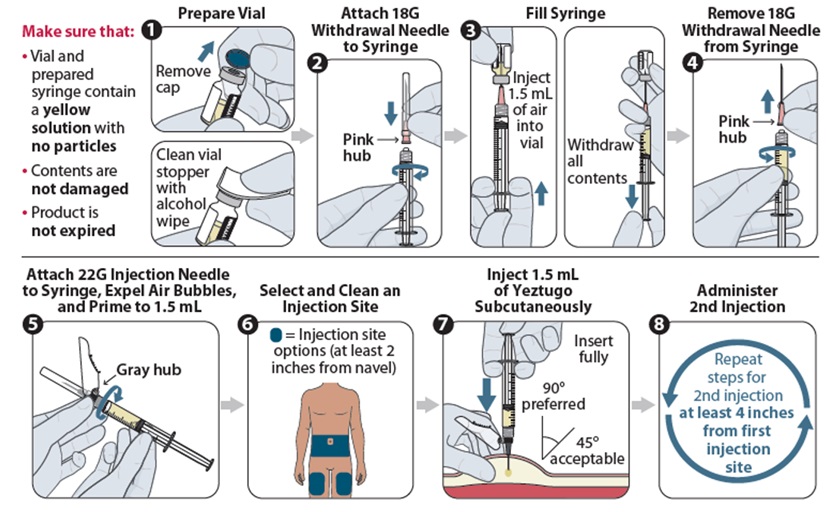
YEZTUGO injection is packaged in a dosing kit (NDC 61958-3402-1) containing:
- 2 single-dose clear glass vials, each containing sufficient volume to allow withdrawal of 463.5 mg/1.5 mL (309 mg/mL) of lenacapavir. The injection solution is sterile, preservative-free, clear, and yellow with no visible particles. Vials are sealed with a stopper and aluminum overseal with flip-off cap.
- 2 disposable syringes, 2 withdrawal needles (18-gauge, 1½ inch), and 2 injection safety needles for subcutaneous injection (22-gauge, ½ inch).
The vial stoppers are not made with natural rubber latex.
Store at 20 °C – 25 °C (68 °F – 77 °F), excursions permitted to 15 °C – 30 °C (59 °F – 86 °F).
Keep the vials in the original carton until just prior to preparation of the injections in order to protect from light.
Once the solution has been drawn into the syringes, the injections should be administered as soon as possible.
Discard any unused portion of the solution.
Important Information for Individuals Receiving YEZTUGO for HIV-1 PrEP
Advise individuals about the following [see Warnings and Precautions (5.1)]:
- YEZTUGO should be used for PrEP as part of an overall HIV-1 prevention strategy, including adherence to the administration schedule and safer sex practices, including condoms, to reduce the risk of STIs.
- YEZTUGO is not always effective in preventing HIV-1 acquisition [see Clinical Studies (14)]. The time from initiation of YEZTUGO for HIV-1 PrEP to maximal protection against HIV-1 infection is unknown.
- Counsel individuals on the use of other prevention measures (e.g., knowledge of partner HIV-1 status, testing for STIs, condom use). Inform individuals about and support their efforts in reducing sexual behaviors associated with HIV-1 acquisition risk.
- YEZTUGO should be used to reduce the risk of HIV-1 acquisition only in individuals confirmed to be HIV-1 negative. Individuals must have a negative HIV-1 test prior to initiating YEZTUGO, prior to each subsequent injection of YEZTUGO, and additionally as clinically appropriate, with a test approved or cleared by the FDA as an aid in the diagnosis of acute or primary HIV-1 infection [see Dosage and Administration (2.1), Contraindications (4), and Warnings and Precautions (5.1, 5.2)].
- Counsel and support individuals on adhering to the required initiation and continuation dosing schedule, on the use of other measures to reduce the risk of STIs, and on the importance of testing for HIV-1 and other STIs.
- Some individuals, such as adolescents, may benefit from additional counseling and appointment reminders to support adherence.
Risk of Resistance
Advise individuals that there is a risk of developing resistance to YEZTUGO if HIV-1 is acquired either before or when receiving YEZTUGO, or following discontinuation of YEZTUGO. HIV-1 resistance substitutions may emerge in individuals with undiagnosed HIV-1 infection who are taking only YEZTUGO, because YEZTUGO alone does not constitute a complete regimen for HIV-1 treatment [see Warnings and Precautions (5.2)]. Inform individuals that YEZTUGO can remain in the body for up to 12 months or longer after receiving their last injection [see Warnings and Precautions (5.3)].
To minimize this risk, it is essential that individuals are routinely tested to confirm HIV-1 negative status. Advise individuals that if they are confirmed to have HIV-1, they must immediately be transitioned to a complete HIV-1 treatment regimen [see Warnings and Precautions (5.2)].
Inform individuals that alternative forms of PrEP should be considered and initiated within 28 weeks of the last YEZTUGO injection [see Warnings and Precautions (5.2)].
Anticipated Delayed Injections
Advise individuals to contact their healthcare provider if the scheduled 6-month injection is anticipated to be delayed by more than 2 weeks. Advise that YEZTUGO tablets may be taken for up to 6 months, if needed, until injections resume. Advise individuals that oral dosing should be used on an interim basis only and that the continuation injection dosage should be resumed at the earliest possible opportunity [see Dosage and Administration (2.4)].
Injection Site Reactions
Inform individuals that a subcutaneous drug depot forms following YEZTUGO injection. Advise that, in some individuals, this may lead to a nodule at the injection site [see Adverse Reactions (6.1) and Clinical Pharmacology (12.3)].
Drug Interactions
YEZTUGO may interact with certain drugs; therefore, advise individuals to report to their healthcare provider the use of any other prescription or non-prescription medication or herbal products [see Drug Interactions (7)].
If YEZTUGO is discontinued, advise individuals that YEZTUGO may remain in the body and affect certain other drugs for up to 9 months after receiving their last injection [see Drug Interactions (7.2)].
Pregnancy Registry
Inform individuals that there is an antiretroviral pregnancy registry to monitor fetal outcomes of pregnant individuals exposed to YEZTUGO [see Use in Specific Populations (8.1)].
YEZTUGO, DESCOVY, and TRUVADA are trademarks of Gilead Sciences, Inc., or its related companies. All other trademarks referenced herein are the property of their respective owners.
Manufactured for:
Gilead Sciences, Inc.
333 Lakeside Dr.
Foster City, CA 94404.
© 2025 Gilead Sciences, Inc. All rights reserved.