ACE-inhibitors
Reports suggest that NSAIDs may diminish the antihypertensive effect of ACEinhibitors. This interaction should be given consideration in patients taking NSAIDs concomitantly with ACE-inhibitors.
Aspirin
When nabumetone is administered with aspirin, its protein binding is reduced, although the clearance of free nabumetone is not altered. The clinical significance of this interaction is not known; however, as with other NSAIDs, concomitant administration of nabumetone and aspirin is not generally recommended because of the potential of increased adverse effects.
Diuretics
Clinical studies, as well as post-marketing observations, have shown that nabumetone can reduce the natriuretic effect of furosemide and thiazides in some patients. This response has been attributed to inhibition of renal prostaglandin synthesis. During concomitant therapy with NSAIDs, the patient should be observed closely for signs of renal failure (see
WARNINGS,
Renal Effects),
as well as to assure diuretic efficacy.
Lithium
NSAIDs have produced an elevation of plasma lithium levels and a reduction in renal lithium clearance. The mean minimum lithium concentration increased 15% and the renal clearance was decreased by approximately 20%. These effects have been attributed to inhibition of renal prostaglandin synthesis by the NSAID. Thus, when NSAIDs and lithium are administered concurrently, subjects should be observed carefully for signs of lithium toxicity.
Methotrexate
NSAIDs have been reported to competitively inhibit methotrexate accumulation in rabbit kidney slices. This may indicate that they could enhance the toxicity of methotrexate. Caution should be used when NSAIDs are administered concomitantly with methotrexate.
Warfarin
The effects of warfarin and NSAIDs on Gl bleeding are synergistic, such that users of both drugs together have a risk of serious Gl bleeding higher than users of either drug alone.
In vitro studies have shown that, because of its affinity for protein, 6MNA may displace other protein-bound drugs from their binding site. Caution should be exercised when administering nabumetone with warfarin since interactions have been seen with other NSAIDs.
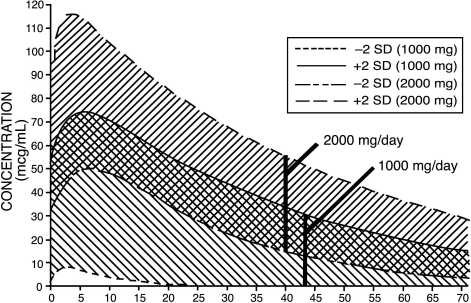
Concomitant administration of an aluminum-containing antacid had no significant effect on the bioavailability of 6MNA. When administered with food or milk, there is more rapid absorption; however, the total amount of 6MNA in the plasma is unchanged (see
CLINICAL PHARMACOLOGY,
Pharmacokinetics).
Carcinogenesis, Mutagenesis
In two-year studies conducted in mice and rats, nabumetone had no statistically significant tumorigenic effect. Nabumetone did not show mutagenic potential in the Ames test and mouse micronucleus test
in vivo. However, nabumetone- and 6MNA- treated lymphocytes in culture showed chromosomal aberrations at 80 mcg/mL and higher concentrations (equal to the average human exposure to nabumetone at the maximum recommended dose).
Impairment of Fertility
Nabumetone did not impair fertility of male or female rats treated orally at doses of 320 mg/kg/day (1888 mg/m
2) before mating.
Pregnancy
Risk Summary
Use of NSAIDs, including nabumetone tablets, can cause premature closure of the fetal ductus arteriosus and fetal renal dysfunction leading to oligohydramnios and, in some cases, neonatal renal impairment. Because of these risks, limit dose and duration of nabumetone tablets use between about 20 and 30 weeks of gestation and avoid nabumetone tablets use at about 30 weeks of gestation and later in pregnancy [see
WARNINGS;
Fetal Toxicity].
Premature Closure of Fetal Ductus Arteriosus
Use of NSAIDs, including nabumetone tablets, at about 30 weeks gestation or later in pregnancy increases the risk of premature closure of the fetal ductus arteriosus.
Oligohydramnios/Neonatal Renal Impairment
Use of NSAIDs at about 20 weeks gestation or later in pregnancy has been associated with cases of fetal renal dysfunction leading to oligohydramnios, and in some cases, neonatal renal impairment.
Data from observational studies regarding other potential embryofetal risks of NSAID use in women in the first or second trimesters of pregnancy are inconclusive. In animal reproduction studies conducted in rats and rabbits have not demonstrated evidence of developmental abnormalities.
However, animal reproduction studies are not always predictive of human response. There are no adequate, wellcontrolled studies in pregnant women. Nabumetone should be used in pregnancy only if the potential benefit justifies the potential risk to the fetus. Based on animal data, prostaglandins have been shown to have an important role in endometrial vascular permeability, blastocyst implantation, and decidualization. In animal studies, administration of prostaglandin synthesis inhibitors such as nabumetone, resulted in increased pre- and post-implantation loss.
Prostaglandins also have been shown to have an important role in fetal kidney development. In published animal studies, prostaglandin synthesis inhibitors have been reported to impair kidney development when administered at clinically relevant doses.
Clinical Considerations
Fetal/Neonatal Adverse Reactions
Premature Closure of Fetal Ductus Arteriosus:
Avoid use of NSAIDs in women at about 30 weeks gestation and later in pregnancy, because NSAIDs, including nabumetone tablets, can cause premature closure of the fetal ductus arteriosus (see
WARNINGS;
Fetal Toxicity).
Oligohydramnios/Neonatal Renal Impairment
If an NSAID is necessary at about 20 weeks gestation or later in pregnancy, limit the use to the lowest effective dose and shortest duration possible. If nabumetone tablets treatment extends beyond 48 hours, consider monitoring with ultrasound for oligohydramnios. If oligohydramnios occurs, discontinue nabumetone tablets and follow up according to clinical practice (see
WARNINGS;
Fetal Toxicity).
Data
Human Data
There are no adequate, well-controlled studies in pregnant women. Nabumetone tablets should be used in pregnancy only if the potential benefit justifies the potential risk to the fetus.
Premature Closure of Fetal Ductus Arteriosus:
Published literature reports that the use of NSAIDs at about 30 weeks of gestation and later in pregnancy may cause premature closure of the fetal ductus arteriosus.
Oligohydramnios/Neonatal Renal Impairment:
Published studies and postmarketing reports describe maternal NSAID use at about 20 weeks gestation or later in pregnancy associated with fetal renal dysfunction leading to oligohydramnios, and in some cases, neonatal renal impairment. These adverse outcomes are seen, on average, after days to weeks of treatment, although oligohydramnios has been infrequently reported as soon as 48 hours after NSAID initiation. In many cases, but not all, the decrease in amniotic fluid was transient and reversible with cessation of the drug. There have been a limited number of case reports of maternal NSAID use and neonatal renal dysfunction without oligohydramnios, some of which were irreversible. Some cases of neonatal renal dysfunction required treatment with invasive procedures, such as exchange transfusion or dialysis.
Methodological limitations of these postmarketing studies and reports include lack of a control group; limited information regarding dose, duration, and timing of drug exposure; and concomitant use of other medications. These limitations preclude establishing a reliable estimate of the risk of adverse fetal and neonatal outcomes with maternal NSAID use. Because the published safety data on neonatal outcomes involved mostly preterm infants, the generalizability of certain reported risks to the full-term infant exposed to NSAIDs through maternal use is uncertain.
Animal Data
In animal reproduction studies conducted in rats and rabbits have not demonstrated evidence of developmental abnormalities. However, animal reproduction studies are not always predictive of human response. There are no adequate, well-controlled studies in pregnant women. Nabumetone should be used in pregnancy only if the potential benefit justifies the potential risk to the fetus. Based on animal data, prostaglandins have been shown to have an important role in endometrial vascular permeability, blastocyst implantation, and decidualization. In animal studies, administration of prostaglandin synthesis inhibitors such as nabumetone, resulted in increased pre- and post-implantation loss. Prostaglandins also have been shown to have an important role in fetal kidney development. In published animal studies, prostaglandin synthesis inhibitors have been reported to impair kidney development when administered at clinically relevant doses. The estimated background risk of major birth defects and miscarriage for the indicated population(s) is unknown. All pregnancies have a background risk of birth defect, loss, or other adverse outcomes. In the U.S. general population, the estimated background risk of major birth defects and miscarriage in clinically recognized pregnancies is 2-4% and 15-20%, respectively.
Labor and Delivery
In rat studies with NSAIDs, as with other drugs known to inhibit prostaglandin synthesis, an increased incidence of dystocia, delayed parturition, and decreased pup survival occurred. The effects of nabumetone on labor and delivery in pregnant women are unknown.
Nursing Mothers
It is not known whether this drug is excreted in human milk, however 6MNA is excreted in the milk of lactating rats. Because many drugs are excreted in human milk and because of the potential for serious adverse reactions in nursing infants from nabumetone, a decision should be made whether to discontinue nursing or to discontinue the drug, taking into account the importance of the drug to the mother.
Pediatric Use
Safety and effectiveness in pediatric patients have not been established.
Geriatric Use
As with any NSAIDs, caution should be exercised in treating the elderly (65 years and older). Of the 1,677 patients in U.S. clinical studies who were treated with nabumetone, 411 patients (24%) were 65 years of age or older; 22 patients (1%) were 75 years of age or older. No overall differences in efficacy or safety were observed between these older patients and younger ones. Similar results were observed in a 1-year, non-U.S. post-marketing surveillance study of 10,800 nabumetone patients, of whom 4,577 patients (42%) were 65 years of age or older.