Oxybutynin chloride extended-release tablets were evaluated for the treatment of patients with overactive bladder with symptoms of urge urinary incontinence, urgency, and frequency in three controlled efficacy studies. The majority of patients were Caucasian (89.0%) and female (91.9%) with a mean age of 59 years (range, 18 to 98 years). Entry criteria required that patients have urge or mixed incontinence (with a predominance of urge) as evidenced by ≥ 6 urge incontinence episodes per week and ≥ 10 micturitions per day. Study 1 was a fixed-dose escalation design, whereas the other two studies used a dose-adjustment design in which each patient's final dose was adjusted to a balance between improvement of incontinence symptoms and tolerability of side effects. All three studies included patients known to be responsive to oxybutynin or other anticholinergic medications, and these patients were maintained on a final dose for up to 2 weeks.
The efficacy results for the three controlled trials are presented in the following Tables 4, 5, and 6 and Figures 3, 4, and 5.
Table 4: Number of Urge Urinary Incontinence Episodes Per Week
Number of Urge Urinary Incontinence Episodes Per Week| Study 1 | n | Oxybutynin chloride extended-release tablets | n | Placebo |
|---|
| Mean Baseline | 34 | 15.9 | 16 | 20.9 |
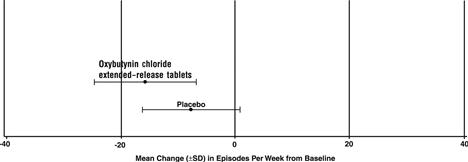
| Mean (SD) Change from Baseline† | 34 | -15.8 (8.9) | 16 | -7.6 (8.6) |
| 95% Confidence Interval for Difference | (-13.6, -2.8)* |
| (Oxybutynin chloride extended-release tablets- Placebo) |
* The difference between Oxybutynin chloride extended-release tablets and placebo was statistically significant.
† Covariate adjusted mean with missing observations set to baseline values
Figure 3: Mean Change (±SD) in Urge Incontinence Episodes Per Week from Baseline (Study 1)
Figure 2*The difference between Oxybutynin chloride extended-release tablets and placebo was statistically significant.
Table 5: Number of Urge Urinary Incontinence Episodes Per Week (Study 2)
| Study 2 | n | Oxybutynin chloride extended-release tablets | n | oxybutynin |
|---|
| Mean Baseline | 53 | 27.6 | 52 | 23.0 |
| Mean (SD) Change from Baseline† | 53 | -17.6 (11.9) | 52 | -19.4 (11.9) |
| 95% Confidence Interval for Difference | (-2.8, 6.5) |
| (Oxybutynin chloride extended-release tablets- oxybutynin) |
† Covariate adjusted mean with missing observations set to baseline values
Figure 4: Mean Change (±SD) in Urge Urinary Incontinence Episodes Per Week from Baseline (Study 2)
Figure 3Table 6: Number of Urge Urinary Incontinence Episodes Per Week (Study 3)
| Study 3 | n | Oxybutynin chloride extended-release tablets | n | oxybutynin |
|---|
| Mean Baseline | 111 | 18.9 | 115 | 19.5 |
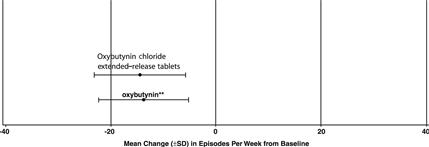
| Mean (SD) Change from Baseline† | 111 | -14.5 (8.7) | 115 | -13.8 (8.6) |
| 95% Confidence Interval for Difference | (-3.0, 1.6)** |
| (Oxybutynin chloride extended-release tablets- oxybutynin) |
** The difference between Oxybutynin chloride extended-release tablets and oxybutynin fulfilled the criteria for comparable efficacy.
† Covariate adjusted mean with missing observations set to baseline values
Figure 5: Mean Change(±SD) in Urge Urinary Incontinence Episodes Per Week from Baseline (Study 3)
Figure 4** The difference between Oxybutynin chloride extended-release tablets and oxybutynin fulfilled the criteria for comparable efficacy.