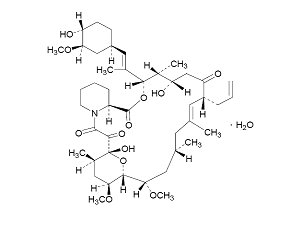
Tacrolimus-based immunosuppression in conjunction with MMF, corticosteroids, and induction has been studied. In a randomized, open-label, multi-center trial (Study 1), 1589 kidney transplant patients received Tacrolimus (Group C, n=401), sirolimus (Group D, n=399), or one of two cyclosporine (CsA) regimens (Group A, n=390 and Group B, n=399) in combination with MMF and corticosteroids; all patients, except those in one of the two cyclosporine groups, also received induction with daclizumab. The trial was conducted outside the United States; the trial population was 93% Caucasian. In this trial, mortality at 12 months in patients receiving Tacrolimus/MMF was similar (3%) compared to patients receiving cyclosporine/MMF (3% and 2%) or sirolimus/MMF (3%). Patients in the Tacrolimus group exhibited higher estimated creatinine clearance rates (eCLcr) using the Cockcroft-Gault formula (Table 16) and experienced fewer efficacy failures, defined as biopsy proven acute rejection (BPAR), graft loss, death, and/or lost to follow-up (Table 17) in comparison to each of the other three groups. Patients randomized to Tacrolimus/MMF were more likely to develop diarrhea and diabetes after the transplantation and experienced similar rates of infections compared to patients randomized to either cyclosporine/MMF regimen [see Adverse Reactions (6.1)].
Table 16. Estimated Creatinine Clearance at 12 Months (Study 1)
| Group | eCLcr[mL/min] at Month 12 a) All death/graft loss (n=41, 27, 23 and 42 in Groups A, B, C and D) and patients whose last recorded creatinine values were prior to month 3 visit (n=10, 9, 7 and 9 in Groups A, B, C and D, respectively) were inputed with Glomerular Filtration Rate (GFR) of 10 mL/min; a subject's last observed creatinine value from month 3 on was used for the remainder of subjects with missing creatinine at month 12 (n=11, 12, 15 and 19 for Groups A, B, C and D, respectively). Weight was also imputed in the calculation of estimated GFR, if missing. |
|---|
| | N | MEAN | SD | MEDIAN | Treatment
Difference with
Group C
(99.2%CI b) Adjusted for multiple (6) pairwise comparisons using Bonferroni corrections. ) |
| (A) Cs A/MMF/CS | 390 | 56.5 | 25.8 | 56.9 | -8.6 (-13.7, -3.7) |
| (B) CsA/ MMF/CS/Daclizumab | 399 | 58.9 | 25.6 | 60.9 | -6.2 (-11.2, -1.2) |
| (C) Tac/ MMF/CS/Daclizumab | 401 | 65.1 | 27.4 | 66.2 | - |
| (D) Siro/ MMF/CS/Daclizumab | 399 | 56.2 | 27.4 | 57.3 | -8.9 (-14.1, -3.9) |
| Total | 1589 | 59.2 | 26.8 | 60.5 | |
| Key: CsA=Cyclosporine, CS=Corticosteroids, Tac=Tacrolimus, Siro=Sirolimus |
Table 17: Incidence of BPAR, Graft Loss, Death or Loss to Follow-up at 12 Months (Study 1)
| Group A
N=390 | Group B
N=399 | Group C
N=401 | Group D
N=399 |
Overall Failure
Components of efficacy failure
BPAR
Graft loss excluding death
Mortality
Lost to follow-up
Treatment Difference of efficacy
failure compared to Group C
(99.2% CI a) Adjusted for multiple (6) pairwise comparisons using Bonferroni corrections. ) | 141 (36.2%)
113 (29.0%)
28 (7.2%)
13 (3.3%)
5 (1.3%)
15.8% (7.1%,
24.3%) | 126 (31.6%)
106 (26.6%)
20 (5.0%)
7 (1.8%)
7 (1.8%)
11.2% (2.7%,
19.5%) | 82 (20.4%)
60 (15.0%)
12 (3.0%)
11 (2.7%)
5 (1.3%)
- | 185 (46.4%)
152 (38.1%)
30 (7.5%)
12 (3.0%)
6 (1.5%)
26.0% (17.2%,
34.7%) |
| Key: Group A =CsA/MMF/CS, B =CsA/MMF/CS/Daclizumab, C=Tac/MMF/CS/Daclizumab, and D=Siro/MMF/CS/Daclizumab |
The protocol-specified target tacrolimus trough concentrations (Ctrough, Tac) were 3-7 ng/mL; however, the observed median Ctroughs, Tac approximated 7 ng/mL throughout the 12 month trial (Table 18). Approximately 80% of patients maintained tacrolimus whole blood concentrations between 4-11 ng/mL through 1 year post-transplant.
Table 18: Tacrolimus Whole Blood Trough Concentrations (Study 1)
| Time | Median (P10-P90 a) 10 to 90th Percentile: range of Ctrough, Tac that excludes lowest 10% and highest 10% of Ctrough,Tac ) tacrolimus whole blood trough concentrations
(ng/mL) |
| Day 30 (N=366) | 6.9 (4.4 – 11.3) |
| Day 90 (N=351) | 6.8 (4.1 – 10.7) |
| Day 180(N=355) | 6.5 (4.0 – 9.6) |
| Day 365 (N=346) | 6.5 (3.8 – 10.0) |
The protocol-specified target cyclosporine trough concentrations (Ctrough,CsA) for Group B were 50-100 ng/mL; however, the observed median Ctroughs,CsA approximated 100 ng/mL throughout the 12 month trial. The protocol-specified target Ctroughs,CsA for Group A were 150-300 ng/mL for the first 3 months and 100-200 ng/mL from month 4 to month 12; the observed median Ctroughs, CsA approximated 225 ng/mL for the first 3 months and 140 ng/mL from month 4 to month 12.
While patients in all groups started MMF at 1gram twice daily, the MMF dose was reduced to less than 2 g per day in 63% of patients in the tacrolimus treatment arm by month 12 (Table 19); approximately 50% of these MMF dose reductions were due to adverse reactions. By comparison, the MMF dose was reduced to less than 2 g per day in 49% and 45% of patients in the two cyclosporine arms (Group A and Group B, respectively), by month 12 and approximately 40% of MMF dose reductions were due to adverse reactions.
Table 19: MMF Dose Over Time in Tacrolimus/MMF (Group C) (Study 1)
| Time period (Days) | Time-averaged MMF dose (g/day) a) Percentage of patients for each time-averaged MMF dose range during various treatment periods. Administration of 2 g per day of time-averaged MMF dose means that MMF dose was not reduced in those patients during the treatment periods. |
| Less than 2.0 | 2.0 | Greater than 2.0 |
| 0-30 (N=364) | 37% | 60% | 2% |
| 0-90 (N=373) | 47% | 51% | 2% |
| 0-180 (N=377) | 56% | 42% | 2% |
| 0-365 (N=380) | 63% | 36% | 1% |
| Key: Time-averaged MMF dose = (total MMF dose) / (duration of treatment) |
In a second randomized, open-label, multi-center trial (Study 2), 424 kidney transplant patients received Tacrolimus (N=212) or cyclosporine (N=212) in combination with MMF 1 gram twice daily, basiliximab induction, and corticosteroids. In this trial, the rate for the combined endpoint of BPAR, graft failure, death, and/or lost to follow-up at 12 months in the Tacrolimus/MMF group was similar to the rate in the cyclosporine/MMF group. There was, however, an imbalance in mortality at 12 months in those patients receiving Tacrolimus/MMF (4%) compared to those receiving cyclosporine/MMF (2%), including cases attributed to overimmunosuppression (Table 20).
Table 20: Incidence of BPAR, Graft Loss, Death or Loss to Follow-up at 12 Months (Study 2)
| Tacrolimus/MMF
(n=212) | Cyclosporin/MMF
(n=212) |
Overall Failure
Components of efficacy failure
BPAR
Graft loss excluding death
Mortality
Lost to follow-up
Treatment Difference of efficacy
failure compared to
Tacrolimus/MMF group (95% CIa) 95% confidence interval calculated using Fisher's Exact Test ) | 32 (15.1%)
16 (7.5%)
6 (2.8%)
9 (4.2%)
4 (1.9%)
- | 36 (17.0%)
29 (13.7%)
4 (1.9%)
5 (2.4%)
1 (0.5%)
1.9% (-5.2%, 9.0%) |
The protocol-specified target tacrolimus whole blood trough concentrations (Ctrough,Tac) in Study 2 were 7-16 ng/mL for the first three months and 5-15 ng/mL thereafter. The observed median Ctroughs,Tac approximated 10 ng/mL during the first three months and 8 ng/mL from month 4 to month 12 (Table 21). Approximately 80% of patients maintained tacrolimus whole trough blood concentrations between 6 to 16 ng/mL during months 1 through 3 and, then, between 5 to 12 ng/mL from month 4 through 1 year.
Table 21: Tacrolimus Whole Blood Trough Concentrations (Study 2)
| Time | Median (P10-P90 a) 10 to 90th Percentile: range of Ctrough,Tac that excludes lowest 10% and highest 10% of Ctrough, Tac ) tacrolimus whole blood trough concentrations
(ng/mL) |
| Day 30 (N=174) | 10.5 (6.3 - 16.8) |
| Day 60 (N=179) | 9.2 (5.9 - 15.3) |
| Day 120 (N=176) | 8.3 (4.6 - 13.3) |
| Day 180 (N=171) | 7.8 (5.5 - 13.2) |
| Day 365 (N=178) | 7.1 (4.2 - 12.4) |
The protocol-specified target cyclosporine whole blood concentrations (Ctrough,CsA) were 125 to 400 ng/mL for the first three months, and 100 to 300 ng/mL thereafter. The observed median Ctroughs, CsA approximated 280 ng/mL during the first three months and 190 ng/mL from month 4 to month 12.
Patients in both groups started MMF at 1gram twice daily. The MMF dose was reduced to less than 2 grams per day by month 12 in 62% of patients in the Tacrolimus/MMF group (Table 22) and in 47% of patients in the cyclosporine/MMF group. Approximately 63% and 55% of these MMF dose reductions were because of adverse reactions in the Tacrolimus/MMF group and the cyclosporine/MMF group, respectively [see Adverse Reactions (6.1)].
Table 22: MMF Dose Over Time in the Tacrolimus/MMF group (Study 2)