Ivabradine
Concurrent use of verapamil increases exposure to ivabradine and may exacerbate bradycardia and conductions disturbances. Avoid concomitant use of ivabradine and verapamil.
System Components and Performance: Verelan PM uses the proprietary CODAS® (Chronotherapeutic Oral Drug Absorption System) technology, which is designed for bedtime dosing, incorporating a 4 to 5-hour delay in drug delivery. The controlled-onset delivery system results in a maximum plasma concentration (Cmax) of verapamil in the morning hours. These pellet filled capsules provide for extended-release of the drug in the gastrointestinal tract. The Verelan PM formulation has been designed to initiate the release of verapamil 4-5 hours after ingestion. This delay is introduced by the level of non-enteric release-controlling polymer applied to drug loaded beads. The release-controlling polymer is a combination of water soluble and water insoluble polymers. As water from the gastrointestinal tract comes into contact with the polymer coated beads, the water soluble polymer slowly dissolves and the drug diffuses through the resulting pores in the coating. The water insoluble polymer continues to act as a barrier, maintaining the controlled release of the drug. The rate of release is essentially independent of pH, posture and food. Multiparticulate systems such as Verelan PM have been shown to be independent of gastrointestinal motility.
Essential Hypertension: Verapamil produces its antihypertensive effect by a combination of vascular and cardiac effects. It acts as a vasodilator with selectivity for the arterial portion of the peripheral vasculature. As a result the systemic vascular resistance is reduced and usually without orthostatic hypotension or reflex tachycardia. Bradycardia (rate less than 50 beats/min) is uncommon. During isometric or dynamic exercise verapamil does not alter systolic cardiac function in patients with normal ventricular function.
Verapamil does not alter total serum calcium levels. However, one report has suggested that calcium levels above the normal range may alter the therapeutic effect of verapamil.
Verapamil regularly reduces the total systemic resistance (afterload) against which the heart works both at rest and at a given level of exercise by dilating peripheral arterioles.
Electrophysiologic Effects: Electrical activity through the AV node depends, to a significant degree, upon the transmembrane influx of extracellular calcium through the L-type (slow) channel. By decreasing the influx of calcium, verapamil prolongs the effective refractory period within the AV node and slows AV conduction in a rate-related manner.
Normal sinus rhythm is usually not affected, but in patients with sick sinus syndrome, verapamil may interfere with sinus-node impulse generation and may induce sinus arrest or sinoatrial block. Atrioventricular block can occur in patients without pre-existing conduction defects [see Warnings and Precautions (5.5)].
Verapamil does not alter the normal atrial action potential or intraventricular conduction time, but depresses amplitude, velocity of depolarization, and conduction in depressed atrial fibers. Verapamil may shorten the antegrade effective refractory period of the accessory bypass tract. Acceleration of ventricular rate and/or ventricular fibrillation has been reported in patients with atrial flutter or atrial fibrillation and a coexisting accessory AV pathway following administration of verapamil [see Warnings and Precautions (5.4)].
Verapamil has a local anesthetic action that is 1.6 times that of procaine on an equimolar basis. It is not known whether this action is important at the doses used in man.
Hemodynamics: Verapamil reduces afterload and myocardial contractility. In most patients, including those with organic cardiac disease, the negative inotropic action of verapamil is countered by reduction of afterload and cardiac index remains unchanged. During isometric or dynamic exercise, verapamil does not alter systolic cardiac function in patients with normal ventricular function. In patients with severe left ventricular dysfunction (e.g., pulmonary wedge pressure above 20 mm Hg or ejection fraction less than 30%), or in patients taking beta-adrenergic blocking agents or other cardiodepressant drugs, deterioration of ventricular function may occur [see Drug Interactions (7.4)].
Pulmonary Function: Verapamil does not induce bronchoconstriction and, hence, does not impair ventilatory function.
Verapamil has been shown to have either a neutral or relaxant effect on bronchial smooth muscle.
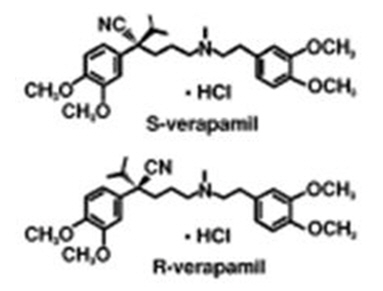
Absorption: In a study in 5 subjects with oral immediate-release verapamil, the systemic bioavailability was from 33% to 65% for the R enantiomer and from 13% to 34% for the S enantiomer. Following oral administration of an immediately releasing formulation every 8 hours in 24 subjects, the relative systemic availability of the S enantiomer compared to the R enantiomer was approximately 13% following a single day's administration and approximately 18% following administration to steady-state. The degree of stereoselectivity of metabolism for Verelan PM was similar to that for the immediately releasing formulation. The R and S enantiomers have differing levels of pharmacologic activity. In studies in animals and humans, the S enantiomer has 8 to 20 times the activity of the R enantiomer in slowing AV conduction. In animal studies, the S enantiomer has 15 to 50 times the activity of the R enantiomer in reducing myocardial contractility in isolated blood-perfused dog papillary muscle, respectively, and twice the effect in reducing peripheral resistance. In isolated septal strip preparations from 5 patients, the S enantiomer was 8 times more potent than the R in reducing myocardial contractility. Dose escalation study data indicate that verapamil concentrations increase disproportionally to dose as measured by relative peak plasma concentrations (Cmax) or areas under the plasma concentration vs time curves (AUC).
Consumption of a high fat meal just prior to dosing in the morning had no effect on the extent of absorption and a modest effect on the rate of absorption from Verelan PM. The rate of absorption was not affected by whether the volunteers were supine two hours after night-time dosing or non-supine for four hours following morning dosing. Administering Verelan PM in the morning increased the extent of absorption of verapamil and/or decreased the metabolism to norverapamil.
When the contents of the Verelan PM capsule were administered by sprinkling onto one tablespoonful of applesauce, the rate and extent of verapamil absorption were found to be bioequivalent to the same dose when administered as an intact capsule. Similar results were observed with norverapamil.
Distribution: Although some evidence of lack of dose linearity was observed for Verelan PM, this non-linearity was enantiomer specific, with the R enantiomer showing the greatest degree of non-linearity.
Table 3. Pharmacokinetic Characteristics of Verapamil Enantiomers After Administration of Escalating Doses of Verelan PM | ISOMER | 200 | 300 | 400 |
|---|
| Dose Ratio | | 1 | 1.5 | 2 |
| Relative Cmax | R
S | 1
1 | 1.89
1.88 | 2.34
2.5 |
| Relative AUC | R
S | 1
1 | 1.67
1.35 | 2.34
2.20 |
Racemic verapamil is released from Verelan PM by diffusion following the gradual solubilization of the water soluble polymer. The rate of solubilization of the water soluble polymer produces a lag period in drug release for approximately 4-5 hours. The drug release phase is prolonged with the peak plasma concentration (Cmax) occurring approximately 11 hours after administration. Trough concentrations occur approximately 4 hours after bedtime dosing while the patient is sleeping. Steady-state pharmacokinetics were determined in healthy volunteers. Steady-state concentration is achieved by day 5 of dosing.
In healthy volunteers, following administration of Verelan PM (200 mg per day), steady-state pharmacokinetics of the R and S enantiomers of verapamil is as follows: Mean Cmax of the R isomer was 77.8 ng/ml and 16.8 ng/ml for the S isomer; AUC (0-24h) of the R isomer was 1037 ng∙h/ml and 195 ng∙h/ml for the S isomer.
In general, bioavailability of verapamil is higher and half life longer in older (>65 yrs) subjects. Lean body weight also affects its pharmacokinetics inversely. It was not possible to observe a gender difference in the clinical trials of Verelan PM due to the small sample size. However, there are conflicting data in the literature suggesting that verapamil clearance decreased with age in women to a greater degree than in men.
Metabolism and Excretion: Orally administered verapamil undergoes extensive metabolism in the liver. Verapamil is metabolized by O-demethylation (25%) and N-dealkylation (40%), and is subject to pre-systemic hepatic metabolism with elimination of up to 80% of the dose. The metabolism is mediated by hepatic cytochrome P450, and animal studies have implied that the mono-oxygenase is the specific isoenzyme of the P450 family. Thirteen metabolites have been identified in urine. Norverapamil enantiomers can reach steady-state plasma concentrations approximately equal to those of the enantiomers of the parent drug. For Verelan PM, the norverapamil R enantiomer reached steady-state plasma concentrations similar to the verapamil R enantiomer, but the norverapamil S enantiomer concentrations were approximately twice that of the verapamil S enantiomer concentrations. The cardiovascular activity of norverapamil appears to be approximately 20% that of verapamil. Approximately 70% of an administered dose is excreted as metabolites in the urine and 16% or more in the feces within 5 days. About 3% to 4% is excreted in the urine as unchanged drug.
R verapamil is 94% bound to plasma albumin, while S verapamil is 88% bound. In addition, R verapamil is 92% and S verapamil 86% bound to alpha-1 acid glycoprotein. In patients with hepatic insufficiency, metabolism of immediate-release verapamil is delayed and elimination half-life prolonged up to 14 to 16 hours because of the extensive hepatic metabolism [see Use in Specific Populations (8.6)]. In addition, in these patients there is a reduced first pass effect, and verapamil is more bioavailable. Verapamil clearance values suggest that patients with liver dysfunction may attain therapeutic verapamil plasma concentrations with one third of the oral daily dose required for patients with normal liver function.
After four weeks of oral dosing of immediate-release verapamil (120 mg q.i.d.), verapamil and norverapamil levels were noted in the cerebrospinal fluid with estimated partition coefficient of 0.06 for verapamil and 0.04 for norverapamil.
Geriatric Use: The pharmacokinetics of verapamil GITS were studied after 5 consecutive nights of dosing 180 mg in 30 healthy young (19-43 years) versus 30 healthy elderly (65-80 years) male and female subjects. Older subjects had significantly higher mean verapamil Cmax, Cmin and AUC(0-24h) compared to younger subjects. Older subjects had mean AUCs that were approximately 1.7-2.0 times higher than those of younger subjects as well as a longer average verapamil t½ (approximately 20 hr vs 13 hr).
Distributed by:
Lannett Company, Inc.
Philadelphia, PA 19136
Manufactured by:
Recro® Gainesville LLC
Gainesville, GA 30504, USA
Verelan® is a registered trademark of Recro® Gainesville LLC
CODAS® is a registered trademark of Alkermes Pharma Ireland Limited, used under license
Printed in USA
Material Code: 6002421-05 Rev. 10/2019