Pregabalin Capsule
Product Images NDC 62332-124

View Photos of Packaging, Regulatory Labels, and Product Appearance

Product Visual Gallery

This gallery contains 21 technical images submitted to the FDA as part of the official labeling for Pregabalin (NDC 62332-124). Unlike standard consumer photos, these assets often include clinical data figures, molecular chemical structures, and official manufacturer packaging layouts.

As provided by Alembic Pharmaceuticals Inc., these visuals offer a comprehensive scientific overview of the product's physical and chemical identity, aiding pharmacists and researchers in product verification and study.

FDA Label Image

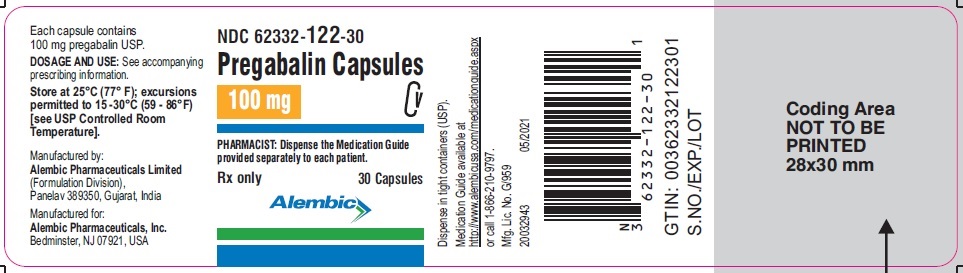
Pregabalin 100 mg

Pregabalin 100 mg
This is a description of a medication called Fochcopalo, containing 100mg of Pregabalin in capsules. It is to be stored at a temperature of 25°C (77°F) but can be permitted at temperatures between 15-30°C (59 - 86°F). The medication is manufactured by Alembic Pharmaceuticals, Limited (Formulation Division) and is available with a prescription only. The text also includes manufacturing and distribution details.*
FDA Label Image

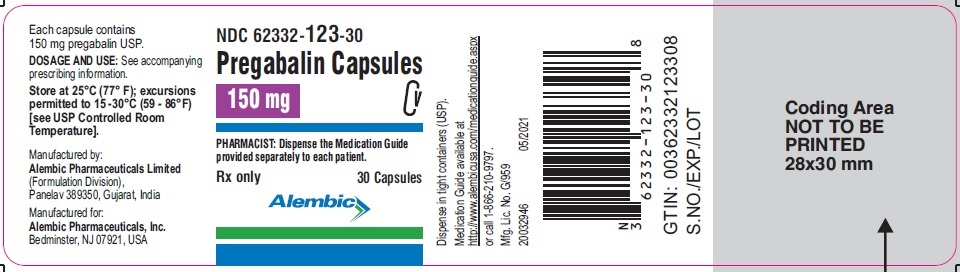
Pregabalin 150 mg

FDA Label Image

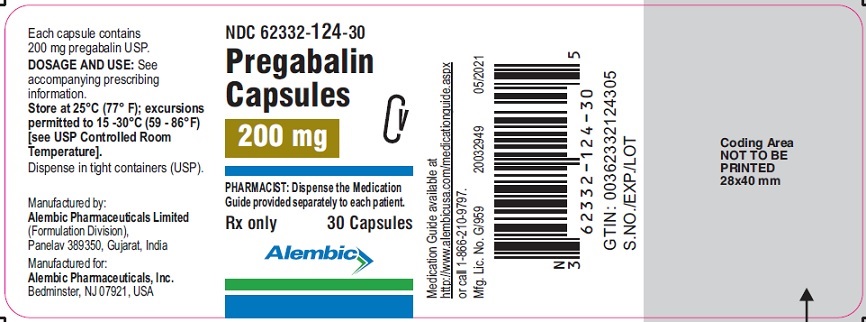
Pregabalin 200 mg

Pregabalin 200 mg
Each capsule of this medication contains 200mg of the active ingredient Pregabalin USP. For proper dosage and usage, please refer to the accompanying prescribing information. It is recommended to store the medication at room temperature not exceeding 25°C (77°F) but may be permitted to fluctuate between 15 - 30°C (59 - 86°F). Dispensing should be done in a USP approved airtight container. Manufactured by Alembic Pharmaceuticals Limited, this medication is available in Bedminster, NJ 7321, USA, and the NDC code for the 30 capsule pack is 62332-124-30. Please provide the medication guide to each patient and can be obtained by visiting alambicusa.com, or by calling 1-866-210-9797. There is also a coding area on this medication's packaging.*
FDA Label Image

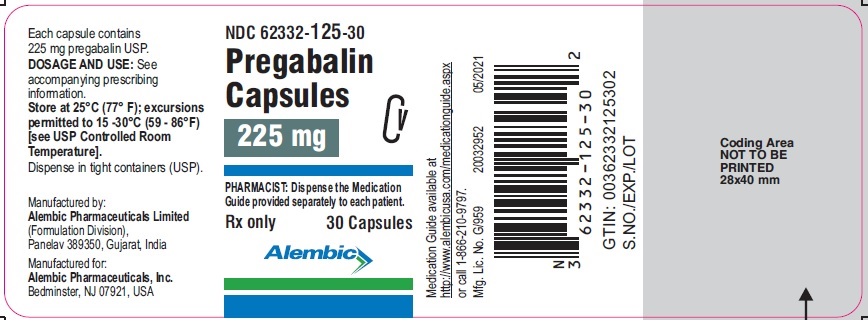
Pregabalin 225 mg

FDA Label Image

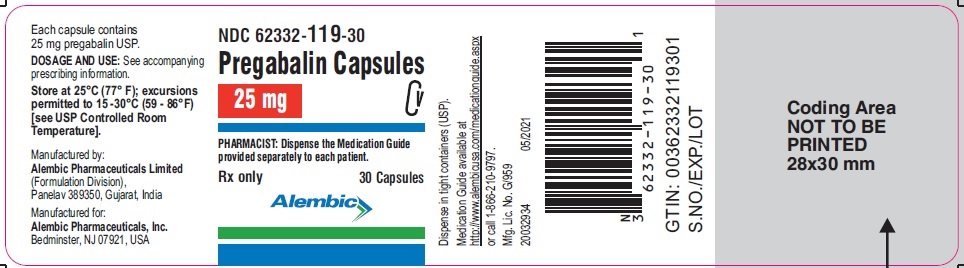
Pregabalin 25 mg

Pregabalin 25 mg
This is a description of a medication labeled as Eochosme o NDC 62332-119-30 that contains 25 mg of pregabalin USP. It is recommended to be stored between 15-30°C (59-86°F). It comes in the form of capsules and is intended for Rx only. The text advises pharmacists to dispense the medication guide alongside the product. The manufacturer is listed as Alembic Pharmaceuticals Limited.*
FDA Label Image

Pregabalin 300 mg

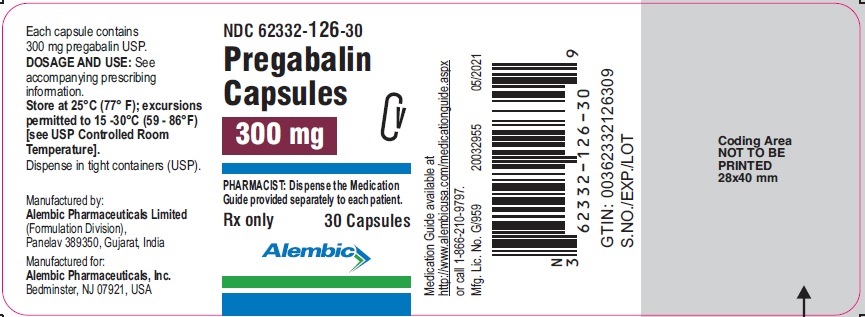
Pregabalin 300 mg
Each capsule contains 300 mg pregabalin USP. For dosage and usage instructions, see accompanying prescribing information. Store between 15-30°C (59-86°F) in a USP labeled container. Manufactured by Alembic Pharmaceutical Limited in India and distributed by Alembic Pharmaceuticals in the USA. A medication guide is available separately for each patient. This medication is available only by prescription in packs of 30 capsules.*
FDA Label Image

Pregabalin 50 mg

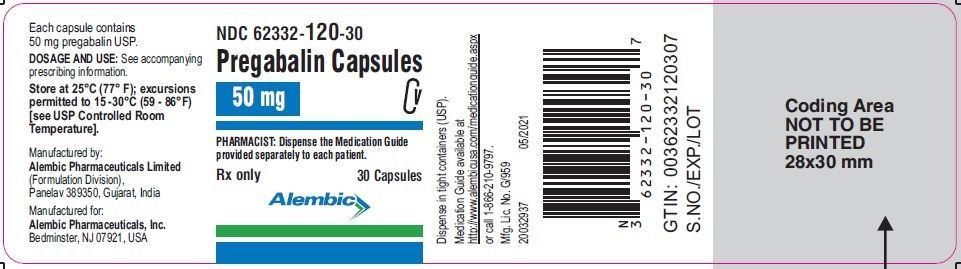
Pregabalin 50 mg
This is a description of a medication called Pregabalin Capsules, with a strength of 50 milligrams. The packaging provides storage instructions, stating that it should be kept at 25°C (77°F) and can be stored at temperatures as low as 15°C (59°F). The medication is manufactured by Alembic Pharmaceuticals Limited and is dispensed by a pharmacist with a medication guide. The text also includes a National Drug Code (NDC) number for the medication.*
FDA Label Image

Pregabalin 75 mg

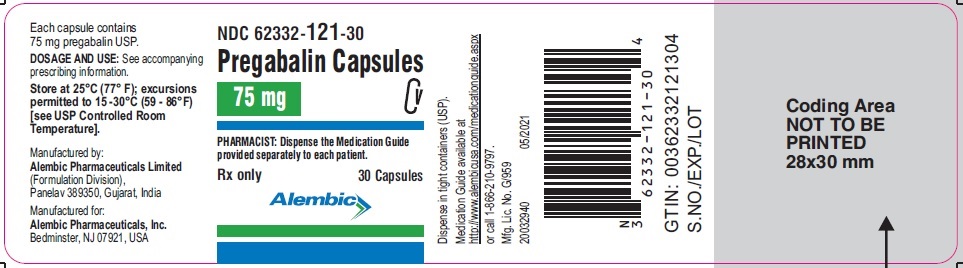
Pregabalin 75 mg
This is a description of a medication named "Pregabalin." It is a capsule containing 75 mg of pregabalin USP, used for pain relief. The recommended storage temperature is 25°C (T7 F) with excursions permitted to 15-30°C (59 - 86°F). The medication guide should be dispensed by the pharmacist separately to the patient. The manufacturer of this medication is Alembic Pharmaceuticals Limited, located in India. The medication is only available by prescription.*
FDA Label Image

Pregabalin-equation (Pregabalin Equation)

Pregabalin-equation (Pregabalin Equation)
The given text seems to be a mathematical formula used for calculating something. Specifically, it involves the factors like age (in years), weight (in kilograms), and serum creatinine (in milligrams per deciliter). However, the context of the formula is not mentioned so the exact outcome of this computation cannot be determined.*
FDA Label Image

Figure 10 (Pregabalin Fig10)

FDA Label Image

Figure 11 (Pregabalin Fig11)

FDA Label Image

Figure 12 (Pregabalin Fig12)

FDA Label Image

Figure 3 (Pregabalin Fig3)

Figure 3 (Pregabalin Fig3)
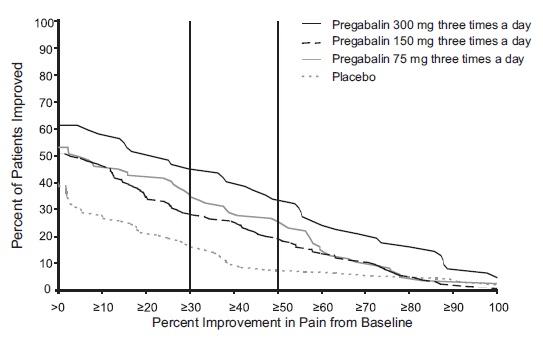
This is a chart displaying the percent improvement in pain from baseline for patients taking different doses of Pregabalin or placebo. The doses are Pregabalin 300mg, 150mg, and 75mg three times a day, and placebo. The chart shows the percentage of patients improved on the y-axis and the percentage improvement in pain from baseline on the x-axis.*
FDA Label Image

Figure 4 (Pregabalin Fig4)

Figure 4 (Pregabalin Fig4)
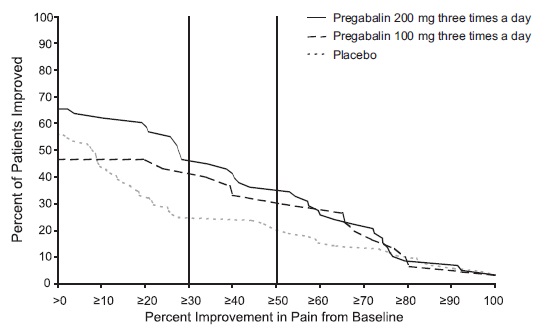
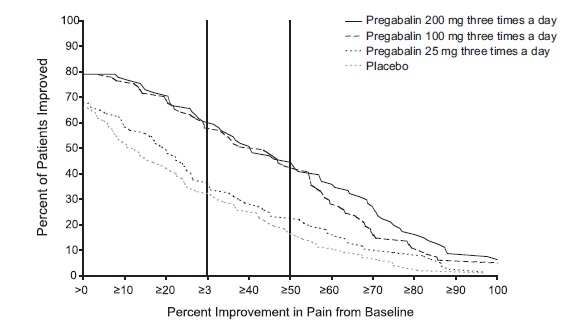
This is a chart that shows the percent improvement in pain from baseline for three different treatments: Pregabalin 200 mg three times a day, Pregabalin 100 mg three times a day, and Placebo. The chart displays data points along the x-axis from 50 to 280, with increments of 10, and along the y-axis from 0 to 100, with increments of 10. There appears to be a significant difference between the percent improvement for Pregabalin 200 mg and Pregabalin 100 mg compared to Placebo.*
FDA Label Image

Figure 5 (Pregabalin Fig5)

Figure 5 (Pregabalin Fig5)
This text appears to be a table displaying the percentage of patients improved and the percent improvement in pain from baseline for Pregabalin 100 mg three times a day, Pregabalin 50 mg three times a day, and Placebo. The table is in a graphical format with numbers representing the percentage of improvement displayed on the Y-axis and numerical values on the X-axis. Any further information such as the context in which the table was found is not available.*
FDA Label Image

Figure 6 (Pregabalin Fig6)

Figure 6 (Pregabalin Fig6)
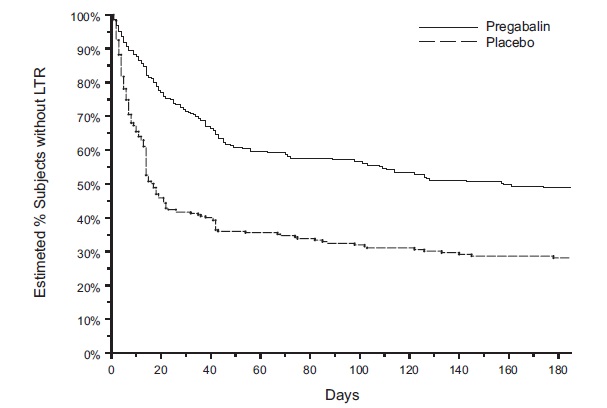
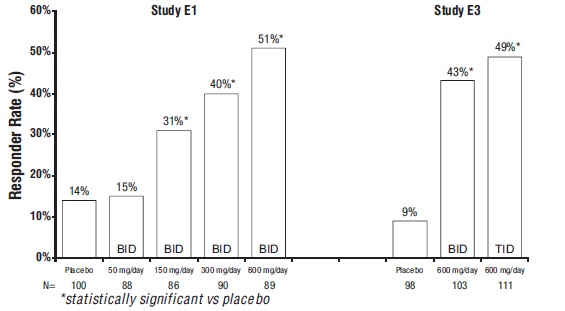
This text provides information about the responder rate in two different studies. The responder rate is reported as 60% in Study E1 and 51% in Study E3. There is also a graph or chart included that shows percentages ranging from 0% to 100% with various values marked off at different points. The text mentions that the data is statistically significant compared to a placebo, but it is not clear which study this refers to. Overall, this text may be useful in analyzing the findings of these studies in the context of responder rates.*
FDA Label Image

Figure 7 (Pregabalin Fig7)

FDA Label Image

Figure 9 (Pregabalin Fig9)

Figure 9 (Pregabalin Fig9)
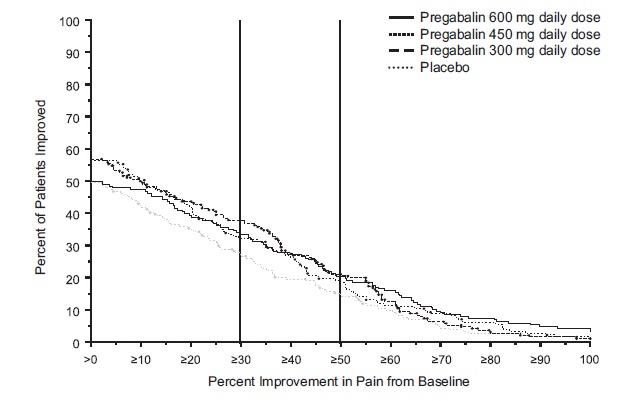
This is a chart showing the percentage of patients who improved while taking different dosages of Pregabalin and a placebo. The chart also includes the percentage improvement in pain from baseline.*
FDA Label Image

Figure 1 (Pregabalin Figure1)

FDA Label Image

Figure 2 (Pregabalin Figure2)

Figure 2 (Pregabalin Figure2)
This is an excerpt from a medical study evaluating the effects of Pregabalin versus a Placebo on patients suffering from pain. The results are presented in a graph format showing the percentage of patients whose conditions improved. Pregabalin, administered at a dose of 100mg three times a day, resulted in a 90% improvement in pain compared to the placebo. The graph also shows the percent improvement in pain from baseline measurements.*
FDA Label Image

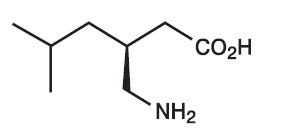
Structure (Pregabalin Structure)

* These product label images have been analyzed using experimental machine learning. Please verify findings with the primary label text.