Fesoterodine Fumarate Tablet, Extended Release
Product Images NDC 62332-176

View Photos of Packaging, Regulatory Labels, and Product Appearance

Product Visual Gallery

This gallery contains 7 technical images submitted to the FDA as part of the official labeling for Fesoterodine Fumarate (NDC 62332-176). Unlike standard consumer photos, these assets often include clinical data figures, molecular chemical structures, and official manufacturer packaging layouts.

As provided by Alembic Pharmaceuticals Inc., these visuals offer a comprehensive scientific overview of the product's physical and chemical identity, aiding pharmacists and researchers in product verification and study.

FDA Label Image

Fesoterodine-4-mg.jpg (Fesoterodine 4 mg)
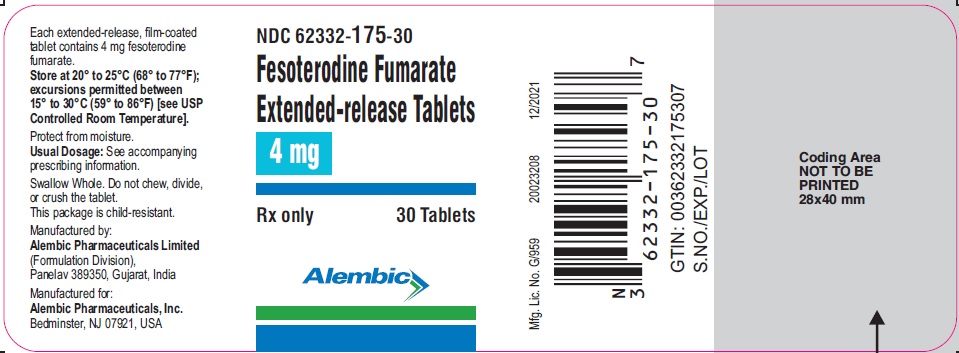
Fesoterodine-4-mg.jpg (Fesoterodine 4 mg)
Each extended-release, film-coated tablet of Fesoterodine Fumarate contains 4 mg Fesoterodine. It is recommended to store it between 20°C to 25°C (68°F to 77°F) and excursions between 15°C to 20°C (59°F to 86°F) are allowed. The package should be protected from moisture. Instructions for dosages are available in the accompanying prescribing information. The tablets should be swallowed whole and must not be chewed, divided or crushed. These tablets are manufactured by Alembic Pharmaceuticals Limited and are child-resistant. They are manufactured for Alembic Pharmaceuticals, Inc. This package contains 30 tablets and it's a prescription medicine. No additional information is available in the text obtained by .*
FDA Label Image

Fesoterodine-8-mg.jpg (Fesoterodine 8 mg)

FDA Label Image

Fesoterodine-figure1.jpg (Fesoterodine Figure1)

Fesoterodine-figure1.jpg (Fesoterodine Figure1)
This is a graph (Figure 1) showing the change in the number of micturitions per 24 hours over a period of 12 weeks for a study involving three groups of participants: placebo (N=279), Fosoterodine fumarate 4mg (N=265), and Fesoterodine fumarate 8mg (N=276). The mean change from baseline is plotted on the y-axis.*
FDA Label Image

Fesoterodine-figure2.jpg (Fesoterodine Figure2)

Fesoterodine-figure2.jpg (Fesoterodine Figure2)
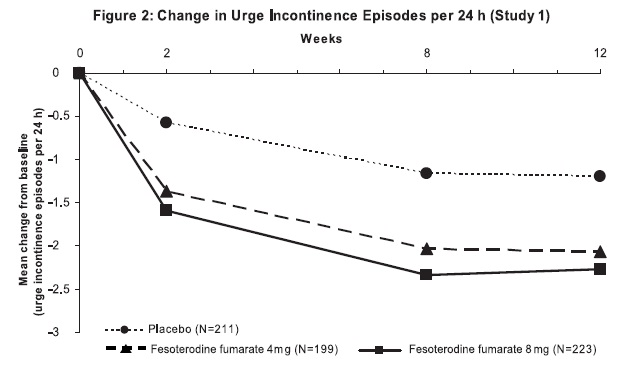
This is a graph depicting the change in the number of urge incontinence episodes per 24 hours over the course of 12 weeks, with data points at weeks 2, 8, and 12. The study compared a placebo group (N=211) to two treatment groups: one group was given Fosotorosine fumarate 4mg (N=198), and the other group was given Fesolerodine fumarate 8mg (N=223). The text "Mean change from baseline" likely refers to the average change in the number of incontinence episodes from the beginning (baseline) of the study to the end of the 12-week period.*
FDA Label Image

Fesoterodine-figure3.jpg (Fesoterodine Figure3)

Fesoterodine-figure3.jpg (Fesoterodine Figure3)
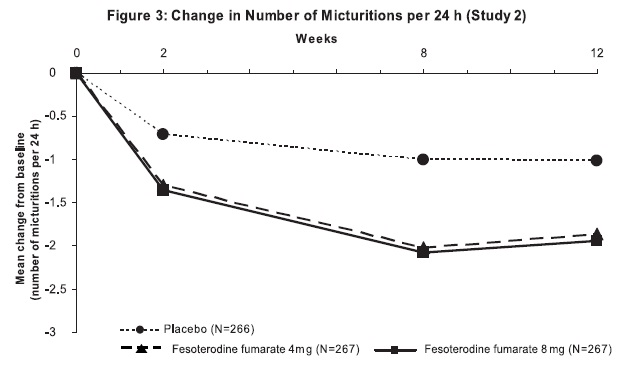
The text describes the mean change from baseline in the number of micturitions per 24 hours. It includes a Figure 3 showing the change in the number of micturitions per 24 hours over weeks for a study comparing a placebo group (N=266) with a group taking either Fesoterodine fumarate 4mg (N=267) or Fesoterodine fumarate 8mg (N=267).*
FDA Label Image

Fesoterodine-figure4.jpg (Fesoterodine Figure4)

Fesoterodine-figure4.jpg (Fesoterodine Figure4)
The text describes the mean change from baseline of urge incontinence episodes per 24 hours in a study with three groups, one receiving placebo, one receiving 4mg of fesolorodine fumarate, and one receiving 8mg of fesoterodine fumarate. The change is presented graphically in Figure 4 over the course of several weeks.*
FDA Label Image

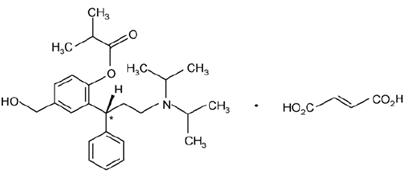
Structure (Fesoterodine Str)

* These product label images have been analyzed using experimental machine learning. Please verify findings with the primary label text.