Arimidex Tablet
Product Images NDC 62559-670

View Photos of Packaging, Regulatory Labels, and Product Appearance

Product Visual Gallery

This gallery contains 10 technical images submitted to the FDA as part of the official labeling for Arimidex (NDC 62559-670). Unlike standard consumer photos, these assets often include clinical data figures, molecular chemical structures, and official manufacturer packaging layouts.

As provided by Ani Pharmaceuticals, Inc., these visuals offer a comprehensive scientific overview of the product's physical and chemical identity, aiding pharmacists and researchers in product verification and study.

FDA Label Image

Figure-1 (Figure 1)

Figure-1 (Figure 1)
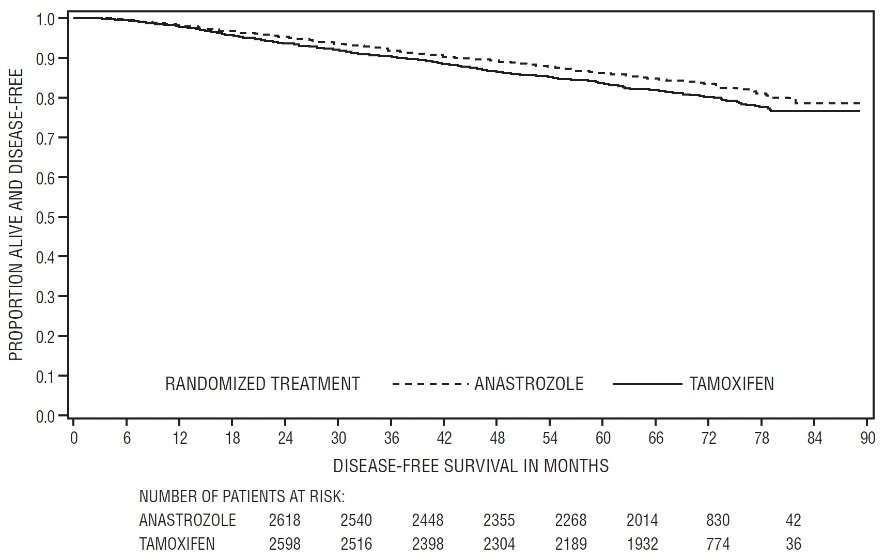
This is a graph showing the disease-free survival of patients treated with either anastrozole or tamoxifen. The graph shows the proportion of patients who are alive and free of disease over time, ranging from 0 to 90 months. The treatment types are indicated by different lines, with anastrozole represented by a solid line and tamoxifen represented by a dashed line. The number of patients at risk at each time point is also provided for each treatment group.*
FDA Label Image

Figure-2 (Figure 2)

Figure-2 (Figure 2)
This appears to be a graph showing disease-free survival in months for patients receiving either anastrozole or tamoxifen. The graph shows the number of surviving patients over time, along with the number of patients still at risk of disease at each time point. The top of the graph shows the proportion of patients who are both still alive and free of disease over time. The numbers at the bottom of the graph indicate the time in months.*
FDA Label Image

Ani (Ani 01)

FDA Label Image

Ani (Ani)

FDA Label Image

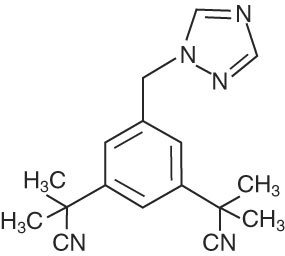
Chemical Structure For Anastrozole (Image 01)

FDA Label Image

Image 02

Image 02
Each tablet contains Anastrozole and is distributed by ANI Pharmaceuticals. The USP recommends storing the tablets at a temperature between 20° to 25°C (68° to 77°F) and these are available in a bottle containing 30 tablets. Further details regarding the dosage can be found in the accompanying Prescription Information.*
FDA Label Image

Figure 3 (Image 04)

Figure 3 (Image 04)
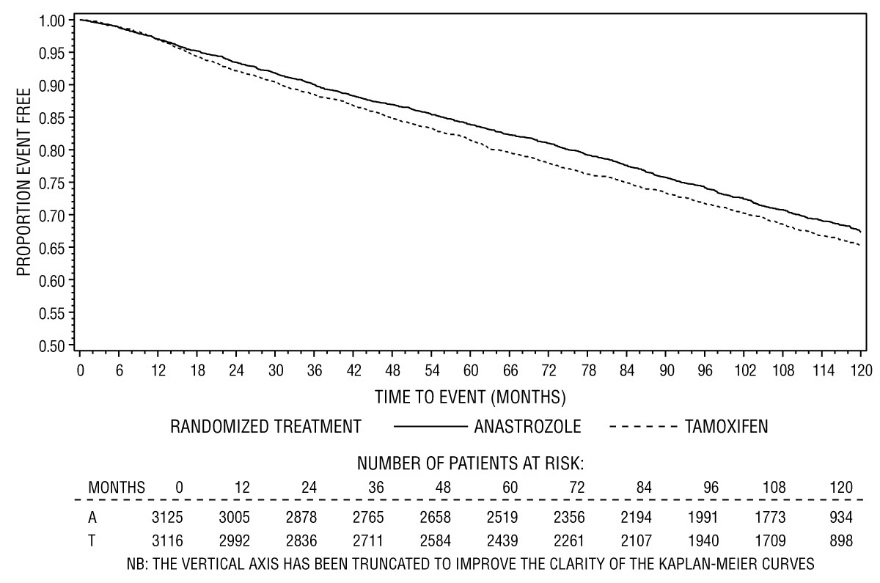
This is a graph showing the proportion of patients event-free over time to the event (in months) while being treated with randomized treatment of Anastrozole or Tamoxifen. The number of patients at risk is shown on the horizontal axis. The vertical axis has been truncated to improve the clarity of the Kaplan-Meier curves.*
FDA Label Image

Figure 4 (Image 05)

Figure 4 (Image 05)
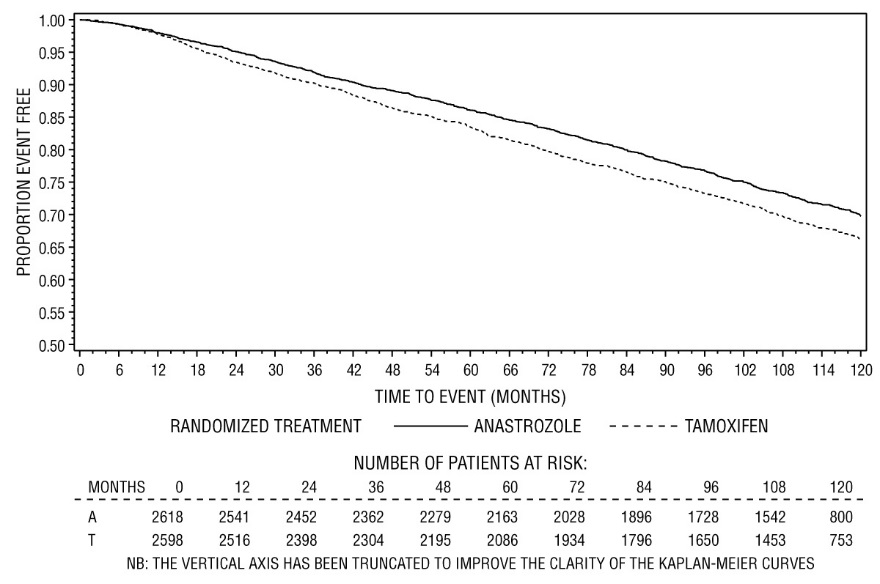
This is a graph displaying the "Proportion Event Free" rates over time (in months) for two randomized treatments, Anastrozole and Tamoxifen. The Kaplan-Meier curves show the percentage of patients who remain event-free (alive without disease progression) during the study. The number of patients at risk for each treatment is shown below the graph. The vertical axis has been truncated to improve clarity.*
FDA Label Image

Figure 5 (Image 06)

Figure 5 (Image 06)
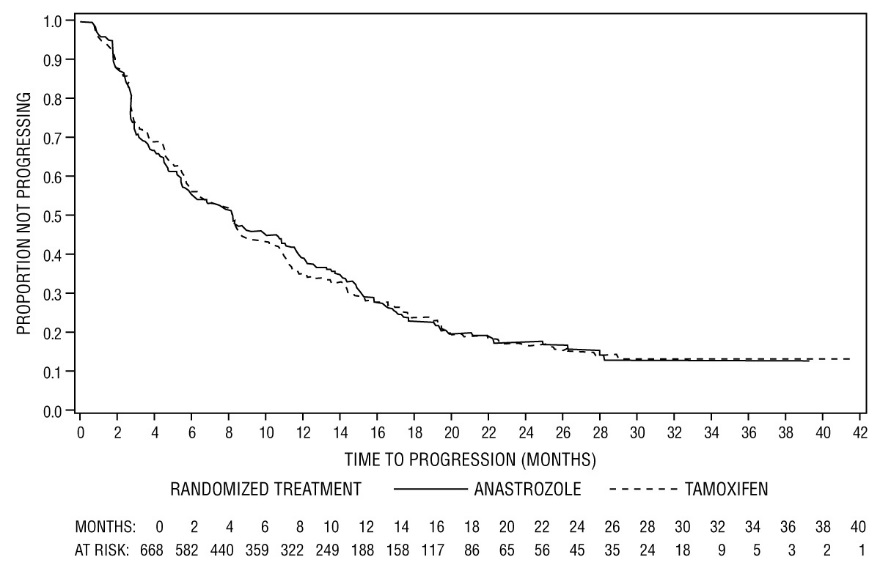
This appears to be a graph or chart showing the time to progression of randomized treatment using two drugs, anastrozole and tamoxifen. However, without further context or a clear title, it is difficult to provide a more useful description.*
FDA Label Image

Figure 6 (Image 07)

Figure 6 (Image 07)
This appears to be a graph or chart. The text shows a plot of time to progression (in months) of a treatment randomly assigned to patients with a certain condition, either anastrozole or tamoxifen. The x-axis shows the time for progression, while the y-axis has numbers that seem to be related to the number of patients. There are also numbers and dots. Without additional context, it is difficult to provide more details.*

* These product label images have been analyzed using experimental machine learning. Please verify findings with the primary label text.