Risk Summary
Based on findings in animal studies and its mechanism of action, FRUZAQLA can cause fetal harm when administered to a pregnant woman. In an embryo-fetal developmental study in pregnant rats, oral administration of fruquintinib during the period of organogenesis resulted in teratogenicity and embryo lethality at exposures below the clinical exposure (see Data). There are no data on the use of FRUZAQLA in pregnant women. Advise pregnant women of the potential risk to a fetus.
In the U.S. general population, the estimated background risk of major birth defects and miscarriage in clinically recognized pregnancies is 2 to 4% and 15 to 20%, respectively.
Data
Animal Data
In an embryo-fetal developmental study in pregnant rats, daily oral administration of fruquintinib at doses ≥0.1 mg/kg [approximately 0.2 times the recommended clinical dose of 5 mg based on body surface area (BSA)] during the period of organogenesis resulted in fetal external (edema and head and tail abnormalities), visceral, and skeletal malformations. At doses of 0.25 mg/kg (approximately 0.5 times the recommended clinical dose of 5 mg based on BSA), an increase in postimplantation loss and reduction in live fetuses was observed.
Risk Summary
There are no data regarding the presence of fruquintinib or its metabolites in human milk or its effects on a breastfed child or on milk production. Because of the potential for serious adverse reactions in the breastfed child, advise women not to breastfeed during treatment with FRUZAQLA and for 2 weeks after the last dose.
Pregnancy Testing
Verify pregnancy status of females of reproductive potential prior to initiating FRUZAQLA.
Contraception
Females and Males
Females of childbearing potential and males with female partners of childbearing potential should use effective contraception during treatment and for 2 weeks after the last dose of FRUZAQLA [see Warnings and Precautions (5.11) and Nonclinical Toxicology (13.1)].
Cardiac Electrophysiology
A mean increase in QTc interval >20 milliseconds (ms) was not observed at the approved recommended dosage.
Absorption
The fruquintinib median (min, max) time to Cmax is approximately 2 hours (0, 26 hours).
Effect of Food
No clinically significant differences in fruquintinib pharmacokinetics were observed following administration of a high-fat meal (800 to 1000 calories, 50% fat).
Distribution
The mean (SD) apparent volume of distribution of fruquintinib is approximately 46 (13) L. Plasma protein binding of fruquintinib is approximately 95%.
Elimination
The fruquintinib mean (SD) elimination half-life is approximately 42 (11) hours and the apparent clearance is 14.8 (4.4) mL/min.
Metabolism
Fruquintinib is primarily eliminated by CYP450 and non-CYP450 (i.e., sulfation and glucuronidation) metabolism. CYP3A and to a lesser extent CYP2C8, CYP2C9, and CYP2C19 are the CYP450 enzymes involved in fruquintinib metabolism.
Excretion
Following oral administration of a 5 mg radiolabeled fruquintinib dose, approximately 60% of the dose was recovered in urine (0.5% unchanged) and 30% of the dose was recovered in feces (5% unchanged).
Specific Populations
No clinically significant differences in the pharmacokinetics of fruquintinib were observed based on age (18 to 82 years), sex, race (Asian, Black, and White), ethnicity (Hispanic/Latino vs. non-Hispanic/Latino), body weight (48 to 108 kg), mild to moderate renal impairment (CrCL 30 to 89 mL/min), mild hepatic impairment (total bilirubin less than or equal to ULN with AST greater than ULN or total bilirubin greater than 1 to 1.5 times ULN with any AST).
The effect of moderate to severe hepatic impairment (total bilirubin greater than 1.5 times ULN and any AST) on fruquintinib pharmacokinetics is unknown.
Drug Interaction Studies
Clinical Studies and Model-Informed Approaches
Strong CYP3A inducers: Fruquintinib Cmax decreased by 12% and AUCinf by 65% following concomitant use with rifampin (strong CYP3A inducer).
Moderate CYP3A inducers: Fruquintinib Cmax is predicted to decrease by 4% and AUCinf by 32% following concomitant use with efavirenz (moderate CYP3A inducer).
Other Drugs: No clinically significant differences in fruquintinib pharmacokinetics were observed when used concomitantly with itraconazole (strong CYP3A inhibitor) or rabeprazole (proton pump inhibitor; gastric acid reducing agent).
No clinically significant differences in the pharmacokinetics of the following drugs were observed when used concomitantly with fruquintinib: dabigatran etexilate (P-gp substrate), or rosuvastatin (BCRP substrate).
In Vitro Studies
Cytochrome P450 Enzymes: Fruquintinib is not an inhibitor of CYP1A2, CYP2B6, CYP2C8, CYP2C9, CYP2C19, CYP2D6 and CYP3A, or an inducer of CYP1A2, CYP2B6, CYP3A.
Transporter Systems: Fruquintinib is not a substrate of P-glycoprotein (P-gp), organic anion transporting polypeptide (OATP)1B1 or OATP1B3. Fruquintinib is not an inhibitor of OATP1B1, OATP1B3, organic anion transporter (OAT)1, OAT3, organic cation transporter (OCT)2, multidrug and toxin extrusion protein (MATE)1, or MATE2-K.
Hypertension
Advise patients to undergo regular blood pressure monitoring and to contact their health care provider if blood pressure is elevated or if symptoms from hypertension occur including severe headache, lightheadedness, or new neurologic symptoms [see Warnings and Precautions (5.1)].
Hemorrhages
Advise patients that FRUZAQLA may increase the risk of bleeding and to contact their healthcare provider for unusual, severe, or persistent bleeding, bruising, or symptoms of bleeding, such as lightheadedness [see Warnings and Precautions (5.2)].
Infections
Advise patients to contact their healthcare provider if they experience signs and symptoms of infection [see Warnings and Precautions (5.3)].
Gastrointestinal Perforation
Advise patients to contact a healthcare provider immediately if they experience severe abdominal pains, or other symptoms of gastrointestinal perforation or fistula [see Warnings and Precautions (5.4)].
Hepatotoxicity
Advise patients that they will need to undergo laboratory tests to monitor liver function and to report any new symptoms indicating hepatic toxicity or failure [see Warnings and Precautions (5.5)].
Proteinuria
Advise patients that they will need to undergo laboratory tests to monitor for proteinuria and to contact their healthcare provider for signs or symptoms of proteinuria [see Warnings and Precautions (5.6)].
Palmar-plantar erythrodysesthesia (PPE)
Advise patients to contact their healthcare provider for progressive or intolerable rash [see Warnings and Precautions (5.7)].
Posterior Reversible Encephalopathy Syndrome (PRES)
Advise patients to immediately contact their healthcare provider for new onset or worsening neurological function [see Warnings and Precautions (5.8)].
Impaired Wound Healing
Advise patients that FRUZAQLA may impair wound healing. Advise patients to inform their healthcare provider of any planned surgical procedure [see Warnings and Precautions (5.9)].
Arterial Thrombosis
Advise patients to seek immediate medical attention for new onset chest pain or acute neurologic symptoms consistent with myocardial infarction or stroke [see Warnings and Precautions (5.10)].
Allergic Reactions to FD&C Yellow No. 5 (Tartrazine) and No. 6 (Sunset Yellow FCF)
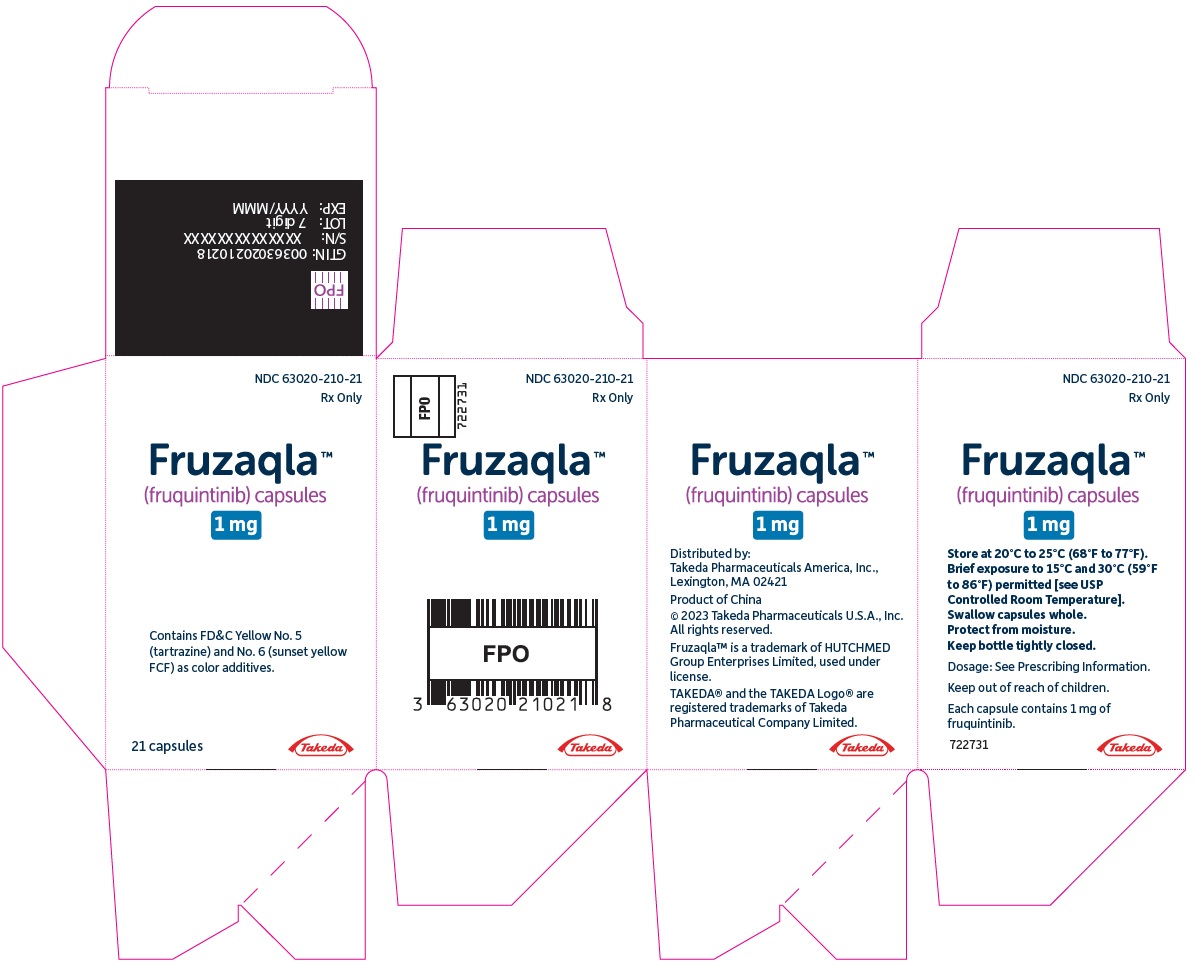
Advise patients that FRUZAQLA 1 mg contains FD&C Yellow No. 5 (tartrazine), which may cause allergic-type reactions (including bronchial asthma) in certain susceptible persons or in patients who also have aspirin hypersensitivity [see Warnings and Precautions (5.11)].
Advise patients FRUZAQLA 1 mg contains FD&C Yellow No. 6 (sunset yellow FCF) which may cause allergic-type reactions [see Warnings and Precautions (5.11)].
Embryo-Fetal Toxicity
Advise females to inform their healthcare provider if they are pregnant or become pregnant. Inform females of the risk to a fetus and potential loss of pregnancy [see Warnings and Precautions (5.12) and Use in Specific Populations (8.1)].
Advise females of reproductive potential to use effective contraception during treatment and for 2 weeks after the last dose of FRUZAQLA [see Warnings and Precautions (5.12) and Use in Specific Populations (8.3)].
Advise males with female partners of reproductive potential to use effective contraception during treatment and for 2 weeks following the last dose of FRUZAQLA [see Warnings and Precautions (5.11) and Use in Specific Populations (8.3)].
Lactation
Advise patients not to breastfeed during treatment with FRUZAQLA and for 2 weeks after the last dose of FRUZAQLA [see Use in Specific Populations (8.2)].
Distributed by:
Takeda Pharmaceuticals America, Inc.
Lexington, MA 02421
FRUZAQLA™ is a trademark of HUTCHMED Group Enterprises Limited, used under license.
TAKEDA® and the TAKEDA Logo® are registered trademarks of Takeda Pharmaceutical Company Limited.
©2023 Takeda Pharmaceuticals U.S.A., Inc. All rights reserved.
FRU380 R1