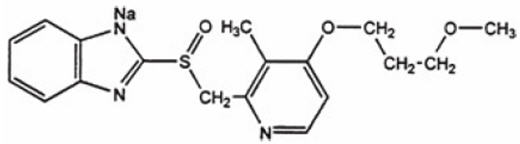
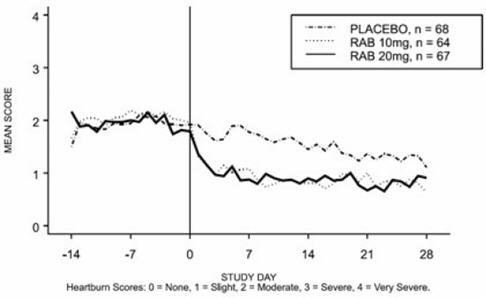
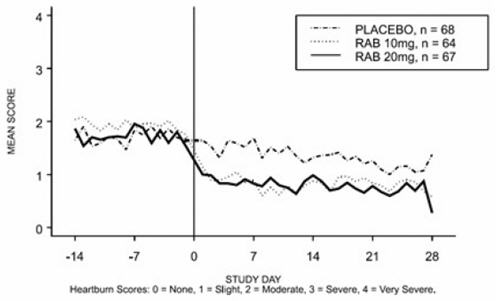
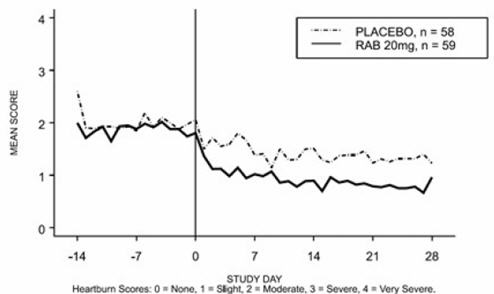
Adults
The data described below reflect exposure to Rabeprazole Sodium Delayed-Release Tablets in 1064 adult patients exposed for up to 8 weeks. The studies were primarily placebo- and active-controlled trials in adult patients with Erosive or Ulcerative Gastroesophageal Reflux Disease (GERD), Duodenal Ulcers and Gastric Ulcers. The population had a mean age of 53 years (range 18-89 years) and had a ratio of approximately 60% male: 40% female. The racial distribution was 86% Caucasian, 8% African American, 2% Asian and 5% other. Most patients received either 10 mg, 20 mg or 40 mg/day of Rabeprazole Sodium Delayed-Release Tablets.
An analysis of adverse reactions appearing in ³ 2% of Rabeprazole Sodium Delayed-Release Tablet patients (n=1064) and with a greater frequency than placebo (n=89) in controlled North American and European acute treatment trials, revealed the following adverse reactions: pain (3% vs. 1%), pharyngitis (3% vs. 2%), flatulence (3% vs. 1%), infection (2% vs. 1%), and constipation (2% vs. 1%).
Three long-term maintenance studies consisted of a total of 740 adult patients; at least 54% of adult patients were exposed to rabeprazole for 6 months while at least 33% were exposed for 12 months. Of the 740 adult patients, 247 (33%) and 241 (33%) patients received 10 mg and 20 mg of Rabeprazole Sodium Delayed-Release Tablets, respectively, while 169 (23%) patients received placebo and 83 (11%) received omeprazole.
The safety profile of rabeprazole in the maintenance studies in adults was consistent with what was observed in the acute studies.
Other adverse reactions that were seen in controlled clinical trials, which do not meet the above criteria (≥ 2% of Rabeprazole Sodium Delayed-Release Tablets treated patients and greater than placebo) and for which there is a possibility of a causal relationship to rabeprazole, include the following: headache, abdominal pain, diarrhea, dry mouth, dizziness, peripheral edema, hepatic enzyme increase, hepatitis, hepatic encephalopathy, myalgia, and arthralgia.
Combination Treatment with Amoxicillin and Clarithromycin: In clinical trials using combination therapy with rabeprazole plus amoxicillin and clarithromycin (RAC), no adverse reactions unique to this drug combination were observed. In the U.S. multicenter study, the most frequently reported drug related adverse reactions for patients who received RAC therapy for 7 or 10 days were diarrhea (8% and 7%) and taste perversion (6% and 10%), respectively.
No clinically significant laboratory abnormalities particular to the drug combinations were observed.
For more information on adverse reactions or laboratory changes with amoxicillin or clarithromycin, refer to their respective package prescribing information, Adverse Reactions section.
Pediatric
In a multicenter, open-label study of adolescent patients aged 12 to 16 years with a clinical diagnosis of symptomatic GERD or endoscopically proven GERD, the adverse event profile was similar to that of adults. The adverse reactions reported without regard to relationship to Rabeprazole Sodium Delayed-Release Tablets that occurred in ≥ 2% of 111 patients were headache (9.9%), diarrhea (4.5%), nausea (4.5%), vomiting (3.6%), and abdominal pain (3.6%). The related reported adverse reactions that occurred in ≥ 2% of patients were headache (5.4%) and nausea (1.8%). There were no adverse reactions reported in these studies that were not previously observed in adults.
Risk Summary
There are no adequate and well-controlled studies with Rabeprazole Sodium Delayed-Release Tablets in pregnant women. No evidence of teratogenicity was seen in animal reproduction studies with rabeprazole at 13 and 8 times the human exposure at the recommended dose for GERD, in rats and rabbits, respectively. Because animal reproduction studies are not always predictive of human response, this drug should be used during pregnancy only if clearly needed.
Animal Data
Embryo-fetal developmental studies have been performed in rats at intravenous doses of rabeprazole up to 50 mg/kg/day (plasma AUC of 11.8 µg∙hr/mL, about 13 times the human exposure at the recommended oral dose for GERD) and rabbits at intravenous doses up to 30 mg/kg/day (plasma AUC of 7.3 µg∙hr/mL, about 8 times the human exposure at the recommended oral dose for GERD) and have revealed no evidence of harm to the fetus due to rabeprazole.
Administration of rabeprazole to rats in late gestation and during lactation at an oral dose of 400 mg/kg/day (about 195-times the human oral dose based on mg/m2) resulted in decreases in body weight gain of the pups.
Symptomatic GERD in Adolescent Patients Greater or Equal to 12 Years of Age
In a multicenter, randomized, open-label, parallel-group study, 111 adolescent patients 12 to 16 years of age with a clinical diagnosis of symptomatic GERD, or suspected or endoscopically proven GERD were randomized and treated with either Rabeprazole Sodium 10 mg or Rabeprazole Sodium Delayed-Release Tablets 20 mg once daily for up to 8 weeks for the evaluation of safety and efficacy. The adverse event profile in adolescent patients was similar to that of adults. The related reported adverse reactions that occurred in ≥2% of patients were headache (5.4%) and nausea (1.8%). There were no adverse reactions reported in these studies that were not previously observed in adults.
Antisecretory Activity
The antisecretory effect begins within one hour after oral administration of 20 mg Rabeprazole Sodium Delayed-Release Tablets. The median inhibitory effect of Rabeprazole Sodium Delayed-Release Tablets on 24 hour gastric acidity is 88% of maximal after the first dose. Rabeprazole Sodium Delayed-Release Tablets 20 mg inhibits basal and peptone meal-stimulated acid secretion versus placebo by 86% and 95%, respectively, and increases the percent of a 24-hour period that the gastric pH>3 from 10% to 65% (see table below). This relatively prolonged pharmacodynamic action compared to the short pharmacokinetic half-life (1-2 hours) reflects the sustained inactivation of the H+, K+ATPase.
TABLE 3 GASTRIC ACID PARAMETERS RABEPRAZOLE SODIUM DELAYED-RELEASE TABLETS VERSUS PLACEBO AFTER 7 DAYS OF ONCE DAILY DOSING| Parameter | Rabeprazole Sodium Delayed-Release Tablets
(20 mg QD) | Placebo |
|---|
Basal Acid Output (mmol/hr) | 0.4 | 2.8 |
Stimulated Acid Output (mmol/hr) | 0.6 | 13.3 |
% Time Gastric pH>3 | 65 | 10 |
Compared to placebo, Rabeprazole Sodium Delayed-Release Tablets, 10 mg, 20 mg, and 40 mg, administered once daily for 7 days significantly decreased intragastric acidity with all doses for each of four meal-related intervals and the 24-hour time period overall. In this study, there were no statistically significant differences between doses; however, there was a significant dose-related decrease in intragastric acidity. The ability of rabeprazole to cause a dose-related decrease in mean intragastric acidity is illustrated below.
TABLE 4 AUC ACIDITY (MMOL∙HR/L) RABEPRAZOLE SODIUM DELAYED-RELEASE TABLETS VERSUS PLACEBO ON DAY 7 OF ONCE DAILY DOSING (MEAN±SD) | Treatment |
|---|
| AUC interval (hrs) | 10 mg RBP
(N=24) | 20 mg RBP
(N=24) | 40 mg RBP
(N=24) | Placebo
(N=24) |
|---|
08:00 – 13:00 | 19.6±21.5 | 12.9±23 | 7.6±14.7 | 91.1±39.7 |
13:00 – 19:00 | 5.6±9.7 | 8.3±29.8 | 1.3±5.2 | 95.5±48.7 |
19:00 – 22:00 | 0.1±0.1 | 0.1±0.06 | 0.0±0.02 | 11.9±12.5 |
22:00 – 08:00 | 129.2±84 | 109.6±67.2 | 76.9±58.4 | 479.9±165 |
AUC 0-24 hours | 155.5±90.6 | 130.9±81 | 85.8±64.3 | 678.5±216 |
After administration of 20 mg Rabeprazole Sodium Delayed-Release Tablets once daily for eight days, the mean percent of time that gastric pH>3 or gastric pH>4 after a single dose (Day 1) and multiple doses (Day 8) was significantly greater than placebo (see table below). The decrease in gastric acidity and the increase in gastric pH observed with 20 mg Rabeprazole Sodium Delayed-Release Tablets administered once daily for eight days were compared to the same parameters for placebo, as illustrated below:
TABLE 5 GASTRIC ACID PARAMETERS RABEPRAZOLE SODIUM DELAYED-RELEASE TABLETS ONCE DAILY DOSING VERSUS PLACEBO ON DAY 1 AND DAY 8| Parameter | Rabeprazole Sodium Delayed-Release Tablets 20 mg QD | Placebo |
|---|
| Day 1 | Day8 | Day 1 | Day 8 |
|---|
Mean AUC0-24 Acidity | 340.8 | 176.9 | 925.5 | 862.4 |
Median trough pH (23-hr) | 3.77 | 3.51 | 1.27 | 1.38 |
% Time Gastric pH>3 | 54.6 | 68.7 | 19.1 | 21.7 |
% Time Gastric pH>4 | 44.1 | 60.3 | 7.6 | 11 |
Effects on Esophageal Acid Exposure
In patients with gastroesophageal reflux disease (GERD) and moderate to severe esophageal acid exposure, Rabeprazole Sodium Delayed-Release 20 mg and 40 mg tablets per day decreased 24-hour esophageal acid exposure. After seven days of treatment, the percentage of time that esophageal pH<4 decreased from baselines of 24.7% for 20 mg and 23.7% for 40 mg, to 5.1% and 2%, respectively. Normalization of 24-hour intraesophageal acid exposure was correlated to gastric pH>4 for at least 35% of the 24-hour period; this level was achieved in 90% of subjects receiving Rabeprazole Sodium Delayed-Release Tablets 20 mg and in 100% of subjects receiving Rabeprazole Sodium Delayed-Release Tablets 40 mg. With Rabeprazole Sodium Delayed-Release Tablets 20 mg and 40 mg per day, significant effects on gastric and esophageal pH were noted after one day of treatment, and more pronounced after seven days of treatment.
Effects on Serum Gastrin
In patients given daily doses of Rabeprazole Sodium Delayed-Release Tablets for up to eight weeks to treat ulcerative or erosive esophagitis and in patients treated for up to 52 weeks to prevent recurrence of disease the median fasting gastrin level increased in a dose-related manner. The group median values stayed within the normal range.
In a group of subjects treated daily with Rabeprazole Sodium Delayed-Release Tablets 20 mg for 4 weeks a doubling of mean serum gastrin concentrations were observed. Approximately 35% of these treated subjects developed serum gastrin concentrations above the upper limit of normal. In a study of CYP2C19 genotyped subjects in Japan, poor metabolizers developed statistically significantly higher serum gastrin concentrations than extensive metabolizers.
Effects on Enterochromaffin-like (ECL) Cells
Increased serum gastrin secondary to antisecretory agents stimulates proliferation of gastric ECL cells which, over time, may result in ECL cell hyperplasia in rats and mice and gastric carcinoids in rats, especially in females [see Nonclinical Toxicology (13.1)].
In over 400 patients treated with Rabeprazole Sodium Delayed-Release Tablets (10 or 20 mg/day) for up to one year, the incidence of ECL cell hyperplasia increased with time and dose, which is consistent with the pharmacological action of the proton-pump inhibitor. No patient developed the adenomatoid, dysplastic or neoplastic changes of ECL cells in the gastric mucosa. No patient developed the carcinoid tumors observed in rats.
Endocrine Effects
Studies in humans for up to one year have not revealed clinically significant effects on the endocrine system. In healthy male volunteers treated with Rabeprazole Sodium Delayed-Release Tablets for 13 days, no clinically relevant changes have been detected in the following endocrine parameters examined: 17 β-estradiol, thyroid stimulating hormone, tri-iodothyronine, thyroxine, thyroxine-binding protein, parathyroid hormone, insulin, glucagon, renin, aldosterone, follicle-stimulating hormone, luteotrophic hormone, prolactin, somatotrophic hormone, dehydroepiandrosterone, cortisol-binding globulin, and urinary 6β-hydroxycortisol, serum testosterone and circadian cortisol profile.
Other Effects
In humans treated with Rabeprazole Sodium Delayed-Release Tablets for up to one year, no systemic effects have been observed on the central nervous, lymphoid, hematopoietic, renal, hepatic, cardiovascular, or respiratory systems. No data are available on long-term treatment with Rabeprazole Sodium Delayed-Release Tablets and ocular effects.
Microbiology
The following in vitro data are available but the clinical significance is unknown.
Rabeprazole sodium, amoxicillin and clarithromycin as a three drug regimen has been shown to be active against most strains of Helicobacter pylori in vitro and in clinical infections as described in the Clinical Studies (14) and Indications and Usage (1) sections.
Helicobacter pylori
Susceptibility testing of H. pylori isolates was performed for amoxicillin and clarithromycin using agar dilution methodology1, and minimum inhibitory concentrations (MICs) were determined.
Standardized susceptibility test procedures require the use of laboratory control microorganisms to control the technical aspects of the laboratory procedures.
Incidence of Antibiotic-Resistant Organisms Among Clinical Isolates
Pretreatment Resistance: Clarithromycin pretreatment resistance rate (MIC ≥ 1 µg/mL) to H. pylori was 9% (51/560) at baseline in all treatment groups combined. A total of > 99% (558/560) of patients had H. pylori isolates which were considered to be susceptible (MIC ≤ 0.25 µg/mL) to amoxicillin at baseline. Two patients had baseline H. pylori isolates with an amoxicillin MIC of 0.5 µg/mL.
For susceptibility testing information about Helicobacter pylori, see Microbiology section in prescribing information for clarithromycin and amoxicillin.
TABLE 6 CLARITHROMYCIN SUSCEPTIBILITY TEST RESULTS AND CLINICAL/BACTERIOLOGIC OUTCOMES FOR A THREE DRUG REGIMEN (RABEPRAZOLE 20 MG TWICE DAILY, AMOXICILLIN 1000 MG TWICE DAILY, AND CLARITHROMYCIN 500 MG TWICE DAILY FOR 7 OR 10 DAYS)| Days of RAC Therapy | Clarithromycin Pretreatment Results | Total Number | H. pylori Negative (Eradicated) | H. pylori Positive (Persistent)
Post-Treatment Susceptibility Results |
|---|
| S | I | R | No MIC |
|---|
7 | Susceptible | 129 | 103 | 2 | 0 | 1 | 23 |
7 | Intermediate | 0 | 0 | 0 | 0 | 0 | 0 |
7 | Resistant | 16 | 5 | 2 | 1 | 4 | 4 |
10 | Susceptible | 133 | 111 | 3 | 1 | 2 | 16 |
10 | Intermediate | 0 | 0 | 0 | 0 | 0 | 0 |
10 | Resistant | 9 | 1 | 0 | 0 | 5 | 3 |
Patients with persistent H. pylori infection following rabeprazole, amoxicillin, and clarithromycin therapy will likely have clarithromycin resistant clinical isolates. Therefore, clarithromycin susceptibility testing should be done when possible. If resistance to clarithromycin is demonstrated or susceptibility testing is not possible, alternative antimicrobial therapy should be instituted.
Amoxicillin Susceptibility Test Results and Clinical/Bacteriological Outcomes: In the U.S. multicenter study, a total of >99% (558/560) of patients had H. pylori isolates which were considered to be susceptible (MIC ≤ 0.25 µg/mL) to amoxicillin at baseline. The other 2 patients had baseline H. pylori isolates with an amoxicillin MIC of 0.5 µg/mL, and both isolates were clarithromycin-resistant at baseline; in one case the H. pylori was eradicated. In the 7- and 10-day treatment groups 75% (107/145) and 79% (112/142), respectively, of the patients who had pretreatment amoxicillin susceptible MICs (≤ 0.25 µg/mL) were eradicated of H. pylori. No patients developed amoxicillin-resistant H. pylori during therapy.
Absorption: Absolute bioavailability for a 20 mg oral tablet of rabeprazole (compared to intravenous administration) is approximately 52%. When Rabeprazole Sodium Delayed-Release Tablets are administered with a high fat meal, Tmax is variable; which concomitant food intake may delay the absorption up to 4 hours or longer. However, the Cmax and the extent of rabeprazole absorption (AUC) are not significantly altered. Thus Rabeprazole Sodium Delayed-Release Tablets may be taken without regard to timing of meals.
Distribution: Rabeprazole is 96.3% bound to human plasma proteins.
Metabolism: Rabeprazole is extensively metabolized. A significant portion of rabeprazole is metabolized via systemic nonenzymatic reduction to a thioether compound. Rabeprazole is also metabolized to sulphone and desmethyl compounds via cytochrome P450 in the liver. The thioether and sulphone are the primary metabolites measured in human plasma. These metabolites were not observed to have significant antisecretory activity. In vitro studies have demonstrated that rabeprazole is metabolized in the liver primarily by cytochromes P450 3A (CYP3A) to a sulphone metabolite and cytochrome P450 2C19 (CYP2C19) to desmethyl rabeprazole. CYP2C19 exhibits a known genetic polymorphism due to its deficiency in some sub-populations (e.g. 3 to 5% of Caucasians and 17 to 20% of Asians). Rabeprazole metabolism is slow in these sub-populations, therefore, they are referred to as poor metabolizers of the drug.
Elimination: Following a single 20 mg oral dose of 14C-labeled rabeprazole, approximately 90% of the drug was eliminated in the urine, primarily as thioether carboxylic acid; its glucuronide, and mercapturic acid metabolites. The remainder of the dose was recovered in the feces. Total recovery of radioactivity was 99.8%. No unchanged rabeprazole was recovered in the urine or feces.
Geriatric: In 20 healthy elderly subjects administered 20 mg rabeprazole tablet once daily for seven days, AUC values approximately doubled and the Cmax increased by 60% compared to values in a parallel younger control group. There was no evidence of drug accumulation after once daily administration [see Use in Special Populations (8.5)].
Pediatric: The pharmacokinetics of rabeprazole was studied in pediatric patients with GERD aged 12 to 16 years.
Patients 12 to 16 Years of Age
The pharmacokinetics of rabeprazole was studied in 12 adolescent patients with GERD 12 to 16 years of age, in a multicenter study. Patients received rabeprazole 20 mg tablets once daily for five or seven days. An approximate 40% increase in exposure was noted following 5 to 7 days of dosing compared with the exposure after 1 day dosing. Pharmacokinetic parameters in adolescent patients with GERD 12 to 16 years of age were within the range observed in healthy adult volunteers.
Gender and Race: In analyses adjusted for body mass and height, rabeprazole pharmacokinetics showed no clinically significant differences between male and female subjects. In studies that used different formulations of rabeprazole, AUC0-∞ values for healthy Japanese men were approximately 50-60% greater than values derived from pooled data from healthy men in the United States.
Renal Disease: In 10 patients with stable end-stage renal disease requiring maintenance hemodialysis (creatinine clearance ≤5 mL/min/1.73 m2), no clinically significant differences were observed in the pharmacokinetics of rabeprazole after a single 20 mg oral dose when compared to 10 healthy volunteers [see Dosage and Administration (2.9)].
Hepatic Disease: In a single dose study of 10 patients with chronic mild to moderate compensated cirrhosis of the liver who were administered a 20 mg dose of rabeprazole, AUC0-24 was approximately doubled, the elimination half-life was 2- to 3-fold higher, and total body clearance was decreased to less than half compared to values in healthy men.
In a multiple dose study of 12 patients with mild to moderate hepatic impairment administered 20 mg rabeprazole once daily for eight days, AUC0-∞ and Cmax values increased approximately 20% compared to values in healthy age- and gender-matched subjects. These increases were not statistically significant.
No information exists on rabeprazole disposition in patients with severe hepatic impairment. Please refer to the Dosage and Administration (2.9) for information on dosage adjustment in patients with hepatic impairment.
Combined Administration with Antimicrobials: Sixteen healthy volunteers genotyped as extensive metabolizers with respect to CYP2C19 were given 20 mg rabeprazole sodium, 1000 mg amoxicillin, 500 mg clarithromycin, or all 3 drugs in a four-way crossover study. Each of the four regimens was administered twice daily for 6 days. The AUC and Cmax for clarithromycin and amoxicillin were not different following combined administration compared to values following single administration. However, the rabeprazole AUC and Cmax increased by 11% and 34%, respectively, following combined administration. The AUC and Cmax for 14-hydroxyclarithromycin (active metabolite of clarithromycin) also increased by 42% and 46%, respectively. This increase in exposure to rabeprazole and 14-hydroxyclarithromycin is not expected to produce safety concerns.
Concomitant Use with Clopidogrel: Clopidogrel is metabolized to its active metabolite in part by CYP2C19. A study of healthy subjects including CYP2C19 extensive and intermediate metabolizers receiving once daily administration of clopidogrel 75 mg concomitantly with placebo or with Rabeprazole Sodium Delayed-Release Tablets 20 mg (n=36), for 7 days was conducted. The mean AUC of the active metabolite of clopidogrel was reduced by approximately 12% (mean AUC ratio was 88 %, with 90% CI of 81.7 to 95.5%) when Rabeprazole Sodium Delayed-Release Tablets was coadministered compared to administration of clopidogrel with placebo.
Symptomatic GERD in Adolescents 12 to 16 Years of Age
In a multicenter, randomized, open-label, parallel-group study, 111 adolescent patients 12 to 16 years of age with a clinical diagnosis of symptomatic GERD or suspected or endoscopically proven GERD were randomized and treated with either Rabeprazole Sodium Delayed-Release Tablets 10 mg or Rabeprazole Sodium Delayed-Release Tablets 20 mg once daily for up to 8 weeks for the evaluation of safety and efficacy.
Distributed by:
Kremers Urban Pharmaceuticals Inc.
Princeton, NJ 08540, USA
Repackaged by:
Proficient Rx LP
Thousand Oaks, CA 91320
CIA76374B
Rev. 2E 10/2013