Other
To reduce the development of drug-resistant bacteria and maintain the effectiveness of clarithromycin tablets and other antibacterial drugs, clarithromycin tablets should be used only to treat or prevent infections that are proven or strongly suspected to be caused by bacteria.
Diffusion Techniques
Quantitative methods that require measurement of zone diameters also provide reproducible estimates of the susceptibility of bacteria to antimicrobial compounds. The zone size provides an estimate of the susceptibility of bacteria to antimicrobial compounds. The zone size should be determined using a standardized method.2,3 The procedure uses paper disks impregnated with 15 mcg of clarithromycin to test the susceptibility of bacteria. The disk diffusion interpretive criteria are provided below.
Zone diameter (mm) | Interpretation |
≥ 18 | Susceptible (S) |
14 to 17 | Intermediate (I) |
≤ 13 | Resistant (R) |
Zone diameter (mm) | Interpretation |
≥ 21 | Susceptible (S) |
17 to 20 | Intermediate (I) |
≤ 16 | Resistant (R) |
f These zone diameter standards only apply to tests performed using Mueller-Hinton agar supplemented with 5% sheep blood incubated in 5% CO2. | |
Zone diameter (mm) | Interpretation |
≥ 13 | Susceptible (S) |
11 to 12 | Intermediate (I) |
≤ 10 | Resistant (R) |
g These zone diameter standards are applicable only to tests with Haemophilus spp. using HTM2. | |
Note: When testing Streptococcus pyogenes and Streptococcus pneumoniae, susceptibility and resistance to clarithromycin can be predicted using erythromycin. |
Quality Control
Standardized susceptibility test procedures require the use of laboratory control bacteria to monitor and ensure the accuracy and precision of supplies and reagents in the assay, and the techniques of the individual performing the test.2,3 For the diffusion technique using the 15 mcg disk, the criteria in the following table should be achieved.
QC Strain | Zone diameter (mm) | |
S. aureus | ATCC 25923 | 26 to 32 |
S. pneumoniaeh | ATCC 49619 | 25 to 31 |
Haemophilus influenzaei | ATCC 49247 | 11 to 17 |
h This quality control range is applicable only to tests performed by disk diffusion using Mueller-Hinton agar supplemented with 5% defibrinated sheep blood. | ||
Quetiapine
Use quetiapine and clarithromycin concomitantly with caution. Co‑administration could result in increased quetiapine exposure and quetiapine related toxicities such as somnolence, orthostatic hypotension, altered state of consciousness, neuroleptic malignant syndrome, and QT prolongation. Refer to quetiapine prescribing information for recommendations on dose reduction if co-administered with CYP3A4 inhibitors such as clarithromycin.
Oral Hypoglycemic Agents/Insulin
The concomitant use of clarithromycin and oral hypoglycemic agents and/or insulin can result in significant hypoglycemia. With certain hypoglycemic drugs such as nateglinide, pioglitazone, repaglinide and rosiglitazone, inhibition of CYP3A enzyme by clarithromycin may be involved and could cause hypoglycemia when used concomitantly. Careful monitoring of glucose is recommended.
Oral Anticoagulants
There is a risk of serious hemorrhage and significant elevations in INR and prothrombin time when clarithromycin is co-administered with warfarin. INR and prothrombin times should be frequently monitored while patients are receiving clarithromycin and oral anticoagulants concurrently.
HMG-CoA Reductase Inhibitors (statins)
Concomitant use of clarithromycin with lovastatin or simvastatin is contraindicated (see CONTRAINDICATIONS) as these statins are extensively metabolized by CYP3A4, and concomitant treatment with clarithromycin increases their plasma concentration, which increases the risk of myopathy, including rhabdomyolysis. Cases of rhabdomyolysis have been reported in patients taking clarithromycin concomitantly with these statins. If treatment with clarithromycin cannot be avoided, therapy with lovastatin or simvastatin must be suspended during the course of treatment.
Caution should be exercised when prescribing clarithromycin with statins. In situations where the concomitant use of clarithromycin with atorvastatin or pravastatin cannot be avoided, atorvastatin dose should not exceed 20 mg daily and pravastatin dose should not exceed 40 mg daily. Use of a statin that is not dependent on CYP3A metabolism (e.g., fluvastatin) can be considered. It is recommended to prescribe the lowest registered dose if concomitant use cannot be avoided.
Acute Hypersensitivity Reactions
In the event of severe acute hypersensitivity reactions, such as anaphylaxis, Stevens-Johnson Syndrome, toxic epidermal necrolysis, drug rash with eosinophilia and systemic symptoms (DRESS), and Henoch-Schonlein purpura clarithromycin therapy should be discontinued immediately and appropriate treatment should be urgently initiated.
Combination Therapy with Other Drugs
For information about warnings of other drugs indicated in combination with clarithromycin, refer to the WARNINGS section of their package inserts.
Based on Body Weight | ||||
Dosing Calculated on 7.5 mg/kg q12h | ||||
Weight | Dose |
|
| |
Kg | lbs | (q12h) | ||
9 | 20 | 62.5 mg | ||
Safety
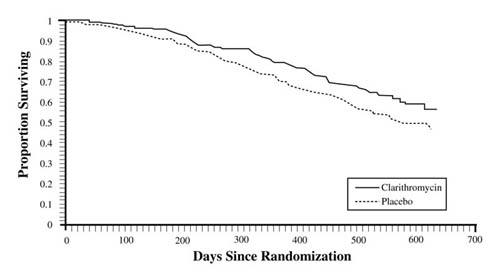
In AIDS patients treated with clarithromycin over long periods of time for prophylaxis against M. avium, it was often difficult to distinguish adverse events possibly associated with clarithromycin administration from underlying HIV disease or intercurrent illness. Median duration of treatment was 10.6 months for the clarithromycin group and 8.2 months for the placebo group.
Body System‡ | Clarithromycin | Placebo |
Body as a Whole |
|
|
Abdominal pain | 5.0% | 3.5% |
Headache | 2.7% | 0.9% |
Digestive |
|
|
Diarrhea | 7.7% | 4.1% |
Dyspepsia | 3.8% | 2.7% |
Flatulence | 2.4% | 0.9% |
Nausea | 11.2% | 7.1% |
Vomiting | 5.9% | 3.2% |
Skin & Appendages |
|
|
Rash | 3.2% | 3.5% |
Special Senses |
|
|
Taste Perversion | 8.0% | 0.3% |
* Includes those events possibly or probably related to study drug and excludes concurrent conditions. | ||
Among these events, taste perversion was the only event that had significantly higher incidence in the clarithromycin-treated group compared to the placebo-treated group.
Discontinuation due to adverse events was required in 18% of patients receiving clarithromycin compared to 17% of patients receiving placebo in this trial. Primary reasons for discontinuation in clarithromycin treated patients include headache, nausea, vomiting, depression and taste perversion.
Changes in Laboratory Values of Potential Clinical Importance
In immunocompromised patients receiving prophylaxis against M. avium, evaluations of laboratory values were made by analyzing those values outside the seriously abnormal value (i.e., the extreme high or low limit) for the specified test.
| Clarithromycin | Placebo | |
Hemoglobin | < 8 g/dL | 4/118 3% | 5/103 5% |
Platelet Count | < 50 x 109/L | 11/249 4% | 12/250 5% |
WBC Count | < 1 x 10⁹/L | 2/103 4% | 0/95 0% |
SGOT | > 5 x ULN(b) | 7/196 4% | 5/208 2% |
SGPT | > 5 x ULN(b) | 6/217 3% | 4/232 2% |
Alk. Phos. | > 5 x ULN(b) | 5/220 2% | 5/218 2% |
(a) Includes only patients with baseline values within the normal range or borderline high (hematology variables) and within the normal range or borderline low (chemistry variables). | |||
H. pylori Eradication for Reducing the Risk of Duodenal Ulcer Recurrence
Two U.S. randomized, double-blind clinical studies in patients with H. pylori and duodenal ulcer disease (defined as an active ulcer or history of an active ulcer within one year) evaluated the efficacy of clarithromycin in combination with lansoprazole and amoxicillin capsules as triple 14-day therapy for eradication of H. pylori. Based on the results of these studies, the safety and efficacy of the following eradication regimen were established:
Triple therapy: clarithromycin 500 mg b.i.d. + lansoprazole 30 mg b.i.d. + amoxicillin 1 gm b.i.d.
Treatment was for 14 days. H. pylori eradication was defined as two negative tests (culture and histology) at 4 to 6 weeks following the end of treatment.
The combination of clarithromycin plus lansoprazole and amoxicillin as triple therapy was effective in eradicating H. pylori. Eradication of H. pylori has been shown to reduce the risk of duodenal ulcer recurrence.
A randomized, double-blind clinical study performed in the U.S. in patients with H. pylori and duodenal ulcer disease (defined as an active ulcer or history of an ulcer within one year) compared the efficacy of clarithromycin in combination with lansoprazole and amoxicillin as triple therapy for 10 and 14 days. This study established that the 10-day triple therapy was equivalent to the 14-day triple therapy in eradicating H. pylori.
Study | Duration | Triple Therapy | Triple Therapy |
M93-131 | 14 days | 92† [80.0-97.7] | 86† [73.3-93.5] |
M95-392 | 14 days | 86‡ [75.7-93.6] | 83‡ [72.0-90.8] |
M95-399¶ | 14 days | 85 [77.0-91.0] | 82 [73.9-88.1] |
| 10 days | 84 [76.0-89.8] | 81 [73.9-87.6] |
* Based on evaluable patients with confirmed duodenal ulcer (active or within one year) and H. pylori infection at baseline defined as at least two of three positive endoscopic tests from CLOtest (Delta West LTD., Bentley, Australia), histology, and/or culture. Patients were included in the analysis if they completed the study. Additionally, if patients were dropped out of the study due to an adverse event related to the study drug, they were included in the analysis as evaluable failures of therapy. ¶ The 95% confidence interval for the difference in eradication rates, 10-day minus 14-day, is (-10.5, 8.1) in the evaluable analysis and (-9.7, 9.1) in the intent-to-treat analysis. | |||
H. pylori Eradication for Reducing the Risk of Duodenal Ulcer Recurrence
Three U.S., randomized, double-blind clinical studies in patients with H. pylori infection and duodenal ulcer disease (n = 558) compared clarithromycin plus omeprazole and amoxicillin to clarithromycin plus amoxicillin. Two studies (Studies 126 and 127) were conducted in patients with an active duodenal ulcer, and the third study (Study 446) was conducted in patients with a duodenal ulcer in the past 5 years, but without an ulcer present at the time of enrollment. The dosage regimen in the studies was clarithromycin 500 mg b.i.d. plus omeprazole 20 mg b.i.d. plus amoxicillin 1 gram b.i.d. for 10 days. In Studies 126 and 127, patients who took the omeprazole regimen also received an additional 18 days of omeprazole 20 mg q.d. Endpoints studied were eradication of H. pylori and duodenal ulcer healing (studies 126 and 127 only). H. pylori status was determined by CLOtest®, histology, and culture in all three studies. For a given patient, H. pylori was considered eradicated if at least two of these tests were negative, and none was positive. The combination of clarithromycin plus omeprazole and amoxicillin was effective in eradicating H. pylori.
| Clarithromycin + omeprazole + amoxicillin | Clarithromycin + amoxicillin | ||
| Per-Protocol † | Intent-to-Treat ‡ | Per-Protocol † | Intent-to-Treat ‡ |
Study 126 | *77 [64, 86] | 69 [57, 79] | 43 [31, 56] | 37 [27, 48] |
Study 127 | *78 [67, 88] | 73 [61, 82] | 41 [29, 54] | 36 [26, 47] |
Study M96-446 | *90 [80, 96] | 83 [74, 91] | 33 [24, 44] | 32 [23, 42] |
† Patients were included in the analysis if they had confirmed duodenal ulcer disease (active ulcer studies 126 and 127; history of ulcer within 5 years, study M96-446) and H. pylori infection at baseline defined as at least two of three positive endoscopic tests from CLOtest®, histology, and/or culture. Patients were included in the analysis if they completed the study. Additionally, if patients dropped out of the study due to an adverse event related to the study drug, they were included in the analysis as failures of therapy. The impact of eradication on ulcer recurrence has not been assessed in patients with a past history of ulcer. | ||||
Eradication of H. pylori Associated with Duodenal Ulcer
The combination of clarithromycin and omeprazole was effective in eradicating H. pylori.
Study | Clarithromycin + Omeprazole | Omeprazole | Clarithromycin |
U.S. Studies | |||
Study 100 | 64% (39/61)†‡ | 0% (0/59) | 39% (17/44) |
Study 067 | 74% (39/53)†‡ | 0% (0/54) | 31% (13/42) |
Non-U.S. Studies | |||
Study 058 | 74% (64/86)‡ | 1% (1/90) | N/A |
Study 812b | 83% (50/60)‡ | 1% (1/74) | N/A |
† Statistically significantly higher than clarithromycin monotherapy (p < 0.05). | |||
H. pylori eradication was defined as no positive test (culture or histology) at 4 weeks following the end of treatment, and two negative tests were required to be considered eradicated. In the per-protocol analysis, the following patients were excluded: dropouts, patients with major protocol violations, patients with missing H. pylori tests post-treatment, and patients that were not assessed for H. pylori eradication at 4 weeks after the end of treatment because they were found to have an unhealed ulcer at the end of treatment.
Ulcer recurrence at 6-months following the end of treatment was assessed for patients in whom ulcers were healed post-treatment.
| H. pylori Negative | H. pylori Positive | |
U.S. Studies | |||
Study 100 |
|
|
|
Clarithromycin + Omeprazole | 6% (2/34) | 56% (9/16) | |
Omeprazole | - (0/0) | 71% (35/49) | |
Clarithromycin | 12% (2/17) | 32% (7/22) | |
Study 067 |
|
| |
Clarithromycin + Omeprazole | 38% (11/29) | 50% (6/12) | |
Omeprazole | - (0/0) | 67% (31/46) | |
Clarithromycin | 18% (2/11) | 52% (14/27) | |
Non-U.S. Studies | |||
Study 058 |
|
|
|
Clarithromycin + Omeprazole | 6% (3/53) | 24% (4/17) | |
Omeprazole | 0% (0/3) | 55% (39/71) | |
Study 812b* |
|
| |
Clarithromycin + Omeprazole | 5% (2/42) | 0% (0/7) | |
Omeprazole | 0% (0/1) | 54% (32/59) | |
*12-month recurrence rates: |
|
| |
Clarithromycin + Omeprazole | 3% (1/40) | 0% (0/6) | |
Omeprazole | 0% (0/1) | 67% (29/43) | |
Thus, in patients with duodenal ulcer associated with H. pylori infection, eradication of H. pylori reduced ulcer recurrence.
Clarithromycin + Ranitidine Bismuth Citrate Therapy
In a U.S. double-blind, randomized, multicenter, dose-comparison trial, ranitidine bismuth citrate 400 mg b.i.d. for 4 weeks plus clarithromycin 500 mg b.i.d. for the first 2 weeks was found to have an equivalent H. pylori eradication rate (based on culture and histology) when compared to ranitidine bismuth citrate 400 mg b.i.d. for 4 weeks plus clarithromycin 500 mg t.i.d. for the first 2 weeks. The intent-to-treat H. pylori eradication rates are shown below:
Analysis | RBC 400 mg + Clarithromycin | RBC 400 mg + Clarithromycin | 95% CI Rate Difference |
ITT | 65% (122/188) | 63% (122/195) | (-8%, 12%) |
Per-Protocol | 72% (117/162) | 71% (120/170) | (-9%, 12%) |
H. pylori eradication was defined as no positive test at 4 weeks following the end of treatment. Patients must have had two tests performed, and these must have been negative to be considered eradicated of H. pylori. The following patients were excluded from the per-protocol analysis: patients not infected with H. pylori prestudy, dropouts, patients with major protocol violations, patients with missing H. pylori tests. Patients excluded from the intent-to-treat analysis included those not infected with H. pylori prestudy and those with missing H. pylori tests prestudy. Patients were assessed for H. pylori eradication (4 weeks following treatment) regardless of their healing status (at the end of treatment).
The relationship between H. pylori eradication and duodenal ulcer recurrence was assessed in a combined analysis of six U.S. randomized, double-blind, multicenter, placebo-controlled trials using ranitidine bismuth citrate with or without antibiotics. The results from approximately 650 U.S. patients showed that the risk of ulcer recurrence within 6 months of completing treatment was two times less likely in patients whose H. pylori infection was eradicated compared to patients in whom H. pylori infection was not eradicated.
Safety
In clinical trials using combination therapy with clarithromycin plus ranitidine bismuth citrate, no adverse reactions peculiar to the combination of these drugs (using clarithromycin twice daily or three times a day) were observed. Adverse reactions that have occurred have been limited to those reported with clarithromycin or ranitidine bismuth citrate (see ADVERSE REACTIONS section of the Tritec package insert.) The most frequent adverse experiences observed in clinical trials using combination therapy with clarithromycin (500 mg three times a day) with ranitidine bismuth citrate (n = 329) were taste disturbance (11%), diarrhea (5%), nausea and vomiting (3%). The most frequent adverse experiences observed in clinical trials using combination therapy with clarithromycin (500 mg twice daily) with ranitidine bismuth citrate (n = 196) were taste disturbance (8%), nausea and vomiting (5%), and diarrhea (4%).
Clarithromycin Tablets, USP
Manufactured by:

Logo (Logo0001 01)
Northern Industry Road 1#,
Song Shan Lake, DongGuan,
GuangDong Province, 523808,
P.R. China
Manufactured for:
Lannett Company, Inc.
Philadelphia, PA 19136
Repackaged by::
Proficient Rx LP
Thousand Oaks, CA 91320
Rev. 10/15 10-307
2431