Major Depressive Disorder — Duloxetine Delayed-release Capsules should be administered at a total dose of 40 mg/day (given as 20 mg twice daily) to 60 mg/day (given either once daily or as 30 mg twice daily). For some patients, it may be desirable to start at 30 mg once daily for 1 week, to allow patients to adjust to the medication before increasing to 60 mg once daily. While a 120 mg/day dose was shown to be effective, there is no evidence that doses greater than 60 mg/day confer any additional benefits. The safety of doses above 120 mg/day has not been adequately evaluated [see Clinical Studies (14.1)].
Generalized Anxiety Disorder — For most patients, the recommended starting dose for Duloxetine Delayed-release Capsules is 60 mg administered once daily. For some patients, it may be desirable to start at 30 mg once daily for 1 week, to allow patients to adjust to the medication before increasing to 60 mg once daily. While a 120 mg once daily dose was shown to be effective, there is no evidence that doses greater than 60 mg/day confer additional benefit. Nevertheless, if a decision is made to increase the dose beyond 60 mg once daily, dose increases should be in increments of 30 mg once daily. The safety of doses above 120 mg once daily has not been adequately evaluated [see Clinical Studies (14.2)].
Diabetic Peripheral Neuropathic Pain — The recommended dose for Duloxetine Delayed-release Capsules is 60 mg administered once daily. There is no evidence that doses higher than 60 mg confer additional significant benefit and the higher dose is clearly less well tolerated [see Clinical Studies (14.3)]. For patients for whom tolerability is a concern, a lower starting dose may be considered.
Since diabetes is frequently complicated by renal disease, a lower starting dose and gradual increase in dose should be considered for patients with renal impairment [see Dosage and Administration (2.3), Use in Specific Populations (8.10), and Clinical Pharmacology (12.3)].
Chronic Musculoskeletal Pain — The recommended dose for Duloxetine Delayed-release Capsules is 60 mg once daily. Dosing may be started at 30 mg for one week, to allow patients to adjust to the medication before increasing to 60 mg once daily. There is no evidence that higher doses confer additional benefit, even in patients who do not respond to a 60 mg dose, and higher doses are associated with a higher rate of adverse reactions [see Clinical Studies (14.5)].
Major Depressive Disorder — It is generally agreed that acute episodes of major depression require several months or longer of sustained pharmacologic therapy. Maintenance of efficacy in MDD was demonstrated with Duloxetine Delayed-release Capsules as monotherapy. Duloxetine Delayed-release Capsules should be administered at a total dose of 60 mg once daily. Patients should be periodically reassessed to determine the need for maintenance treatment and the appropriate dose for such treatment [see Clinical Studies (14.1)].
Generalized Anxiety Disorder — It is generally agreed that episodes of generalized anxiety disorder require several months or longer of sustained pharmacological therapy. Maintenance of efficacy in GAD was demonstrated with Duloxetine Delayed-release Capsules as monotherapy. Duloxetine Delayed-release Capsules should be administered in a dose range of 60-120 mg once daily. Patients should be periodically reassessed to determine the continued need for maintenance treatment and the appropriate dose for such treatment [see Clinical Studies (14.2)].
Diabetic Peripheral Neuropathic Pain — As the progression of diabetic peripheral neuropathy is highly variable and management of pain is empirical, the effectiveness of Duloxetine Delayed-release Capsules must be assessed individually. Efficacy beyond 12 weeks has not been systematically studied in placebo-controlled trials.
Chronic Musculoskeletal Pain — The efficacy of Duloxetine Delayed-release Capsules has not been established in placebo-controlled studies beyond 13 weeks.
Hepatic Insufficiency — It is recommended that Duloxetine Delayed-release Capsules should ordinarily not be administered to patients with any hepatic insufficiency [see Warnings and Precautions (5.13) and Use in Specific Populations (8.9)].
Severe Renal Impairment — Duloxetine Delayed-release Capsules are not recommended for patients with end-stage renal disease or severe renal impairment (estimated creatinine clearance <30 mL/min) [see Warnings and Precautions (5.13) and Use in Specific Populations (8.10)].
Elderly Patients — No dose adjustment is recommended for elderly patients on the basis of age. As with any drug, caution should be exercised in treating the elderly. When individualizing the dosage in elderly patients, extra care should be taken when increasing the dose [see Use in Specific Populations (8.5)].
Pregnant Women — There are no adequate and well-controlled studies in pregnant women; therefore, Duloxetine Delayed-release Capsules should be used during pregnancy only if the potential benefit justifies the potential risk to the fetus [see Use in Specific Populations (8.1)].
Nursing Mothers — Because the safety of duloxetine in infants is not known, nursing while on Duloxetine Delayed-release Capsules is not recommended [see Use in Specific Populations (8.3)].
Screening Patients for Bipolar Disorder — A major depressive episode may be the initial presentation of bipolar disorder. It is generally believed (though not established in controlled trials) that treating such an episode with an antidepressant alone may increase the likelihood of precipitation of a mixed/manic episode in patients at risk for bipolar disorder. Whether any of the symptoms described above represent such a conversion is unknown. However, prior to initiating treatment with an antidepressant, patients with depressive symptoms should be adequately screened to determine if they are at risk for bipolar disorder; such screening should include a detailed psychiatric history, including a family history of suicide, bipolar disorder, and depression. It should be noted that Duloxetine Delayed-release Capsules are not approved for use in treating bipolar depression.
Potential for Other Drugs to Affect Duloxetine Delayed-release Capsules
CYP1A2 Inhibitors — Co-administration of Duloxetine Delayed-release Capsules with potent CYP1A2 inhibitors should be avoided [see Drug Interactions (7.1)].
CYP2D6 Inhibitors — Because CYP2D6 is involved in duloxetine metabolism, concomitant use of duloxetine with potent inhibitors of CYP2D6 would be expected to, and does, result in higher concentrations (on average of 60%) of duloxetine [see Drug Interactions (7.2)].
Potential for Duloxetine Delayed-release Capsules to Affect Other Drugs
Drugs Metabolized by CYP2D6 — Co-administration of Duloxetine Delayed-release Capsules with drugs that are extensively metabolized by CYP2D6 and that have a narrow therapeutic index, including certain antidepressants (tricyclic antidepressants [TCAs], such as nortriptyline, amitriptyline, and imipramine), phenothiazines and Type 1C antiarrhythmics (e.g., propafenone, flecainide), should be approached with caution. Plasma TCA concentrations may need to be monitored and the dose of the TCA may need to be reduced if a TCA is co-administered with Duloxetine Delayed-release Capsules. Because of the risk of serious ventricular arrhythmias and sudden death potentially associated with elevated plasma levels of thioridazine, Duloxetine Delayed-release Capsules and thioridazine should not be co-administered [see Drug Interactions (7.9)].
Other Clinically Important Drug Interactions
Alcohol — Use of Duloxetine Delayed-release Capsules concomitantly with heavy alcohol intake may be associated with severe liver injury. For this reason, Duloxetine Delayed-release Capsules should not be prescribed for patients with substantial alcohol use [see Warnings and Precautions (5.2) and Drug Interactions (7.15)].
CNS Acting Drugs — Given the primary CNS effects of Duloxetine Delayed-release Capsules, it should be used with caution when it is taken in combination with or substituted for other centrally acting drugs, including those with a similar mechanism of action [see Warnings and Precautions (5.11) and Drug Interactions (7.16)].
Hepatic Insufficiency — Duloxetine Delayed-release Capsules should ordinarily not be used in patients with hepatic insufficiency [see Dosage and Administration (2.3), Warnings and Precautions (5.2), and Use in Specific Populations (8.9)].
Severe Renal Impairment — Duloxetine Delayed-release Capsules should ordinarily not be used in patients with end-stage renal disease or severe renal impairment (creatinine clearance <30 mL/min). Increased plasma concentration of duloxetine, and especially of its metabolites, occur in patients with end-stage renal disease (requiring dialysis) [see Dosage and Administration (2.3) and Use in Specific Populations (8.10)].
Controlled Narrow-Angle Glaucoma — In clinical trials, Duloxetine Delayed-release Capsules were associated with an increased risk of mydriasis; therefore, it should be used cautiously in patients with controlled narrow-angle glaucoma [see Contraindications (4.2)].
Glycemic Control in Patients with Diabetes — As observed in DPNP trials, Duloxetine Delayed-release Capsules treatment worsens glycemic control in some patients with diabetes. In three clinical trials of Duloxetine Delayed-release Capsules for the management of neuropathic pain associated with diabetic peripheral neuropathy, the mean duration of diabetes was approximately 12 years, the mean baseline fasting blood glucose was 176 mg/dL, and the mean baseline hemoglobin A1c (HbA1c) was 7.8%. In the 12-week acute treatment phase of these studies, Duloxetine Delayed-release Capsules was associated with a small increase in mean fasting blood glucose as compared to placebo. In the extension phase of these studies, which lasted up to 52 weeks, mean fasting blood glucose increased by 12 mg/dL in the Duloxetine Delayed-release Capsules group and decreased by 11.5 mg/dL in the routine care group. HbA1c increased by 0.5% in the Duloxetine Delayed-release Capsules and by 0.2% in the routine care groups.
Major Depressive Disorder — Approximately 9% (209/2327) of the patients who received duloxetine in placebo-controlled trials for MDD discontinued treatment due to an adverse reaction, compared with 4.7% (68/1460) of the patients receiving placebo. Nausea (duloxetine 1.3%, placebo 0.5%) was the only common adverse reaction reported as a reason for discontinuation and considered to be drug-related (i.e., discontinuation occurring in at least 1% of the duloxetine-treated patients and at a rate of at least twice that of placebo).
Generalized Anxiety Disorder — Approximately 15.3% (102/668) of the patients who received duloxetine in placebo-controlled trials for GAD discontinued treatment due to an adverse reaction, compared with 4.0% (20/495) for placebo. Common adverse reactions reported as a reason for discontinuation and considered to be drug-related (as defined above) included nausea (duloxetine 3.7%, placebo 0.2%), and vomiting (duloxetine 1.3%, placebo 0.0%), and dizziness (duloxetine 1.0%, placebo 0.2%).
Diabetic Peripheral Neuropathic Pain — Approximately 12.9% (117/906) of the patients who received duloxetine in placebo-controlled trials for DPNP discontinued treatment due to an adverse reaction, compared with 5.1% (23/448) for placebo. Common adverse reactions reported as a reason for discontinuation and considered to be drug-related (as defined above) included nausea (duloxetine 3.5%, placebo 0.7%), dizziness (duloxetine 1.2%, placebo 0.4%), and somnolence (duloxetine 1.1%, placebo 0.0%).
Chronic Pain due to Osteoarthritis — Approximately 16.3% (39/239) of the patients who received duloxetine in 13-week, placebo-controlled trials for chronic pain due to OA discontinued treatment due to an adverse reaction, compared with 5.6% (14/248) for placebo. Common adverse reactions reported as a reason for discontinuation and considered to be drug-related (as defined above) included nausea (duloxetine 2.9%, placebo 0.8%) and asthenia (duloxetine 1.3%, placebo 0.0%).
Chronic Low Back Pain — Approximately 16.5% (99/600) of the patients who received duloxetine in 13-week, placebo-controlled trials for CLBP discontinued treatment due to an adverse reaction, compared with 6.3% (28/441) for placebo. Common adverse reactions reported as a reason for discontinuation and considered to be drug-related (as defined above) included nausea (duloxetine 3.0%, placebo 0.7%), and somnolence (duloxetine 1.0%, placebo 0.0%).
Pooled Trials for all Approved Indications — The most commonly observed adverse reactions in Duloxetine Delayed-release Capsules-treated patients (incidence of at least 5% and at least twice the incidence in placebo patients) were nausea, dry mouth, somnolence, constipation, decreased appetite, and hyperhidrosis.
Diabetic Peripheral Neuropathic Pain — The most commonly observed adverse reactions in Duloxetine Delayed-release Capsules-treated patients (as defined above) were nausea, somnolence, decreased appetite, constipation, hyperhidrosis, and dry mouth.
Chronic Pain due to Osteoarthritis — The most commonly observed adverse reactions in Duloxetine Delayed-release Capsules -treated patients (as defined above) were nausea, fatigue, and constipation.
Chronic Low Back Pain — The most commonly observed adverse reactions in Duloxetine Delayed-release Capsules-treated patients (as defined above) were nausea, dry mouth, insomnia, somnolence, constipation, dizziness, and fatigue.
Pooled MDD and GAD Trials — Table 3 gives the incidence of treatment-emergent adverse reactions in MDD and GAD placebo-controlled trials for approved indications that occurred in 2% or more of patients treated with duloxetine and with an incidence greater than placebo.
Table 3: Treatment-Emergent Adverse Reactions: Incidence of 2% or More in MDD and GAD Placebo-Controlled TrialsThe inclusion of an event in the table is determined based on the percentages before rounding; however, the percentages displayed in the table are rounded to the nearest integer.
| System Organ Class / Adverse Reaction | Percentage of Patients Reporting Reaction |
|---|
| Duloxetine Delayed-release Capsules (N=2995) | Placebo (N=1955) |
|---|
Cardiac Disorders | | |
Palpitations | 2 | 2 |
Eye Disorders | | |
Vision blurred | 3 | 2 |
Gastrointestinal Disorders | | |
Nausea | 25 | 9 |
Dry mouth | 15 | 6 |
Diarrhea | 10 | 7 |
Constipation Events for which there was a significant dose-dependent relationship in fixed-dose studies, excluding three MDD studies which did not have a placebo lead-in period or dose titration. | 10 | 4 |
Abdominal pain Also includes abdominal pain upper, abdominal pain lower, abdominal tenderness, abdominal discomfort, and gastrointestinal pain | 4 | 4 |
Vomiting | 5 | 2 |
General Disorders and Administration Site Conditions | | |
Fatigue Also includes asthenia | 10 | 6 |
Investigations | | |
Weight decreased | 2 | <1 |
Metabolism and Nutrition Disorders | | |
Decreased appetite Also includes anorexia | 7 | 2 |
Nervous System Disorders | | |
Dizziness | 10 | 6 |
Somnolence Also includes hypersomnia and sedation | 10 | 4 |
Tremor | 3 | <1 |
Psychiatric Disorders | | |
Insomnia Also includes middle insomnia, early morning awakening and initial insomnia | 10 | 6 |
Agitation Also includes feeling jittery, nervousness, restlessness, tension and psychomotor agitation | 5 | 3 |
Anxiety | 3 | 2 |
Libido decreased Also includes loss of libido | 4 | 1 |
Orgasm abnormal, Also includes anorgasmia | 3 | <1 |
Abnormal dreams Also includes nightmare | 2 | 1 |
Reproductive System and Breast Disorders | | |
Erectile dysfunction Male patients only | 4 | 1 |
Ejaculation delayed, | 3 | <1 |
Ejaculation disorder, Also includes ejaculation failure and ejaculation dysfunction | 2 | <1 |
Respiratory, Thoracic, and Mediastinal Disorders | | |
Yawning | 2 | <1 |
Skin and Subcutaneous Tissue Disorders | | |
Hyperhidrosis | 6 | 2 |
Vascular Disorders | | |
Hot flush | 2 | <1 |
DPNP, FM, OA, and CLBP — Table 4 gives the incidence of treatment-emergent adverse events that occurred in 2% or more of patients treated with Duloxetine Delayed-release Capsules (determined prior to rounding) in the premarketing acute phase of DPNP, FM, OA, and CLBP placebo-controlled trials and with an incidence greater than placebo.
Table 4: Treatment-Emergent Adverse Reactions: Incidence of 2% or More in DPNP, FM, OA, and CLBP Placebo-Controlled TrialsThe inclusion of an event in the table is determined based on the percentages before rounding; however, the percentages displayed in the table are rounded to the nearest integer.
| System Organ Class / Adverse Reaction | Percentage of Patients Reporting Reaction |
|---|
| Duloxetine Delayed-release Capsules (N=2621) | Placebo (N=1672) |
|---|
Gastrointestinal Disorders | | |
Nausea | 23 | 7 |
Dry Mouth Incidence of 120 mg/day is significantly greater than the incidence for 60 mg/day. | 11 | 3 |
Constipation | 10 | 3 |
Diarrhea | 9 | 6 |
Abdominal Pain Also includes abdominal discomfort, abdominal pain lower, abdominal pain upper, abdominal tenderness and gastrointestinal pain | 6 | 5 |
Vomiting | 3 | 2 |
Dyspepsia Also includes stomach discomfort | 2 | 1 |
General Disorders and Administration Site Conditions | | |
Fatigue Also includes asthenia | 11 | 5 |
Infections and Infestations | | |
Nasopharyngitis | 5 | 4 |
Upper Respiratory Tract Infection | 4 | 4 |
Influenza | 3 | 2 |
Metabolism and Nutrition Disorders | | |
Decreased Appetite, Also includes anorexia | 9 | 1 |
Musculoskeletal and Connective Tissue | | |
Musculoskeletal Pain, Also includes myalgia and neck pain | 4 | 4 |
Muscle Spasms | 3 | 2 |
Nervous System Disorders | | |
Headache | 13 | 9 |
Somnolence, Also includes hypersomnia and sedation | 12 | 3 |
Dizziness | 10 | 5 |
Paraesthesia Also includes hypoaesthesia, hypoaesthesia facial and paraesthesia oral | 2 | 2 |
Tremor | 2 | <1 |
Psychiatric Disorders | | |
Insomnia, Also includes middle insomnia, early morning awakening and initial insomnia | 10 | 6 |
Agitation Also includes feeling jittery, nervousness, restlessness, tension and psychomotor hyperactivity | 3 | <1 |
Reproductive System and Breast Disorders | | |
Erectile Dysfunction, Male patients only (N=885 for duloxetine, 494 for placebo) | 4 | <1 |
Ejaculation Disorder Male patients only (N=885 for duloxetine, 494 for placebo). Also includes ejaculation failure | 2 | <1 |
Respiratory, Thoracic, and Mediastinal Disorders | | |
Cough | 3 | 2 |
Oropharyngeal Pain | 2 | 2 |
Skin and Subcutaneous Tissue Disorders | | |
Hyperhidrosis | 6 | 1 |
Vascular Disorders | | |
Flushing Also includes hot flush | 3 | 1 |
Absorption and Distribution — Orally administered duloxetine is well absorbed. There is a median 2 hour lag until absorption begins (Tlag), with maximal plasma concentrations (Cmax) of duloxetine occurring 6 hours post dose. Food does not affect the Cmax of duloxetine, but delays the time to reach peak concentration from 6 to 10 hours and it marginally decreases the extent of absorption (AUC) by about 10%. There is a 3 hour delay in absorption and a one-third increase in apparent clearance of duloxetine after an evening dose as compared to a morning dose.
The apparent volume of distribution averages about 1640 L. Duloxetine is highly bound (>90%) to proteins in human plasma, binding primarily to albumin and α1-acid glycoprotein. The interaction between duloxetine and other highly protein bound drugs has not been fully evaluated. Plasma protein binding of duloxetine is not affected by renal or hepatic impairment.
Metabolism and Elimination — Biotransformation and disposition of duloxetine in humans have been determined following oral administration of 14C-labeled duloxetine. Duloxetine comprises about 3% of the total radiolabeled material in the plasma, indicating that it undergoes extensive metabolism to numerous metabolites. The major biotransformation pathways for duloxetine involve oxidation of the naphthyl ring followed by conjugation and further oxidation. Both CYP1A2 and CYP2D6 catalyze the oxidation of the naphthyl ring in vitro. Metabolites found in plasma include 4-hydroxy duloxetine glucuronide and 5-hydroxy, 6-methoxy duloxetine sulfate. Many additional metabolites have been identified in urine, some representing only minor pathways of elimination. Only trace (<1% of the dose) amounts of unchanged duloxetine are present in the urine. Most (about 70%) of the duloxetine dose appears in the urine as metabolites of duloxetine; about 20% is excreted in the feces. Duloxetine undergoes extensive metabolism, but the major circulating metabolites have not been shown to contribute significantly to the pharmacologic activity of duloxetine.
Carcinogenesis — Duloxetine was administered in the diet to mice and rats for 2 years.
In female mice receiving duloxetine at 140 mg/kg/day (11 times the maximum recommended human dose [MRHD, 60 mg/day] and 6 times the human dose of 120 mg/day on a mg/m2 basis), there was an increased incidence of hepatocellular adenomas and carcinomas. The no-effect dose was 50 mg/kg/day (4 times the MRHD and 2 times the human dose of 120 mg/day on a mg/m2 basis). Tumor incidence was not increased in male mice receiving duloxetine at doses up to 100 mg/kg/day (8 times the MRHD and 4 times the human dose of 120 mg/day on a mg/m2 basis).
In rats, dietary doses of duloxetine up to 27 mg/kg/day in females (4 times the MRHD and 2 times the human dose of 120 mg/day on a mg/m2 basis) and up to 36 mg/kg/day in males (6 times the MRHD and 3 times the human dose of 120 mg/day on a mg/m2 basis) did not increase the incidence of tumors.
Mutagenesis — Duloxetine was not mutagenic in the in vitro bacterial reverse mutation assay (Ames test) and was not clastogenic in an in vivo chromosomal aberration test in mouse bone marrow cells. Additionally, duloxetine was not genotoxic in an in vitro mammalian forward gene mutation assay in mouse lymphoma cells or in an in vitro unscheduled DNA synthesis (UDS) assay in primary rat hepatocytes, and did not induce sister chromatid exchange in Chinese hamster bone marrow in vivo.
Impairment of Fertility — Duloxetine administered orally to either male or female rats prior to and throughout mating at doses up to 45 mg/kg/day (7 times the maximum recommended human dose of 60 mg/day and 4 times the human dose of 120 mg/day on a mg/m2 basis) did not alter mating or fertility.
Studies in Chronic Low Back Pain —
The efficacy of Duloxetine Delayed-release Capsules in chronic low back pain (CLBP) was assessed in two double-blind, placebo-controlled, randomized clinical trials of 13-weeks duration (Study CLBP-1 and Study CLBP-2), and one of 12-weeks duration (CLBP-3). CLBP-1 and CLBP-3 demonstrated efficacy of Duloxetine Delayed-release Capsules in the treatment of chronic low back pain. Patients in all studies had no signs of radiculopathy or spinal stenosis.
Study CLBP-1: Two hundred thirty-six adult patients (N=115 on Duloxetine Delayed-release Capsules, N=121 on placebo) enrolled and 182 (77%) completed 13-week treatment phase. After 7 weeks of treatment, Duloxetine Delayed-release Capsules patients with less than 30% reduction in average daily pain and who were able to tolerate duloxetine 60 mg once daily had their dose of Duloxetine Delayed-release Capsules, in a double-blinded fashion, increased to 120 mg once daily for the remainder of the study. Patients had a mean baseline pain rating of 6 on a numerical rating scale ranging from 0 (no pain) to 10 (worst possible pain). After 13 weeks of treatment, patients taking Duloxetine Delayed-release Capsules 60-120 mg daily had a significantly greater pain reduction compared to placebo. Randomization was stratified by the patients' baseline NSAIDs-use status. Subgroup analyses did not indicate that there were differences in treatment outcomes as a function of NSAIDs use.
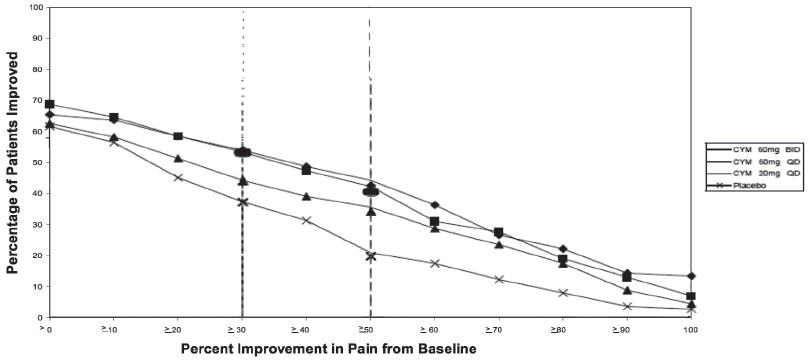
Study CLBP-2: Four hundred and four patients were randomized to receive fixed doses of Duloxetine Delayed-release Capsules daily or a matching placebo (N=59 on Duloxetine Delayed-release Capsules 20 mg, N=116 on Duloxetine Delayed-release Capsules 60 mg, N=112 on Duloxetine Delayed-release Capsules 120 mg, N=117 on placebo) and 267 (66%) completed the entire 13-week study. After 13 weeks of treatment, none of the three Duloxetine Delayed-release Capsules doses showed a statistically significant difference in pain reduction compared to placebo.
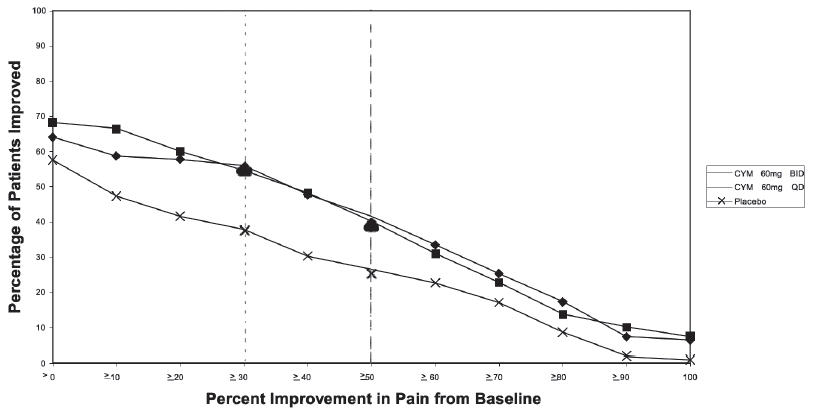
Study CLBP-3: Four hundred and one patients were randomized to receive fixed doses of Duloxetine Delayed-release Capsules 60 mg daily or placebo (N=198 on Duloxetine Delayed-release Capsules, N=203 on placebo), and 303 (76%) completed the study. Patients had a mean baseline pain rating of 6 on a numerical rating scale ranging from 0 (no pain) to 10 (worst possible pain). After 12 weeks of treatment, patients taking Duloxetine Delayed-release Capsules 60 mg daily had significantly greater pain reduction compared to placebo.
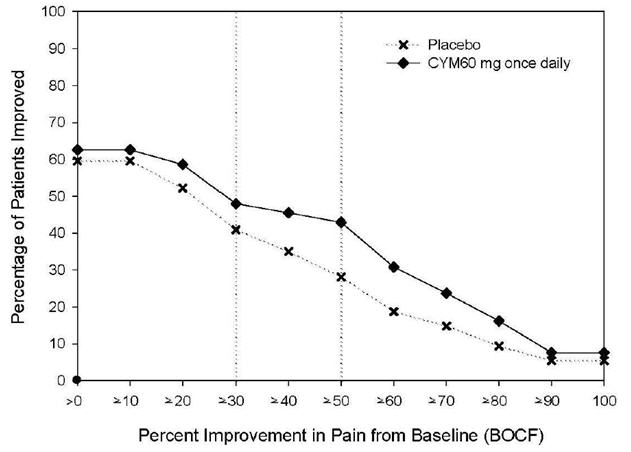
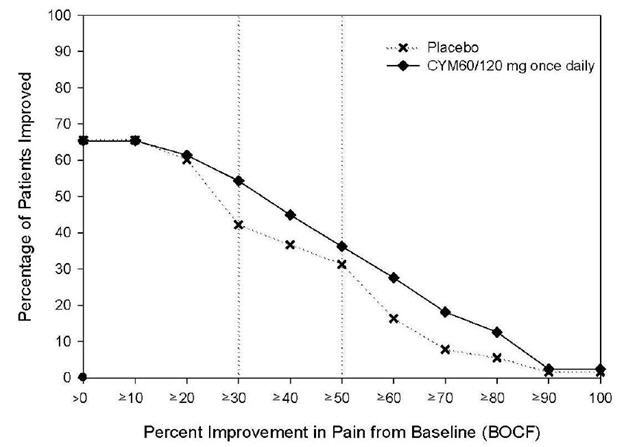
For various degrees of improvement in pain from baseline to study endpoint, Figures 3 and 4 show the fraction of patients in CLBP-1 and CLBP-3 achieving that degree of improvement. The figures are cumulative, so that patients whose change from baseline is, for example, 50%, are also included at every level of improvement below 50%. Patients who did not complete the study were assigned the value of 0% improvement.
Figure 3: Percentage of Patients Achieving Various Levels of Pain Relief as Measured by 24-Hour Average Pain Severity – CLBP-1
Figure 4: Percentage of Patients Achieving Various Levels of Pain Relief as Measured by 24-Hour Average Pain Severity – CLBP-3
Studies in Chronic Pain Due to Osteoarthritis —
The efficacy of Duloxetine Delayed-release Capsules in chronic pain due to osteoarthritis was assessed in 2 double-blind, placebo-controlled, randomized clinical trials of 13-weeks duration (Study OA-1 and Study OA-2). All patients in both studies fulfilled the ACR clinical and radiographic criteria for classification of idiopathic osteoarthritis of the knee. Randomization was stratified by the patients' baseline NSAIDs-use status. Patients assigned to Duloxetine Delayed-release Capsules started treatment in both studies at a dose of 30 mg once daily for one week. After the first week, the dose of Duloxetine Delayed-release Capsules was increased to 60 mg once daily. After 7 weeks of treatment with Duloxetine Delayed-release Capsules 60 mg once daily, in OA-1 patients with sub-optimal response to treatment (<30% pain reduction) and tolerated duloxetine 60 mg once daily had their dose increased to 120 mg. However, in OA-2, all patients, regardless of their response to treatment after 7 weeks, were re-randomized to either continue receiving Duloxetine Delayed-release Capsules 60 mg once daily or have their dose increased to 120 mg once daily for the remainder of the study. Patients in the placebo treatment groups in both studies received a matching placebo for the entire duration of studies. For both studies, efficacy analyses were conducted using 13-week data from the combined Duloxetine Delayed-release Capsules 60 mg and 120 mg once daily treatment groups compared to the placebo group.
Study OA-1: Two hundred fifty-six patients (N=128 on Duloxetine Delayed-release Capsules, N=128 on placebo) enrolled and 204 (80%) completed the study. Patients had a mean baseline pain rating of 6 on a numerical rating scale ranging from 0 (no pain) to 10 (worst possible pain). After 13 weeks of treatment, patients taking Duloxetine Delayed-release Capsules had significantly greater pain reduction. Subgroup analyses did not indicate that there were differences in treatment outcomes as a function of NSAIDs use.
Study OA-2: Two hundred thirty-one patients (N=111 on Duloxetine Delayed-release Capsules, N=120 on placebo) enrolled and 173 (75%) completed the study. Patients had a mean baseline pain of 6 on a numerical rating scale ranging from 0 (no pain) to 10 (worst possible pain). After 13 weeks of treatment, patients taking Duloxetine Delayed-release Capsules did not show a significantly greater pain reduction.
In Study OA-1, for various degrees of improvement in pain from baseline to study endpoint, Figure 5 shows the fraction of patients achieving that degree of improvement. The figure is cumulative, so that patients whose change from baseline is, for example, 50%, are also included at every level of improvement below 50%. Patients who did not complete the study were assigned the value of 0% improvement.
Figure 5: Percentage of Patients Achieving Various Levels of Pain Relief as Measured by 24-Hour Average Pain Severity – OA-1
Revised: 06/2014
Manufactured for:
Breckenridge Pharmaceutical, Inc.,
Boca Raton, FL 33487
Manufactured by:
Laboratorios Dr. Esteve, S.A.,
Martorelles (Barcelona), Spain
Repackaged by:
Proficient Rx LP
Thousand Oaks, CA 91320
706454-04