The LIFE study was a multinational, double-blind study comparing losartan potassium and atenolol in 9193 hypertensive patients with ECG-documented left ventricular hypertrophy. Patients with myocardial infarction or stroke within six months prior to randomization were excluded. Patients were randomized to receive once daily losartan potassium 50 mg or atenolol 50 mg. If goal blood pressure (<140/90 mmHg) was not reached, hydrochlorothiazide (12.5 mg) was added first and, if needed, the dose of losartan potassium or atenolol was then increased to 100 mg once daily. If necessary, other antihypertensive treatments (e.g., increase in dose of hydrochlorothiazide therapy to 25 mg or addition of other diuretic therapy, calcium-channel blockers, alpha-blockers, or centrally acting agents, but not ACE inhibitors, angiotensin II antagonists, or beta-blockers) were added to the treatment regimen to reach the goal blood pressure.
Of the randomized patients, 4963 (54%) were female and 533 (6%) were Black. The mean age was 67 with 5704 (62%) age ≥65. At baseline, 1195 (13%) had diabetes, 1326 (14%) had isolated systolic hypertension, 1469 (16%) had coronary heart disease, and 728 (8%) had cerebrovascular disease. Baseline mean blood pressure was 174/98 mmHg in both treatment groups. The mean length of follow-up was 4.8 years. At the end of study or at the last visit before a primary endpoint, 77% of the group treated with losartan potassium and 73% of the group treated with atenolol were still taking study medication. Of the patients still taking study medication, the mean doses of losartan potassium and atenolol were both about 80 mg/day, and 15% were taking atenolol or losartan as monotherapy, while 77% were also receiving hydrochlorothiazide (at a mean dose of 20 mg/day in each group). Blood pressure reduction measured at trough was similar for both treatment groups but blood pressure was not measured at any other time of the day. At the end of study or at the last visit before a primary endpoint, the mean blood pressures were 144.1/81.3 mmHg for the group treated with losartan potassium and 145.4/80.9 mmHg for the group treated with atenolol; the difference in systolic blood pressure (SBP) of 1.3 mmHg was significant (p<0.001), while the difference of 0.4 mmHg in diastolic blood pressure (DBP) was not significant (p=0.098).
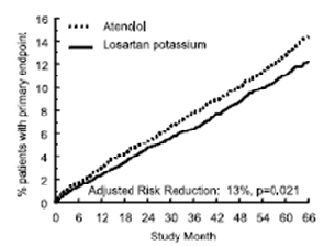
The primary endpoint was the first occurrence of cardiovascular death, nonfatal stroke, or nonfatal myocardial infarction. Patients with nonfatal events remained in the trial, so that there was also an examination of the first event of each type even if it was not the first event (e.g., a stroke following an initial myocardial infarction would be counted in the analysis of stroke). Treatment with losartan potassium resulted in a 13% reduction (p=0.021) in risk of the primary endpoint compared to the atenolol group (see Figure 1 and Table 3); this difference was primarily the result of an effect on fatal and nonfatal stroke. Treatment with losartan potassium reduced the risk of stroke by 25% relative to atenolol (p=0.001) (see Figure 2 and Table 3).
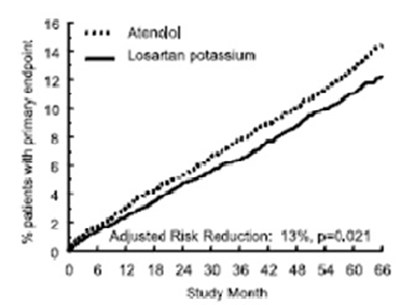
Losartanfigure1 (Losartanfigure1)
Figure 1: Kaplan-Meier estimates of the primary endpoint of time to cardiovascular death, nonfatal stroke, or nonfatal myocardial infarction in the groups treated with losartan potassium and atenolol. The Risk Reduction is adjusted for baseline Framingham risk score and level of electrocardiographic left ventricular hypertrophy.

Losartanfigure2 (Losartanfigure2)
Figure 2: Kaplan-Meier estimates of the time to fatal/nonfatal stroke in the groups treated with losartan potassium and atenolol. The Risk Reduction is adjusted for baseline Framingham risk score and level of electrocardiographic left ventricular hypertrophy.
Table 3 shows the results for the primary composite endpoint and the individual endpoints. The primary endpoint was the first occurrence of stroke, myocardial infarction or cardiovascular death, analyzed using an ITT approach. The table shows the number of events for each component in two different ways. The Components of Primary Endpoint (as a first event) counts only the events that define the primary endpoint, while the Secondary Endpoints count all first events of a particular type, whether or not they were preceded by a different type of event.
Table 3: Incidence of Primary Endpoint Events
|
Losartan Potassium
|
Atenolol
| Risk Reduction
†
|
95% CI
|
p-Value
|
| N (%)
| Rate*
| N (%)
| Rate*
|
|
|
|
Primary Composite Endpoint
| 508
(11)
| 23.8
| 588 (13)
| 27.9
| 13%
| 2% to 23%
| 0.021
|
Components of Primary Composite Endpoint (as a first event)
|
|
Stroke (nonfatal)
| 209 (5)
|
| 286 (6)
|
|
|
|
|
Myocardial infarction (nonfatal
| 174 (4)
|
| 168 (4)
|
|
|
|
|
Cardiovascular mortality
| 125 (3)
|
| 134 (3)
|
|
|
|
|
Secondary Endpoints (any time in study)
|
|
Stroke (fatal/nonfatal)
| 232 (5)
| 10.8
| 309 (7)
| 14.5
| 25%
| 11% to 37%
| 0.001
|
Myocardial infarction (fatal/nonfatal)
| 198 (4)
| 9.2
| 188 (4)
| 8.7
| -7%
| -13% to 12%
| 0.491
|
Cardiovascular mortality
| 204 (4)
| 9.2
| 234 (5)
| 10.6
| 11%
| -7% to
27%
| 0.206
|
Due to CHD
| 125 (3)
| 5.6
| 124 (3)
| 5.6
| -3%
| -32% to
20%
| 0.839
|
Due to Stroke
| 40 (1)
| 1.8
| 62 (1)
| 2.8
| 35%
| 4% to 67%
| 0.032
|
Other‡
| 39 (1)
| 1.8
| 48 (1)
| 2.2
| 16%
| -28% to
45%
| 0.411
|
* Rate per 1000 patient-years of follow-up
† Adjusted for baseline Framingham risk score and level of electrocardiographic left ventricular hypertrophy
‡ Death due to heart failure, non-coronary vascular disease, pulmonary embolism, or a cardiovascular cause other than stroke or coronary heart disease
Although the LIFE study favoured losartan potassium over atenolol with respect to the primary endpoint (p=0.021), this result is from a single study and, therefore, is less compelling than the difference between losartan potassium and placebo. Although not measured directly, the difference between losartan potassium and placebo is compelling because there is evidence that atenolol is itself effective (vs. placebo) in reducing cardiovascular events, including stroke, in hypertensive patients.
Other clinical endpoints of the LIFE study were: total mortality, hospitalization for heart failure or angina pectoris, coronary or peripheral revascularization procedures, and resuscitated cardiac arrest. There were no significant differences in the rates of these endpoints between the losartan potassium and atenolol groups.
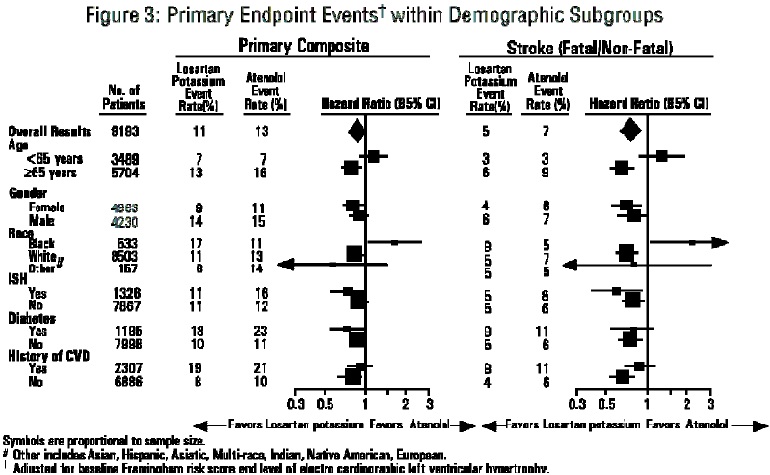
For the primary endpoint and stroke, the effects of losartan potassium in patient subgroups defined by age, gender, race and presence or absence of isolated systolic hypertension (ISH), diabetes, and history of cardiovascular disease (CVD) are shown in Figure 3 below. Subgroup analyses can be difficult to interpret and it is not known whether these represent true differences or chance effects.
Figure 3: Primary Endpoint Events† within Demographic Subgroups

Losartanfigure3 (Losartanfigure3)
Symbols are proportional to sample size.
#Other includes Asian, Hispanic, Asiatic, Multi-race, Indian, Native American, European.
†Adjusted for baseline Framingham risk score and level of electrocardiographic left ventricular hypertrophy.