Other
Rx Only
Adults given 50 mg once daily for | Age 6-16 given 0.7 mg/kg once | |||
Parent | Active Metabolite | Parent | Active Metabolite | |
AUC0-24 (ng•h/mL) Mean ± standard deviation | 442 ± 173 | 1685 ± 452 | 368 ± 169 | 1866 ± 1076 |
CMAX (ng/mL) | 224 ± 82 | 212 ± 73 | 141 ± 88 | 222 ± 127 |
T1/2 (h) Harmonic mean and standard deviation | 2.1 ± 0.70 | 7.4 ± 2.4 | 2.3 ± 0.8 | 5.6 ± 1.2 |
TPEAK (h) Median | 0.9 | 3.5 | 2.0 | 4.1 |
CLREN (mL/min) | 56 ± 23 | 20 ± 3 | 53 ± 33 | 17 ± 8 |
The bioavailability of the suspension formulation was compared with losartan tablets in healthy adults. The suspension and tablet are similar in their bioavailability with respect to both losartan and the active metabolite (see DOSAGE AND ADMINISTRATION, Preparation of Suspension).
Race: Pharmacokinetic differences due to race have not been studied (see also PRECAUTIONS, Race and CLINICAL PHARMACOLOGY, Pharmacodynamics and Clinical Effects, Reduction in the Risk of Stroke, Race).
Hepatic Insufficiency: Following oral administration in patients with mild to moderate alcoholic cirrhosis of the liver, plasma concentrations of losartan and its active metabolite were, respectively, 5-times and about 1.7-times those in young male volunteers. Compared to normal subjects the total plasma clearance of losartan in patients with hepatic insufficiency was about 50% lower and the oral bioavailability was about 2-times higher. A lower starting dose is recommended for patients with a history of hepatic impairment (see DOSAGE AND ADMINISTRATION).
Reduction in the Risk of Stroke: The Losartan Intervention For Endpoint reduction in hypertension (LIFE) study was a multinational, double-blind study comparing Losartan potassium and atenolol in 9193 hypertensive patients with ECG-documented left ventricular hypertrophy. Patients with myocardial infarction or stroke within six months prior to randomization were excluded. Patients were randomized to receive once daily Losartan potassium 50 mg or atenolol 50 mg. If goal blood pressure (<140/90 mmHg) was not reached, hydrochlorothiazide (12.5 mg) was added first and, if needed, the dose of Losartan potassium or atenolol was then increased to 100 mg once daily. If necessary, other antihypertensive treatments (e.g., increase in dose of hydrochlorothiazide therapy to 25 mg or addition of other diuretic therapy, calcium-channel blockers, alpha-blockers, or centrally acting agents, but not ACE inhibitors, angiotensin II antagonists, or beta-blockers) were added to the treatment regimen to reach the goal blood pressure.
Of the randomized patients, 4963 (54%) were female and 533 (6%) were Black. The mean age was 67 with 5704 (62%) age ≥65. At baseline, 1195 (13%) had diabetes, 1326 (14%) had isolated systolic hypertension, 1469 (16%) had coronary heart disease, and 728 (8%) had cerebrovascular disease. Baseline mean blood pressure was 174/98 mmHg in both treatment groups. The mean length of follow-up was 4.8 years. At the end of study or at the last visit before a primary endpoint, 77% of the group treated with Losartan potassium and 73% of the group treated with atenolol were still taking study medication. Of the patients still taking study medication, the mean doses of Losartan potassium and atenolol were both about 80 mg/day, and 15% were taking atenolol or losartan as monotherapy, while 77% were also receiving hydrochlorothiazide (at a mean dose of 20 mg/day in each group). Blood pressure reduction measured at trough was similar for both treatment groups but blood pressure was not measured at any other time of the day. At the end of study or at the last visit before a primary endpoint, the mean blood pressures were 144.1/81.3 mmHg for the group treated with Losartan potassium and 145.4/80.9 mmHg for the group treated with atenolol [the difference in systolic blood pressure (SBP) of 1.3 mmHg was significant (p<0.001), while the difference of 0.4 mmHg in diastolic blood pressure (DBP) was not significant (p=0.098)].
The primary endpoint was the first occurrence of cardiovascular death, nonfatal stroke, or nonfatal myocardial infarction. Patients with non-fatal events remained in the trial, so that there was also an examination of the first event of each type even if it was not the first event (e.g., a stroke following an initial myocardial infarction would be counted in the analysis of stroke). Treatment with Losartan potassium resulted in a 13% reduction (p=0.021) in risk of the primary endpoint compared to the atenolol group (see Figure 1 and Table 2); this difference was primarily the result of an effect on fatal and nonfatal stroke. Treatment with Losartan potassium reduced the risk of stroke by 25% relative to atenolol (p=0.001) (see Figure 2 and Table 2).
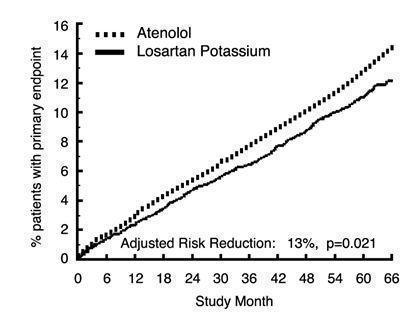
Figure 1 (8ca0c9d3 3a50 4efe 92df 30a0c50d48a7 02)
Figure 1. Kaplan-Meier estimates of the primary endpoint of time to cardiovascular death, nonfatal stroke, or nonfatal myocardial infarction in the groups treated with Losartan potassium and atenolol. The Risk Reduction is adjusted for baseline Framingham risk score and level of electrocardiographic left ventricular hypertrophy.
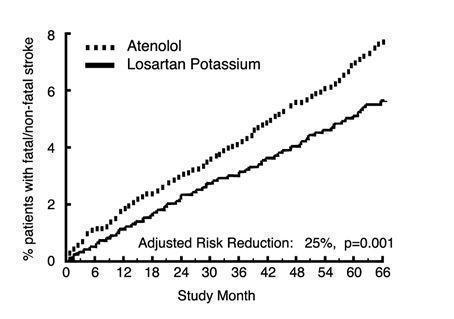
Figure 2 (8ca0c9d3 3a50 4efe 92df 30a0c50d48a7 03)
Figure 2. Kaplan-Meier estimates of the time to fatal/nonfatal stroke in the groups treated with Losartan potassium and atenolol. The Risk Reduction is adjusted for baseline Framingham risk score and level of electrocardiographic left ventricular hypertrophy.
Table 2 shows the results for the primary composite endpoint and the individual endpoints. The primary endpoint was the first occurrence of stroke, myocardial infarction or cardiovascular death, analyzed using an intention-to-treat (ITT) approach. The table shows the number of events for each component in two different ways. The Components of Primary Endpoint (as a first event) counts only the events that define the primary endpoint, while the Secondary Endpoints count all first events of a particular type, whether or not they were preceded by a different type of event.
| Losartan potassium | Atenolol | Risk Reduction Adjusted for baseline Framingham risk score and level of electrocardiographic left ventricular hypertrophy | 95% CI | p-Value | |||
|---|---|---|---|---|---|---|---|
N (%) | Rate Rate per 1000 patient-years of follow-up | N (%) | Rate | ||||
|
|
|
|
|
|
|
|
| |||||||
Stroke (nonfatal First report of an event, in some cases the patient died subsequently to the event reported ) | 209 (5) | 286 (6) | |||||
Myocardial infarction (nonfatal | 174 (4) | 168 (4) | |||||
Cardiovascular mortality | 125 (3) | 134 (3) | |||||
| |||||||
Stroke (fatal/nonfatal) | 232 (5) | 10.8 | 309 (7) | 14.5 | 25% | 11% to 37% | 0.001 |
Myocardial infarction (fatal/nonfatal) | 198 (4) | 9.2 | 188 (4) | 8.7 | -7% | -13% to 12% | 0.491 |
Cardiovascular mortality | 204 (4) | 9.2 | 234 (5) | 10.6 | 11% | -7% to 27% | 0.206 |
Due to CHD | 125 (3) | 5.6 | 124 (3) | 5.6 | -3% | -32% to 20% | 0.839 |
Due to Stroke | 40 (1) | 1.8 | 62 (1) | 2.8 | 35% | 4% to 67% | 0.032 |
Other Death due to heart failure, non-coronary vascular disease, pulmonary embolism, or a cardiovascular cause other than stroke or coronary heart disease | 39 (1) | 1.8 | 48 (1) | 2.2 | 16% | -28% to 45% | 0.411 |
Although the LIFE study favored Losartan potassium over atenolol with respect to the primary endpoint (p=0.021), this result is from a single study and, therefore, is less compelling than the difference between Losartan potassium and placebo. Although not measured directly, the difference between Losartan potassium and placebo is compelling because there is evidence that atenolol is itself effective (vs. placebo) in reducing cardiovascular events, including stroke, in hypertensive patients.
Other clinical endpoints of the LIFE study were: total mortality, hospitalization for heart failure or angina pectoris, coronary or peripheral revascularization procedures, and resuscitated cardiac arrest. There were no significant differences in the rates of these endpoints between the Losartan potassium and atenolol groups.
For the primary endpoint and stroke, the effects of Losartan potassium in patient subgroups defined by age, gender, race and presence or absence of isolated systolic hypertension (ISH), diabetes, and history of cardiovascular disease (CVD) are shown in Figure 3 below. Subgroup analyses can be difficult to interpret and it is not known whether these represent true differences or chance effects.
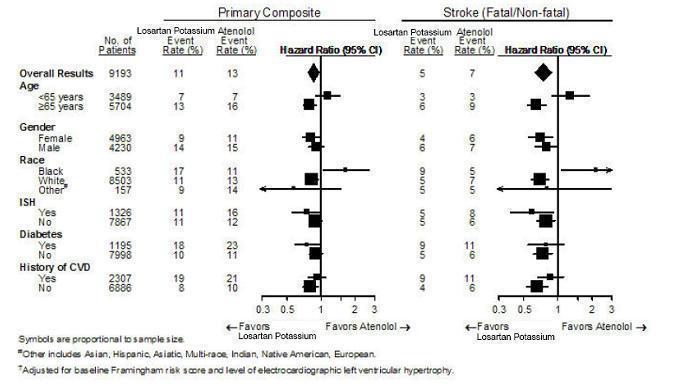
Figure 3 (8ca0c9d3 3a50 4efe 92df 30a0c50d48a7 04)
Figure 3. Primary Endpoint Events† within Demographic Subgroups
Race: In the LIFE study, Black patients treated with atenolol were at lower risk of experiencing the primary composite endpoint compared with Black patients treated with Losartan potassium. In the subgroup of Black patients (n=533; 6% of the LIFE study patients), there were 29 primary endpoints among 263 patients on atenolol (11%, 26 per 1000 patient-years) and 46 primary endpoints among 270 patients (17%, 42 per 1000 patient-years) on Losartan potassium. This finding could not be explained on the basis of differences in the populations other than race or on any imbalances between treatment groups. In addition, blood pressure reductions in both treatment groups were consistent between Black and non-Black patients. Given the difficulty in interpreting subset differences in large trials, it cannot be known whether the observed difference is the result of chance. However, the LIFE study provides no evidence that the benefits of Losartan potassium on reducing the risk of cardiovascular events in hypertensive patients with left ventricular hypertrophy apply to Black patients.
Nephropathy in Type 2 Diabetic Patients: The Reduction of Endpoints in NIDDM with the Angiotensin II Receptor Antagonist Losartan (RENAAL) study was a randomized, placebo-controlled, double-blind, multicenter study conducted worldwide in 1513 patients with type 2 diabetes with nephropathy (defined as serum creatinine 1.3 to 3.0 mg/dl in females or males ≤60 kg and 1.5 to 3.0 mg/dl in males >60 kg and proteinuria [urinary albumin to creatinine ratio ≥300 mg/g]).
Patients were randomized to receive Losartan potassium 50 mg once daily or placebo on a background of conventional antihypertensive therapy excluding ACE inhibitors and angiotensin II antagonists. After one month, investigators were instructed to titrate study drug to 100 mg once daily if the trough blood pressure goal (140/90 mmHg) was not achieved. Overall, 72% of patients received the 100-mg daily dose more than 50% of the time they were on study drug. Because the study was designed to achieve equal blood pressure control in both groups, other antihypertensive agents (diuretics, calcium-channel blockers, alpha- or beta-blockers, and centrally acting agents) could be added as needed in both groups. Patients were followed for a mean duration of 3.4 years.
The study population was diverse with regard to race (Asian 16.7%, Black 15.2%, Hispanic 18.3%, White 48.6%). Overall, 63.2% of the patients were men, and 66.4% were under the age of 65 years. Almost all of the patients (96.6%) had a history of hypertension, and the patients entered the trial with a mean serum creatinine of 1.9 mg/dl and mean proteinuria (urinary albumin/creatinine) of 1808 mg/g at baseline.
The primary endpoint of the study was the time to first occurrence of any one of the following events: doubling of serum creatinine, end-stage renal disease (ESRD) (need for dialysis or transplantation), or death. Treatment with Losartan potassium resulted in a 16% risk reduction in this endpoint (see Figure 4 and Table 3). Treatment with Losartan potassium also reduced the occurrence of sustained doubling of serum creatinine by 25% and ESRD by 29% as separate endpoints, but had no effect on overall mortality (see Table 3).
The mean baseline blood pressures were 152/82 mmHg for Losartan potassium plus conventional antihypertensive therapy and 153/82 mmHg for placebo plus conventional antihypertensive therapy. At the end of the study, the mean blood pressures were 143/76 mmHg for the group treated with Losartan potassium and 146/77 mmHg for the group treated with placebo.
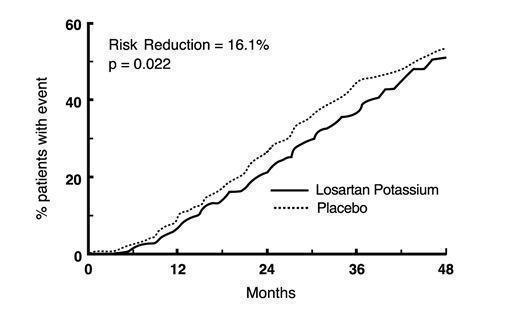
Losartan (8ca0c9d3 3a50 4efe 92df 30a0c50d48a7 05)
Figure 4. Kaplan-Meier curve for the primary composite endpoint of doubling of serum creatinine, end stage renal disease (need for dialysis or transplantation) or death.
| Incidence | Risk Reduction | 95% C.I. | p-Value | ||
|---|---|---|---|---|---|
Losartan | Placebo | ||||
|
|
|
|
|
|
| |||||
Doubling of Serum Creatinine | 21.6% | 26.0% | |||
ESRD | 8.5% | 8.5% | |||
Death | 13.4% | 12.6% | |||
| |||||
Doubling of Serum Creatinine | 21.6% | 26.0% | 25.3% | 7.8% to 39.4% | 0.006 |
ESRD | 19.6% | 25.5% | 28.6% | 11.5% to 42.4% | 0.002 |
Death | 21.0% | 20.3% | -1.7% | -26.9% to 18.6% | 0.884 |
The secondary endpoints of the study were change in proteinuria, change in the rate of progression of renal disease, and the composite of morbidity and mortality from cardiovascular causes (hospitalization for heart failure, myocardial infarction, revascularization, stroke, hospitalization for unstable angina, or cardiovascular death). Compared with placebo, Losartan potassium significantly reduced proteinuria by an average of 34%, an effect that was evident within 3 months of starting therapy, and significantly reduced the rate of decline in glomerular filtration rate during the study by 13%, as measured by the reciprocal of the serum creatinine concentration. There was no significant difference in the incidence of the composite endpoint of cardiovascular morbidity and mortality.
The favorable effects of Losartan potassium were seen in patients also taking other anti-hypertensive medications (angiotensin II receptor antagonists and angiotensin converting enzyme inhibitors were not allowed), oral hypoglycemic agents and lipid-lowering agents.
For the primary endpoint and ESRD, the effects of Losartan potassium in patient subgroups defined by age, gender and race are shown in Table 4 below. Subgroup analyses can be difficult to interpret and it is not known whether these represent true differences or chance effects.
| Primary Composite Endpoint | ESRD | ||||||
|---|---|---|---|---|---|---|---|
No. of Patients | Losartan Potassium | Placebo | Hazard Ratio | Losartan Potassium | Placebo | Hazard Ratio | |
Overall Results | 1513 | 43.5 | 47.1 | 0.839 (0.721, 0.977) | 19.6 | 25.5 | 0.714 (0.576, 0.885) |
Age | |||||||
<65 years | 1005 | 44.1 | 49.0 | 0.784 (0.653, 0.941) | 21.1 | 28.5 | 0.670 (0.521, 0.863) |
≥65 years | 508 | 42.3 | 43.5 | 0.978 (0.749, 1.277) | 16.5 | 19.6 | 0.847 (0.560, 1.281) |
Gender | |||||||
Female | 557 | 47.8 | 54.1 | 0.762 (0.603, 0.962) | 22.8 | 32.8 | 0.601 (0.436, 0.828) |
Male | 956 | 40.9 | 43.3 | 0.892 (0.733, 1.085) | 17.5 | 21.5 | 0.809 (0.605, 1.081) |
Race | |||||||
Asian | 252 | 41.9 | 54.8 | 0.655 (0.453, 0.947) | 18.8 | 27.4 | 0.625 (0.367, 1.066) |
Black | 230 | 40.0 | 39.0 | 0.983 (0.647, 1.495) | 17.6 | 21.0 | 0.831 (0.456, 1.516) |
Hispanic | 277 | 55.0 | 54.0 | 1.003 (0.728, 1.380) | 30.0 | 28.5 | 1.024 (0.661, 1.586) |
White | 735 | 40.5 | 43.2 | 0.809 (0.645, 1.013) | 16.2 | 23.9 | 0.596 (0.427, 0.831) |
Hypertensive Patients with Left Ventricular Hypertrophy
Losartan potassium tablets USP are indicated to reduce the risk of stroke in patients with hypertension and left ventricular hypertrophy, but there is evidence that this benefit does not apply to Black patients. (See PRECAUTIONS, Race and CLINICAL PHARMACOLOGY, Pharmacodynamics and Clinical Effects, Reduction in the Risk of Stroke, Race.)
Pregnancy: Female patients of childbearing age should be told about the consequences of exposure to Losartan potassium during pregnancy. Discuss treatment options with women planning to become pregnant. Patients should be asked to report pregnancies to their physicians as soon as possible.
Potassium Supplements: A patient receiving Losartan potassium should be told not to use potassium supplements or salt substitutes containing potassium without consulting the prescribing physician (see PRECAUTIONS, Drug Interactions).
Lithium: Increases in serum lithium concentrations and lithium toxicity have been reported during concomitant administration of lithium with angiotensin II receptor antagonists. Monitor serum lithium levels during concomitant use.
Non-Steroidal Anti-Inflammatory Drugs (NSAIDs) Including Selective Cyclooxygenase-2 Inhibitors (COX-2 Inhibitors): In patients who are elderly, volume-depleted (including those on diuretic therapy), or with compromised renal function, co-administration of NSAIDs, including selective COX-2 inhibitors, with angiotensin II receptor antagonists (including losartan) may result in deterioration of renal function, including possible acute renal failure. These effects are usually reversible. Monitor renal function periodically in patients receiving losartan and NSAID therapy.
The antihypertensive effect of angiotensin II receptor antagonists, including losartan, may be attenuated by NSAIDs, including selective COX-2 inhibitors.
Dual Blockade of the Renin-Angiotensin System (RAS): Dual blockade of the RAS with angiotensin receptor blockers, ACE inhibitors, or aliskiren is associated with increased risks of hypotension, syncope, hyperkalemia, and changes in renal function (including acute renal failure) compared to monotherapy. The Veterans Affairs Nephropathy in Diabetes (VA NEPHRON-D) trial enrolled 1448 patients with type 2 diabetes, elevated urinary-albumin-to-creatinine ratio, and decreased estimated glomerular filtration rate (GFR 30 to 89.9 ml/min), randomized them to lisinopril or placebo on a background of losartan therapy and followed them for a median of 2.2 years. Patients receiving the combination of losartan and lisinopril did not obtain any additional benefit compared to monotherapy for the combined endpoint of decline in GFR, end stage renal disease, or death, but experienced an increased incidence of hyperkalemia and acute kidney injury compared with the monotherapy group.
Closely monitor blood pressure, renal function, and electrolytes in patients on Losartan potassium and other agents that affect the RAS.
Do not co-administer aliskiren with Losartan potassium in patients with diabetes. Avoid use of aliskiren with Losartan potassium in patients with renal impairment (GFR <60 ml/min).
Pediatric Patients: No relevant differences between the adverse experience profile for pediatric patients and that previously reported for adult patients were identified.
Hemoglobin and Hematocrit: Small decreases in hemoglobin and hematocrit (mean decreases of approximately 0.11 grams percent and 0.09 volume percent, respectively) occurred frequently in patients treated with Losartan potassium alone, but were rarely of clinical importance. No patients were discontinued due to anemia.
Liver Function Tests: Occasional elevations of liver enzymes and/or serum bilirubin have occurred. In patients with essential hypertension treated with Losartan potassium alone, one patient (<0.1%) was discontinued due to these laboratory adverse experiences.