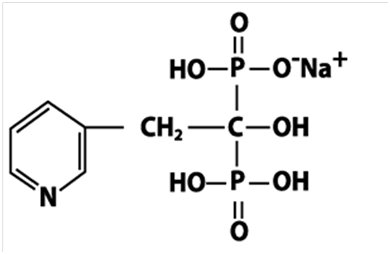
The efficacy of risedronate sodium delayed-release 35 mg once-a-week in the treatment of postmenopausal osteoporosis was demonstrated in a randomized, double-blind, active-control trial of approximately 900 subjects. All patients in this study received supplemental calcium (1000 mg/day) and vitamin D (800 to 1000 international units/day). The primary efficacy endpoint was percent change in lumbar spine bone mineral density at 1 year.
Risedronate sodium delayed-release 35 mg once-a-week administered after breakfast was shown to be non-inferior to risedronate sodium immediate-release 5 mg daily. Table 2 presents the primary efficacy analysis, percent change in lumbar spine BMD, in the intent-to-treat population with last observation carried forward (LOCF).
Table 2
Lumbar Spine BMD-Percent Change from Baseline at Endpoint[a] | Risedronate sodium immediate-release 5 mg Daily N = 307 | Risedronate sodium delayed-release 35 mg Once-a-Week Following Breakfast N = 307 |
Primary Efficacy (LOCF) | | |
n | 270 | 261 |
LS Mean (95% CI) | 3.1* (2.7, 3.5) | 3.3* (2.9, 3.7) |
LS Mean Difference [b] (95% CI) | | -0.2 (-0.8, 0.3) |
N = number of intent-to-treat patients within specified treatment; n = number of patients with values at the visit.
*Indicates a statistically significant difference from baseline determined from 95% CI unadjusted for multiple comparisons.
LS = Least Squares
[a] at 1 year LOCF
[b] LS Mean Difference is 5 mg daily minus 35 mg weekly treatment.
Fracture efficacy with Risedronate Sodium Immediate-Release 5 mg Daily
The fracture efficacy of risedronate sodium immediate-release 5 mg daily in the treatment of postmenopausal osteoporosis was demonstrated in 2 large, randomized, placebo-controlled, double-blind studies that enrolled a total of almost 4000 postmenopausal women under similar protocols. The Multinational study (VERT MN) (risedronate sodium immediate-release 5 mg daily, N = 408) was conducted primarily in Europe and Australia; a second study was conducted in North America (VERT NA) (risedronate sodium immediate-release 5 mg daily, N = 821). Patients were selected on the basis of radiographic evidence of previous vertebral fracture, and therefore, had established disease. The average number of prevalent vertebral fractures per patient at study entry was 4 in VERT MN, and 2.5 in VERT NA, with a broad range of baseline BMD levels. All patients in these studies received supplemental calcium 1000 mg/day. Patients with low 25-hydroxyvitamin D3 levels (approximately 40 nmol/L or less) also received 500 international units/day supplemental vitamin D.
Effect on Vertebral Fractures
Fractures of previously undeformed vertebrae (new fractures) and worsening of pre-existing vertebral fractures were diagnosed radiographically; some of these fractures were also associated with symptoms (that is, clinical fractures). Spinal radiographs were scheduled annually and prospectively planned analyses were based on the time to a patient’s first diagnosed fracture. The primary endpoint for these studies was the incidence of new and worsening vertebral fractures across the period of 0 to 3 years. Risedronate sodium immediate-release 5 mg daily significantly reduced the incidence of new and worsening vertebral fractures and of new vertebral fractures in both VERT NA and VERT MN at all time points (Table 3). The reduction in risk seen in the subgroup of patients who had 2 or more vertebral fractures at study entry was similar to that seen in the overall study population.
Table 3
The Effect of Risedronate sodium 5 mg Immediate-Release Daily on the Risk of Vertebral FracturesVERT NA | Proportion of Patients with Fracture (%)a | | |
Placebo N = 678 | Risedronate sodium 5 mg N = 696 | Absolute Risk Reduction (%) | Relative Risk Reduction (%) |
New and Worsening | | | | |
0 to 1 Year | 7.2 | 3.9 | 3.3 | 49 |
0 to 2 Years | 12.8 | 8 | 4.8 | 42 |
0 to 3 Years | 18.5 | 13.9 | 4.6 | 33 |
New | | | | |
0 to 1 Year | 6.4 | 2.4 | 4 | 65 |
0 to 2 Years | 11.7 | 5.8 | 5.9 | 55 |
0 to 3 Years | 16.3 | 11.3 | 5 | 41 |
VERT MN | Placebo N = 346 | Risedronate sodium 5 mg N = 344 | Absolute Risk Reduction (%) | Relative Risk Reduction (%) |
New and Worsening | | | | |
0 to 1 Year | 15.3 | 8.2 | 7.1 | 50 |
0 to 2 Years | 28.3 | 13.9 | 14.4 | 56 |
0 to 3 Years | 34 | 21.8 | 12.2 | 46 |
New | | | | |
0 to 1 Year | 13.3 | 5.6 | 7.7 | 61 |
0 to 2 Years | 24.7 | 11.6 | 13.1 | 59 |
0 to 3 Years | 29 | 18.1 | 10.9 | 49 |
a Calculated by Kaplan-Meier methodology.
Effect on Osteoporosis-Related Nonvertebral Fractures
In VERT MN and VERT NA, a prospectively planned efficacy endpoint was defined consisting of all radiographically confirmed fractures of skeletal sites accepted as associated with osteoporosis. Fractures at these sites were collectively referred to as osteoporosis-related nonvertebral fractures. Risedronate sodium immediate-release 5 mg daily significantly reduced the incidence of nonvertebral osteoporosis-related fractures over 3 years in VERT NA (8% versus 5%; relative risk reduction 39%) and reduced the fracture incidence in VERT MN from 16% to 11%. There was a significant reduction from 11% to 7% when the studies were combined, with a corresponding 36% reduction in relative risk. Figure 1 shows the overall results as well as the results at the individual skeletal sites for the combined studies.
Figure 1 Nonvertebral Osteoporosis-Related Fractures Cumulative Incidence Over 3 years Combined VER MN and VERT NA
Histology/Histomorphometry
Bone biopsies from 110 postmenopausal women were obtained at endpoint in the VERT NA study. Patients had received placebo or daily risedronate sodium immediate-release (2.5 mg or 5 mg) for 2 to 3 years. Histologic evaluation (N = 103) showed no osteomalacia, impaired bone mineralization, or other adverse effects on bone in risedronate sodium immediate-release treated women. These findings demonstrate that bone formed during risedronate sodium immediate-release administration is of normal quality. The histomorphometric parameter mineralizing surface, an index of bone turnover, was assessed based upon baseline and post-treatment biopsy samples from 21 treated with placebo and 23 patients treated with risedronate sodium immediate-release 5 mg daily. Mineralizing surface decreased moderately in risedronate sodium immediate-release treated patients (median percent change: placebo, -21%; risedronate sodium immediate-release 5 mg daily, -74%), consistent with the known effects of treatment on bone turnover.
Effect on Height
In the two 3-year osteoporosis treatment studies, standing height was measured yearly by stadiometer. Both risedronate sodium immediate-release 5 mg daily and placebo-treated groups lost height during the studies. Patients who received risedronate sodium immediate-release 5 mg daily had a statistically significantly smaller loss of height than those who received placebo. In VERT MN, the median annual height change was -2.4 mm/yr in the placebo group compared to -1.3 mm/yr in the risedronate sodium immediate-release 5 mg daily group. In VERT NA, the median annual height change was -1.1 mm/yr in the placebo group compared to -0.7 mm/yr in the risedronate sodium immediate-release 5 mg daily group.
Effect on Bone Mineral Density
The results of 4 randomized, placebo-controlled trials in women with postmenopausal osteoporosis (VERT MN, VERT NA, BMD MN, BMD NA) demonstrate that risedronate sodium immediate-release 5 mg daily increases BMD at the spine, hip, and wrist compared to the effects seen with placebo. Table 4 displays the significant increases in BMD seen at the lumbar spine, femoral neck, femoral trochanter, and midshaft radius in these trials compared to placebo. In both VERT studies (VERT MN and VERT NA), risedronate sodium immediate-release 5 mg daily produced increases in lumbar spine BMD that were progressive over the 3 years of treatment, and were statistically significant relative to baseline and to placebo at 6 months and at all later time points.
Table 4 Mean Percent Increase in BMD from Baseline in Patients Taking Risedronate sodium Immediate-Release 5 mg or Placebo at Endpointa | VERT MNb | VERT NAb | BMD MNc | BMD NAc |
Placebo N = 323 | 5 mg N = 323 | Placebo N = 599 | 5 mg N = 606 | Placebo N = 161 | 5 mg N = 148 | Placebo N = 191 | 5 mg N = 193 |
Lumbar Spine | 1 | 6.6 | 0.8 | 5 | 0 | 4 | 0.2 | 4.8 |
Femoral Neck | -1.4 | 1.6 | -1 | 1.4 | -1.1 | 1.3 | 0.1 | 2.4 |
Femoral Trochanter | -1.9 | 3.9 | -0.5 | 3 | -0.6 | 2.5 | 1.3 | 4 |
Midshaft Radius | -1.5* | 0.2* | -1.2* | 0.1* | ND | ND |
a The endpoint value is the value at the study's last time point for all patients who had BMD measured at that time; otherwise the last post-baseline BMD value prior to the study's last time point is used.
b The duration of the studies was 3 years.
c The duration of the studies was 1.5 to 2 years.
*BMD of the midshaft radius was measured in a subset of centers in VERT MN (placebo, N = 222; 5 mg, N = 214) and VERT NA (placebo, N = 310; 5 mg, N = 306).
ND = analysis not done