1. Treatment of CMV Retinitis
The diagnosis of CMV retinitis should be made by indirect ophthalmoscopy. Other conditions in the differential diagnosis of CMV retinitis include candidiasis, toxoplasmosis, histoplasmosis, retinal scars and cotton wool spots, any of which may produce a retinal appearance similar to CMV. For this reason it is essential that the diagnosis of CMV be established by an ophthalmologist familiar with the retinal presentation of these conditions. The diagnosis of CMV retinitis may be supported by culture of CMV from urine, blood, throat or other sites, but a negative CMV culture does not rule out CMV retinitis.
Studies Comparing Ganciclovir-Capsules to Ganciclovir-IV:
Population Characteristics in Studies ICM 1653, ICM 1774 and AVI 034
| ICM 1653
(n = 121) | ICM 1774
(n = 225) | AVI 034
(n = 159) |
| Median age (years)
Range | 38 | 37 | 39 |
| 24 to 62 | 22 to 56 | 23 to 62 |
| Sex | Males | 116 (96%) | 222 (99%) | 148 (93%) |
| Female | 5 (4%) | 3 (1%) | 10 (6%) |
| Ethnicity | Asian | 3 (3%) | 5 (2%) | 7 (4%) |
| Black | 11 (9%) | 9 (4%) | 3 (2%) |
| Caucasian | 98 (81%) | 186 (83%) | 140 (88%) |
| Other | 9 (7%) | 25 (11%) | 8 (5%) |
| Median CD4 Count Range | | 9.5 | 7 | 10 |
| 0 to 141 | 0 to 80 | 0 to 320 |
| Mean (SD) Observation Time (days) | | 107.9 (43) | 97.6 (42.5) | 80.9 (47) |
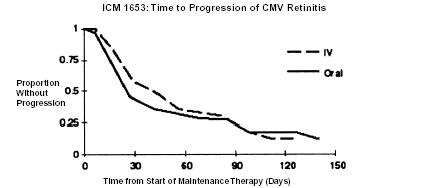
ICM 1653: In this randomized, open-label, parallel group trial, conducted between March 1991 and November 1992, patients with AIDS and newly diagnosed CMV retinitis received a 3-week induction course of ganciclovir- IV solution, 5 mg/kg bid for 14 days followed by 5 mg/kg once daily for 1 additional week.1 Following the 21-day intravenous induction course, patients with stable CMV retinitis were randomized to receive 20 weeks of maintenance treatment with either ganciclovir-IV solution, 5 mg/kg once daily, or ganciclovir capsules, 500 mg 6 times daily (3000 mg/day). The study showed that the mean [95% CI] and median [95% CI] times to progression of CMV retinitis, as assessed by masked reading of fundus photographs, were 57 days [44, 70] and 29 days [28, 43], respectively, for patients on oral therapy compared to 62 days [50, 73] and 49 days [29, 61], respectively, for patients on intravenous therapy. The difference [95% CI] in the mean time to progression between the oral and intravenous therapies (oral - IV) was -5 days [-22, 12]. See Figure 1 for comparison of the proportion of patients remaining free of progression over time.
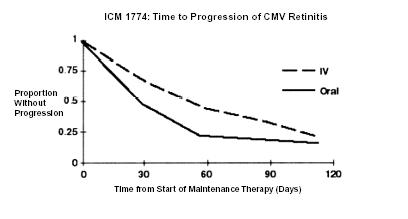
ICM 1774: In this three-arm, randomized, open-label, parallel group trial, conducted between June 1991 and August 1993, patients with AIDS and stable CMV retinitis following from 4 weeks to 4 months of treatment with ganciclovir-IV solution were randomized to receive maintenance treatment with ganciclovir-IV solution, 5 mg/kg once daily, ganciclovir capsules, 500 mg 6 times daily, or ganciclovir capsules, 1000 mg tid for 20 weeks. The study showed that the mean [95% CI] and median [95% CI] times to progression of CMV retinitis, as assessed by masked reading of fundus photographs, were 54 days [48, 60] and 42 days [31, 54], respectively, for patients on oral therapy compared to 66 days [56, 76] and 54 days [41, 69], respectively, for patients on intravenous therapy. The difference [95% CI] in the mean time to progression between the oral and intravenous therapies (oral - IV) was -12 days [-24, 0]. See Figure 2 for comparison of the proportion of patients remaining free of progression over time.
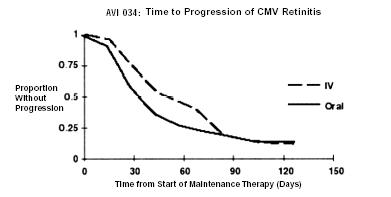
AVI 034: In this randomized, open-label, parallel group trial, conducted between June 1991 and February 1993, patients with AIDS and newly diagnosed (81%) or previously treated (19%) CMV retinitis who had tolerated 10 to 21 days of induction treatment with ganciclovir-IV, 5 mg/kg twice daily, were randomized to receive 20 weeks of maintenance treatment with either ganciclovir capsules, 500 mg 6 times daily or ganciclovir-IV solution, 5 mg/kg/day.2 The mean [95% CI] and median [95% CI] times to progression of CMV retinitis, as assessed by masked reading of fundus photographs, were 51 days [44, 57] and 41 days [31, 45], respectively, for patients on oral therapy compared to 62 days [52, 72] and 60 days [42, 83], respectively, for patients on intravenous therapy. The difference [95% CI] in the mean time to progression between the oral and intravenous therapies (oral - IV) was -11 days [-24, 1]. See Figure 3 for comparison of the proportion of patients remaining free of progression over time.
Comparison of other CMV retinitis outcomes between oral and IV formulations (development of bilateral retinitis, progression into Zone 1, and deterioration of visual acuity), while not definitive, showed no marked differences between treatment groups in these studies. Because of low event rates among these endpoints, these studies are underpowered to rule out significant differences in these endpoints.
Figure 1 - ICM 1653
Figure 2 - ICM 1774
Figure 3 - AVI 034
2. Prevention of CMV Disease in Subjects With AIDS
ICM 1654: In a double-blind study conducted between November 1992 and July 1994, 725 subjects with AIDS, who were CMV seropositive and/or culture positive, were randomized to receive ganciclovir capsules, 1000 mg, every 8 hours, or placebo.3 The study population had a median age of 38 years (range: 21 to 69); were 99% male; were 82% Caucasian, 10% Hispanic, 7% African-American and 1% Asian; and had a median CD4 count of 21 (range: 0 to 100). The mean observation time was 351 days (range: 5 to 621). As shown in the following table, significantly more placebo recipients developed CMV disease.
Incidence of CMV Disease at 6, 12 and 18 Months After Enrollment (Kaplan-Meier Estimates)
| Incidence (Number Still at Risk) |
| CMV Disease |
| Ganciclovir | Placebo |
| 6 months | 8% (397) | 11% (190) |
| 12 months | 14% (225) | 26% (92) |
| 18 months | 20% (27) | 39% (9) |
3. Prevention of CMV Disease in Transplant Recipients
GAN040: Ganciclovir capsules were evaluated in a randomized, double-blind, placebo-controlled study of 304 orthotopic liver transplant recipients who were CMV seropositive or recipients of an organ from a seropositive donor. Administration of ganciclovir capsules (1000 mg three times daily) or matching placebo commenced as soon as patients were able to take medication by mouth, but no later than 10 days following transplantation, and continued through 14 weeks after transplantation. Dosing was adjusted for patients with an estimated creatinine clearance < 50 mL/min. The incidence of CMV disease at 6 months is summarized in the table below:
Incidence of CMV Disease at 6 Months (Kaplan-Meier Estimates)
| CMV Disease at 6 months |
| Ganciclovir
(n = 150) | Placebo
(n = 154) | Relative Risk
(95% Cl) |
| CMV Disease,* N (%) | 7 (4.8%) | 29 (18.9%) | 0.22 (0.10, 0.51) |
| CMV syndrome# | 6 (4.1%) | 19 (12.4%) | |
| CMV hepatitis | 1 (0.7%) | 9 (5.9%) |
| CMV GI disease | 0 (0%) | 3 (2%) |
| CMV lung disease | 0 (0%) | 4 (2.6%) |
* One or more CMV endpoints
# CMV syndrome: CMV viremia and unexplained fever, accompanied by malaise and/or neutropenia.
Ganciclovir capsules significantly reduced the 6-month incidence of CMV disease in patients at increased risk of CMV disease, including seronegative recipients of organs from seropositive donors (15% [3/21] with ganciclovir capsules vs 44% [11/25] with placebo), and patients receiving antilymphocyte antibodies (5% [2/44] with ganciclovir capsules vs 33% [12/37] with placebo). The incidence of HSV infection at 6 months was 4% (5/150) in ganciclovir vs 24% (36/154) in placebo recipients (relative risk: 0.13; 95% CI: 0.05, 0.32).