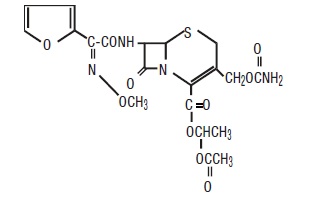
Absorption and Metabolism: After oral administration, cefuroxime axetil is absorbed from the gastrointestinal tract and rapidly hydrolyzed by nonspecific esterases in the intestinal mucosa and blood to cefuroxime. Cefuroxime is subsequently distributed throughout the extracellular fluids. The axetil moiety is metabolized to acetaldehyde and acetic acid.
Pharmacokinetics: Approximately 50% of serum cefuroxime is bound to protein. Serum pharmacokinetic parameters for cefuroxime axetil for oral suspension are shown in Table 1.
Table 1. Postprandial Pharmacokinetics of Cefuroxime Administered as Cefuroxime Axetil for Oral Suspension to Pediatric Patients*|
Dose†
(Cefuroxime
Equivalent) |
n |
Peak Plasma
Concentration
(mcg/mL) |
Time of Peak
Plasma
Concentration
(hr) |
Mean
Elimination
Half-Life
(hr) |
AUC
(mcg-hr mL) |
|
10 mg/kg |
8 |
3.3 |
3.6 |
1.4 |
12.4 |
|
15 mg/kg |
12 |
5.1 |
2.7 |
1.9 |
22.5 |
|
20 mg/kg |
8 |
7 |
3.1 |
1.9 |
32.8 |
*Mean age = 23 months.
†Drug administered with milk or milk products
Comparative Pharmacokinetic Properties: A 250 mg/5 mL dose of cefuroxime axetil for oral suspension is bioequivalent to 2 times 125 mg/5 mL dose of cefuroxime axetil for oral suspension when administered with food (see Table 2). Cefuroxime axetil for oral suspension was not bioequivalent to cefuroxime axetil tablets when tested in healthy adults. The tablet and powder for oral suspension formulations are NOT substitutable on a milligram-per-milligram basis. The area under the curve for the suspension averaged 91% of that for the tablet, and the peak plasma concentration for the suspension averaged 71% of the peak plasma concentration of the tablets. Therefore, the safety and effectiveness of both the tablet and oral suspension formulations had to be established in separate clinical trials.
Table 2: Pharmacokinetics of Cefuroxime Administered as 250 mg/5 mL or 2 x 125 mg/5 mL Cefuroxime Axetil for Oral Suspension to Adults* With Food|
Dose
(Cefuroxime
Equivalent) |
Peak Plasma
Concentration
(mcg/mL) |
Time of Peak
Plasma
Concentration (hr) |
Mean
Elimination
Half-Life (hr) |
AUC
(mcg-hr mL) |
|
250 mg/5 mL |
2.23 |
3 |
1.40 |
8.92 |
|
2 x 125 mg/5 mL |
2.37 |
3 |
1.44 |
9.75 |
*Mean values of 18 healthy adult volunteers
Food Effect on Pharmacokinetics: All pharmacokinetic and clinical effectiveness and safety studies in pediatric patients using the suspension formulation were conducted in the fed state. No data are available on the absorption kinetics of the suspension formulation when administered to fasted pediatric patients.
Renal Excretion: Cefuroxime is excreted unchanged in the urine; in adults, approximately 50% of the administered dose is recovered in the urine within 12 hours. The pharmacokinetics of cefuroxime in the urine of pediatric patients have not been studied at this time. Until further data are available, the renal pharmacokinetic properties of cefuroxime axetil established in adults should not be extrapolated to pediatric patients.
Because cefuroxime is renally excreted, the serum half-life is prolonged in patients with reduced renal function. In a study of 20 elderly patients (mean age = 83.9 years) having a mean creatinine clearance of 34.9 mL/min, the mean serum elimination half-life was 3.5 hours. Despite the lower elimination of cefuroxime in geriatric patients, dosage adjustment based on age is not necessary (see PRECAUTIONS: Geriatric Use).
Microbiology: The in vivo bactericidal activity of cefuroxime axetil is due to cefuroxime's binding to essential target proteins and the resultant inhibition of cell-wall synthesis.
Cefuroxime has bactericidal activity against a wide range of common pathogens, including many beta-lactamase-producing strains. Cefuroxime is stable to many bacterial beta-lactamases, especially plasmid-mediated enzymes that are commonly found in enterobacteriaceae.
Cefuroxime has been demonstrated to be active against most strains of the following microorganisms both in vitro and in clinical infections as described in the INDICATIONS AND USAGE section (see INDICATIONS AND USAGE section).
Aerobic Gram-Positive Microorganisms:
Staphylococcus aureus (including beta-lactamase-producing strains)
Streptococcus pneumoniae
Streptococcus pyogenes
Aerobic Gram-Negative Microorganisms:
Escherichia coli
Haemophilus influenzae (including beta-lactamase-producing strains)
Haemophilus parainfluenzae
Klebsiella pneumoniae
Moraxella catarrhalis (including beta-lactamase-producing strains)
Neisseria gonorrhoeae (including beta-lactamase-producing strains)
Spirochetes:
Borrelia burgdorferi
Cefuroxime has been shown to be active in vitro against most strains of the following microorganisms; however, the clinical significance of these findings is unknown.
Cefuroxime exhibits in vitro minimum inhibitory concentrations (MICs) of 4 mcg/mL or less (systemic susceptible breakpoint) against most (> 90%) strains of the following microorganisms; however, the safety and effectiveness of cefuroxime in treating clinical infections due to these microorganisms have not been established in adequate and well-controlled trials.
Aerobic Gram-Positive Microorganisms:
Staphylococcus epidermidis
Staphylococcus saprophyticus
Streptococcus agalactiae
NOTE: Listeria monocytogenes and certain strains of enterococci, e.g., Enterococcus faecalis (formerly Streptococcus faecalis), are resistant to cefuroxime. Methicillin-resistant staphylococci are resistant to cefuroxime.
Aerobic Gram-Negative Microorganisms:
Morganella morganii
Proteus inconstans
Proteus mirabilis
Providencia rettgeri
NOTE: Pseudomonas spp., Campylobacter spp., Acinetobactercalcoaceticus, Legionella spp., and most strains of Serratia spp. and Proteus vulgaris are resistant to most first- and second-generation cephalosporins. Some strains of Morganellamorganii, Enterobactercloacae, and Citrobacter spp. have been shown by in vitro tests to be resistant to cefuroxime and other cephalosporins.
Anaerobic Microorganisms:
Peptococcusniger
NOTE: Most strains of Clostridium difficile and Bacteroides fragilis are resistant to cefuroxime.
SusceptibilityTests: DilutionTechniques: Quantitative methods that are used to determine MICs provide reproducible estimates of the susceptibility of bacteria to antimicrobial compounds. One such standardized procedure uses a standardized dilution method1 (broth, agar, or microdilution) or equivalent with cefuroxime powder. The MIC values obtained should be interpreted according to the following criteria:
| MIC (mcg/mL) | Interpretation |
|
≤ 4 |
(S) Susceptible |
|
8 to16 |
(I) Intermediate |
|
≥ 32 |
(R) Resistant |
A report of "Susceptible" indicates that the pathogen, if in the blood, is likely to be inhibited by usually achievable concentrations of the antimicrobial compound in blood. A report of "Intermediate" indicates that inhibitory concentrations of the antibiotic may be achieved if high dosage is used or if the infection is confined to tissues or fluids in which high antibiotic concentrations are attained. This category also provides a buffer zone that prevents small, uncontrolled technical factors from causing major discrepancies in interpretation. A report of "Resistant" indicates that usually achievable concentrations of the antimicrobial compound in the blood are unlikely to be inhibitory and that other therapy should be selected.
Standardized susceptibility test procedures require the use of laboratory control microorganisms. Standard cefuroxime powder should give the following MIC values:
| Microorganism | MIC (mcg/mL) |
| Escherichia coli ATCC 25922 |
2 to 8 |
| Staphylococcus aureus ATCC 29213 |
0.5 to 2 |
DiffusionTechniques: Quantitative methods that require measurement of zone diameters provide estimates of the susceptibility of bacteria to antimicrobial compounds. One such standardized procedure2 that has been recommended (for use with disks) to test the susceptibility of microorganisms to cefuroxime uses the 30 mcg cefuroxime disk. Interpretation involves correlation of the diameter obtained in the disk test with the MIC for cefuroxime.
Reports from the laboratory providing results of the standard single-disk susceptibility test with a 30 mcg cefuroxime disk should be interpreted according to the following criteria:
| Zone Diameter (mm) | Interpretation |
|
≥ 23 |
(S) Susceptible |
|
15 to 22 |
(I) Intermediate |
|
≤ 14 |
(R) Resistant |
Interpretation should be as stated above for results using dilution techniques.
As with standard dilution techniques, diffusion methods require the use of laboratory control microorganisms. The 30 mcg cefuroxime disk provides the following zone diameters in these laboratory test quality control strains:
| Microorganism | Zone Diameter (mm) |
| Escherichia coli ATCC 25922 |
20 to 26 |
| Staphylococcus aureus ATCC 25923 |
27 to 35 |