Dose Modifications
Based on recommended dose-levels described in Table 3, Single-Agent Regimens of Irinotecan Hydrochloride and Dose Modifications, subsequent doses should be adjusted as suggested in Table 4, Recommended Dose Modifications for Single-Agent Schedules. All dose modifications should be based on the worst preceding toxicity.
Table 4. Recommended Dose Modifications For Single-Agent Schedulesa |
|
|
|
| A new cycle of therapy should not begin until the granulocyte count has recovered to ≥1500/mm3, and the platelet count has recovered to ≥100,000/mm3, and treatment-related diarrhea is fully resolved. Treatment should be delayed 1 to 2 weeks to allow for recovery from treatment-related toxicities. If the patient has not recovered after a 2-week delay, consideration should be given to discontinuing irinotecan hydrochloride.
|
Worst Toxicity NCI Gradeb
(Value) |
During a Cycle of Therapy | At the Start of the Next Cycles of Therapy (After Adequate Recovery), Compared with the Starting Dose in the Previous Cyclea |
| Weekly
| Weekly
| Once Every 3 Weeks
|
| No toxicity
| Maintain dose level
| ↑25 mg/m2 up to a maximum dose of 150 mg/m2 | Maintain dose level
|
Neutropenia
1 (1500 to 1999/mm3)
2 (1000 to 1499/mm3)
3 (500 to 999/mm3)
4 (<500/mm3)
|
Maintain dose level
↓ 25 mg/m2
Omit dose until resolved to ≤ grade 2, then
↓ 25 mg/m2
Omit dose until resolved to ≤ grade 2, then
↓ 50 mg/m2 |
Maintain dose level Maintain dose level
↓ 25 mg/m2
↓ 50 mg/m2 |
Maintain dose level Maintain dose level
↓ 50 mg/m2
↓ 50 mg/m2 |
| Neutropenic fever | Omit dose until resolved, then
↓ 50 mg/m2 when resolved
| ↓ 50 mg/m2 | ↓ 50 mg/m2 |
| Other hematologic toxicities | Dose modifications for leukopenia, thrombocytopenia, and anemia during a cycle of therapy and at the start of subsequent cycles of therapy are also based on NCI toxicity criteria and are the same as recommended for neutropenia above.
|
Diarrhea
1 (2-3 stools/day > pretxc)
2 (4-6 stools/day > pretx)
3 (7-9 stools/day > pretx)
4 (≥10 stools/day > pretx)
|
Maintain dose level
↓ 25 mg/m2
Omit dose until resolved to ≤ grade 2, then
↓ 25 mg/m2
Omit dose until resolved to ≤ grade 2, then
↓ 50 mg/m2 |
Maintain dose level Maintain dose level
↓ 25 mg/m2
↓ 50 mg/m2 |
Maintain dose level Maintain dose level
↓ 50 mg/m2
↓ 50 mg/m2 |
| Other nonhematologicd |
Maintain dose level
|
Maintain dose level
|
Maintain dose level
|
| toxicities |
| 1
|
| 2
| ↓ 25 mg/m2 | ↓ 25 mg/m2 | ↓ 50 mg/m2 |
| 3
| Omit dose until resolved to ≤ grade 2, then
| ↓ 25 mg/m2 | ↓ 50 mg/m2 |
| ↓25 mg/m2 | | |
| 4
| Omit dose until resolved to ≤ grade 2, then
| ↓ 50 mg/m2 | ↓ 50 mg/m2 |
| ↓ 50 mg/m2 |
Second-Line Single-Agent Therapy
Weekly Dosage Schedule
In three clinical studies evaluating the weekly dosage schedule, 304 patients with metastatic carcinoma of the colon or rectum that had recurred or progressed following 5-FU-based therapy were treated with irinotecan hydrochloride. Seventeen of the patients died within 30 days of the administration of irinotecan hydrochloride; in five cases (1.6%, 5/304), the deaths were potentially drug-related. One of the patients died of neutropenic sepsis without fever. Neutropenic fever occurred in nine (3.0%) other patients; these patients recovered with supportive care.
One hundred nineteen (39.1%) of the 304 patients were hospitalized because of adverse events; 81 (26.6%) patients were hospitalized for events judged to be related to administration of irinotecan hydrochloride injection. The primary reasons for drug-related hospitalization were diarrhea, with or without nausea and/or vomiting (18.4%); neutropenia/leukopenia, with or without diarrhea and/or fever (8.2%); and nausea and/or vomiting (4.9%).
The first dose of at least one cycle of irinotecan hydrochloride was reduced for 67% of patients who began the studies at the 125-mg/m2 starting dose. Within-cycle dose reductions were required for 32% of the cycles initiated at the 125-mg/m2 dose level. The most common reasons for dose reduction were late diarrhea, neutropenia, and leukopenia. Thirteen (4.3%) patients discontinued treatment with irinotecan hydrochloride because of adverse events. The adverse events in Table 7 are based on the experience of the 304 patients enrolled in the three studies described in Clinical Studies (14.1).
Table 7. Adverse Events Occurring in >10% of 304 Previously Treated Patients With Metastatic Carcinoma of the Colon or Rectuma |
|
|
|
|
Body System & Event | % of Patients Reporting |
| NCI Grades 1-4 | NCI Grades 3 & 4 |
GASTROINTESTINAL
Diarrhea (late)b
7-9 stools/day (grade 3)
≥ 10 stools/day (grade 4)
Nausea
Vomiting
Anorexia
Diarrhea (early)c Constipation
|
88
86
67
55
51
30
|
31
(16)
(14)
17
12
6
8
2
|
| Flatulence
| 12
| 0
|
| Stomatitis
| 12
| 1
|
| Dyspepsia
| 10
| 0
|
HEMATOLOGIC
Leukopenia
Anemia
Neutropenia
500 to <1000/mm3 (grade 3)
<500/mm3 (grade 4)
|
63
60
54
-
-
|
28
7
26
(15)
(12)
|
| BODY AS A WHOLE |
76
|
12
|
| Asthenia
|
| Abdominal cramping/pain
| 57
| 16
|
| Fever
| 45
| 1
|
| Pain
| 24
| 2
|
| Headache
| 17
| 1
|
| Back pain
| 14
| 2
|
| Chills
| 14
| 0
|
| Minor infectiond | 14
| 0
|
| Edema
| 10
| 1
|
| Abdominal enlargement
| 10
| 0
|
| METABOLIC AND NUTRITIONAL |
30
|
1
|
| ↓ Body weight
|
| Dehydration
| 15
| 4
|
| ↑ Alkaline phosphatase
| 13
| 4
|
| ↑ SGOT
| 10
| 1
|
| DERMATOLOGIC |
60
|
NAe |
| Alopecia
|
| Sweating
| 16
| 0
|
| Rash
| 13
| 1
|
| RESPIRATORY |
22
|
4
|
| Dyspnea
|
| ↑ Coughing
| 17
| 0
|
| Rhinitis
| 16
| 0
|
| NEUROLOGIC |
19
|
0
|
| Insomnia
|
| Dizziness
| 15
| 0
|
CARDIOVASCULAR
Vasodilation (flushing)
|
11
|
0
|
Once-Every-3-Week Dosage Schedule
A total of 535 patients with metastatic colorectal cancer whose disease had recurred or progressed following prior 5-FU therapy participated in the two phase 3 studies: 316 received irinotecan, 129 received 5-FU, and 90 received best supportive care. Eleven (3.5%) patients treated with irinotecan died within 30 days of treatment. In three cases (1%, 3/316), the deaths were potentially related to irinotecan treatment and were attributed to neutropenic infection, grade 4 diarrhea, and asthenia, respectively. One (0.8%, 1/129) patient treated with 5-FU died within 30 days of treatment; this death was attributed to grade 4 diarrhea.
Hospitalizations due to serious adverse events occurred at least once in 60% (188/316) of patients who received irinotecan, 63% (57/90) who received best supportive care, and 39% (50/129) who received 5-FU-based therapy. Eight percent of patients treated with irinotecan and 7% treated with 5-FU-based therapy discontinued treatment due to adverse events.
Of the 316 patients treated with irinotecan, the most clinically significant adverse events (all grades, 1-4) were diarrhea (84%), alopecia (72%), nausea (70%), vomiting (62%), cholinergic symptoms (47%), and neutropenia (30%). Table 8 lists the grade 3 and 4 adverse events reported in the patients enrolled to all treatment arms of the two studies described in Clinical Studies (14.1).
Table 8. Percent Of Patients Experiencing Grade 3 & 4 Adverse Events In Comparative Studies Of Once-Every-3-Week Irinotecan Therapya |
|
|
|
|
|
|
|
Adverse Event | Study 1 | Study 2 |
| Irinotecan N=189 | BSC
b
N=90 | Irinotecan N=127 | 5-FU N=129
|
| TOTAL Grade 3/4 Adverse Events
|
79
|
67
|
69
|
54
|
| GASTROINTESTINAL | | | | |
| Diarrhea
| 22
| 6
| 22
| 11
|
| Vomiting
| 14
| 8
| 14
| 5
|
| Nausea
| 14
| 3
| 11
| 4
|
| Abdominal pain
| 14
| 16
| 9
| 8
|
| Constipation
| 10
| 8
| 8
| 6
|
| Anorexia
| 5
| 7
| 6
| 4
|
| Mucositis
| 2
| 1
| 2
| 5
|
| HEMATOLOGIC | | | | |
| Leukopenia/Neutropenia
| 22
| 0
| 14
| 2
|
| Anemia
| 7
| 6
| 6
| 3
|
| Hemorrhage
| 5
| 3
| 1
| 3
|
| Thrombocytopenia
| 1
| 0
| 4
| 2
|
Infection
| | | | |
| without grade 3/4 neutropenia
| 8
| 3
| 1
| 4
|
| with grade 3/4 neutropenia
| 1
| 0
| 2
| 0
|
Fever
| | | | |
| without grade 3/4 neutropenia
| 2
| 1
| 2
| 0
|
| with grade 3/4 neutropenia
| 2
| 0
| 4
| 2
|
| BODY AS A WHOLE | | | | |
| Pain
| 19
| 22
| 17
| 13
|
| Asthenia
| 15
| 19
| 13
| 12
|
| METABOLIC AND NUTRITIONAL | | | | |
| Hepatic c | 9
| 7
| 9
| 6
|
| DERMATOLOGIC | | | | |
| Hand and foot syndrome
| 0
| 0
| 0
| 5
|
| Cutaneous signs d | 2
| 0
| 1
| 3
|
| RESPIRATORYe | 10
| 8
| 5
| 7
|
| NEUROLOGIC
f | 12
| 13
| 9
| 4
|
| CARDIOVASCULAR
g | 9
| 3
| 4
| 2
|
| OTHERh | 32
| 28
| 12
| 14
|
The incidence of akathisia in clinical trials of the weekly dosage schedule was greater (8.5%, 4/47 patients) when prochlorperazine was administered on the same day as irinotecan hydrochloride than when these drugs were given on separate days (1.3%, 1/80 patients). The 8.5% incidence of akathisia, however, is within the range reported for use of prochlorperazine when given as a premedication for other chemotherapies.
Risk Summary
Based on findings from animal studies and its mechanism of action, irinotecan hydrochloride can cause fetal harm when administered to a pregnant woman [see Clinical Pharmacology (12.1)].
Available postmarketing and published data reporting the use of irinotecan hydrochloride in pregnant women, are insufficient and confounded by the concomitant use of other cytotoxic drugs, to evaluate for any drug-associated risk for major birth defects, miscarriage, or adverse maternal or fetal outcomes. In animal studies, intravenous administration of irinotecan to rats and rabbits during the period of organogenesis resulted in embryofetal mortality and teratogenicity in pregnant animals at exposures lower than the human exposure based on AUC at the clinical dose of 125 mg/m2 (see Data). Advise pregnant women of the potential risk to a fetus.
In the U.S. general population, the estimated background risk of major birth defects and miscarriage in clinically recognized pregnancies is 2 to 4% and 15 to 20%, respectively.
Data
Animal Data
Radioactivity related to 14C-irinotecan crosses the placenta of rats following intravenous administration. Intravenous administration of irinotecan to rats at a dose of 6 mg/kg/day (approximately 0.2 times the clinical exposure (AUC) at the 125 mg/m2 dose based on exposure data from a separate rat study) during the period of organogenesis resulted in increased post-implantation loss and decreased numbers of live fetuses; at doses ≥ 1.2 mg/kg/day (approximately 0.03 times the clinical exposure (AUC) at the 125 mg/m2 dose based on exposure data from a separate rat study) there were increases in a variety of external, visceral, and skeletal abnormalities. Administration of irinotecan to pregnant rabbits at a dose of 6 mg/kg (approximately half of the clinical dose of 125 mg/m2 based on BSA) resulted in similar findings to those in rats, with increased post-implantation loss, decreased live fetuses, and increased external, visceral, and skeletal abnormalities.
Irinotecan administered to rat dams for the period following organogenesis through weaning at doses of 6 mg/kg/day caused decreased learning ability and decreased female body weights in the offspring.
Risk Summary
Irinotecan and its metabolites are present in human milk. There is no information regarding the effects of irinotecan on the breastfed infant, or on milk production. Because of the potential for serious adverse reactions from irinotecan hydrochloride in the breastfed child, advise lactating women not to breastfeed during treatment with irinotecan hydrochloride and for 7 days after the final dose.
Pregnancy Testing
Verify the pregnancy status in female patients of reproductive potential prior to initiating irinotecan hydrochloride.
Contraception
Irinotecan hydrochloride can cause fetal harm when administered to a pregnant woman.
Females
Advise female patients of reproductive potential to use effective contraception during treatment and for 6 months after the final dose of irinotecan hydrochloride [see Use in Specific Populations (8.1) and Nonclinical Toxicology (13.1)].
Males
Due to the potential for genotoxicity, advise male patients with female partners of reproductive potential to use condoms during treatment and for 3 months after the final dose of irinotecan hydrochloride [see Nonclinical Toxicology (13.1)].
Infertility
Females
Based on postmarketing reports, female fertility may be impaired by treatment with irinotecan hydrochloride. Menstrual dysfunction has been reported following irinotecan hydrochloride administration.
Males
Based on findings from animal studies, male fertility may be impaired by treatment with irinotecan hydrochloride [see Nonclinical Toxicology (13.1)].
Distribution
Irinotecan exhibits moderate plasma protein binding (30% to 68% bound). SN-38 is highly bound to human plasma proteins (approximately 95% bound). The plasma protein to which irinotecan and SN-38 predominantly binds is albumin.
Elimination
Metabolism
Irinotecan is subject to extensive metabolic conversion by various enzyme systems, including esterases that form an active metabolite SN-38, and UGT1A1 which mediates the glucuronidation of SN-38 to form an inactive metabolite. SN-38 glucuronide had 1/50 to 1/100 the activity of SN-38. Patients who are homozygous for either the UGT1A1*28 or *6 alleles, or who are compound heterozygous for these alleles, have higher SN-38 AUC than patients with the wild-type UGT1A1 alleles [see Dosage and Administration (2.3), Warnings and Precautions (5.3), and Clinical Pharmacology (12.5)].
Irinotecan can also undergo CYP3A4-mediated oxidative metabolism to several inactive metabolites, one of which can be hydrolyzed by carboxylesterase to release the active metabolite SN-38.
Excretion
The disposition of irinotecan has not been fully elucidated in humans. The urinary excretion of irinotecan is 11% to 20%; SN-38, <1%; and SN-38 glucuronide, 3%. The cumulative biliary and urinary excretion of irinotecan and its metabolites (SN-38 and SN-38 glucuronide) over a period of 48 hours following administration of irinotecan in two patients ranged from approximately 25% (100 mg/m2) to 50% (300 mg/m2).
Specific Populations
Geriatric Patients
The pharmacokinetics of irinotecan administered using the weekly schedule was evaluated in a study of 183 patients that was prospectively designed to investigate the effect of age on irinotecan toxicity. Results from this trial indicate that there are no differences in the pharmacokinetics of irinotecan, SN- 38, and SN-38 glucuronide in patients <65 years of age compared with patients
≥65 years of age. In a study of 162 patients that was not prospectively designed to investigate the effect of age, small (less than 18%) but statistically significant differences in dose-normalized irinotecan pharmacokinetic parameters in patients <65 years of age compared to patients ≥65 years of age were observed. Although dose-normalized AUC0-24 for SN-38 in patients ≥65 years of age was 11% higher than in patients <65 years of age, this difference was not statistically significant. No change in the starting dose is recommended for geriatric patients receiving the weekly dosage schedule of irinotecan [see Dosage and Administration (2)].
Male and Female Patients
The pharmacokinetics of irinotecan do not appear to be influenced by gender.
Racial and Ethnic Groups
The influence of race on the pharmacokinetics of irinotecan has not been evaluated.
Patients with Renal Impairment
The influence of renal impairment on the pharmacokinetics of irinotecan has not been evaluated.
Patients with Hepatic Impairment
Irinotecan clearance is diminished in patients with hepatic impairment while exposure to the active metabolite SN-38 is increased relative to that in patients with normal hepatic function. The magnitude of these effects is proportional to the degree of liver impairment as measured by elevations in total bilirubin and transaminase concentrations. However, the tolerability of irinotecan in patients with hepatic dysfunction (bilirubin greater than 2 mg/dl) has not been assessed sufficiently.
Drug Interaction Studies
Clinical Studies and Model-Informed Approaches
Dexamethasone, a moderate CYP3A4 inducer, does not appear to alter the pharmacokinetics of irinotecan.
In Vitro Studies
Irinotecan and the metabolites SN-38 and aminopentane carboxylic acid (APC) do not inhibit cytochrome P-450 isozymes.
Second-Line Therapy After 5-FU-Based Treatment
4 Weekly Doses on a 6-Week Cycle: Studies 3, 4, and 5
Data from three open-label, single-agent, clinical studies, involving a total of 304 patients in 59 centers, support the use of irinotecan hydrochloride in the treatment of patients with metastatic cancer of the colon or rectum that has recurred or progressed following treatment with 5-FU-based therapy. These studies were designed to evaluate tumor response rate and do not provide information on effects on survival and disease-related symptoms. In each study, irinotecan hydrochloride was administered in repeated 6-week cycles consisting of a 90-minute intravenous infusion once weekly for 4 weeks, followed by a 2-week rest period. Starting doses of irinotecan hydrochloride in these trials were 100, 125, or 150 mg/m2, but the 150-mg/m2 dose was poorly tolerated (due to high rates of grade 4 late diarrhea and febrile neutropenia). Study 3 enrolled 48 patients and was conducted by a single investigator at several regional hospitals. Study 4 was a multicenter study conducted by the North Central Cancer Treatment Group. All 90 patients enrolled in Study 4 received a starting dose of 125 mg/m2. Study 5 was a multicenter study that enrolled 166 patients from 30 institutions. The initial dose in Study 5 was 125 mg/m2 but was reduced to 100 mg/m2 because the toxicity seen at the 125-mg/m2 dose was perceived to be greater than that seen in previous studies. All patients in these studies had metastatic colorectal cancer, and the majority had disease that recurred or progressed following a 5-FU-based regimen administered for metastatic disease. The results of the individual studies are shown in Table 11.
Table 11. Weekly Dosage Schedule: Study Results
|
|
|
| Study |
| 3
| 4
| 5
|
| Number of Patients
| 48
| 90
| 64
| 102
|
| Starting Dose (mg/m2/week x 4)
| 125a | 125
| 125
| 100
|
| Demographics and Treatment Administration |
| Study |
| 3
| 4
| 5
|
| Number of Patients
| 48
| 90
| 64
| 102
|
| Starting Dose (mg/m2/week x 4)
| 125a | 125
| 125
| 100
|
| Demographics and Treatment Administration |
| Female/Male (%)
| 46/54
| 36/64
| 50/50
| 51/49
|
| Median Age in years (range)
| 63 (29-78)
| 63 (32-81)
| 61 (42-84)
| 64 (25-84)
|
| Ethnic Origin (%)
|
79
|
96
|
81
|
91
|
| White
|
| African American
| 12
| 4
| 11
| 5
|
| Hispanic
| 8
| 0
| 8
| 2
|
| Oriental/Asian
| 0
| 0
| 0
| 2
|
| Performance Status (%)
|
60
|
38
|
59
|
44
|
| 0
|
| 1
| 38
| 48
| 33
| 51
|
| 2
| 2
| 14
| 8
| 5
|
| Primary Tumor (%)
|
100
|
71
|
89
|
87
|
| Colon
|
| Rectum
| 0
| 29
| 11
| 8
|
| Unknown
| 0
| 0
| 0
| 5
|
| Prior 5-FU Therapy (%)
|
81
|
66
|
73
|
68
|
| For Metastatic Disease
|
| ≤ 6 months after Adjuvant
| 15
| 7
| 27
| 28
|
| > 6 months after Adjuvant
| 2
| 16
| 0
| 2
|
| Classification Unknown
| 2
| 12
| 0
| 3
|
| Prior Pelvic/Abdominal Irradiation
| | | | |
| (%)
| | | | |
| Yes
| 3
| 29
| 0
| 0
|
| Other
| 0
| 9
| 2
| 4
|
| None
| 97
| 62
| 98
| 96
|
Duration of Treatment with
Irinotecan (median, months)
|
5
|
4
|
4
|
3
|
| Relative Dose Intensityb (median %)
| 74
| 67
| 73
| 81
|
| Efficacy |
| Confirmed Objective Response Rate
| 21
| 13
| 14
| 9
|
| (%)c | | | | |
| (95% CI)
| (9.3 -
| (6.3 -
| (5.5 -
| (3.3 - 14.3)
|
| 32.3)
| 20.4)
| 22.6)
| |
| Time to Response (median, months)
| 2.6
| 1.5
| 2.8
| 2.8
|
| Response Duration (median, months)
| 6.4
| 5.9
| 5.6
| 6.4
|
| Survival (median, months)
| 10.4
| 8.1
| 10.7
| 9.3
|
| 1-Year Survival (%)
| 46
| 31
| 45
| 43
|
In the intent-to-treat analysis of the pooled data across all three studies, 193 of the 304 patients began therapy at the recommended starting dose of 125 mg/m2. Among these 193 patients, 2 complete and 27 partial responses were observed, for an overall response rate of 15.0% (95% Confidence Interval [CI], 10.0% to 20.1%) at this starting dose. A considerably lower response rate was seen with a starting dose of 100 mg/m2. The majority of responses were observed within the first two cycles of therapy, but responses did occur in later cycles of treatment (one response was observed after the eighth cycle). The median response duration for patients beginning therapy at 125 mg/m2 was 5.8 months (range, 2.6 to 15.1 months). Of the 304 patients treated in the three studies, response rates to irinotecan hydrochloride were similar in males and females and among patients older and younger than 65 years. Rates were also similar in patients with cancer of the colon or cancer of the rectum and in patients with single and multiple metastatic sites. The response rate was 18.5% in patients with a performance status of 0 and 8.2% in patients with a performance status of 1 or 2. Patients with a performance status of 3 or 4 have not been studied. Over half of the patients responding to irinotecan hydrochloride had not responded to prior 5-FU. Patients who had received previous irradiation to the pelvis responded to irinotecan hydrochloride at approximately the same rate as those who had not previously received irradiation.
Once-Every-3-Week Dosage Schedule
Single Arm Study: Study 6
Data from an open-label, single-agent, single-arm, multicenter, clinical study involving a total of 132 patients support a once every-3-week dosage schedule of irinotecan in the treatment of patients with metastatic cancer of the colon or rectum that recurred or progressed following treatment with 5-FU. Patients received a starting dose of 350 mg/m2 given by 30-minute intravenous infusion once every 3 weeks. Among the 132 previously treated patients in this trial, the intent-to-treat response rate was 12.1% (95% CI, 7.0% to 18.1%).
Randomized Studies: Studies 7 and 8
Two multicenter, randomized, clinical studies further support the use of irinotecan given by the once-every-3-week dosage schedule in patients with metastatic colorectal cancer whose disease has recurred or progressed following prior 5-FU therapy. In Study 7, second-line irinotecan therapy plus best supportive care was compared with best supportive care alone. In Study 8, second-line irinotecan therapy was compared with infusional 5-FU-based therapy. In both studies, irinotecan was administered intravenously at a starting dose of 350 mg/m2 over 90 minutes once every 3 weeks. The starting dose was 300 mg/m2 for patients who were 70 years and older or who had a performance status of 2. The highest total dose permitted was 700 mg. Dose reductions and/or administration delays were permitted in the event of severe hematologic and/or nonhematologic toxicities while on treatment. Best supportive care was provided to patients in both arms of Study 7 and included antibiotics, analgesics, corticosteroids, transfusions, psychotherapy, or any other symptomatic therapy as clinically indicated. In both studies, concomitant medications such as antiemetics, atropine, and loperamide were given to patients for prophylaxis and/or management of symptoms from treatment. If late diarrhea persisted for greater than 24 hours despite loperamide, a 7-day course of fluoroquinolone antibiotic prophylaxis was given. Patients in the control arm of the Study 8 received one of the following 5-FU regimens: (1) LV, 200 mg/m2 IV over 2 hours; followed by 5-FU, 400 mg/m2 IV bolus; followed by 5-FU, 600 mg/m2 continuous IV infusion over 22 hours on days 1 and 2 every 2 weeks; (2) 5-FU, 250 to 300 mg/m2/day protracted continuous IV infusion until toxicity; (3) 5-FU, 2.6 to 3 g/m2 IV over 24 hours every week for 6 weeks with or without LV, 20 to 500 mg/m2/day every week IV for 6 weeks with 2-week rest between cycles. Patients were to be followed every 3 to 6 weeks for 1 year.
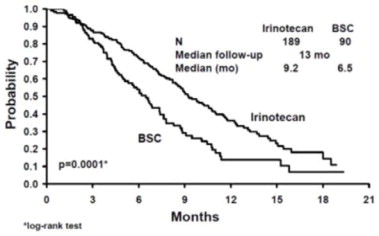
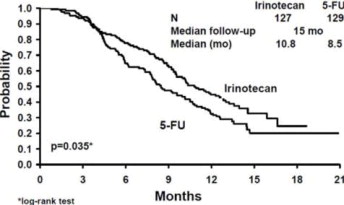
A total of 535 patients were randomized in the two studies at 94 centers. The primary endpoint in both studies was survival. The studies demonstrated a significant overall survival advantage for irinotecan compared with best supportive care (p=0.0001) and infusional 5-FU-based therapy (p=0.035) as shown in Figures 3 and 4. In Study 7, median survival for patients treated with irinotecan was 9.2 months compared with 6.5 months for patients receiving best supportive care. In Study 8, median survival for patients treated with irinotecan was 10.8 months compared with 8.5 months for patients receiving infusional 5-FU-based therapy. Multiple regression analyses determined that patients' baseline characteristics also had a significant effect on survival.
When adjusted for performance status and other baseline prognostic factors, survival among patients treated with irinotecan remained significantly longer than in the control populations (p=0.001 for Study 7 and p=0.017 for Study 8). Measurements of pain, performance status, and weight loss were collected prospectively in the two studies; however, the plan for the analysis of these data was defined retrospectively. When comparing irinotecan with best supportive care in Study 7, this analysis showed a statistically significant advantage for irinotecan, with longer time to development of pain (6.9 months versus 2.0 months), time to performance status deterioration (5.7 months versus 3.3 months), and time to >5% weight loss (6.4 months versus 4.2 months). Additionally, 33.3% (33/99) of patients with a baseline performance status of 1 or 2 showed an improvement in performance status when treated with irinotecan versus 11.3% (7/62) of patients receiving best supportive care (p=0.002). Because of the inclusion of patients with non-measurable disease, intent-to-treat response rates could not be assessed.
Figure 3. Survival
Second-Line Irinotecan vs Best Supportive Care (BSC)
Study 7
Figure 4. Survival
Second-Line Irinotecan vs Infusion 5-FU
Study 8
Table 12. Once-Every-3-Week Dosage Schedule: Study Results
|
|
| Study 7
| Study 8
|
| Irinotecan
| BSCa | Irinotecan
| 5-FU
|
Number of patients
| 189
| 90
| 127
| 129
|
Demographics and treatment administration |
Female/Male (%)
| 32/68
| 42/58
| 43/57
| 35/65
|
Median age in years (range)
| 59 (22-75)
| 62 (34-75)
| 58 (30-75)
| 58 (25-75)
|
Performance status (%)
| 47
| 31
| 58
| 54
|
0
| 39
| 46
| 35
| 43
|
1
| 14
| 23
| 8
| 3
|
2
| | | | |
Primary tumor (%)
| | | | |
Colon
| 55
| 52
| 57
| 62
|
Rectum
| 45
| 48
| 43
| 38
|
Prior 5-FU therapy (%)
| | | | |
For metastatic disease
| 70
| 63
| 58
| 68
|
As adjuvant treatment
| 30
| 37
| 42
| 32
|
Prior irradiation (%)
| 26
| 27
| 18
| 20
|
Duration of study treatment (median, months)
| | | | |
(Log-rank test)
| 4.1
| --
| 4.2
| |
| 2.8
| | (p=0.02)
| |
Relative dose intensity (median %)b | 94
| --
| 95
| 81-99
|
Survival |
Survival (median, months)
| 9.2
| 6.5
| 10.8
| 8.5
|
(Log-rank test)
| (p=0.0001)
| | (p=0.035)
| |
In the two randomized studies, the EORTC QLQ-C30 instrument was utilized. At the start of each cycle of therapy, patients completed a questionnaire consisting of 30 questions, such as “Did pain interfere with daily activities?” (1 = Not at All, to 4 = Very Much) and “Do you have any trouble taking a long walk?” (Yes or No). The answers from the 30 questions were converted into 15 subscales, that were scored from 0 to 100, and the global health status subscale that was derived from two questions about the patient's sense of general well being in the past week. The results as summarized in Table 13 are based on patients' worst post-baseline scores. In Study 7, a multivariate analysis and univariate analyses of the individual subscales were performed and corrected for multivariate testing. Patients receiving irinotecan reported significantly better results for the global health status, on two of five functional subscales, and on four of nine symptom subscales. As expected, patients receiving irinotecan noted significantly more diarrhea than those receiving best supportive care. In Study 8, the multivariate analysis on all 15 subscales did not indicate a statistically significant difference between irinotecan and infusional 5-FU.
Table 13. EORTC QLQ-C30: Mean Worst Post-Baseline Scorea |
QLQ-C30 Subscale | Study 7 | Study 8 |
Irinotecan | BSC | p-value | Irinotecan | 5-FU | p-value |
Global health status | 47
| 37
| 0.03
| 53
| 52
| 0.9
|
Functional scales |
Cognitive
| 77
| 68
| 0.07
| 79
| 83
| 0.9
|
Emotional
| 68
| 64
| 0.4
| 64
| 68
| 0.9
|
Social
| 58
| 47
| 0.06
| 65
| 67
| 0.9
|
Physical
| 60
| 40
| 0.0003
| 66
| 66
| 0.9
|
Role
| 53
| 35
| 0.02
| 54
| 57
| 0.9
|
Symptom Scales |
Fatigue
| 51
| 63
| 0.03
| 47
| 46
| 0.9
|
Appetite loss
| 37
| 57
| 0.0007
| 35
| 38
| 0.9
|
Pain assessment
| 41
| 56
| 0.009
| 38
| 34
| 0.9
|
Insomnia
| 39
| 47
| 0.3
| 39
| 33
| 0.9
|
Constipation
| 28
| 41
| 0.03
| 25
| 19
| 0.9
|
Dyspnea
| 31
| 40
| 0.2
| 25
| 24
| 0.9
|
Nausea/Vomiting
| 27
| 29
| 0.5
| 25
| 16
| 0.09
|
Financial impact
| 22
| 26
| 0.5
| 24
| 15
| 0.3
|
Diarrhea
| 32
| 19
| 0.01
| 32
| 22
| 0.2
|