Nausea: Nausea with or without vomiting has been noted in about 10% of patients treated with calcitonin-salmon. It is most evident when treatment is first initiated and tends to decrease or disappear with continued administration.
Dermatologic Reactions: Local inflammatory reactions at the site of subcutaneous or intramuscular injection have been reported in about 10% of patients. Flushing of face or hands occurred in about 2% to 5% of patients. Skin rashes and pruritus of the ear lobes have also been reported.
Other Adverse Reactions: Nocturia, feverish sensation, pain in the eyes, poor appetite, abdominal pain, pedal edema, and salty taste have been reported in patients treated with calcitonin-salmon injection.
Malignancy
A meta-analysis of 21 randomized, controlled clinical trials with calcitonin-salmon (nasal spray or investigational oral formulations) was conducted to assess the risk of malignancies in calcitonin-salmon-treated patients compared to placebo-treated patients. The trials in the meta-analysis ranged in duration from 6 months to 5 years and included a total of 10883 patients (6151 treated with calcitonin-salmon and 4732 treated with placebo). The overall incidence of malignancies reported in these 21 trials was higher among calcitonin-salmon-treated patients (254/6151 or 4.1%) compared with placebo-treated patients (137/4732 or 2.9%). Findings were similar when analyses were restricted to the 18 nasal spray only trials [calcitonin-salmon 122/2712 (4.5%); placebo 30/1309 (2.3%)].
The meta-analysis results suggest an increased risk of overall malignancies in calcitonin-salmon treated patients compared to placebo-treated patients when all 21 trials are included and when the analysis is restricted to the 18 nasal spray only trials (see Table 1). It is not possible to exclude an increased risk when calcitonin-salmon is administered by the subcutaneous, intramuscular, or intravenous route because these routes of administration were not investigated in the meta-analysis. The increased malignancy risk seen with the meta-analysis was heavily influenced by a single large 5-year trial, which had an observed risk difference of 3.4% [95% CI (0.4%, 6.5%)]. Imbalances in risks were still observed when analyses excluded basal cell carcinoma (see Table 1); the data were not sufficient for further analyses by type of malignancy. A mechanism for these observations has not been identified. Although a definitive causal relationship between calcitonin-salmon use and malignancies cannot be established from this meta-analysis, the benefits for the individual patient should be carefully evaluated against all possible risks [see Warnings and Precautions (5.3)].
Table 1: Risk Difference for Malignancies in Calcitonin-Salmon-Treated Patients Compared with Placebo-Treated Patients
|
|
| Patients | Malignancies | Risk Difference1
(%) | 95% Confidence Interval2
(%) |
| All (nasal spray + oral)
| All
| 1.0
| (0.3, 1.6)
|
| All (nasal spray + oral)
| Excluding basal cell carcinoma
| 0.5
| (-0.1, 1.2)
|
| All (nasal spray only)
| All
| 1.4
| (0.3, 2.6)
|
| All (nasal spray only)
| Excluding basal cell carcinoma
| 0.8
| (-0.2, 1.8)
|
Risk Summary
There are no studies with Calcitonin Salmon injection in pregnant women to inform a drug associated risk for birth defects or miscarriage. In an animal reproduction study, subcutaneous administration of calcitonin-salmon to pregnant rabbits during organogenesis at 4-18 times the recommended parenteral human dose caused a decrease in fetal birth weights. No adverse developmental outcome was observed in the rat with subcutaneous administration of calcitonin-salmon at 9 times the recommended human parenteral dose based on body surface area (see Data).
In the U.S. general population, the estimated background risk of major birth defects and miscarriage in clinically recognized pregnancies is 2-4% and 15-20%, respectively.
Data
Animal Data
Calcitonin-salmon has been shown to cause a decrease in fetal birth weights in rabbits when given by subcutaneous injection in doses 4 to 18 times the parenteral dose recommended for human use (of 54 International Units/m2).
No embryo/fetal toxicities related to Calcitonin Salmon were reported from maternal subcutaneous daily doses in rats up to 80 International Units/kg/day from gestation day 6 to 15.
Risk Summary
There is no information on the presence of calcitonin-salmon in human milk, the effects on the breastfed child, or the effects on milk production. Calcitonin has been shown to inhibit lactation in rats. The developmental and health benefits of breastfeeding should be considered along with the mother's clinical need for Calcitonin Salmon injection and any potential adverse effects on the breastfed infant from Calcitonin Salmon injection or from the underlying maternal condition.
Bone
Single injections of calcitonin-salmon caused a marked transient inhibition of the ongoing bone resorptive process. With prolonged use, there is a persistent, smaller decrease in the rate of bone resorption. Histologically, this is associated with a decreased number of osteoclasts and an apparent decrease in their resorptive activity.
In healthy adults, who have a relatively low rate of bone resorption, the administration of exogenous calcitonin-salmon results in decreases in serum calcium within the limits of the normal range. In healthy children and in patients whose bone resorption is more rapid, decreases in serum calcium are more pronounced in response to calcitonin-salmon.
Kidney
Studies with injectable calcitonin-salmon show increases in the excretion of filtered phosphate, calcium, and sodium by decreasing their tubular reabsorption.
Gastrointestinal Tract
Some evidence from studies with injectable preparations suggests that calcitonin-salmon may have effects on the gastrointestinal tract. Short-term administration of injectable calcitonin-salmon results in marked transient decreases in the volume and acidity of gastric juice and in the volume and the trypsin and amylase content of pancreatic juice. Whether these effects continue to be elicited after each injection of calcitonin-salmon during chronic therapy has not been investigated.
Rat findings:
The only clear neoplastic finding in rats dosed subcutaneously with calcitonin-salmon was an increase in the incidence of pituitary adenomas in male Fisher 344 rats and female Sprague Dawley rats after one year of dosing and male Sprague Dawley rats dosed for one and two years. In female Sprague Dawley rats, the incidence of pituitary adenomas after two years was high in all treatment groups (between 80% and 92% including the control groups) such that a treatment- related effect could not be distinguished from natural background incidence. The lowest dose in male Sprague Dawley rats that developed an increased incidence of pituitary adenomas after two years of dosing (1.7 International Units/kg/day) is approximately 1/6th of the maximum recommended subcutaneous dose in humans (100 International Units/day) based on body surface area conversion between rats and humans. The findings suggest that calcitonin-salmon reduced the latency period for development of non-functioning pituitary adenomas.
Mouse findings:
No carcinogenicity potential was evident in male or female mice dosed subcutaneously for two years with synthetic calcitonin-salmon at doses up to 800 International Units/kg/day. The 800 International Units/kg/day dose is approximately 39 times the maximum recommended subcutaneous dose in humans (100 International Units/day) based on body surface area conversion between mice and humans.
Mutagenesis
Synthetic calcitonin-salmon tested negative for mutagenicity using Salmonella typhimurium (5 strains) and Escherichia coli (2 strains), with and without rat liver metabolic activation, and was not clastogenic in a chromosome aberration test in Chinese Hamster V79 cells. There was no evidence that calcitonin-salmon was clastogenic in the in vivo mouse micronucleus test.
Fertility
Effects of calcitonin-salmon on fertility have not been assessed in animals.
How Supplied
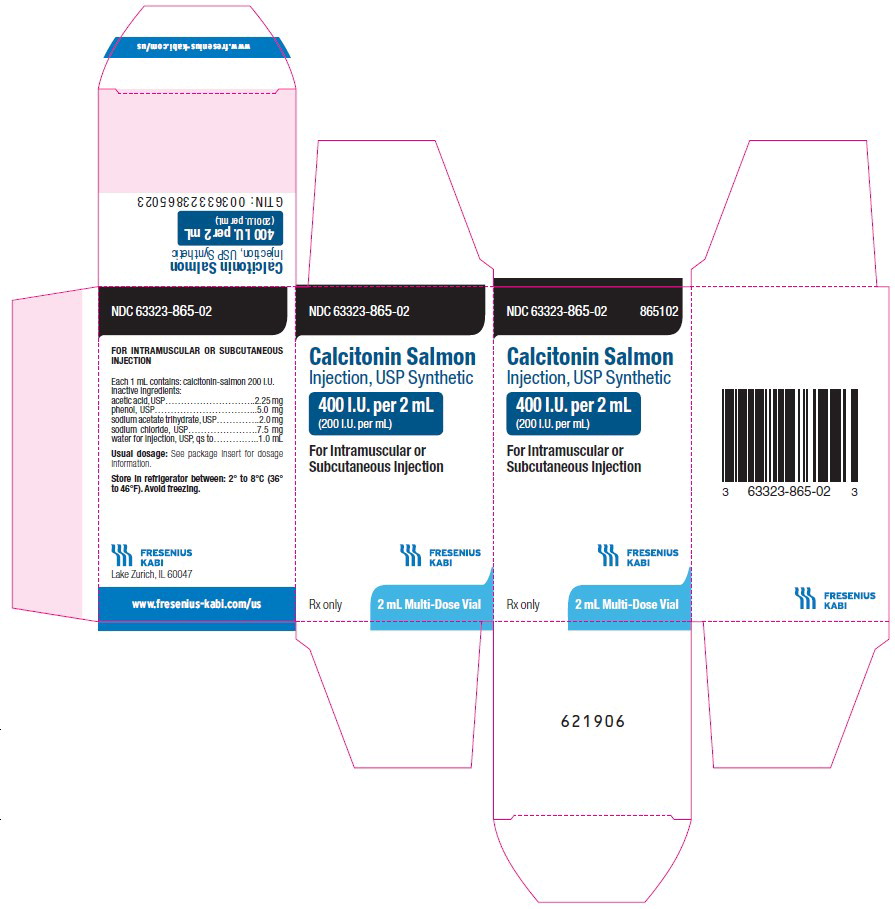
Calcitonin Salmon Injection, USP Synthetic is available as a sterile solution in individual 2 mL multi-dose vials containing 200 International Units (I.U.) per mL.
| Product Code | Unit of Sale | Strength/Concentration | Each |
| 865102
| NDC 63323-865-02
Unit of 1
| 400 I.U. per 2 mL (200 I.U. per mL)
| 2 mL Multi-Dose Vial
|