Xeljanz Solution
Product Images NDC 63539-029

27 FDA label images from U.s. Pharmaceuticals · Packaging, Regulatory Labels, and Product Appearance

Product Visual Gallery

This gallery contains 27 technical images submitted to the FDA as part of the official labeling for Xeljanz (NDC 63539-029). Unlike standard consumer photos, these assets often include clinical data figures, molecular chemical structures, and official manufacturer packaging layouts.

As provided by U.s. Pharmaceuticals, these visuals offer a comprehensive scientific overview of the product's physical and chemical identity, aiding pharmacists and researchers in product verification and study.

FDA Label Image

Chemical Structure (Xeljanz 01)
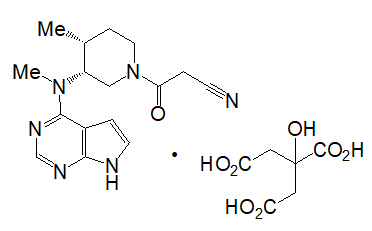
Chemical Structure (Xeljanz 01)
Chemical structure diagram showing the active ingredient tofacitinib citrate, including its molecular components and arrangement.*
FDA Label Image

Figure 1 (Xeljanz 02)

Figure 1 (Xeljanz 02)
A dot plot with 90% confidence intervals displaying pharmacokinetic (PK) ratios for AUC and Cmax relative to reference values for tofacitinib (XELJANZ). It compares intrinsic factors such as weight, age, sex, race, and renal and hepatic impairment, with corresponding dose adjustment recommendations indicated.*
FDA Label Image

Figure 2 (Xeljanz 03)

Figure 2 (Xeljanz 03)
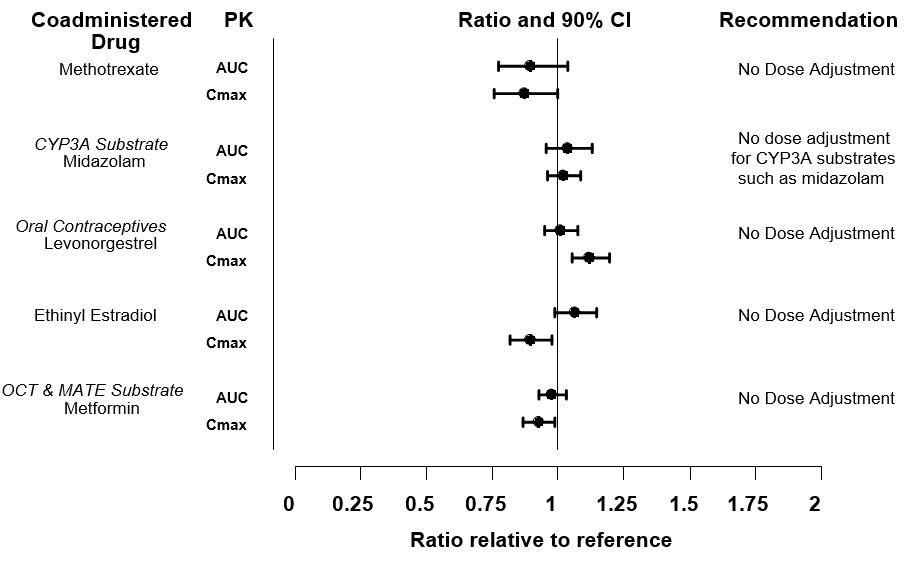
A forest plot chart depicting pharmacokinetic (PK) ratios and 90% confidence intervals (CI) for coadministered drugs with XELJANZ (tofacitinib). The chart compares AUC and Cmax ratios relative to reference for Methotrexate, Midazolam, Levonorgestrel, Ethinyl Estradiol, and Metformin, with all recommendations indicating no dose adjustment required.*
FDA Label Image

Figure 3 (Xeljanz 04)

Figure 3 (Xeljanz 04)
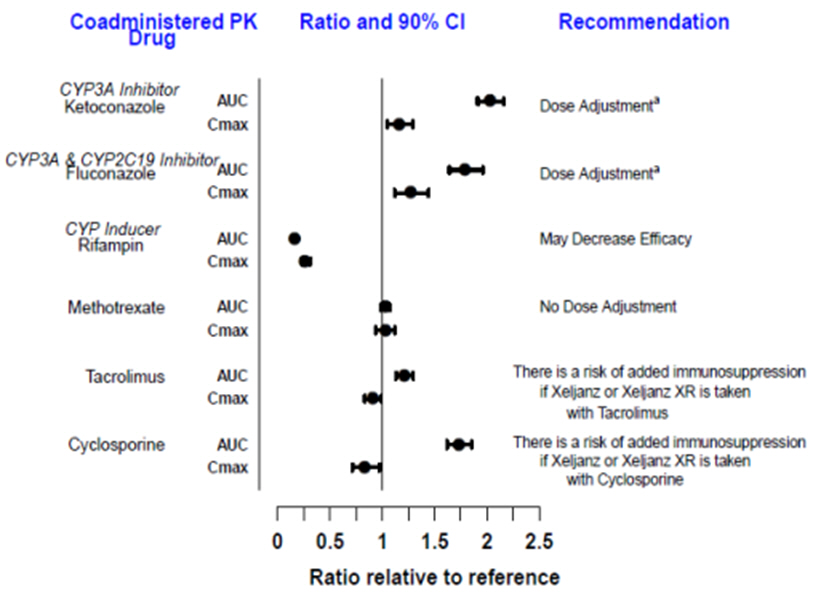
A pharmacokinetic (PK) interaction chart showing the ratio and 90% confidence intervals (CI) of drug exposure (AUC and Cmax) for XELJANZ (tofacitinib) when coadministered with various drugs, including CYP3A inhibitors (ketoconazole), CYP3A & CYP2C19 inhibitors (fluconazole), CYP inducers (rifampin), methotrexate, tacrolimus, and cyclosporine. Recommendations related to dose adjustment or immunosuppression risks accompany the data.*
FDA Label Image

Figure 4 (Xeljanz 05)

Figure 4 (Xeljanz 05)
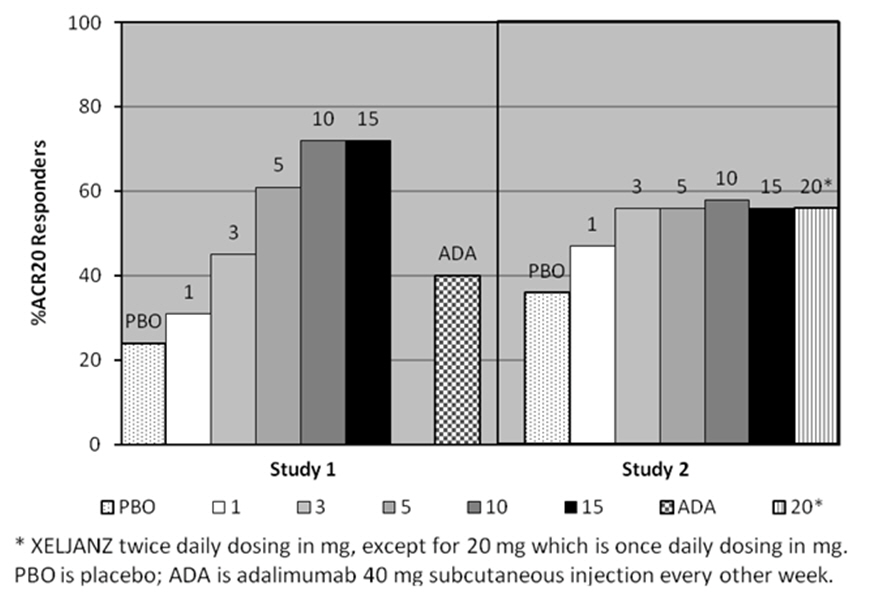
A bar graph comparing %ACR20 responders from two studies evaluating XELJANZ (tofacitinib) across various dosages (1, 3, 5, 10, 15, 20 mg) with placebo (PBO) and adalimumab (ADA). The chart shows the response rates for each dose group, with footnotes explaining dosing schedules: XELJANZ twice daily except 20 mg once daily; ADA as 40 mg subcutaneous injection every other week.*
FDA Label Image

Figure 5 (Xeljanz 06)

Figure 5 (Xeljanz 06)
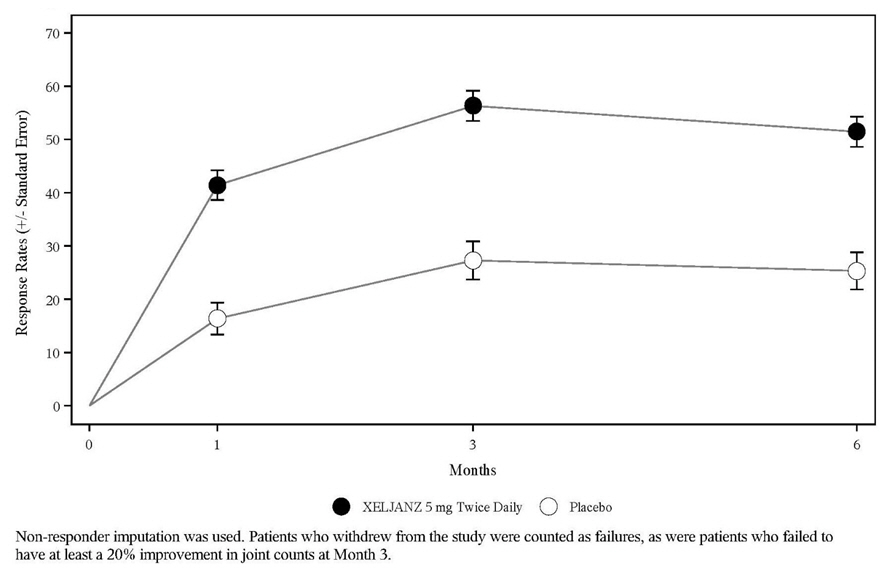
A line graph comparing response rates over 6 months between XELJANZ 5 mg twice daily and placebo. The y-axis represents response rates (+/- standard error), and the x-axis represents time in months. The graph shows higher response rates for XELJANZ relative to placebo throughout the study period, with error bars indicating variability.*
FDA Label Image

Figure 6 (Xeljanz 07)

Figure 6 (Xeljanz 07)
A line graph comparing the response rate (percentage) over a 3-month period for tofacitinib 5 mg twice daily (BID) versus placebo. The x-axis represents visit months (0 to 3), and the y-axis shows response rate percentages from 0 to 100%. Two lines are shown: a solid line for tofacitinib and a dashed line for placebo, each with error bars indicating standard error.*
FDA Label Image

Logo (Xeljanz 08)

Logo (Xeljanz 08)
A line graph showing the occurrence of disease flare over time in weeks, comparing tofacitinib 5 mg BID (88 subjects) to placebo (85 subjects). The y-axis represents the percentage occurrence of disease flare, showing a higher percentage in the placebo group throughout weeks 18 to 44, with statistical significance noted at week 44 (p = 0.0007). Error bars indicate standard error (SE).*
FDA Label Image

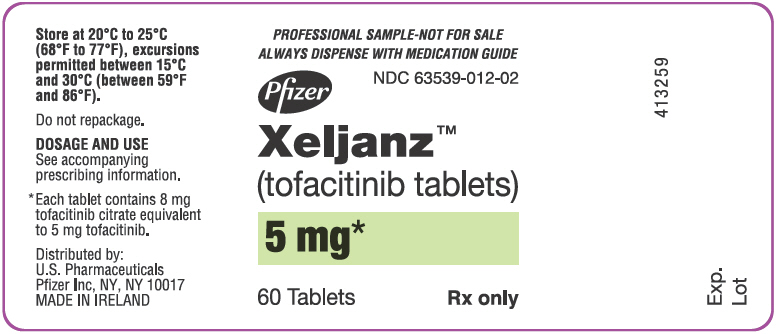
Principal Display Panel (5 mg Tablet Bottle Label)

FDA Label Image

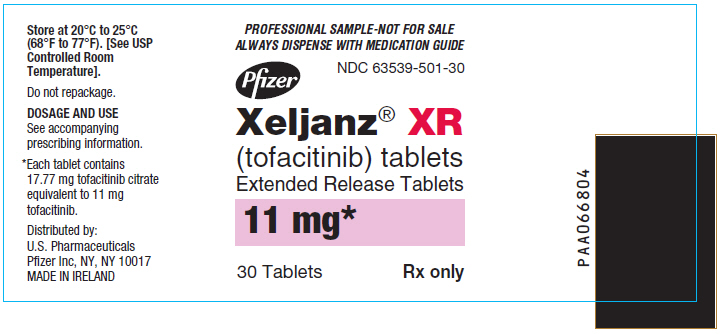
Principal Display Panel (11 mg Tablet Bottle Label)

FDA Label Image

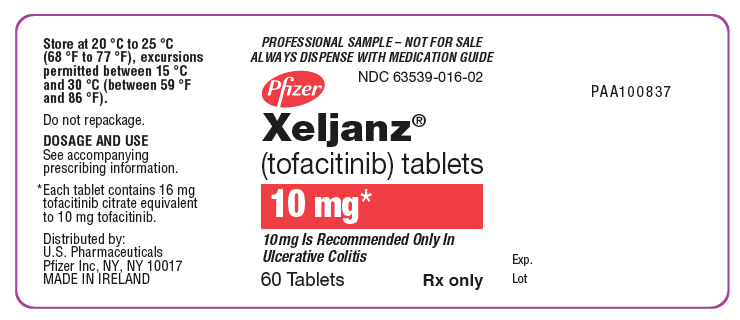
Principal Display Panel (10 mg Tablet Bottle Label)

Principal Display Panel (10 mg Tablet Bottle Label)
An instructional illustration showing the components included with XELJANZ oral solution: a bottle containing the solution, a press-in bottle adapter with ribbed end, and an oral dosing syringe labeled with parts including the barrel and plunger. The diagram visually identifies each item for proper assembly and use.*
FDA Label Image

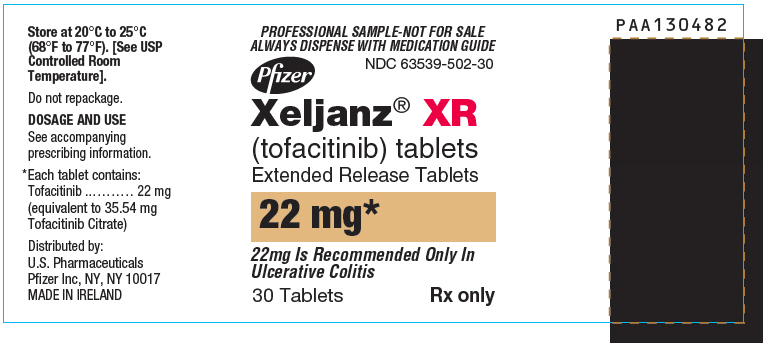
Principal Display Panel (22 mg Tablet Bottle Label)

Principal Display Panel (22 mg Tablet Bottle Label)
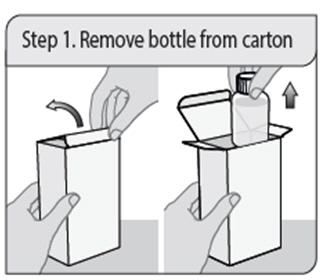
An instructional diagram showing Step 1 for opening a medication package. It illustrates removing a bottle from a carton by first opening the carton and then lifting the bottle out. The bottle appears to have a cap and an arrow indicates upward motion to take it out.*
FDA Label Image

Xeljanz 14

Xeljanz 14
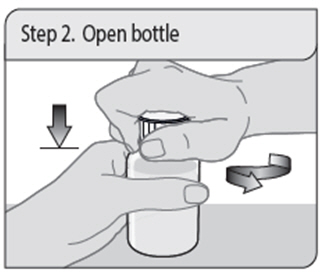
An instructional illustration demonstrating Step 2 of opening a bottle. It shows one hand pressing down on the bottle cap while the other hand turns the cap to open it, indicating the method of opening a child-resistant container.*
FDA Label Image

Xeljanz 15

Xeljanz 15
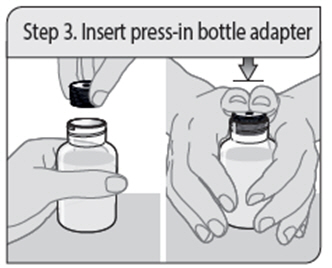
An instructional illustration showing Step 3 in using a bottle adapter. The left side depicts a hand holding a bottle with the cap removed, while an adapter is positioned above. The right side shows two hands pressing the adapter into the bottle opening, indicating how to insert the press-in bottle adapter securely.*
FDA Label Image

Xeljanz 16

Xeljanz 16
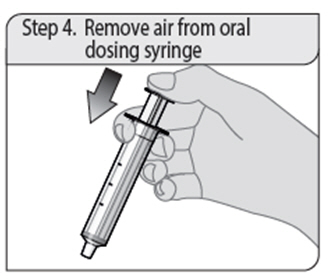
An instructional illustration showing a hand holding an oral dosing syringe with the plunger pulled back, directing to remove air from the syringe, marked as Step 4 in a dosing process.*
FDA Label Image

Xeljanz 17

Xeljanz 17
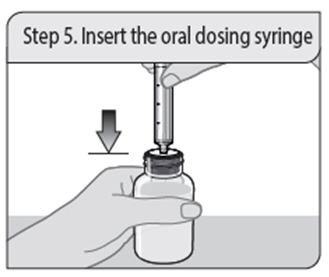
An instructional diagram showing a hand holding a medicine bottle while inserting an oral dosing syringe into the bottle's opening. The step is labeled as 'Step 5. Insert the oral dosing syringe.' An arrow indicates the direction of syringe insertion into the bottle.*
FDA Label Image

Xeljanz 18

Xeljanz 18
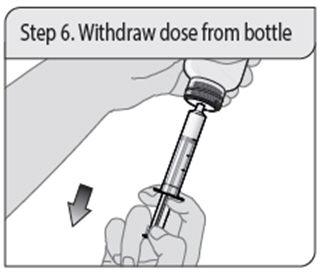
An instructional illustration labeled 'Step 6. Withdraw dose from bottle' depicting hands holding a syringe being filled from an inverted bottle. The image visually guides on how to withdraw a liquid dose using a syringe from a bottle.*
FDA Label Image

Xeljanz 19

Xeljanz 19
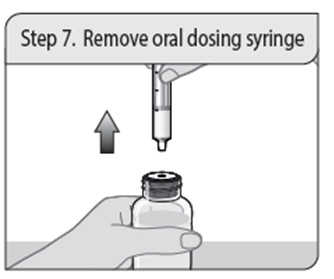
Illustration showing Step 7 in the administration process: removing an oral dosing syringe from the top of a medication bottle. The hand holds the bottle steady while the syringe is being lifted upwards and away.*
FDA Label Image

Xeljanz 20

Xeljanz 20
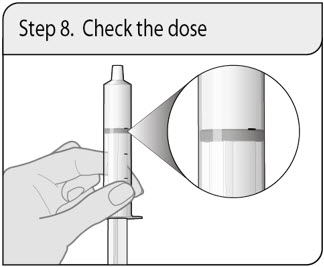
Illustration demonstrating Step 8 of a dosing procedure, showing a hand holding a syringe with a close-up inset highlighting the dose measurement on the syringe barrel.*
FDA Label Image

Xeljanz 21

Xeljanz 21
An instructional illustration showing a person taking a dose of XELJANZ. The image depicts a hand holding a syringe-like oral applicator positioned at the open mouth, indicating how to administer the medication orally.*
FDA Label Image

Xeljanz 22

Xeljanz 22
An instructional illustration labeled "Step 10. Close the bottle" showing a sequence of actions: pressing down and twisting a child-resistant cap onto a bottle, placing the bottle into a carton, and closing the carton flap. The grayscale drawing features hands performing each step.*
FDA Label Image

Xeljanz 23

Xeljanz 23
An instructional illustration demonstrating step 11 of cleaning an oral dosing syringe. The left panel shows a hand pulling the plunger out of the syringe barrel. The right panel shows the syringe being rinsed under running water, with water flowing into the barrel.*
FDA Label Image

Xeljanz 24

FDA Label Image

Xeljanz 25

Xeljanz 25
Label for Xeljanz (tofacitinib) tablets by Pfizer, containing 5 mg film-coated tablets. The pack contains 60 tablets for oral use. The label includes storage instructions and notes that the product is a professional sample not for sale, distributed by U.S. Pharmaceuticals and Pfizer Inc.*
FDA Label Image

Xeljanz 26

Xeljanz 26
Xeljanz XR (tofacitinib) extended release tablets, 11 mg strength, 30 count, film-coated oral tablets. Label indicates professional sample, not for sale, distributed by U.S. Pharmaceuticals and Pfizer Inc. Storage at 20°C to 25°C advised. Contains 17.77 mg tofacitinib citrate equivalent to 11 mg tofacitinib.*
FDA Label Image

Xeljanz 27

Xeljanz 27
Label for Xeljanz (tofacitinib) tablets, 10 mg strength, film coated oral tablets. The label indicates professional sample not for sale, with storage instructions and dosage information. Distributed by U.S. Pharmaceuticals and Pfizer Inc. The package contains 60 tablets and is marked Rx only.*
FDA Label Image

Xeljanz 28

Xeljanz 28
Label for Xeljanz XR (tofacitinib) extended release tablets, 22 mg strength. The label indicates it is a professional sample not for sale and contains 30 tablets. Distributed by U.S. Pharmaceuticals, Pfizer Inc. Storage instructions specify 20°C to 25°C controlled room temperature. The label states the drug is Rx only and recommends 22 mg only for ulcerative colitis.*

* About these descriptions: Image descriptions on this page are generated by automated AI analysis of the product label images from the manufacturer's FDA label submission (SPL). They are provided for reference only and may contain errors or omissions. Always rely on the printed label itself and the official FDA labeling, and consult a pharmacist or healthcare professional with any questions about this product.