Stroke
In the WHI estrogen-alone substudy, a statistically significant increased risk of stroke was reported in women 50 to 79 years of age receiving daily conjugated estrogens (CE) (0.625 mg)-alone compared to women in the same age group receiving placebo (45 versus 33 per 10,000 women-years). The increase in risk was demonstrated in year 1 and persisted [see Clinical Studies (14.5)].
Subgroup analyses of women 50 to 59 years of age suggest no increased risk of stroke for those women receiving conjugated estrogens (0.625 mg)-alone versus those receiving placebo (18 versus 21 per 10,000 women-years).
Should a stroke occur or be suspected, DUAVEE should be discontinued immediately [see Contraindications (4)].
Coronary Heart Disease
In the WHI estrogen-alone substudy, no overall effect on coronary heart disease (CHD) events (defined as nonfatal myocardial infarction, silent myocardial infarction, or CHD death) was reported in women receiving estrogen-alone compared to placebo [see Clinical Studies (14.5)].
Subgroup analyses of women 50 to 59 years of age suggest a statistically non-significant reduction in CHD events (CE [0.625 mg]-alone compared to placebo) in women with less than 10 years since menopause (8 versus 16 per 10,000 women-years).
Venous Thromboembolism (VTE)
In the WHI estrogen-alone substudy, the risk of VTE [DVT and pulmonary embolism (PE)] was increased for women receiving daily conjugated estrogens (0.625 mg)-alone compared to placebo (30 versus 22 per 10,000 women-years), although only the increased risk of DVT reached statistical significance (23 versus 15 per 10,000 women-years). The increase in VTE risk was demonstrated during the first 2 years [see Clinical Studies (14.5)].
If feasible, DUAVEE should be discontinued at least 4 to 6 weeks before surgery of the type associated with an increased risk of thromboembolism, or during periods of prolonged immobilization. Because immobilization increases the risk for venous thromboembolic events independent of therapy, DUAVEE should be discontinued prior to and during prolonged immobilization (e.g., post-surgical recovery, prolonged bed rest) and DUAVEE therapy should be resumed only after the patient is fully ambulatory. In addition, women taking DUAVEE should be advised to move about periodically during travel involving prolonged immobilization.
Endometrial Cancer
An increased risk of endometrial cancer has been reported with the use of unopposed estrogen therapy in women with a uterus. The reported endometrial cancer risk among unopposed estrogen users is about 2 to 12 times greater than in non-users, and appears dependent on duration of treatment and on estrogen dose. Most studies show no significant increased risk associated with use of estrogens for less than 1 year. The greatest risk appears associated with prolonged use, with increased risks of 15- to 24-fold for 5 to 10 years or more of treatment. This risk has been shown to persist for at least 8 to 15 years after estrogen therapy is discontinued.
DUAVEE contains an estrogen agonist/antagonist. This component reduces the risk of endometrial hyperplasia that can occur with the conjugated estrogens component. Endometrial hyperplasia may be a precursor to endometrial cancer. Women taking DUAVEE should not take additional estrogens as this may increase the risk of endometrial hyperplasia.
Clinical surveillance of all women taking DUAVEE is important. Adequate diagnostic measures, including directed or random endometrial sampling when indicated, should be undertaken to rule out malignancy in postmenopausal women with undiagnosed persistent or recurring abnormal genital bleeding.
Breast Cancer
The most important randomized clinical study providing information about breast cancer in estrogen-alone users is the WHI substudy of daily conjugated estrogens (0.625 mg)-alone. In the WHI estrogen-alone substudy, after an average follow-up of 7.1 years, daily conjugated estrogen (0.625 mg)-alone was not associated with an increased risk of invasive breast cancer (relative risk [RR] 0.80).
The use of estrogen-alone has been reported to result in an increase in abnormal mammograms requiring further evaluation. The effect of treatment with DUAVEE on the risk of breast cancer is unknown.
All women should receive yearly breast examinations by a healthcare provider and perform monthly breast self-examinations. In addition, mammography examinations should be scheduled based on patient age, risk factors, and prior mammogram results.
Ovarian Cancer
In some epidemiological studies, the use of estrogen-only products, in particular for 5 or more years, has been associated with an increased risk of ovarian cancer. However, the duration of exposure associated with increased risk is not consistent across all epidemiologic studies, and some report no association. The effect of treatment with DUAVEE on the risk of ovarian cancer is unknown.
Venous thromboembolism: In the clinical studies with DUAVEE, the reporting rates for venous thromboembolism (deep venous thrombosis, pulmonary embolism, and retinal vein thrombosis) were low in all treatment groups. Adverse reactions of venous thromboembolism were reported in 0.0% of patients treated with DUAVEE and 0.1% of patients treated with placebo. Due to the low rate of events in both groups, it is not possible to conclude that the risk of venous thromboembolism with DUAVEE is different from that seen with other estrogen therapies [see Warnings and Precautions (5.2)].
Absorption
Following administration of multiple doses of conjugated estrogens 0.45 mg/bazedoxifene 20 mg to healthy women who were naturally postmenopausal or who had undergone bilateral oophorectomy, the mean steady state pharmacokinetic parameters at Day 10 for conjugated estrogens (baseline adjusted for total estrone) and bazedoxifene are summarized in Table 2.
Table 2: Mean ± SD Steady-State Pharmacokinetic Parameters (n=24) | Cmax
(ng/mL) | Tmax
(hr) | AUCss
(ng∙hr/mL) |
|---|
| Baseline-Adjusted Total Estrone | 2.6 ± 0.8 | 6.5 ± 1.6 | 35 ± 12 |
| Bazedoxifene | 6.9 ± 3.9 | 2.5 ± 2.1 | 71 ± 34 |
Results from monotherapy studies with conjugated estrogens or bazedoxifene components of DUAVEE, are noted below:
Conjugated estrogens are soluble in water and are well-absorbed from the gastrointestinal tract after release from the drug formulation.
Bazedoxifene exhibits a linear increase in plasma concentrations for single doses from 0.5 mg up to 120 mg and multiple daily doses from 1 mg to 80 mg. The absolute bioavailability of bazedoxifene is approximately 6%.
Food Effect
In a single-dose, crossover study in 23 postmenopausal women given conjugated estrogens 0.625 mg/bazedoxifene 20 mg with a high fat/high calorie meal, food increased AUC0–inf of bazedoxifene by 25%. The Cmax of bazedoxifene was unchanged.
Distribution
The distribution of conjugated estrogens and bazedoxifene after administration of DUAVEE has not been studied.
Results from monotherapy studies with conjugated estrogens or bazedoxifene, components of DUAVEE, are noted below:
The distribution of exogenous estrogens is similar to that of endogenous estrogens. Estrogens are widely distributed in the body and are generally found in higher concentrations in the sex hormone target organs. Estrogens circulate in the blood largely bound to sex hormone binding globulin (SHBG) and albumin.
Following intravenous (IV) administration of a 3 mg dose of bazedoxifene, the volume of distribution is 14.7 ± 3.9 L/kg. Bazedoxifene is highly bound (98%–99%) to plasma proteins in vitro, but does not bind to SHBG.
Metabolism
The metabolic disposition of conjugated estrogens and bazedoxifene, after administration of DUAVEE, has not been studied.
Results from monotherapy studies with conjugated estrogens or bazedoxifene, components of DUAVEE, are noted below:
Exogenous estrogens are metabolized in the same manner as endogenous estrogens. Circulating estrogens exist in a dynamic equilibrium of metabolic interconversions. 17-β estradiol is converted reversibly to estrone, and both can be converted to estriol, which is the major urinary metabolite. In postmenopausal women, a significant proportion of the circulating estrogens exists as sulfate conjugates, especially estrone sulfate, which serves as a circulating reservoir for the formation of more active estrogens.
The metabolic disposition of bazedoxifene has been determined following oral administration of 20 mg of radiolabeled bazedoxifene. Bazedoxifene is extensively metabolized in women. Glucuronidation is the major metabolic pathway. Little or no cytochrome P450-mediated metabolism is evident. Bazedoxifene-5-glucuronide is the major circulating metabolite. The concentrations of this glucuronide are approximately 10-fold higher than those of unchanged drug in plasma.
Excretion
After administration of a single dose of conjugated estrogens/bazedoxifene, baseline-adjusted total estrone (representing conjugated estrogens) is eliminated with a half-life of approximately 17 hours. Bazedoxifene is eliminated with a half-life of approximately 30 hours. Steady-state concentrations are achieved by the second week of once-daily administration.
Results from monotherapy studies with conjugated estrogens or bazedoxifene, components of DUAVEE, are noted below:
The conjugated estrogens components, 17β-estradiol, estrone, and estriol are excreted in the urine, along with glucuronide and sulfate conjugates.
The clearance of bazedoxifene is 0.4 ± 0.1 L/h/kg based on intravenous administration. The major route of excretion after oral administration of 20 mg of radiolabeled bazedoxifene is via biliary excretion, followed by elimination in the feces (~85%), with < 1% of the radioactive dose eliminated in the urine. Based on these results, it is expected that bazedoxifene undergoes entero-hepatic recycling from the gut back to the systemic circulation, therefore, some drugs may potentially interfere with bazedoxifene recycling process in the gut by various mechanisms resulting in a decrease in its systemic exposure.
Use in Specific Populations
Pediatric
The pharmacokinetics of conjugated estrogens/bazedoxifene tablets have not been evaluated in a pediatric population [see Use in Specific Populations (8.4)].
Geriatric
The effect of age on the pharmacokinetics of conjugated estrogens/bazedoxifene tablets have not been evaluated [see Use in Specific Populations (8.5)].
No pharmacokinetic studies with conjugated estrogens were conducted in specific populations, including women over 75 years of age.
The pharmacokinetics of a 20 mg single-dose of bazedoxifene, were evaluated in postmenopausal women. On average, compared to women 51 to 64 years of age (n=8), women 65 to 74 years of age (n=8) showed a 1.5-fold increase in AUC, and women ≥ 75 years of age (n=8) showed a 2.6-fold increase in AUC.
Renal Impairment
The pharmacokinetics of conjugated estrogens/bazedoxifene tablets have not been evaluated in women with renal impairment [see Dosage and Administration (2.6) and Use in Specific Populations (8.6)].
Hepatic Impairment
The pharmacokinetics of conjugated estrogens/bazedoxifene tablets have not been evaluated in women with hepatic impairment [see Contraindications (4), Warnings and Precautions (5.5), and Use in Specific Populations (8.7)].
No pharmacokinetic studies with conjugated estrogens were conducted in specific populations, including women with hepatic impairment.
A single dose of bazedoxifene 20 mg was given to fasted, healthy (N=18) and hepatically impaired postmenopausal women. In six mild hepatic impairment patients (Child Pugh Class A), Cmax and AUC of bazedoxifene increased 67% and 143%, respectively, compared to healthy subjects. In six moderate hepatic impairment patients (Child Pugh Class B), Cmax and AUC of bazedoxifene increased 32% and 109%, respectively, compared to healthy subjects. In six severe hepatic impairment patients (Child Pugh Class C), Cmax and AUC of bazedoxifene increased 20% and 268%, respectively, compared to healthy subjects. Half-life was prolonged from 32 to 50 hrs in patients with severe hepatic impairment, compared to healthy subjects.
Drug Interactions
No drug-drug interaction studies were conducted with conjugated estrogens/bazedoxifene tablets.
Effect of Co-Administered Drugs on the Pharmacokinetics of Bazedoxifene
Conjugated Estrogens
Conjugated estrogens 0.625 mg were administered alone for 6 consecutive days prior to the co-administration of a single dose of 20 mg bazedoxifene and conjugated estrogens 0.625 mg in thirty postmenopausal women. Conjugated estrogens 0.625 mg were continued for 2 additional days after the co-administration of bazedoxifene and conjugated estrogens. The Cmax of bazedoxifene increased by 3% and AUC of bazedoxifene decreased by 6%.
Ibuprofen
A single dose of ibuprofen 600 mg was given with a bazedoxifene 20 mg capsule in twelve postmenopausal women after an overnight fast. Co-administration of ibuprofen and bazedoxifene increased Cmax and AUC of bazedoxifene by 18% and 7%, respectively.
Atorvastatin
Atorvastatin 20 mg was given once with bazedoxifene 40 mg in thirty postmenopausal women. Co-administration of atorvastatin and bazedoxifene decreased Cmax of bazedoxifene by 3% and increased AUC of bazedoxifene by 6%.
Azithromycin
Azithromycin 500 mg was given once daily for 8 consecutive days in thirty postmenopausal women. Azithromycin 500 mg and a bazedoxifene 40 mg tablet were co-administered on Day 9. Azithromycin 250 mg administration once daily continued on Days 10 to 13. Co-administration of azithromycin and bazedoxifene increased Cmax of bazedoxifene by 6% and decreased AUC of bazedoxifene by 15%.
Aluminum and Magnesium Hydroxide
A single dose of 460 mg aluminum hydroxide and 400 mg magnesium hydroxide was given with a bazedoxifene 40 mg tablet in thirty postmenopausal women after an overnight fast. Co-administration of aluminum/magnesium hydroxide and bazedoxifene decreased Cmax of bazedoxifene by 8% and increased AUC of bazedoxifene by 7%.
Effect of Bazedoxifene on the Pharmacokinetics of Co-Administered Drugs
Conjugated Estrogens
Bazedoxifene 20 mg was administered alone for 8 consecutive days prior to co-administration of a single dose of conjugated estrogens 0.625 mg and bazedoxifene 20 mg in twenty-six postmenopausal women. Bazedoxifene 20 mg was continued for 2 additional days after co-administration of bazedoxifene and conjugated estrogens. The Cmax and AUC of unconjugated estrone increased by 11% and 3%, respectively. The Cmax and AUC of unconjugated equilin increased by 17% and 14%, respectively.
Ibuprofen
A single dose of bazedoxifene 20 mg capsule was given with a single dose of ibuprofen 600 mg in twelve fasted, postmenopausal women. Co-administration of bazedoxifene and ibuprofen increased the Cmax of ibuprofen by 6%. The AUC of ibuprofen was unchanged.
Atorvastatin
Bazedoxifene 40 mg was given for 8 consecutive days prior to co-administration of bazedoxifene 40 mg and atorvastatin 20 mg. Co-administration of bazedoxifene and atorvastatin decreased Cmax of atorvastatin by 14%. The AUC of atorvastatin was unchanged. The Cmax and AUC of 2-OH atorvastatin were decreased by 18% and 8%, respectively.
Carcinogenesis
Carcinogenicity studies with conjugated estrogens/bazedoxifene have not been conducted.
Long-term continuous administration of natural and synthetic estrogens in certain animal species increases the frequency of carcinomas of the breast, uterus, cervix, vagina, testis, and liver.
In 6-month oral gavage carcinogenicity studies of bazedoxifene in transgenic Tg.RasH2 mice, there was a drug-related increased incidence of benign, ovarian granulosa-cell tumors in female mice given 150 or 500 mg/kg/day. In a two-year dietary carcinogenicity study of bazedoxifene in rats (administered at 0.003%, 0.01%, 0.03%, or 0.1%) a drug-related marked increased incidence of benign, ovarian granulosa-cell tumors was observed in female rats at concentrations of 0.03% and 0.1%. Systemic exposure (AUC) of bazedoxifene in these groups was 3 and 8 times that observed in postmenopausal women administered 20 mg/day. In male rats, drug-related renal tumors (adenomas and carcinomas), in the presence of renal toxicity, were observed at all doses tested, which corresponded to exposure ratios of 0.06 to 5 times the clinical AUC at a dose of 20 mg.
Mutagenesis
Mutagenicity studies with conjugated estrogens/bazedoxifene have not been conducted.
Bazedoxifene was not genotoxic or mutagenic in a battery of tests, including in vitro bacterial reverse mutation assay, in vitro mammalian cell forward mutation assay at the thymidine kinase (TK+/-) locus in L5178Y mouse lymphoma cells, in vitro chromosome aberration assay in Chinese hamster ovary (CHO) cells, and in vivo mouse micronucleus assay.
Impairment of Fertility
Impairment of fertility studies with conjugated estrogens/bazedoxifene have not been conducted.
Female rats were administered daily dosages of 0.3 to 30 mg/kg bazedoxifene (0.03 to 10 times human AUC at the 20 mg dose) prior to and during mating with untreated males. Estrous cycles and fertility were adversely affected in all bazedoxifene-treated female groups.
LAB-0582-1.0
What is DUAVEE?
DUAVEE is a prescription medicine that contains a mixture of estrogens and bazedoxifene.
What is DUAVEE used for?
DUAVEE is used after menopause for women with a uterus to:
- reduce moderate to severe hot flushes
Estrogens are hormones made by a woman's ovaries. The ovaries normally stop making estrogens when a woman is between 45 and 55 years old. This drop in body estrogen levels causes the "change of life" or menopause (the end of monthly menstrual periods). Sometimes both ovaries are removed during an operation before natural menopause takes place. The sudden drop in estrogen levels causes "surgical menopause."
When the estrogen levels begin dropping, some women get very uncomfortable symptoms, such as feelings of warmth in the face, neck, and chest, or sudden intense episodes of heat and sweating ("hot flashes" or "hot flushes"). In some women, the symptoms are mild, and they will not need to take medicines. In other women, symptoms can be more severe. - help reduce your chances of developing osteoporosis (thin, weak bones)
If you use DUAVEE only to prevent osteoporosis due to menopause, talk with your healthcare provider about whether a different treatment or medicine without estrogens might be better for you.
DUAVEE should be taken for the shortest time possible and only for as long as treatment is needed. You and your healthcare provider should talk regularly about whether you still need treatment with DUAVEE.
DUAVEE is not for use in children.
It is not known if DUAVEE is safe and effective in people with kidney problems.
Who should not take DUAVEE?
Do not take DUAVEE if you:
- currently have or have had blood clots
- are allergic to estrogens or bazedoxifene, the active ingredients in DUAVEE, or any of its ingredients. See the list of ingredients in DUAVEE at the end of this leaflet.
- have unusual vaginal bleeding. Vaginal bleeding after menopause may be a warning sign of cancer of the uterus (womb). Your healthcare provider should check any unusual vaginal bleeding to find out the cause.
- currently have or have had certain cancers. Estrogens may increase the chances of getting certain types of cancers, including cancer of the breast or uterus. If you have or have had cancer, talk with your healthcare provider about whether you should use DUAVEE.
- currently have or have had liver problems
- have been diagnosed with a bleeding disorder
- think you may be pregnant. DUAVEE is not for pregnant women. If you think you may be pregnant, you should have a pregnancy test and know the results. Do not take DUAVEE if the test is positive and talk to your healthcare provider.
- are breastfeeding or plan to breastfeed. It is not known if DUAVEE passes into your breast milk. You and your healthcare provider should decide if you will take DUAVEE or breastfeed. You should not do both.
What should I tell my healthcare provider before taking DUAVEE?
Before you take DUAVEE, tell your healthcare provider if you:
- have any unusual vaginal bleeding.
- have any other medical conditions. Your healthcare provider may need to check you more carefully if you have certain conditions, such as asthma (wheezing), epilepsy (seizures), diabetes, migraine, endometriosis, lupus, or problems with your heart, liver, thyroid, kidneys, or have high calcium levels in your blood.
- are going to have surgery or will be on bed rest. Your healthcare provider will let you know if you need to stop taking DUAVEE.
Tell your healthcare provider about all the medicines you take, including prescription and over-the-counter medicines, vitamins, and herbal supplements.
Especially tell your healthcare provider if you take other hormonal medicines, including progestins or other medicines like DUAVEE. Ask your healthcare provider if you do not know if you take any of these medicines.
Some medicines may affect how DUAVEE works. DUAVEE may also affect how your other medicines work. Keep a list of your medicines and show it to your healthcare provider and pharmacist when you get a new medicine.
How should I take DUAVEE?
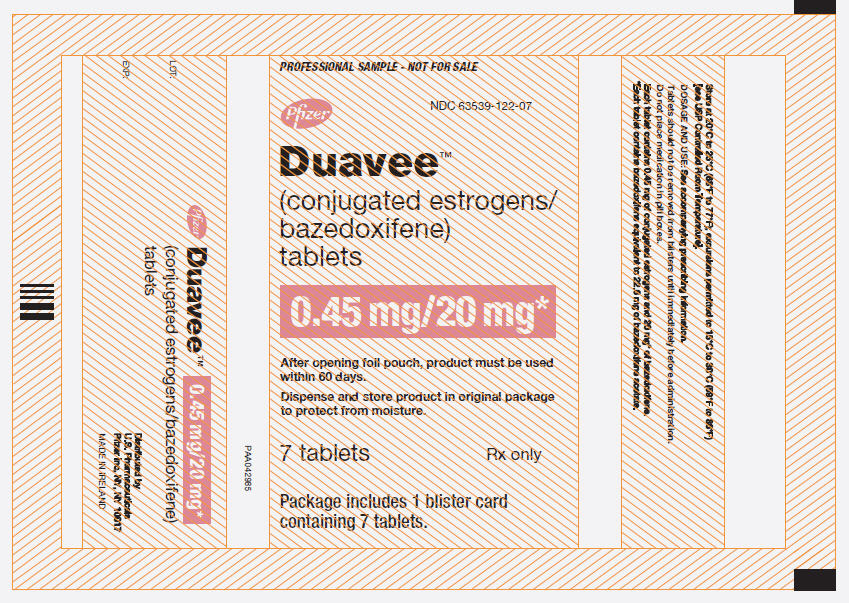
- DUAVEE comes in a blister package.
- Record the date you open the foil pouch in the space provided on the blister package label. Do not use if the blister package has been open for more than 60 days.
- Take DUAVEE exactly as your healthcare provider tells you to take it.
- Take 1 DUAVEE tablet at the same time each day.
- DUAVEE should be swallowed whole.
- Take DUAVEE with or without food.
- You should not remove DUAVEE from the blister until right before you are ready to take it. Remove 1 tablet at a time from the blister package. Do not place DUAVEE in pill boxes or pill organizers.
- If you miss a dose of DUAVEE, take it as soon as you remember. If it is almost time for your next dose, skip the missed dose. Take the next dose at your regular time. Do not take 2 doses at the same time unless your healthcare provider tells you to. If you are not sure about your dosing, call your healthcare provider.
- If you take a calcium or vitamin D supplement, you may take it at the same time you take DUAVEE.
- If you take too much DUAVEE, call your healthcare provider. Symptoms of taking too much DUAVEE include:
- nausea
- vomiting
- breast tenderness
- dizziness
| - abdominal pain
- feeling tired
- vaginal bleeding
|
What are the possible side effects of DUAVEE?
Side effects are grouped by how serious they are and how often they happen when you are treated.
Serious side effects include:
- blood clots
- stroke
- heart attack
- cancer of the lining of the uterus
- breast cancer
- cancer of the ovary
- dementia
- gallbladder problems
- loss of vision
- high blood pressure
- increased fats in your blood
- liver problems
- thyroid problems
- fluid retention
- low calcium
- swelling of your mouth or tongue
- worsening of other medical problems such as asthma, diabetes, epilepsy, migraines, a genetic problem called porphyria, lupus and liver problems
Call your healthcare provider right away if you get any of the following warning signs, or any other unusual symptoms that concern you:
- new breast lumps
- unusual vaginal bleeding
- changes in vision or speech
- sudden new severe headaches
- severe pains in your chest or legs with or without shortness of breath, weakness and fatigue
Less serious, but common side effects include:
- muscle spasms
- nausea
- diarrhea
- upset stomach
- abdominal pain
- throat pain
- dizziness
- neck pain
These are not all the possible side effects of DUAVEE. For more information, ask your healthcare provider or pharmacist. Tell your healthcare provider if you have any side effects that bother you or do not go away.
Call your doctor for medical advice about side effects. You may report side effects to FDA at 1-800-FDA-1088.
What can I do to lower my chances of a serious side effect with DUAVEE?
- Talk with your healthcare provider regularly about whether you should continue taking DUAVEE.
- See you healthcare provider right away if you get vaginal bleeding while taking DUAVEE.
- Have a pelvic exam, breast exam and mammogram (breast X-ray) every year unless your healthcare provider tells you something else.
- If members of your family have had breast cancer or if you have ever had breast lumps or an abnormal mammogram, you may need to have breast exams more often.
- If you have high blood pressure, high cholesterol (fat in the blood), diabetes, are overweight, or if you use tobacco, you may have higher chances of getting heart disease.
Ask your healthcare provider for ways to lower your chances of getting heart disease.
How do I store DUAVEE?
- Store DUAVEE at room temperature between 68°F to 77°F (20°C to 25°C).
- Keep DUAVEE in the blister until you are ready to take it to protect the tablet from moisture.
- Do not place DUAVEE in pill boxes or pill organizers.
- After opening the foil pouch the DUAVEE blisters come in, DUAVEE must be used within 60 days.
Keep DUAVEE and all other medicines out of the reach of children.
General information about the safe and effective use of DUAVEE
Medicines are sometimes prescribed for purposes other than those listed in a Patient Information leaflet. Do not use DUAVEE for a condition for which it was not prescribed. Do not give DUAVEE to other people, even if they have the same symptoms you have. It may harm them.
This Patient Information summarizes the most important information about DUAVEE. If you would like more information, talk with your healthcare provider. You can ask your pharmacist or healthcare provider for information about DUAVEE that is written for health professionals.
For more information, go to www.DUAVEE.com, or call 1-800-438-1985.
What are the ingredients in DUAVEE?
Active Ingredients: conjugated estrogens and bazedoxifene. Conjugated estrogens are a mixture of sodium estrone sulfate and sodium equilin sulfate and other components, including sodium sulfate conjugates, 17α-dihydroequilin, 17α-estradiol, and 17β-dihydroequilin.
Inactive Ingredients: calcium phosphate tribasic, hydroxypropyl cellulose, microcrystalline cellulose, powdered cellulose, hypromellose, lactose monohydrate, magnesium stearate, polyethylene glycol, sucrose, ascorbic acid, sucrose palmitic acid ester, hydroxyethylcellulose, titanium dioxide, red iron oxide, yellow iron oxide, black iron oxide, povidone, polydextrose, maltitol, poloxamer 188, propylene glycol, isopropyl alcohol.
This Patient Information has been approved by the U.S. Food and Drug Administration.
This product's label may have been updated. For current full prescribing information, please visit www.pfizer.com.
LAB-0583-1.0
October 2013