Dutasteride Capsule, Liquid Filled
Product Images NDC 63629-1223

11 FDA label images from Bryant Ranch Prepack · Packaging, Regulatory Labels, and Product Appearance

Product Visual Gallery

This gallery contains 11 technical images submitted to the FDA as part of the official labeling for Dutasteride (NDC 63629-1223). Unlike standard consumer photos, these assets often include clinical data figures, molecular chemical structures, and official manufacturer packaging layouts.

As provided by Bryant Ranch Prepack, these visuals offer a comprehensive scientific overview of the product's physical and chemical identity, aiding pharmacists and researchers in product verification and study.

FDA Label Image

Tab 1 (Tab1)

Tab 1 (Tab1)
A table displaying adverse reactions reported in at least 1% of subjects receiving Dutasteride versus placebo over 24 months from pooled randomized, double-blind, placebo-controlled trials. It shows the frequency and onset time of impotence, decreased libido, ejaculation disorders, and breast disorders, comparing Dutasteride and placebo groups at 0-6, 7-12, 13-18, and 19-24 months.*
FDA Label Image

Tab 2 (Tab2)

Tab 2 (Tab2)
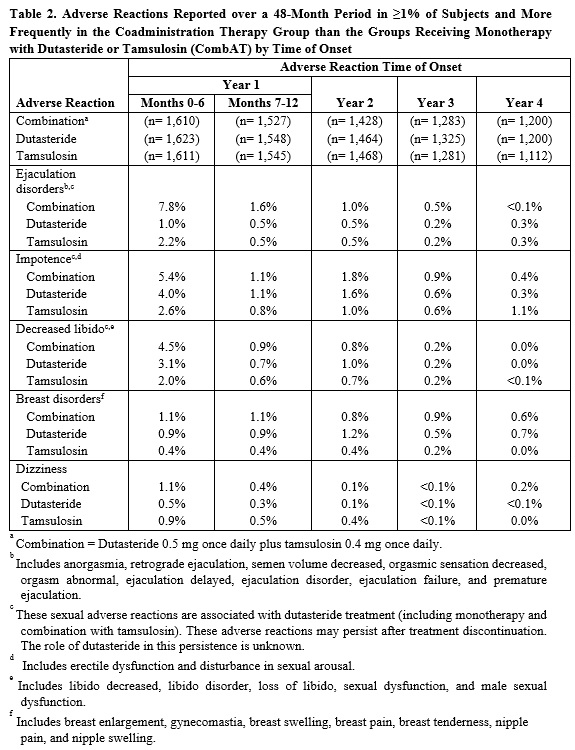
A data table titled 'Table 2. Adverse Reactions Reported over a 48-Month Period in ≥1% of Subjects and More Frequently in the Coadministration Therapy Group than the Groups Receiving Monotherapy with Dutasteride or Tamsulosin (CombAT) by Time of Onset.' It presents the percentage of subjects experiencing various adverse reactions such as ejaculation disorders, impotence, decreased libido, breast disorders, and dizziness. Data are shown separately for combination therapy, dutasteride monotherapy, and tamsulosin monotherapy across different time intervals from 0 to 4 years.*
FDA Label Image

Structure (Structure)

Structure (Structure)
Chemical structure of Dutasteride, showing its molecular framework with distinctive atoms and bonds, including trifluoromethyl groups attached to a benzene ring and a steroid backbone.*
FDA Label Image

Fig 1 (Fig1)

Fig 1 (Fig1)
A line graph showing mean change in AUA-SI score from baseline over 24 months of treatment in randomized, double-blind, placebo-controlled trials. The x-axis represents months of treatment (0 to 24), and the y-axis shows mean change in score. Two lines compare placebo and Dutasteride groups, with Dutasteride showing a greater decrease in AUA-SI score over time. Sample sizes for each time point are noted below the x-axis.*
FDA Label Image

Fig 2 (Fig2)

Fig 2 (Fig2)
A line graph titled "Percent of Subjects Developing Acute Urinary Retention over a 24-Month Period." It compares the placebo group and the dutasteride group in a randomized, double-blind, placebo-controlled trial, showing the percent of patients over time (months of treatment). The placebo group line rises higher than the dutasteride group, indicating a greater cumulative number of events. The graph includes cumulative event counts and the number of patients at risk at 0, 6, 12, 18, and 24 months for both groups.*
FDA Label Image

Fig 3 (Fig3)

Fig 3 (Fig3)
A line graph depicting the percent of subjects undergoing surgery for benign prostatic hyperplasia over a 24-month period, comparing a placebo group and a dutasteride group. The x-axis represents months of treatment (0 to 24), and the y-axis shows the percent of patients (0 to 6%). Two lines indicate the cumulative percent of patients having surgery, with the placebo group showing a higher rate than the dutasteride group. A table below lists cumulative events and number of patients at risk for each group at various time points.*
FDA Label Image

Fig 4 (Fig4)

Fig 4 (Fig4)
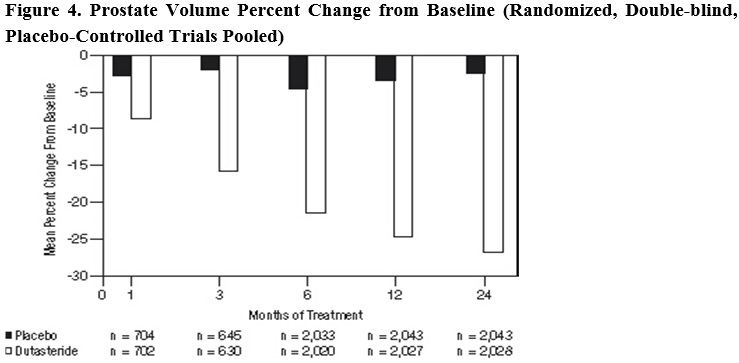
A bar chart titled 'Prostate Volume Percent Change from Baseline (Randomized, Double-blind, Placebo-Controlled Trials Pooled)' showing mean percent change from baseline in prostate volume over 0 to 24 months of treatment. The chart compares placebo and dutasteride groups at 1, 3, 6, 12, and 24 months, with dutasteride showing a greater reduction in prostate volume than placebo across all time points.*
FDA Label Image

Fig 5 (Fig5)

Fig 5 (Fig5)
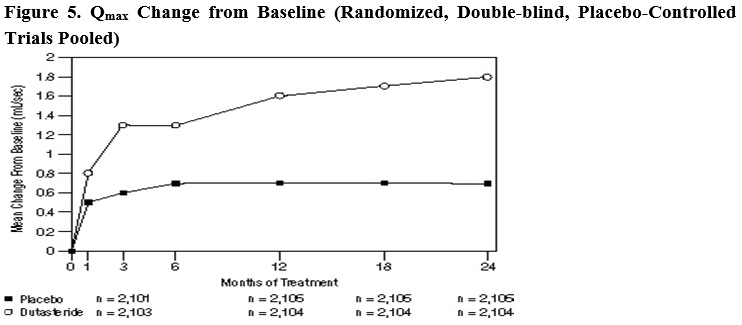
A line graph titled 'Qmax Change from Baseline (Randomized, Double-blind, Placebo-Controlled Trials Pooled)' showing mean change from baseline in mL/sec over 24 months of treatment. The graph compares Qmax changes between placebo and Dutasteride groups, with data points at 0, 1, 3, 6, 12, 18, and 24 months. Dutasteride shows a higher increasing trend compared to placebo.*
FDA Label Image

Fig 6 (Fig6)

Fig 6 (Fig6)
A line graph titled 'International Prostate Symptom Score Change from Baseline over a 48-Month Period' showing the mean change from baseline in IPSS on the vertical axis and months of treatment on the horizontal axis. The graph compares three groups: Dutasteride + tamsulosin, Dutasteride 0.5 mg, and Tamsulosin 0.4 mg, tracked over 48 months with sample sizes around 1,575 for each group. Dutasteride + tamsulosin shows the greatest decrease in symptom score over time, followed by Dutasteride 0.5 mg, and then Tamsulosin 0.4 mg.*
FDA Label Image

Fig 7 (Fig7)

Fig 7 (Fig7)
A line graph showing mean change from baseline in Qmax (mL/sec) over a 24-month period in a randomized, double-blind, parallel-group trial for Dutasteride and combinations. The x-axis represents months of treatment (0 to 24), and the y-axis shows mean change from baseline (0 to 3.0 mL/sec). Three lines compare Dutasteride + Tamsulosin, Dutasteride 0.5 mg, and Tamsulosin 0.4 mg, with sample sizes listed at each time point.*
FDA Label Image

Label (Lbl636291223)

Label (Lbl636291223)
Label for Dutasteride Capsule, USP 0.5 mg liquid-filled oral capsules by Bryant Ranch Prepack. The label shows NDC 63629-1223-1 and indicates a package of 30 capsules. It includes storage instructions, manufacturer Ascent Pharmaceuticals, and a BRP Pharmaceuticals logo.*

* About these descriptions: Image descriptions on this page are generated by automated AI analysis of the product label images from the manufacturer's FDA label submission (SPL). They are provided for reference only and may contain errors or omissions. Always rely on the printed label itself and the official FDA labeling, and consult a pharmacist or healthcare professional with any questions about this product.