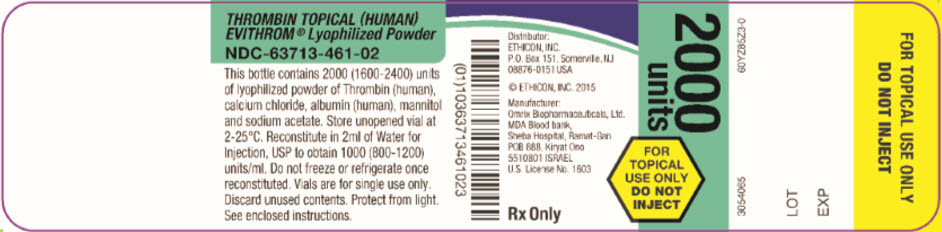
EVITHROM® is a sterile lyophilized powder of purified human thrombin (1600–2400 units) of white to slightly yellowish color. When reconstituted, EVITHROM® solution, pH 6.8–7.2, is clear to slightly opalescent and colorless to slightly yellowish. Other inactive ingredients are Calcium chloride, Human albumin, Mannitol, Sodium acetate.
EVITHROM® is made from pooled Human Source obtained from US licensed plasma collection centers. Individual plasma units obtained for production of EVITHROM® are tested by licensed serological tests for HBsAg, HIV 1 & 2 Ab and HCV Ab. Additionally, the plasma units are tested by licensed Nucleic Acid Testing (NAT) for HIV-1, HCV, HBV, HAV and parvovirus B19. All tests for HIV, HCV, HBV and HAV must be negative (non-reactive). However, since the effectiveness of the HBV and HAV NAT methods in detecting low levels of viral material is still under investigation, the significance of a negative result for these viruses is unknown. The level of parvovirus B19 contamination is not permitted to exceed 10,000 copies/ml. This limit is applied to restrict the viral load of parvovirus B19 in the starting plasma pool. In addition to the screening of plasma units, each manufacturing pool is tested for HBsAg, HIV-1 & 2 Ab, HCV NAT and for parvovirus B19 by NAT. Manufacturing pool testing, however, is of lower sensitivity than individual unit testing.
EVITHROM® is manufactured by chromatographic purification of prothrombin from cryo-poor plasma followed by activation with calcium chloride. The manufacturing process includes two targeted steps for inactivation or removal of viruses. The first of these is treatment with a solvent/detergent (S/D) mixture (1% tri-n-butyl phosphate, 1% Triton X-100) for 6 hours at 26°C to inactivate lipid enveloped viruses. The S/D reagents are removed by cation exchange chromatography. Mannitol and human albumin are used to stabilize the solution, which undergoes nanofiltration for removal of both enveloped and non-enveloped viruses. After nanofiltration, the solution is formulated with calcium chloride, sterile filtered and aseptically filled and frozen.
The effectiveness of the S/D treatment and nanofiltration procedures for reducing virus content has been assessed using a series of viruses with a range of physico-chemical characteristics. The results of the validation studies are summarized in Table 2.
Table 2: Reducing factors of S/D treatment and nanofiltration for a series of viruses| Virus | HIV-1 | SBV | BVDV | PRV | EMCV | HAV | MVM |
|---|
| Reduction factor (log10) |
|---|
| HIV-1: Human Immunodeficiency Virus Type 1 |
| SBV: Sindbis Virus |
| BVDV: Bovine Viral Diarrhea Virus |
| PRV: Pseudorabies Virus |
| EMCV: Encephalomyocarditis Virus |
| HAV: Hepatitis A Virus |
| MVM: Minute Virus of Mouse |
| SD Treatment | >5.8 | >5.0 | >4.6 | >4.2 | Not Done | Not Done | Not Done |
| Nanofiltration | >4.6 | Not Done | >5.6 | >5.7 | >7.4 | >7.5 | >6.3 |
| Global Reduction Factor | >10.4 | >5.0 | >10.2 | >9.9
| >7.4
| >7.5 | >6.3 |