Moderatly Emetogenic Chemotherapy
The first trial compared granisetron hydrochloride tablets doses of 0.25 mg to 2 mg twice a day, in 930 cancer patients receiving, principally, cyclophosphamide, carboplatin, and cisplatin (20 mg/m2 to 50 mg/m2). Efficacy was based on complete response (i.e., no vomiting, no moderate or severe nausea, no rescue medication), no vomiting, and no nausea. Table 2 summarizes the results of this study.
Table 2: Prevention of Nausea and Vomiting 24 Hours Post-Chemotherapy*
*Chemotherapy included oral and injectable cyclophosphamide, carboplatin, cisplatin (20 mg/m2 to 50 mg/m2), dacarbazine, doxorubicin, epirubicin.
† No vomiting, no moderate or severe nausea, no rescue medication.
‡ Statistically significant (p<0.01) vs. 0.25 mg bid.
§ Statistically significant (p<0.01) vs. 0.5 mg bid. |
| Percentages of Patients
Granisetron hydrochloride Tablet Dose
|
Efficacy Measures
| 0.25 mg twice a day
(n=229)
%
| 0.5 mg twice a day
(n=235)
%
| 1 mg twice a day
(n=233)
%
| 2 mg twice a day
(n=233)
%
|
Complete Response†
| 61
| 70
| 81
| 72‡
|
No Vomiting
| 66
| 77‡
| 88‡
| 79‡
|
No Nausea
| 48
| 57
| 63‡
| 54
|
Results from a second double-blind, randomized trial evaluating granisetron hydrochloride tablets 2 mg once a day and granisetron hydrochloride tablets 1 mg twice a day were compared to prochlorperazine 10 mg twice a day derived from a historical control. At 24 hours, there was no statistically significant difference in efficacy between the two granisetron hydrochloride tablet regimens. Both regimens were statistically superior to the prochlorperazine control regimen (see Table 3).
Table 3: Prevention of Nausea and Vomiting 24 Hours Post-Chemotherapy*
*Moderately emetogenic chemotherapeutic agents included cisplatin (20 mg/m2 to 50 mg/m2), oral and intravenous cyclophosphamide, carboplatin, dacarbazine, doxorubicin.
† Historical control from a previous double-blind granisetron hydrochloride trial.
‡ No vomiting, no moderate or severe nausea, no rescue medication.
§ Statistically significant (p<0.05) vs. prochlorperazine historical control.
¶ No vomiting, no nausea, no rescue medication. |
Efficacy Measures
| Percentages of Patients
|
Granisetron hydrochloride
Tablets
1 mg twice a day
(n = 354)
%
| Granisetron hydrochloride Tablets
2 mg once a day
(n = 343)
%
| Prochlorperazine†
10 mg twice daily
(n=111)
%
|
Complete Response
| 69
| 64§
| 41
|
No Vomiting
| 82§
| 77§
| 48
|
No Nausea
| 51§
| 53§
| 35
|
Total Control¶
| 51§
| 50§
| 33
|
Results from a granisetron hydrochloride tablets 2 mg daily alone treatment arm in a third double-blind, randomized trial, were compared to prochlorperazine (PCPZ), 10 mg bid, derived from a historical control. The 24 hour results for granisetron hydrochloride tablets 2 mg daily were statistically superior to PCPZ for all efficacy parameters: complete response (58%), no vomiting (79%), no nausea (51%), total control (49%). The PCPZ rates are shown in Table 3.
Cisplatin-Based Chemotherapy
The first double-blind trial compared granisetron hydrochloride tablets 1 mg bid, relative to placebo (historical control), in 119 cancer patients receiving high-dose cisplatin (mean dose 80 mg/m2). At 24 hours, granisetron hydrochloride tablets 1 mg bid was significantly (p<0.001) superior to placebo (historical control) in all efficacy parameters: complete response (52%), no vomiting (56%) and no nausea (45%). The placebo rates were 7%, 14%, and 7%, respectively, for the three efficacy parameters.
Results from a granisetron hydrochloride tablets 2 mg once a day alone treatment arm in a second double-blind, randomized trial, were compared to both granisetron hydrochloride tablets 1 mg twice a day and placebo historical controls. The 24 hour results for granisetron hydrochloride tablets 2 mg once a day were: complete response (44%), no vomiting (58%), no nausea (46%), total control (40%). The efficacy of granisetron hydrochloride tablets 2 mg once a day was comparable to granisetron hydrochloride tablets 1 mg twice a day and statistically superior to placebo. The placebo rates were 7%, 14%, 7%, and 7%, respectively, for the four parameters.
No controlled study comparing granisetron injection with the oral formulation to prevent chemotherapy-induced nausea and vomiting has been performed.
Table 5 gives the comparative frequencies of the five commonly reported adverse events (≥3%) in patients receiving granisetron hydrochloride injection, 40 mcg/kg, in single-day chemotherapy trials. These patients received chemotherapy, primarily cisplatin, and intravenous fluids during the 24 hour period following granisetron hydrochloride injection administration.
Table 5: Principal Adverse Events in Clinical Trials — Single-Day Chemotherapy
| Percent of Patients with Event
|
Granisetron hydrochloride Injection*
40mcg/kg
(n=1268)
| Comparator†
(n=422)
|
Headache
| 14%
| 6%
|
Asthenia
| 5%
| 6%
|
Somnolence
| 4%
| 15%
|
Diarrhea
| 4%
| 6%
|
Constipation
| 3%
| 3%
|
* Adverse events were generally recorded over 7 days post- granisetron hydrochloride injection administration.
† Metoclopramide/dexamethasone and phenothiazines/dexamethasone. |
In the absence of a placebo group, there is uncertainty as to how many of these events should be attributed to granisetron, except for headache, which was clearly more frequent than in comparison groups.
Granisetron Hydrochloride Tablets USP are available as:
White colored, triangular shaped, biconvex, film-coated tablets with debossing of '1GN' on one side and plain surface on the other side.
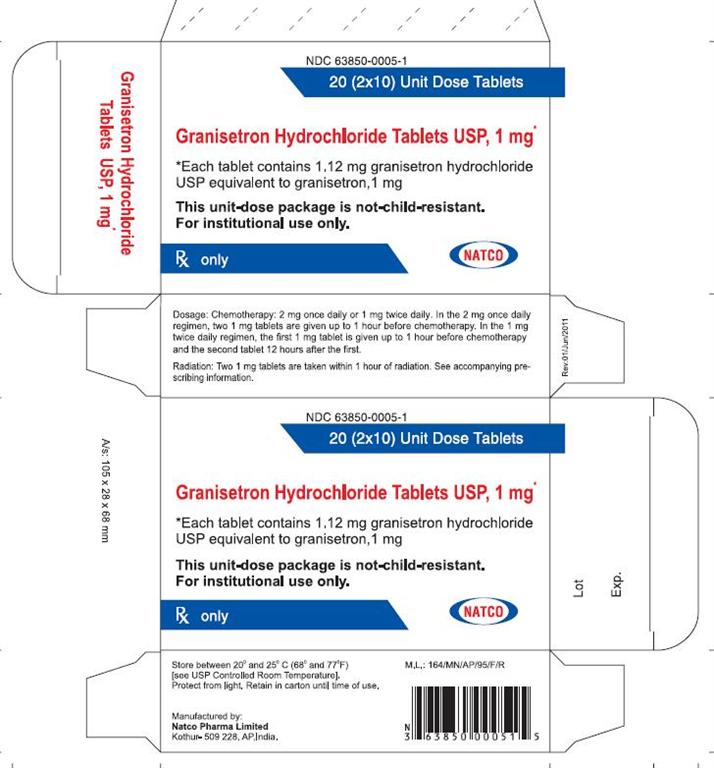
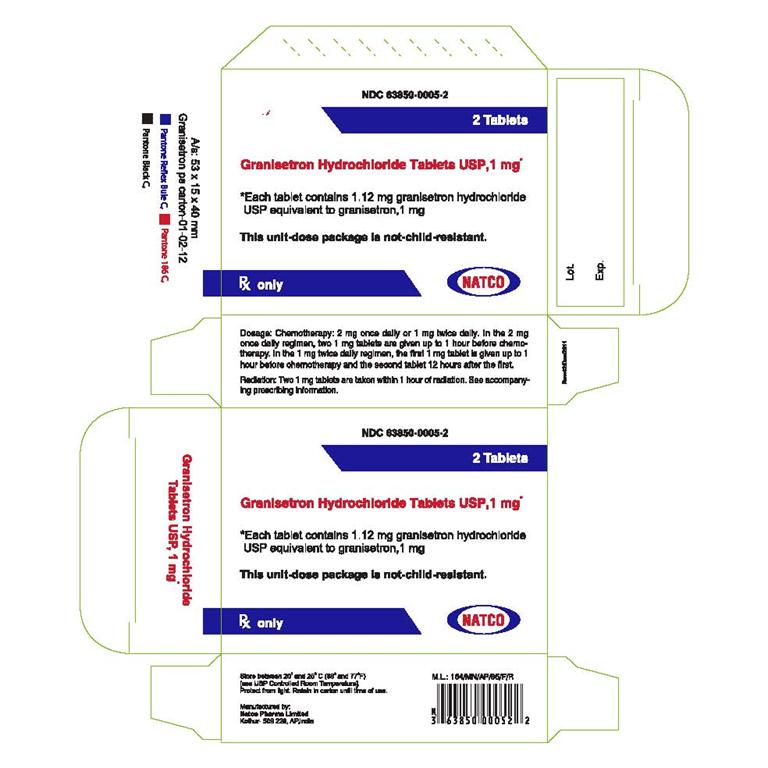
Granisetron HCl tablets, USP are available as 20 Unit Dose Tablets (Intended for institutional use only) and 2’s pack.
NDC 63850-0005-1-20’S Pack
NDC No. 63850-0005-2 – 2’S Pack