Treatment of Primary Humoral Immunodeficiency
As there are significant differences in the half-life of IgG among patients with PI, the frequency and amount of immunoglobulin therapy may vary from patient to patient. The proper amount can be determined by monitoring clinical response.
The recommended dose of GAMMAPLEX 10% for patients with PI is 300 to 800 mg/kg (3 to 8 mL/kg), administered every 3 to 4 weeks. If a patient has been exposed to measles, it may be prudent to administer an extra dose of Immune Globulin Intravenous as soon as possible and within 6 days of exposure. A dose of 400 mg/kg should provide a serum level > 240 mIU/mL of measles antibodies for at least two weeks. If a patient is at risk of future measles exposure and receives a dose of less than 530 mg/kg every 3-4 weeks, the dose should be increased to at least 530 mg/kg. This should provide a serum level of 240 mIU/mL of measles antibodies for at least 22 days after infusion. Adjust the dosage over time to achieve the desired serum trough levels and clinical response. If a patient misses a dose, administer the missed dose as soon as possible, and then resume scheduled treatments every 3 or 4 weeks, as applicable.
Treatment of Chronic Immune Thrombocytopenic Purpura
The recommended dose of GAMMAPLEX 10% for patients with ITP is 1 g/kg (10 mL/kg) on 2 consecutive days, providing a total dose of 2 g/kg. Carefully consider the relative risks and benefits before prescribing the high dose regimen (i.e. 1 g/kg/day for 2 days) in patients at increased risk of thrombosis, hemolysis, acute kidney injury, or volume overload [see Warnings and Precautions (5)]. Adequate data on the platelet response to the low dose regimen (e.g. 400 mg/kg per day for 5 consecutive days) are not available for GAMMAPLEX 10%.
Primary Humoral Immunodeficiency Study
A multicenter, open-label, randomized two-period crossover study (bioequivalence study) evaluated the PK, safety and tolerability of GAMMAPLEX 10% and GAMMAPLEX 5% in 33 adults aged 17 to 55 years with PI. Twenty one (63.6%) subjects were female and 12 (36.4%) were male; 33 (100%) were White, of which 1 (3.0%) was Hispanic or Latino. The safety analysis included all 33 subjects for GAMMAPLEX 5% and 32 subjects for GAMMAPLEX 10%. One subject withdrew consent during the first infusion of GAMMAPLEX 5%, citing inconvenience of the study visits. Thirty two subjects received at least five infusions of each product either on a 28-day or 21-day cycle. The mean doses per infusion for GAMMAPLEX 10% were 491.7 mg/kg and 499 mg/kg respectively, and were similar for GAMMAPLEX 5% [see Clinical Studies (14.1)]. No subjects were on regular systemic corticosteroids at entry to, or during the study. Twelve (36.4%) adult subjects received short courses of corticosteroids, from a single dose to a maximum of 6 days duration, for various clinical conditions. No subjects received corticosteroids as premedications for GAMMAPLEX infusions. The use of local anesthetics, antipyretics, antihistamines, analgesics, and antiemetics before infusion was allowed; three (9.1%) adult subjects received a total of 5 courses of such premedication.
While on GAMMAPLEX 10%, 10 of the adults (31.3%) had an adverse reaction (AR) with a similar proportion (12; 36.4%) when on GAMMAPLEX 5%. Headache was the most commonly reported AR with both formulations of GAMMAPLEX. In total, 166 infusions of GAMMAPLEX 10% and 163 infusions of GAMMAPLEX 5% were given to adults during the study.
Two subjects had a positive direct antiglobulin (Coombs') test (DAT; DCT) result at some stage in the study. For one adult, the test was positive before starting in the study and it remained positive throughout, but without evidence of hemolysis. One other adult had a positive DAT one week after an infusion of GAMMAPLEX 5% but there was no evidence of hemolysis and no positive DAT results when receiving GAMMAPLEX 10%. No other adults had a positive DAT during the study.
In the same study, 15 pediatric subjects with PI, 3 years of age and older, received GAMMAPLEX 10%. All subjects were White, of which 2 (13.3%) were Hispanic or Latino. The mean doses per infusion were 552.9 mg/kg for subjects on the 28-day cycle (n=8) and 514.7 mg/kg for subjects on the 21-day cycle (n=7), overall range 343 to 745 mg/kg. Two subjects were in the 2-5 year age group, 7 were in the 6-11 year age group and 6 were in the 12-15 year age group. Fourteen subjects completed the study with at least 5 infusions of GAMMAPLEX 10% (pediatric subjects only received GAMMAPLEX 10% in this study); 82 infusions were given in total. Two pediatric subjects received IV methylprednisolone as premedication for each infusion. Local anesthetics, antipyretics, antihistamines and analgesics were allowed.
While on GAMMAPLEX 10%, 6 (40%) pediatric subjects had an AR. Headache was the most common with 3 subjects (20%) reporting a total of 4 events. All other ARs were not reported by more than a single pediatric subject. One pediatric subject had a positive direct antiglobulin (Coombs') test without evidence of hemolysis.
Table 2 lists the ARs occurring in at least 5% of all subjects (adult and pediatric combined) with PI treated with GAMMAPLEX 10% in the clinical study.
Table 2: Adverse Reactions (ARsAdverse Reactions (ARs) are defined as adverse events considered by the investigators to have been possibly, probably, or definitely related to administration of GAMMAPLEX.
) Occurring in ≥5% of Subjects with PI Receiving GAMMAPLEX 10% (Adult and Pediatric Subjects Combined)| Preferred Term | Subjects (%)
[n=32] | Events |
|---|
| Headache | 7 (14.9) | 16 |
| Migraine | 3 (6.4) | 3 |
| Pyrexia | 3 (6.4) | 3 |
Chronic Immune Thrombocytopenic Purpura Study
The safety of GAMMAPLEX 10% has not been established in patients with ITP. However, the safety profile for GAMMAPLEX 5% has been studied in subjects with ITP, and it is anticipated that the safety profile for both formulations are comparable for ITP patients. The following is a summary of the study of GAMMAPLEX 5% in chronic ITP. In a multicenter, open-label, non-randomized clinical trial, 35 subjects with chronic ITP were treated with a nominal dose of 1000 mg/kg on each of two consecutive days (total dose 2000 mg/kg). Doses of GAMMAPLEX 5% ranged from 482 to 1149 mg/kg on an infusion day. The median total dose per subject was 2035 mg/kg. Pre-medication with antihistamine or analgesic drugs was permitted if required, but corticosteroids were not permitted prior to infusion as pre-medication. Ten subjects received corticosteroids for ITP during the trial and one additional subject received corticosteroids as pre-medication in violation of the protocol. All 35 subjects received at least one infusion of clinical trial drug, and all but one subject completed the first course of treatment.
Fifteen subjects (42.9%) reported at least one AR (63 in total); the most commonly reported being headache (10 subjects, 28.6%), vomiting (6 subjects, 17.1%), pyrexia (5 subjects, 14.3%), nausea (3 subjects, 8.6%), arthralgia (2 subjects, 5.7%) and dehydration (2 subjects, 5.7%). Three subjects experienced a total of five serious ARs. Of the five serious ARs, one subject had three concurrently (vomiting, dehydration and headache) and two subjects each had one serious AR (headache). One of these latter two subjects discontinued from the clinical trial because of the severe headache. Table 3 lists the ARs in more than ≥5% of subjects. Based on a review of clinical and laboratory data, 4/35 subjects (11%) with drops in hemoglobin exceeding 2 g/dL following administration of GAMMAPLEX 5% were considered to have experienced suspected treatment-emergent hemolysis. Milder treatment-emergent hemolysis could not be excluded for an additional 7 subjects, giving a total of 11 of 35 subjects (31%) for whom hemolysis could not be excluded (not including an additional two subjects who lacked follow-up testing for hemolysis, so their hemolysis status was considered unassessable). Data for two subjects were consistent with possible intravascular hemolysis, including one subject who may also have had an element of extravascular hemolysis. Nine of the possible hemolysis cases were mild and appeared consistent with possible extravascular hemolysis.
There was no evidence of transmission of HBV, HCV, HIV and parvovirus B19 during this clinical trial.
Table 3: Adverse Reactions (ARsAdverse Reactions (ARs) are defined as adverse events considered by the investigators to have been possibly, probably, or definitely related to administration of GAMMAPLEX.
) Occurring in ≥5% of Subjects with ITP| Adverse Reactions | Subjects % [n=35] | Events |
|---|
| Headache | 10 (28.6) | 19 |
| Vomiting | 6 (17.1) | 8 |
| Pyrexia | 5 (14.3) | 6 |
| Nausea | 3 (8.6) | 3 |
| Arthralgia | 2 (5.7) | 3 |
| Dehydration | 2 (5.7) | 2 |
GAMMAPLEX 10% Postmarketing Experience
The following adverse reactions have been identified and reported during the postmarketing use of GAMMAPLEX 10%:
- Cardiovascular: Tachycardia, Thromboembolism, Hypertension, Flushing
- Gastrointestinal: Nausea
- General/Body as a Whole: Chills, Chest discomfort, Pyrexia
- Musculoskeletal: Back pain, Polymyositis
- Neurological: Headache
- Respiratory: Dyspnea
- Integumentary: Rash, Urticaria
- Investigations: Blood Pressure increased, Blood Pressure diastolic decreased
The following adverse reactions have been identified during postmarketing use of intravenous immune globulins9:
- Infusion reactions: Hypersensitivity (e.g. anaphylaxis), headache, diarrhea, tachycardia, fever, fatigue, dizziness, malaise, chills, flushing, urticaria or other skin reactions, wheezing or other chest discomfort, nausea, vomiting, rigors, back pain, myalgia, arthralgia, and changes in blood pressure
- Renal: Acute renal dysfunction/failure, osmotic nephropathy
- Respiratory: Apnea, Acute Respiratory Distress Syndrome (ARDS), TRALI, cyanosis, hypoxemia, pulmonary edema, dyspnea, bronchospasm, pulmonary embolism
- Cardiovascular: Cardiac arrest, thromboembolism, vascular collapse, hypotension, myocardial infarction
- Neurological: Coma, loss of consciousness, seizures, tremor, aseptic meningitis syndrome, migraine
- Integumentary: Stevens-Johnson syndrome, epidermolysis, erythema multiforme, dermatitis (e.g. bullous dermatitis)
- Hematologic: Pancytopenia, leukopenia, hemolysis, positive direct antiglobulin (Coombs') test
- Musculoskeletal: Musculoskeletal pain
- Gastrointestinal: Hepatic dysfunction, abdominal pain
- General/Body as a Whole: Pyrexia, rigors
Risk Summary
Animal reproduction studies have not been conducted with GAMMAPLEX 10%. It is also not known whether GAMMAPLEX 10% can cause fetal harm when administered to a pregnant woman or can affect reproduction capacity. GAMMAPLEX 10% should be given to a pregnant woman only if clearly needed. Immunoglobulins cross the placenta from maternal circulation increasingly after 30 weeks of gestation.12
Risk Summary
Use of GAMMAPLEX 10% has not been evaluated in breast-feeding mothers.
Treatment of Primary Humoral Immunodeficiency
GAMMAPLEX 10% was evaluated in 13 pediatric patients with primary humoral immunodeficiency (2 between ages of 3 to 5, 6 between ages of 6 to 11, and 5 between ages of 12 to 15). No pediatric-specific dose requirements were necessary to achieve the desired serum IgG levels [see Clinical Studies (14)]. The safety and pharmacokinetics of GAMMAPLEX 10% were assessed in pediatric subjects 3 years of age and older with PI [see Clinical Studies (14)].
Treatment of Chronic Immune Thrombocytopenic Purpura
The safety and effectiveness of GAMMAPLEX 10% has not been established in pediatric patients with ITP. GAMMAPLEX 5% was evaluated in three (3) pediatric subjects with chronic ITP (two aged 6 years and one aged 12 years). This number of pediatric patients was too small for separate evaluation from the adult patients for efficacy [see Clinical Studies (14)].
Treatment of Primary Humoral Immunodeficiency - GAMMAPLEX 10% is a replacement therapy for primary humoral immunodeficiency. GAMMAPLEX 10% acts through a broad spectrum of opsonic and neutralizing IgG antibodies against pathogens and their toxins involving antigen binding and effector functions.13,14 However, the mechanism of action in PI has not been fully elucidated.
Treatment of Chronic Immune Thrombocytopenic Purpura - The mechanism of action of high doses of immunoglobulins in the treatment of chronic ITP has not been fully elucidated.
Treatment of Primary Humoral Immunodeficiency
In the cross-over clinical trial assessing bioequivalence, safety and tolerability between GAMMAPLEX 10% and GAMMAPLEX 5% in PI, the pharmacokinetics (PK) of these products was assessed after administration to 30 adult subjects on 28-day (n = 16) or 21-day (n = 14) infusion cycles. Blood samples for PK analysis were obtained after at least five infusions.
The dose of GAMMAPLEX 10% ranged from 361-691 mg/kg for subjects on a 28-day cycle and from 254-794 mg/kg for those on a 21-day cycle. The doses of GAMMAPLEX 5% were similar to those of GAMMAPLEX 10% in this cross-over study. Table 6 compares the other PK variables parameters for GAMMAPLEX 10% and GAMMAPLEX 5% for both the 21-day and 28-day cycle regimens.
GAMMAPLEX 10% was pharmacokinetically equivalent to GAMMAPLEX 5% in adults.
PK outcomes after administration of GAMMAPLEX 10% were assessed in 13 pediatric subjects. Six subjects were on a 28-day regimen and 7 were on a 21-day regimen; doses for the PK assessments ranged from 400 to 745 mg/kg and 355 to 702 mg/kg respectively. Results are shown in Table 6 together with those from the adults in the study.
Table 6: Pharmacokinetic Parameters of GAMMAPLEX 10% compared with GAMMAPLEX 5% in Adults, and GAMMAPLEX 10% in Pediatric Subjects (corrected for baseline concentration)| Indication: | ADULTS | PEDIATRICS |
|---|
| Parameter (unit) | GAMMAPLEX 10% | GAMMAPLEX 5% | GAMMAPLEX 10% |
|---|
28-day Dosing Interval
(n=16) | 21-day Dosing Interval
(n=14) | 28-day Dosing Interval
(n=16) | 21-day Dosing Interval
(n=14) | 2-5 years
(n=2) | 6-11 years
(n=6) | 12-15 years
(n=5) |
|---|
| Mean Geometric mean
(CV% ) | Mean
(CV%) | Mean
(CV%) | Mean
(CV%) | Mean
(CV% ) | Mean
(CV%) | Mean
(CV%) |
|---|
| Cmax = maximum observed concentration |
| Tmax = time at which Cmax was apparent |
| Cmax (mg/dL) | 1090
(20.5) | 1150
(27.6) | 1020
(23.6) | 1090
(21.6) | 1120
(33.5) | 907
(37.9) | 977
(34.9) |
| Tmax (hr) Median and range are presented for tmax | 2.87
(1.6-31) | 2.70
(1.8-7.8) | 3.73
(2.1-9.0) | 3.68
(2.2-5.7) | 3.24
(2.8-3.7) | 2.76
(2.0-5.1) | 2.33
(1.7-4.5) |
| AUC AUC0-tau = area under the concentration versus time curve within a dosing interval, tau = dosing interval (days*mg/dL) | 7830
(30.2) | 6980
(33.0) | 7230
(35.3) | 6380
(32.8) | 7620
(70.0) | 6160
(71.1) | 6650
(31.9) |
| Half-Life (hr) | 123
(32.3) | 118
(39.3) | 132
(45.8) | 119
(48.7) | 167
(9.14) | 111
(37.3) | 144
(16.0) |
| Clearance (dL/day/kg) | 0.0635
(24.0) | 0.0674
(21.9) | 0.0684
(37.6) | 0.0743
(38.6) | 0.0716
(19.3) | 0.0845
(39.7) | 0.0787
(19.3) |
| Volume of Distribution (dL/kg) | 0.498
(27.4) | 0.528
(50.3) | 0.569
(38.4) | 0.536
(32.6) | 0.688
(7.45) | 0.571
(28.8) | 0.711
(26.4) |
Pharmacokinetics, Safety and Tolerability study
A cross-over clinical trial assessed bioequivalence, safety and tolerability between GAMMAPLEX 10% and GAMMAPLEX 5% in PI after administration to 33 adult subjects on 28-day (n = 19) or 21-day (n = 14) infusion cycles, of whom 30 (90.9%) completed the PK component [see Pharmacokinetics (12.3)]. Thirty-two subjects completed the study of whom 12 were male and 20 were female. All adults were aged between 17 and 55 years. The mean doses of GAMMAPLEX 10% were 491.7 mg/kg for those on a 28-day cycle and 499.0 mg/kg for those on a 21-day cycle. For GAMMAPLEX 5%, the doses were similar: 473.5 and 502.1 mg/kg respectively. The maximum infusion rate was 0.08 mL/kg/min for each product and this rate was achieved by all adult subjects. In this study, PK bioequivalence was used as a surrogate marker for efficacy. Nevertheless, an ad hoc comparison was made between the products for the number of subjects reporting an infection while on each product. Comparing the number of subjects developing infections of any severity or type while on GAMMAPLEX 10% (22/32) with the period on GAMMAPLEX 5% (17/32) using the McNemar test provided an exact p value of 0.180, confirming the relevance of PK as a surrogate marker. No subject had an acute serious bacterial infection (SABI) during the study.
The pediatric population in the study comprised 15 subjects who received only GAMMAPLEX 10%, of whom 8 were on a 28-day cycle and 7 on a 21-day cycle. Of these, 13 completed the PK component (6 on a 28-day cycle and 7 on a 21-day cycle) [see Pharmacokinetics (12.3)]. There were two subjects in the 2-5 year age group, 7 in the 6-11 year age group and 6 in the 12-15 year age group. The mean dose across all infusions was 535.1 mg/kg. All pediatric subjects tolerated an infusion rate of 0.04 mL/kg/min and 8 subjects (53.3%) tolerated an infusion rate of 0.08 mL/kg/min for all infusions.
Overall, in the population receiving GAMMAPLEX 10%, the PK results (the surrogate for efficacy in this study) and the types and frequencies of adverse reactions were similar for the adult and pediatric populations.
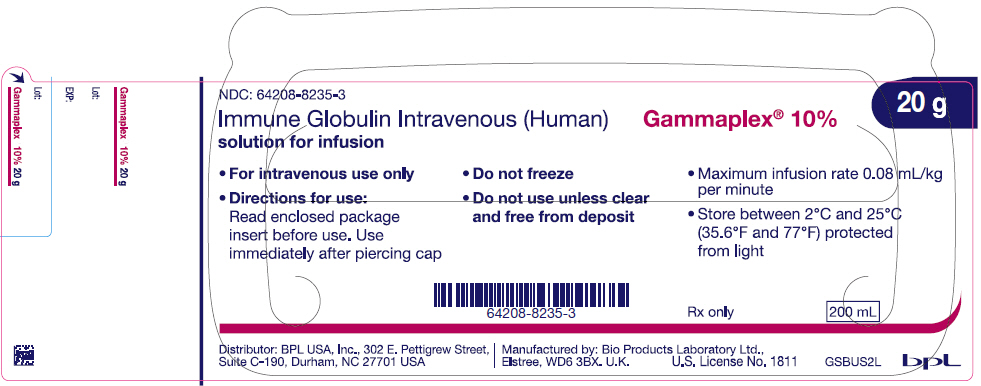
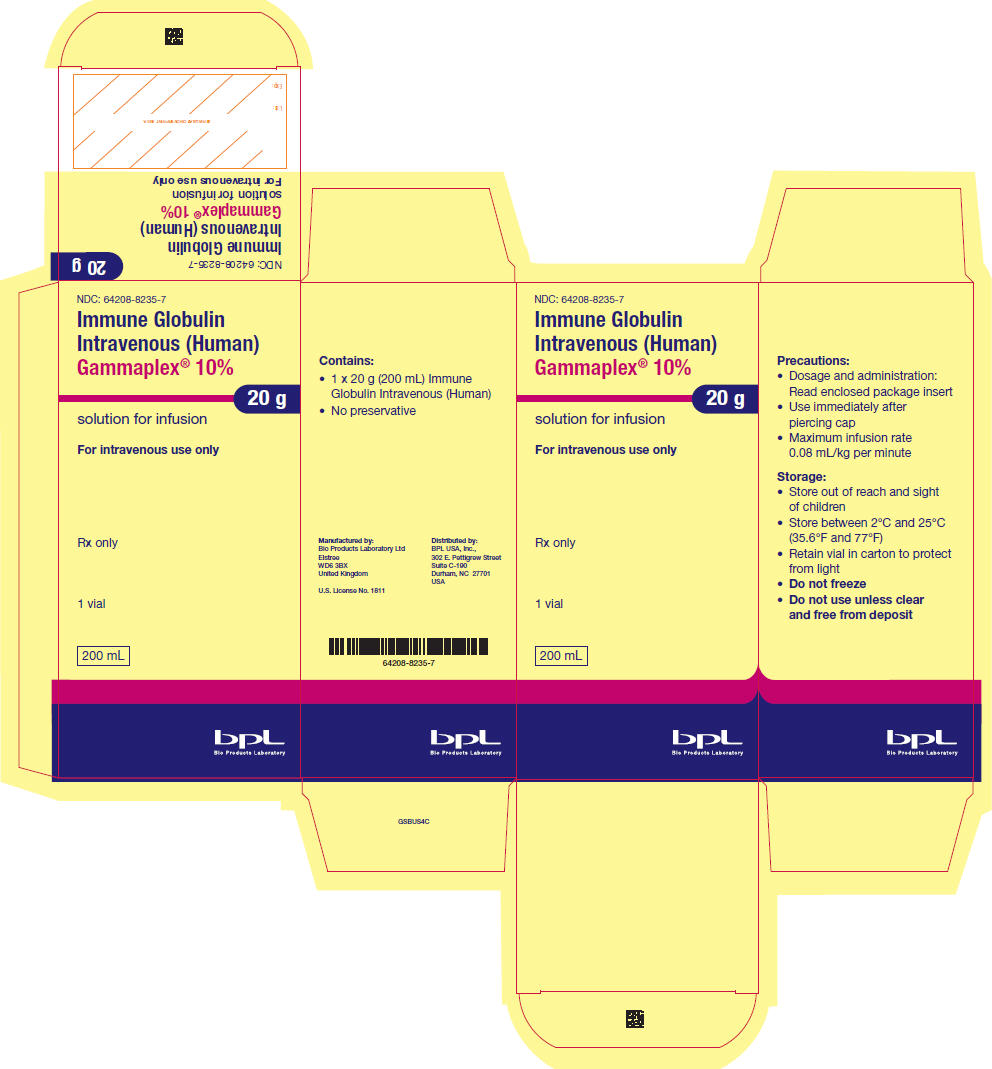
Manufactured by:
Bio Products Laboratory Ltd.,
Elstree,
WD6 3BX.
United Kingdom.
U.S. License No. 1811
U.S. Distributor:
BPL Inc.,
302 E. Pettigrew Street,
Suite C-190,
Durham, NC 27701
U.S.A.
GSUS7PI