The recommended dosage of colchicine tablets for prophylaxis of gout flares for adults and adolescents older than 16 years of age is 0.6 mg once or twice daily. The maximum recommended dose for prophylaxis of gout flares is 1.2 mg/day.
An increase in gout flares may occur after initiation of uric acid-lowering therapy, including pegloticase, febuxostat and allopurinol, due to changing serum uric acid levels resulting in mobilization of urate from tissue deposits. Colchicine tablets is recommended upon initiation of gout flare prophylaxis with uric acid-lowering therapy. Prophylactic therapy may be beneficial for at least the first six months of uric acid-lowering therapy.
The recommended dose of colchicine tablets for treatment of a gout flare is 1.2 mg (two tablets) at the first sign of the flare followed by 0.6 mg (one tablet) one hour later. Higher doses have not been found to be more effective. The maximum recommended dose for treatment of gout flares is 1.8 mg over a 1-hour period. Colchicine tablets may be administered for treatment of a gout flare during prophylaxis at doses not to exceed 1.2 mg (two tablets) at the first sign of the flare followed by 0.6 mg (one tablet) one hour later. Wait 12 hours and then resume the prophylactic dose.
Colchicine tablets is not recommended for pediatric use in prophylaxis or treatment of gout flares.
The recommended dosage of Colchicine tablets for FMF in pediatric patients 4 years of age and older is based on age. The following daily doses may be given as a single or divided dose twice daily:
- Children 4 to 6 years: 0.3 mg to 1.8 mg daily
- Children 6 to 12 years: 0.9 mg to 1.8 mg daily
- Adolescents older than 12 years: 1.2 mg to 2.4 mg daily
Concomitant Therapy
Coadministration of Colchicine tablets with drugs known to inhibit CYP3A4 and/or P-glycoprotein (P-gp) increases the risk of colchicine-induced toxic effects (Table 1). If patients are taking or have recently completed treatment with drugs listed in Table 1 within the prior 14 days, the dose adjustments are as shown in the table below [see Drug Interactions (7)].
Table 1: Colchicine tablets Dose Adjustment for Co-administration with Interacting Drugs if no Alternative Available*
|
|
|
Strong CYP3A4 Inhibitors†
|
Drug
| Noted or Anticipated Outcome
| Gout Flares
| FMF
|
Prophylaxis of
Gout Flares
| Treatment of Gout
Flares
|
Original
Intended
Dosage
| Adjusted
Dose
| Original
Intended
Dosage
| Adjusted
Dose
| Original
Intended
Dosage
| Adjusted
Dose
|
Atazanavir
Clarithromycin
Darunavir/
Ritonavir†
Indinavir
Itraconazole
Ketoconazole
Lopinavir/
Ritonavir†
Nefazodone
Nelfinavir
Ritonavir
Saquinavir
Telithromycin
Tipranavir/
Ritonavir†
| Significant increase
in colchicine
plasma levels*;
fatal colchicine
toxicity has been
reported with
clarithromycin, a strong CYP3A4
inhibitor. Similarly,
significant increase
in colchicine
plasma levels is
anticipated with
other strong
CYP3A4 inhibitors.
| 0.6 mg
twice a
day
0.6 mg
once a day
| 0.3 mg
once a
day
0.3 mg
once
every
other day
| 1.2 mg
(2 tablets)
followed
by 0.6 mg
(1 tablet) 1 hour later.
Dose to be
repeated
no earlier
than 3 days.
| 0.6 mg
(1 tablet) × 1 dose,
followed by 0.3 mg (1/2 tablet) 1 hour later.
Dose to be
repeated no
earlier than
3 days.
| Maximum
daily dose
of 1.2 – 2.4 mg
| Maximum
daily dose
of 0.6 mg
(may be
given as
0.3 mg
twice a
day)
|
Moderate CYP3A4 Inhibitors
|
Drug
| Noted or
Anticipated
Outcome
| Gout Flares
| FMF
|
Prophylaxis of
Gout Flares
| Treatment of Gout
Flares
|
Original
Intended
Dosage
| Adjusted
Dose
| Original
Intended
Dosage
| Adjusted
Dose
| Original
Intended
Dosage
| Adjusted
Dose
|
Amprenavir†
Aprepitant
Diltiazem
Erythromycin
Fluconazole
Fosamprenavir†
(pro-drug of
Amprenavir)
Grapefruit
juice
Verapamil
| Significant increase in colchicine plasma concentration is anticipated.
Neuromuscular
toxicity has been reported with diltiazem and verapamil interactions.
| 0.6 mg
twice a
day
0.6 mg
once a
day
| 0.3 mg
twice a
day or 0.6
mg once a
day
0.3 mg
once a
day
| 1.2 mg
(2 tablets)
followed
by 0.6 mg
(1 tablet) 1 hour later.
Dose to be
repeated
no earlier than 3 days.
| 1.2 mg
(2 tablets) × 1 dose.
Dose to be
repeated no
earlier than
3 days.
| Maximum
daily dose
of 1.2 – 2.4
mg.
| Maximum
daily dose
of 1.2 mg
(may be
given as
0.6 mg
twice a
day)
|
P-gp Inhibitors‡
|
Drug
| Noted or
Anticipated
Outcome
| Gout Flares
| FMF
|
Prophylaxis of
Gout Flares
| Treatment of Gout
Flares
|
Original
Intended
Dosage
| Adjusted
Dose
| Original
Intended
Dosage
| Adjusted
Dose
| Original
Intended
Dosage
| Adjusted
Dose
|
Cyclosporine Ranolazine
| Significant increase in colchicine
plasma levels*; fatal colchicine
toxicity has been reported with
cyclosporine, a P-gp inhibitor.
Similarly,
significant increase
in colchicine
plasma levels is
anticipated with
other P-gp inhibitors.
| 0.6 mg
twice a
day
0.6 mg
once a
day
| 0.3 mg
once a
day
0.3 mg
once
every
other day
| 1.2 mg
(2 tablets)
Followed by 0.6 mg
(1 tablet) 1
hour later.
Dose to be
repeated
no earlier
than 3 days.
| 0.6 mg
(1 tablet) × 1 dose. Dose to be
repeated no
earlier than
3 days.
| Maximum
daily dose
of 1.2 – 2.4 mg
| Maximum
daily dose
of 0.6 mg (may be
given as
0.3 mg
twice a
day)
|
Table 2. Colchicine Dose Adjustment for Coadministration with Protease Inhibitors Protease Inhibitor
| Clinical Comment
| w/Colchicine - Prophylaxis of Gout Flares
| w/Colchicine -
Treatment of Gout Flares
| w/Colchicine - Treatment of FMF
|
Atazanavir sulfate.
(Reyataz)
| Patients with renal or hepatic impairment should not be given colchicine with Reyataz.
| Original dose
| Adjusted dose
| 0.6 mg (1 tablet) × 1 dose, followed by 0.3 mg (1/2 tablet) 1 hour later. Dose to be repeated no earlier than 3 days.
| Maximum daily dose of 0.6 mg (may be given as 0.3 mg twice a day)
|
0.6 mg twice a day
0.6 mg once a day
| 0.3 mg once a day
0.3 mg once every other day
|
Darunavir (Prezista)
| Patients with renal or hepatic impairment should not be given colchicine with Prezista/ritonavir.
| Original dose
| Adjusted dose
| 0.6 mg (1 tablet) × 1 dose, followed by 0.3 mg (1/2 tablet) 1 hour later. Dose to be repeated no earlier than 3 days.
| Maximum daily dose of 0.6 mg (may be given as 0.3 mg twice a day)
|
0.6 mg twice a day
0.6 mg once a day
| 0.3 mg once a day
0.3 mg once every other day
|
Fosamprenavir (Lexiva) with Ritonavir
| Patients with renal or hepatic impairment should not be given colchicine with Lexiva/ritonavir.
| Original dose
| Adjusted dose
| 0.6 mg (1 tablet) × 1 dose, followed by 0.3 mg (1/2 tablet) 1 hour later. Dose to be repeated no earlier than 3 days.
| Maximum daily dose of 0.6 mg (may be given as 0.3 mg twice a day)
|
0.6 mg twice a day
0.6 mg once a day
| 0.3 mg once a day
0.3 mg once every other day
|
Fosamprenavir (Lexiva)
| Patients with renal or hepatic impairment should not be given colchicine with Lexiva/ritonavir.
| Original dose
| Adjusted dose
| 1.2 mg (2 tablets) × 1 dose. Dose to be repeated no earlier than 3 days.
| Maximum daily dose of 1.2 mg (may be given as 0.6 mg twice a day)
|
0.6 mg twice a day
0.6 mg once a day
| 0.3 mg twice a day or 0.6 mg once a day
0.3 mg once a day
|
Indinavir (Crixivan)
| Patients with renal or hepatic impairment should not be given colchicine with Crixivan.
| Original dose
| Adjusted dose
| 0.6 mg (1 tablet) × 1 dose, followed by 0.3 mg (1/2 tablet) 1 hour later. Dose to be repeated no earlier than 3 days.
| Maximum daily dose of 0.6 mg (may be given as 0.3 mg twice a day)
|
0.6 mg twice a day
0.6 mg once a day
| 0.3 mg once a day
0.3 mg once every other day
|
Lopinavir/Ritonavir (Kaletra)
| Patients with renal or hepatic impairment should not be given colchicine with Kaletra.
| Original dose
| Adjusted dose
| 0.6 mg (1 tablet) × 1 dose, followed by 0.3 mg (1/2 tablet) 1 hour later. Dose to be repeated no earlier than 3 days.
| Maximum daily dose of 0.6 mg (may be given as 0.3 mg twice a day)
|
0.6 mg twice a day
0.6 mg once a day
| 0.3 mg once a day
0.3 mg once every other day
|
Nelfinavir mesylate (Viracept)
| Patients with renal or hepatic impairment should not be given colchicine with Viracept.
| Original dose
| Adjusted dose
| 0.6 mg (1 tablet) × 1 dose, followed by 0.3 mg (1/2 tablet) 1 hour later. Dose to be repeated no earlier than 3 days.
| Maximum daily dose of 0.6 mg (may be given as 0.3 mg twice a day)
|
0.6 mg twice a day
0.6 mg once a day
| 0.3 mg once a day
0.3 mg once every other day
|
Ritonavir (Norvir)
| Patients with renal or hepatic impairment should not be given colchicine with Norvir.
| Original dose
| Adjusted dose
| 0.6 mg (1 tablet) × 1 dose, followed by 0.3 mg (1/2 tablet) 1 hour later. Dose to be repeated no earlier than 3 days.
| Maximum daily dose of 0.6 mg (may be given as 0.3 mg twice a day)
|
0.6 mg twice a day
0.6 mg once a day
| 0.3 mg once a day
0.3 mg once every other day
|
Saquinavir mesylate (Invirase)
| Patients with renal or hepatic impairment should not be given colchicine with Invirase/ritonavir.
| Original dose
| Adjusted dose
| 0.6 mg (1 tablet) × 1 dose, followed by 0.3 mg (1/2 tablet) 1 hour later. Dose to be repeated no earlier than 3 days.
| Maximum daily dose of 0.6 mg (may be given as 0.3 mg twice a day)
|
0.6 mg twice a day
0.6 mg once a day
| 0.3 mg once a day
0.3 mg once every other day
|
Tipranavir (Aptivus)
| Patients with renal or hepatic impairment should not be given colchicine with Aptivus/ritonavir.
| Original dose
| Adjusted dose
| 0.6 mg (1 tablet) × 1 dose, followed by 0.3 mg (1/2 tablet) 1 hour later. Dose to be repeated no earlier than 3 days.
| Maximum daily dose of 0.6 mg (may be given as 0.3 mg twice a day)
|
0.6 mg twice a day
0.6 mg once a day
| 0.3 mg once a day
0.3 mg once every other day
|
Treatment of gout flares with colchicine tablets is not recommended in patients receiving prophylactic dose of Colchicine and CYP3A4 inhibitors.
Gout Flares
Prophylaxis of Gout Flares
For prophylaxis of gout flares in patients with mild to moderate hepatic function impairment, adjustment of the recommended dose is not required, but patients should be monitored closely for adverse effects of colchicine. Dose reduction should be considered for the prophylaxis of gout flares in patients with severe hepatic impairment [see Use in Specific Populations (8.7)].
Treatment of Gout Flares
For treatment of gout flares in patients with mild to moderate hepatic function impairment, adjustment of the recommended dose is not required, but patients should be monitored closely for adverse effects of colchicine. However, for the treatment of gout flares in patients with severe impairment, while the dose does not need to be adjusted, a treatment course should be repeated no more than once every two weeks. For these patients, requiring repeated courses for the treatment of gout flares, consideration should be given to alternate therapy [see Use in Specific Populations (8.7)].
Treatment of gout flares with Colchicine is not recommended in patients with hepatic impairment who are receiving Colchicine for prophylaxis.
FMF
Patients with mild to moderate hepatic impairment should be monitored closely for adverse effects of colchicine. Dose reduction should be considered in patients with severe hepatic impairment. [see Use in Specific Populations (8.7)].
Prophylaxis of Gout Flares
The most commonly reported adverse reaction in clinical trials of colchicine for the prophylaxis of gout was diarrhea.
Treatment of Gout Flares
The most common adverse reactions reported in the clinical trial with colchicine for treatment of gout flares were diarrhea (23%) and pharyngolaryngeal pain (3%).
FMF
Gastrointestinal tract adverse effects are the most frequent side effects in patients initiating colchicine tablets, usually presenting within 24 hours, and occurring in up to 20% of patients given therapeutic doses. Typical symptoms include cramping, nausea, diarrhea, abdominal pain, and vomiting. These events should be viewed as dose-limiting if severe, as they can herald the onset of more significant toxicity.
Prophylaxis of Gout Flares
For prophylaxis of gout flares in patients with mild (estimated creatinine clearance Clcr 50 to 80 mL/min) to moderate (Clcr 30 to 50 mL/min) renal function impairment, adjustment of the recommended dose is not required, but patients should be monitored closely for adverse effects of colchicine. However, in patients with severe impairment, the starting dose should be 0.3 mg per day and any increase in dose should be done with close monitoring. For the prophylaxis of gout flares in patients undergoing dialysis, the starting doses should be 0.3 mg given twice a week with close monitoring [see Dosage and Administration (2.5)].
Treatment of Gout Flares
For treatment of gout flares in patients with mild (Clcr 50 to 80 mL/min) to moderate (Clcr 30 to 50 mL/min) renal function impairment, adjustment of the recommended dose is not required, but patients should be monitored closely for adverse effects of colchicine. However, in patients with severe impairment, while the dose does not need to be adjusted for the treatment of gout flares, a treatment course should be repeated no more than once every two weeks. For patients with gout flares requiring repeated courses, consideration should be given to alternate therapy. For patients undergoing dialysis, the total recommended dose for the treatment of gout flares should be reduced to a single dose of 0.6 mg (one tablet). For these patients, the treatment course should not be repeated more than once every two weeks [see Dosage and Administration (2.5)].
FMF
Although, pharmacokinetics of colchicine in patients with mild (Clcr 50 to 80 mL/min) and moderate (Clcr 30 to 50 mL/min) renal impairment is not known, these patients should be monitored closely for adverse effects of colchicine. Dose reduction may be necessary. In patients with severe renal failure (Clcr less than 30 mL/min) and end-stage renal disease requiring dialysis, Colchicine tablets may be started at the dose of 0.3 mg/day. Any increase in dose should be done with adequate monitoring of the patient for adverse effects of colchicine. [see Clinical Pharmacology (12.3), Dosage and Administration (2.5)].
Prophylaxis of Gout Flares
For prophylaxis of gout flares in patients with mild to moderate hepatic function impairment, adjustment of the recommended dose is not required, but patients should be monitored closely for adverse effects of colchicine. Dose reduction should be considered for the prophylaxis of gout flares in patients with severe hepatic impairment [see Dosage and Administration (2.6)].
Treatment of Gout Flares
For treatment of gout flares in patients with mild to moderate hepatic function impairment, adjustment of the recommended Colchicine dose is not required, but patients should be monitored closely for adverse effects of Colchicine. However, for the treatment of gout flares in patients with severe impairment, while the dose does not need to be adjusted, the treatment course should be repeated no more than once every two weeks. For these patients, requiring repeated courses for the treatment of gout flares, consideration should be given to alternate therapy [see Dosage and Administration (2.6)].
FMF
In patients with severe hepatic disease, dose reduction should be considered with careful monitoring. [see Clinical Pharmacology (12.3), Dosage and Administration (2.6)].
Absorption
In healthy adults, colchicine tablets is absorbed when given orally, reaching a mean Cmax of 2.5 ng/mL (range 1.1 to 4.4 ng/mL) in one to two hours (range 0.5 to 3 hours) after a single dose administered under fasting conditions.
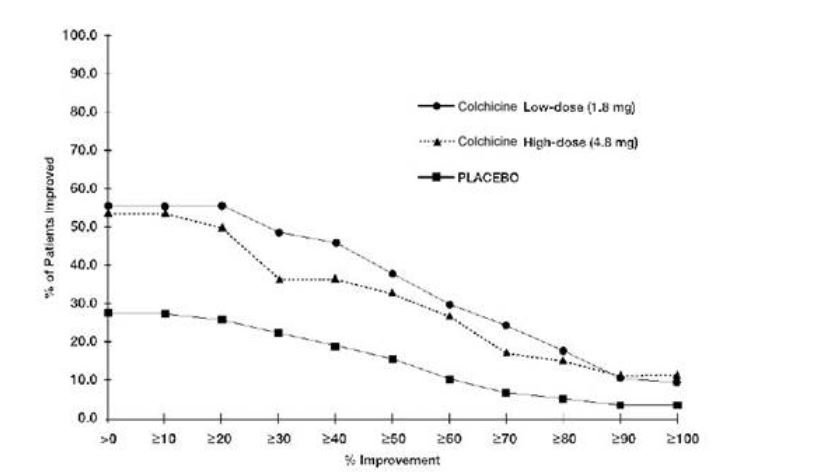
Following oral administration of colchicine tablets given as 1.8 mg colchicine over one hour to healthy, young adults under fasting conditions, colchicine appears to be readily absorbed, reaching mean maximum plasma concentrations of 6.2 ng/mL at a median 1.81 hours (range: 1.0 to 2.5 hours). Following administration of the nonrecommended high-dose regimen (4.8 mg over six hours), mean maximal plasma concentrations were 6.8 ng/mL, at a median 4.47 hours (range: 3.1 to 7.5 hours).
After ten days on a regimen of 0.6 mg twice daily, peak concentrations are 3.1 to 3.6 ng/mL (range 1.6 to 6.0 ng/mL), occurring 1.3 to 1.4 hours postdose (range 0.5 to 3.0 hours). Mean pharmacokinetic parameter values in healthy adults are shown in Table 5.
Table 5. Mean (%CV) Pharmacokinetic Parameters in Healthy Adults Given Colchicine Tablets Cmax (Colchicine ng/mL)
| Tmax* (h)
| Vd/F (L)
| CL/F (L/hr)
| t1/2 (h)
|
Colchicine tablets 0.6 mg Single Dose (N=13)
|
2.5 (28.7)
| 1.5 (1.0 – 3.0)
| 341.5 (54.4)
| 54.1 (31.0)
| --
|
Colchicine tablets 0.6 mg Twice Daily × 10 Days (N=13)
|
3.6 (23.7)
| 1.3 (0.5 – 3.0)
| 1150 (18.7)
| 30.3 (19.0)
| 26.6 (16.3)
|
*Tmax mean (range)
CL = Dose/AUC0-t (calculated from mean values)
Vd = CL/Ke (calculated from mean values)
|
In some subjects, secondary colchicine peaks are seen, occurring between three and 36 hours postdose and ranging from 39 to 155% of the height of the initial peak. These observations are attributed to intestinal secretion and reabsorption and/or biliary recirculation.
Absolute bioavailability is reported to be approximately 45%.
Administration of colchicine tablets with food has no effect on the rate of colchicine absorption but does decrease the extent of colchicine by approximately 15%. This is without clinical significance.
Distribution
The mean apparent volume of distribution in healthy young volunteers is approximately 5 to 8 L/kg.
Colchicine binding to serum protein is low, 39 ± 5%, primarily to albumin regardless of concentration.
Colchicine crosses the placenta (plasma levels in the fetus are reported to be approximately 15% of the maternal concentration). Colchicine also distributes into breast milk at concentrations similar to those found in the maternal serum. [see Use in Specific Populations (8.1, 8.2)].
Metabolism
Colchicine is demethylated to two primary metabolites, 2-O-demethylcolchicine and 3-O-demethylcolchicine (2- and 3-DMC, respectively) and one minor metabolite, 10-O-demethylcolchicine (also known as colchiceine). In vitro studies using human liver microsomes have shown that CYP3A4 is involved in the metabolism of colchicine to 2- and 3-DMC. Plasma levels of these metabolites are minimal (less than 5% of parent drug).
Elimination/Excretion
In healthy volunteers (n=12), 40 to 65% of 1 mg orally administered colchicine was recovered unchanged in urine. Enterohepatic recirculation and biliary excretion are also postulated to play a role in colchicine elimination. Following multiple oral doses (0.6 mg twice daily), the mean elimination half-lives in young healthy volunteers (mean age 25 to 28 years of age) is 26.6 to 31.2 hours. Colchicine is a substrate of P-gp.
Extracorporeal Elimination
Colchicine is not removed by hemodialysis.
Special Populations
There is no difference between men and women in the pharmacokinetic disposition of colchicine.
Pediatric Patients
Pharmacokinetics of colchicine was not evaluated in pediatric patients.
Elderly
A published report described the pharmacokinetics of 1 mg oral colchicine tablet in four elderly women compared to six young healthy males. The mean age of the four elderly women was 83 years (range 75 to 93), mean weight was 47 kg (38 to 61 kg) and mean creatinine clearance was 46 mL/min (range 25 to 75 mL/min). Mean peak plasma levels and AUC of colchicine were two times higher in elderly subjects compared to young healthy males.
A pharmacokinetic study using a single oral dose of one 0.6 mg colchicine tablet was conducted in young healthy subjects (n=20) between the ages of 18 and 30 years and elderly subjects (n=18) between the ages of 60 and 70 years. Elderly subjects in this study had a median age of 62 years and a mean (±SD) age of 62.83 ± 2.83 years. A statistically significant difference in creatinine clearance (mean ± SD) was found between the two age groups (132.56 ± 23.16 mL/min for young vs. 87.02 ± 17.92 mL/min for elderly subjects, respectively). The following pharmacokinetic parameter values (mean ± SD) were observed for colchicine in the young and elderly subjects, respectively: AUC0-inf (ng/hr/mL) 22.39 ± 6.95 and 25.01 ± 6.92; Cmax (ng/mL) 2.61 ± 0.71 and 2.56 ± 0.97; Tmax (hr) 1.38 ± 0.42 and 1.25 ± 0.43; apparent elimination half-life (hr) 24.92 ± 5.34 and 30.06 ± 10.78; and clearance (mL/min) 0.0321 ± 0.0091 and 0.0292 ± 0.0071.
Clinical studies with colchicine for prophylaxis and treatment of gout flares and for treatment of FMF did not include sufficient numbers of patients aged 65 years and older to determine whether they respond differently than younger patients. In general, dose selection for an elderly patient with gout should be cautious, reflecting the greater frequency of decreased renal function, concomitant disease or other drug therapy [see Dosage and Administration (2.4), Use in Specific Populations (8.5)].
Renal Impairment
Pharmacokinetics of colchicine in patients with mild and moderate renal impairment is not known. A published report described the disposition of colchicine (1 mg) in young adult men and women with FMF who had normal renal function or end-stage renal disease requiring dialysis. Patients with end-stage renal disease had 75% lower colchicine clearance (0.17 vs 0.73 L/hr/kg) and prolonged plasma elimination half-life (18.8 vs 4.4 hours) as compared to subjects with FMF and normal renal function [See Dosage and Administration (2.5), Use in Specific Populations (8.6)].
Hepatic Impairment
Published reports on the pharmacokinetics of IV colchicine in patients with severe chronic liver disease, as well as those with alcoholic or primary biliary cirrhosis, and normal renal function suggest wide interpatient variability. In some subjects with mild to moderate cirrhosis, the clearance of colchicine is significantly reduced and plasma half-life prolonged compared to healthy subjects. In subjects with primary biliary cirrhosis, no consistent trends were noted. [see Dosage and Administration (2.6), Use in Specific Populations (8.7)]. No pharmacokinetic data are available for patients with severe hepatic impairment (Child-Pugh C).
Drug Interactions
In Vitro Drug Interactions
In vitro studies in human liver microsomes have shown that colchicine is not an inhibitor or inducer of CYP1A2, CYP2A6, CYP2B6, CYP2C8, CYP2C9, CYP2C19, CYP2D6, CYP2E1, or CYP3A4 activity.
In Vivo Drug Interactions
The effects of coadministration of other drugs with colchicine tablets on Cmax, AUC, and Cmin are summarized in Table 6 (effect of other drugs on colchicine) and Table 7 (effect of colchicine on other drugs). For information regarding clinical recommendations, see Table 1 in Dose Modification for Coadministration of Interacting Drugs [see Dosage and Administration (2.4)].
Table 6. Drug Interactions: Pharmacokinetic Parameters for Colchicine Tablets in the Presence of the Coadministered Drug Coadministered Drug
| Dose of Coadministered Drug (mg)
| Dose of
colchicine tablets
(mg )
| N
| % Change in Colchicine Concentrations from Baseline
(Range: Min - Max)
|
Cmax
| AUC0-t
|
Cyclosporine
| 100 mg
single dose
| 0.6 mg
single dose
| 23
| 270.0.
(62.0 to 606.9)
| 259.0.
(75.8 to 511.9)
|
Clarithromycin
| 250 mg twice daily, 7 days
| 0.6 mg
single dose
| 23
| 227.2.
(65.7 to 591.1)
| 281.5.
(88.7 to 851.6)
|
Ketoconazole
| 200 mg twice daily, 5 days
| 0.6 mg
single dose
| 24
| 101.7.
(19.6 to 219.0)
| 212.2.
(76.7 to 419.6)
|
Ritonavir
| 100 mg twice daily, 5 days
| 0.6 mg
single dose
| 18
| 184.4.
(79.2 to 447.4)
| 296.0.
(53.8 to 924.4)
|
Verapamil
| 240 mg daily,
5 days
| 0.6 mg
single dose
| 24
| 40.1.
(-47.1 to 149.5)
| 103.3.
(-9.8 to 217.2)
|
Diltiazem
| 240 mg daily,
7 days
| 0.6 mg
single dose
| 20
| 44.2.
(-46.0 to 318.3)
| 93.4.
(-30.2 to 338.6)
|
Azithromycin
| 500 mg × 1 day, then.
250 mg × 4 days
| 0.6 mg
single dose
| 21
| 21.6.
(-41.7 to 222.0)
| 57.1.
(-24.3 to 241.1)
|
Grapefruit juice
| 240 mL twice daily, 4 days
| 0.6 mg
single dose
| 21
| -2.55.
(-53.4 to 55.0)
| -2.36.
(-46.4 to 62.2)
|
Estrogen-containing oral contraceptives: In healthy female volunteers given ethinyl estradiol and norethindrone (Ortho-Novum 1/35) coadministered with colchicine tablets (0.6 mg twice daily × 14 days), hormone concentrations are not affected.
In healthy volunteers given theophylline coadministered with colchicine tablets (0.6 mg twice daily x 14 days), theophylline concentrations were not affected.
Table 7. Drug Interactions: Pharmacokinetic Parameters for Coadministration of Drug in the Presence of Colchicine Tablets
Coadministered Drug
| Dose of Coadministered Drug (mg)
| Dose of Colchicine tablets (mg)
| N
| % Change in Coadministered Drug Concentrations from Baseline
(Range: Min - Max)
|
Cmax
| AUC0-t
|
Theophylline
| 300 mg (elixir) single dose
| 0.6 mg twice daily × 14 days
| 27
| 1.6
(-30.4 to 23.1)
| 1.6
(-28.5 to 27.1)
|
Ethinyl Estradiol (Ortho-Novum 1/35)
| 21-day cycle (active treatment) + 7-day placebo
| 0.6 mg twice daily × 14 days
| 27 Conducted in healthy adult females
| -6.7
(-40.3 to 44.7)
| -3.0 AUCτ
(-25.3 to 24.9)
|
Norethindrone (Ortho-Novum 1/35)
| 0.94
(-37.3 to 59.4)
| -1.6
(-32.0 to 33.7)
|
The evidence for the efficacy of colchicine in patients with FMF is derived from the published literature. Three randomized, placebo-controlled studies were identified. The three placebo-controlled studies randomized a total of 48 adult patients diagnosed with FMF and reported similar efficacy endpoints as well as inclusion and exclusion criteria.
One of the studies randomized 15 patients with FMF to a six month crossover study during which five patients discontinued due to study noncompliance. The ten patients completing the study experienced five attacks over the course of 90 days while treated with colchicine compared to 59 attacks over the course of 90 days while treated with placebo. Similarly, the second study randomized 22 patients with FMF to a four-month crossover study during which nine patients discontinued due to lack of efficacy while receiving placebo or study noncompliance. The 13 patients completing the study experienced 18 attacks over the course of 60 days while treated with colchicine compared to 68 attacks over the course of 60 days while treated with placebo. The third study was discontinued after an interim analysis of six of the 11 patients enrolled had completed the study; results could not be confirmed.
Open-label experience with colchicine in adults and children with FMF is consistent with the randomized, controlled trial experience and was utilized to support information on the safety profile of colchicine and for dosing recommendations.
Dosing Instructions
Patients should be advised to take colchicine tablets as prescribed, even if they are feeling better. Patients should not alter the dose or discontinue treatment without consulting with their doctor. If a dose of colchicine tablets is missed:
- For treatment of a gout flare when the patient is not being dosed for prophylaxis, take the missed dose as soon as possible.
- For treatment of a gout flare during prophylaxis, take the missed dose immediately, wait 12 hours, then resume the previous dosing schedule.
- For prophylaxis without treatment for a gout flare, or FMF, take the dose as soon as possible and then return to the normal dosing schedule. However, if a dose is skipped the patient should not double the next dose.
Fatal Overdose
Instruct patient that fatal overdoses, both accidental and intentional, have been reported in adults and children who have ingested colchicine. Colchicine tablets should be kept out of the reach of children.
Blood Dyscrasias
Patients should be informed that bone marrow depression with agranulocytosis, aplastic anemia, and thrombocytopenia may occur with colchicine tablets.
Drug and Food Interactions
Patients should be advised that many drugs or other substances may interact with colchicine tablets and some interactions could be fatal. Therefore, patients should report to their healthcare provider all of the current medications they are taking, and check with their healthcare provider before starting any new medications, particularly antibiotics. Patients should also be advised to report the use of nonprescription medication or herbal products. Grapefruit and grapefruit juice may also interact and should not be consumed during colchicine tablets treatment.
Neuromuscular Toxicity
Patients should be informed that muscle pain or weakness, tingling or numbness in fingers or toes may occur with colchicine tablets alone or when it is used with certain other drugs. Patients developing any of these signs or symptoms must discontinue colchicine tablets and seek medical evaluation immediately.
Infertility
Advise males of reproductive potential that colchicine tablets may rarely and transiently impair fertility [see Use in Specific Populations (8.3)].
Manufactured By:
Strides Pharma Science Ltd.
Bengaluru-562106, India
Distributed by:
Strides Pharma Inc.
East Brunswick, NJ 08816
Revised: 04/2022