CYP3A4 Inducers
Avoid concomitant use of ZURZUVAE with CYP3A4 inducers [see Drug Interactions (7) and Clinical Pharmacology (12.3)].
CYP3A4 Inhibitors
Reduce the ZURZUVAE dosage to 30 mg orally once daily in the evening for 14 days when used concomitantly with a strong CYP3A4 inhibitor [see Drug Interactions (7) and Clinical Pharmacology (12.3)]. No dosage modification is recommended when ZURZUVAE is concomitantly used with a moderate CYP3A4 inhibitor.
Pregnancy Exposure Registry
There is a pregnancy exposure registry that monitors pregnancy outcomes in women exposed to antidepressants, including ZURZUVAE, during pregnancy. Healthcare providers are encouraged to register patients by calling the National Pregnancy Registry for Antidepressants at 1-844-405-6185 or visiting online at https://womensmentalhealth.org/research/pregnancyregistry/antidepressants/
Risk Summary
Based on findings from animal studies, ZURZUVAE may cause fetal harm. Advise pregnant women of the potential risk to a fetus. Available data on ZURZUVAE use in pregnant women from the clinical development program are insufficient to evaluate for a drug-associated risk of major birth defects, miscarriage, or adverse maternal or fetal outcomes.
In animals, oral administration of zuranolone to pregnant rats during organogenesis resulted in developmental toxicity, including embryofetal death and fetal malformations, with a no adverse effect level (NOAEL) associated with maternal plasma exposures 7 times greater than in humans at the maximum recommended human dose (MRHD) of 50 mg. Oral administration of zuranolone to rats during pregnancy and lactation resulted in developmental toxicity in the offspring, including, perinatal mortality, at maternal exposures similar to that in humans at the MRHD. Developmental toxicity was observed at doses that were also maternally toxic. Neuronal death was observed in rats exposed to zuranolone during a period of brain development that begins during the third trimester of pregnancy in humans and continues up to a few years after birth.
The estimated background risk of major birth defects and miscarriage for the indicated population is unknown. All pregnancies have a background risk of birth defect, loss, or other adverse outcomes. In the U.S. general population, the estimated background risk of major birth defects and miscarriage in clinically recognized pregnancies is 2% to 4% and 15% to 20%, respectively.
Data
Animal Data
Oral administration of zuranolone (0, 2.5, 7.5, or 22.5 mg/kg/day) to pregnant rats during organogenesis resulted in increased incidences of fetal malformations, reductions in embryofetal survival, and reduced fetal body weights as well as maternal mortality and sedation at the highest dose. The no effect dose (7.5 mg/kg/day) for adverse effects on embryofetal development was associated with maternal exposures (AUC) approximately 7 times that in humans at the MRHD of 50 mg.
Potential adverse effects of zuranolone on embryofetal development in pregnant rabbits were not adequately assessed.
Oral administration of zuranolone (0, 1, 4, or 10 mg/kg/day) to rats throughout pregnancy and into lactation resulted in increased perinatal mortality and persistent bodyweight reductions in the offspring at the mid and high doses, which also produced maternal mortality and adverse clinical signs. The no-effect dose (1 mg/kg/day) for adverse effects on pre- and postnatal development in rats was associated with maternal exposures (AUC) approximately 2 times that in the humans at the MRHD.
Oral administration of a single dose of zuranolone (0, 2.5, or 7.5 mg/kg) to rats on postnatal day 7 resulted in increased apoptotic neurodegeneration in the brain at the highest dose tested. The no-effect dose (2.5 mg/kg) was associated with plasma exposures (AUC) comparable to that in humans at the MRHD. Brain development on PND 7 in rats corresponds to a period of brain development that begins during the third trimester of pregnancy in humans and continue up to a few years after birth.
Risk Summary
Available data from a clinical lactation study in 14 women indicate that zuranolone is present in low levels in human milk (see Data). There are no data on the effects of zuranolone on a breastfed infant and limited data on the effects on milk production.
The developmental and health benefits of breastfeeding should be considered along with the mother's clinical need for ZURZUVAE and any potential adverse effects on the breastfed child from ZURZUVAE or from the underlying maternal condition.
Data
A steady-state milk study was conducted in 14 healthy lactating women treated with daily oral administration of 30 mg of ZURZUVAE for 5 days. At steady state (Day 5), the calculated maximum relative infant dose for ZURZUVAE was < 1%. The daily infant dose was low (approximately 0.0013 mg/kg/day), reflecting a mean relative infant dose of 0.357% compared to the maternal dose. Concentrations of ZURZUVAE in breastmilk were below the level of quantification limit (BQL) by 4-6 days after the last dose.
Contraception
Advise female patients of reproductive potential to use effective contraception during treatment with ZURZUVAE and for one week after the final dose.
Cardiac Electrophysiology
At two times the maximum recommended dose, ZURZUVAE does not cause clinically significant QTc interval prolongation.
Psychomotor Performance with Alcohol or Alprazolam
Co-administration of repeated 50 mg daily doses of ZURZUVAE with alcohol or alprazolam led to impairment in psychomotor performance [see Warnings and Precautions (5.2), Drug Interactions (7)].
Absorption
Following oral administration, peak zuranolone concentrations occur at 5 to 6 hours (Tmax).
The absolute bioavailability of ZURZUVAE was not evaluated.
Effect of Food
Following administration of 30 mg of ZURZUVAE to healthy subjects, the Cmax increased by approximately 3.5-fold and the AUClast increased by approximately 1.8-fold with a low-fat meal (400 to 500 calories, 25% fat) compared to fasted conditions. The Cmax increased by approximately 4.3-fold and the AUClast increased by approximately 2-fold with a high-fat meal (800 to 1,000 calories, 50% fat) compared to fasted conditions. The Tmax was not impacted by food.
Distribution
The volume of distribution of zuranolone following oral administration is greater than 500 L. The mean blood-to-plasma concentration ratio ranged from 0.54 to 0.58. Plasma protein binding is greater than 99.5%.
Elimination
The terminal half-life of zuranolone is approximately 19.7 to 24.6 hours in an adult population. The mean apparent clearance (CL/F) of zuranolone is 33 L/h.
Metabolism
Zuranolone undergoes extensive metabolism, with CYP3A4 identified as a primary enzyme involved. There were no circulating human metabolites greater than 10% of total drug-related materials and none are considered to contribute to the therapeutic effects of zuranolone.
Excretion
Following oral administration of radiolabeled zuranolone, 45% of the dose was recovered in urine as metabolites with negligible unchanged zuranolone and 41% in feces as metabolites with less than 2% as unchanged zuranolone.
Specific Populations
Racial Groups
Black or African American participants had a 14% higher CL/F compared to participants of other races (Asian, White, or other).
Male and Female Patients, Patients with Renal Impairment, Patients with Hepatic Impairment
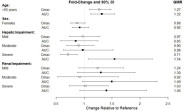
Exposures of zuranolone in specific populations are summarized in Figure 1
[see Dosage and Administration (2.4, 2.5) and Use in Specific Populations (8.6, 8.7)].
Figure 1 Effect of Specific Populations on the Pharmacokinetics of Zuranolone
Data shown for participants ≥65 years relative to younger participants (18 to 45 years); female participants relative to male participants; renal and hepatic impairment relative to participants with normal renal and hepatic function, respectively. Hepatic impairment: Mild (Child-Pugh Class A); moderate (Child-Pugh Class B); severe (Child-Pugh Class C). Renal impairment: Mild (eGFR 60-89 mL/min/1.73m2); moderate (eGFR 30-59 mL/min/1.73m2); severe (eGFR <30 mL/min/1.73m2 and not on dialysis). CI = confidence interval; GMR = geometric mean ratio
Drug Interaction Studies
The effect of co-administered drugs on the pharmacokinetics of zuranolone is summarized in Figure 2 [see Dosage and Administration (2.3) and Drug Interactions (7)].
Figure 2 Effect of Co-Administered Drugs on the Pharmacokinetics of Zuranolone
Data shown are zuranolone plus co-administered drug relative to zuranolone alone. CI = confidence interval; GMR = geometric mean ratio; * clinically significant drug interaction
ZURZUVAE did not affect the pharmacokinetics of alprazolam or ethanol. Increased impairment of psychomotor performance was observed when ZURZUVAE was co-administered with alprazolam or ethanol [see Warnings and Precautions (5.2) and Drug Interactions (7)].
In Vitro Studies
Enzyme systems: Zuranolone is not an inhibitor of CYP1A2, 2B6, 2C19, 2C8, 2C9, 2D6 or 3A4. Zuranolone is not an inducer for CYP1A2, CYP2B6 or CYP3A4 at the therapeutic dose range.
Transporter systems: Zuranolone is not a substrate of P-glycoprotein (P-gp), BCRP, OATP1B1 or OATP1B3. Zuranolone does not inhibit P-gp, BCRP, BSEP, OATP1B1, OATP1B3, OAT1, OAT2, OCT1, OCT2, MATE1, or MATE2.
Carcinogenesis
Oral administration of zuranolone in a 26-week carcinogenicity study in transgenic mice (0, 10, 30, or 100 mg/kg/day), and in a 104-week carcinogenicty study in rats (0, 2, 6, or 20 mg/kg/day in males and 0, 0.2, 0.6, or 1.5 mg/kg/day in females) was not associated with increases in tumors in either species. Plasma exposures (AUC) in rats at the highest dose tested were approximately 4 times that in humans at the maximum recommended human dose (MRHD) of 50 mg.
Mutagenesis
Zuranolone was not genotoxic when tested in an in vitro microbial mutagenicity (Ames) assay, an in vitro chromosome aberration assay in Chinese hamster ovary cells, and an in vivo bone marrow micronucleus assay in rats.
Impairment of Fertility
Oral administration of zuranolone (0, 3, 10, or 30 mg/kg/day) to male rats prior to and during mating with untreated females resulted in increased post-implantation loss and a corresponding decrease in the number of viable embryos at the high dose, which was also paternally toxic. There were no adverse effects on fertility or sperm parameters. Adverse effects on reproduction were not observed when males were remated after a 6-week treatment-free period. The no effect dose (10 mg/kg/day) for male reproductive toxicity was associated with a plasma zuranolone exposure (AUC) of approximately 4 times the human exposure at the MRHD. Oral administration of zuranolone (0, 1, 3, or 10 mg/kg/day) to female rats prior to and throughout mating and continuing through early gestation resulted in disruption of estrous cyclicity at the high dose, but there were no adverse effects on fertility or early embryonic development. The no-effect dose (3 mg/kg/day) for female reproductive toxicity was associated with exposures approximately 4 times that in humans at the MRHD.
Baseline Demographics and Disease Characteristics
In Studies 1 and 2, the baseline demographic and disease characteristics of patients were similar between the ZURZUVAE and placebo groups. In Study 1, patients had a mean age of 30 years (range 19 to 44 years); were 70% White, 22% Black or African American, 1% Asian, and 7% were other races; and 38% were of Hispanic or Latino ethnicity. Baseline use of stable oral antidepressants was reported in 15% of patients. In Study 2, patients had a mean age of 28 years (range 18 to 44 years); were 56% White, 41% Black or African American, 1% Asian, and 2% were other races; and 23% were of Hispanic or Latino ethnicity. Baseline use of stable oral antidepressants was reported in 19% of patients.
The primary endpoint for Studies 1 and 2 was the change from baseline in depressive symptoms as measured by the HAMD-17 total score at Day 15. In these studies, patients in the ZURZUVAE groups experienced statistically significantly greater improvement on the primary endpoint compared to patients in the placebo groups, as shown in Table 5. For Study 1, the key secondary endpoints included change from baseline in HAMD-17 total score at Days 3, 28, and 45.
Table 5 Results for the Primary Endpoint: Change from Baseline in the HAMD-17 Total Score at Day 15 (Studies 1 and 2 in Women with PPD)
|
|
| Study Number | Treatment Group | N | Mean Baseline Score (SD) | LS Mean Change from Baseline (SE) | Placebo- subtracted Difference
(95% CI) |
| 1 | 50 mg of ZURZUVAE
| 98
| 28.6 (2.49)
| -15.6 (0.82)
| -4.0 (-6.3, -1.7)
|
| Placebo
| 97
| 28.8 (2.34)
| -11.6 (0.82)
|
| 2 | Zuranolone (another capsule formulation)* | 76
| 28.4 (2.09)
| -17.8 (1.04)
| -4.2 (-6.9, -1.5)
|
| Placebo
| 74
| 28.8 (2.32)
| -13.6 (1.07)
|
Subgroup analyses of the primary endpoint did not suggest differences in response to 50 mg of ZURZUVAE for age, race, or BMI.
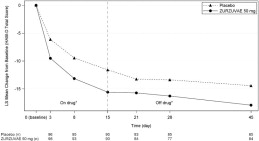
The time course of response for 50 mg ZURZUVAE compared to placebo for Study 1 is shown in Figure 3.
Figure 3 Mean Change from Baseline in HAM-D Total Score Over Time (Days) in Women with PPD in Study 1
*Both phases were double-blind.
Study 3
In Study 3, 50 mg of ZURZUVAE was administered for six consecutive nights and on the seventh night a single dose of 50 mg or 100 mg (two times the recommended dose) was administered. The primary driving performance outcome measure was the change in Standard Deviation of Lateral Position (SDLP) (a measure of driving impairment) in the ZURZUVAE group compared to the placebo group on Days 2 and 8 (after a single dose and repeat doses, respectively).
Study 3 included 67 healthy participants. The median age was 45 years old (age ranged from 22 to 81 years old; 7 participants were ≥ 65 years of age); there were 38 males and 29 females; 88% were White, 5% were Black or African American, 3% were Asian, and 5% were other races; and 12% were of Hispanic/Latino ethnicity.
A single 50 mg dose of ZURZUVAE caused statistically significant impairment in next-morning driving performance compared to placebo. Statistically significant effects on driving were also observed on Day 8 following daily administration of 50 mg of ZURZUVAE. Administration of 100 mg of ZURZUVAE (twice the maximum recommended dose) on the final night increased impairment in driving ability [see Warnings and Precautions (5.1)].
The exposure-response analysis for driving impairment in Study 3 suggested that the projected mean placebo-adjusted SDLP at 12 hours post-dose would be less than the threshold associated with driving impairment.
Study 4
In Study 4, 30 mg of ZURZUVAE (0.6 times the maximum recommended daily dose) was administered for four consecutive nights and on the fifth night a single dose of 30 mg or 60 mg (1.2 times the recommended daily dose) was administered. The primary driving performance outcome measure was the change in SDLP in the ZURZUVAE group compared to the placebo group on Days 2 and 6 (after a single dose and repeat doses, respectively).
Study 4 included 60 participants; 60% and 40% were male and female, respectively; the median age was 41 years old (range was 22 to 62 years old); 90% were White, 5% were Black or African American, 3% were Asian, and 2% were other races; and 15% were of Hispanic/Latino ethnicity.
A single 30 mg dose of ZURZUVAE caused a statistically significant impairment in next-morning driving performance compared to placebo. The mean effect on driving performance was not statistically significantly different following 30 mg of ZURZUVAE compared to placebo on Day 6; however, driving ability was impaired in some participants taking ZURZUVAE. Administration of 60 mg of ZURZUVAE (1.2 times the maximum recommended dose) on the final night caused statistically significant impairment in next-morning driving performance compared to placebo [see Warnings and Precautions (5.1)].
How Supplied
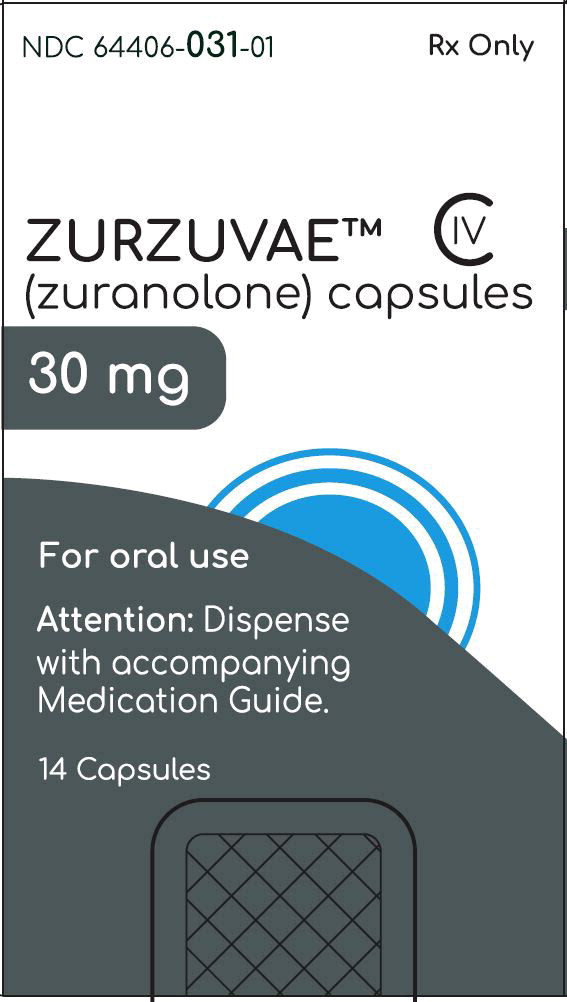
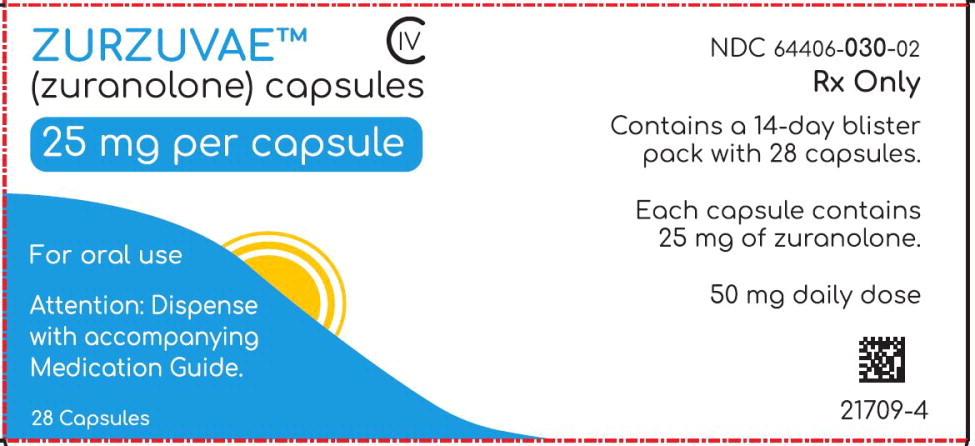
ZURZUVAE (zuranolone) is supplied as 20 mg, 25 mg, and 30 mg capsules as follows:
Capsule
Strength
| Capsule Colors
| Capsule Markings
| Packaging Configuration
| NDC
|
|---|
| 20 mg
| light-orange cap
ivory to light-yellow body
| Black “S-217 20 mg” on body
| Bottle of 14
| 64406-029-01
|
| 25 mg
| light-orange cap
light-orange body
| Black “S-217 25 mg” on body
| Bottle of 14
| 64406-030-01
|
| Blister pack of 28
| 64406-030-02
|
| 30 mg
| orange cap
light-orange body
| Black “S-217 30 mg” on body
| Bottle of 14
| 64406-031-01
|
Impaired Ability to Drive or Engage in Other Potentially Hazardous Activities
Inform patients that ZURZUVAE causes driving impairment. Advise patients to take ZURZUVAE in the evening. Advise patients not to drive a motor vehicle or engage in other potentially hazardous activities requiring complete mental alertness, such as operating machinery, until at least 12 hours after ZURZUVAE administration. Warn patients that they may not be able to assess their own ability to drive or the degree of impairment caused by ZURZUVAE [see Warnings and Precautions (5.1)].
Central Nervous System Depressant Effects
Inform patients that ZURZUVAE can cause somnolence, dizziness, sedation, and confusion. Advise patients to use caution if taking ZURZUVAE in combination with alcohol, other CNS depressants, or medications that increase the concentration of ZURZUVAE [see Warnings and Precautions (5.2), Adverse Reactions (6.1) and Drug Interactions (7)].
Suicidal Thoughts and Behavior
Advise patients to look for the emergence of suicidal thoughts and behaviors and instruct them to report such symptoms to the healthcare provider immediately [see Warnings and Precautions (5.3)].
Administration Instructions
Inform patients to take ZURZUVAE with fat-containing food [see Dosage and Administration (2.1) and Clinical Pharmacology (12.3)].
Instruct patients that if a daily dose is missed, the missed dose should be taken the next day as scheduled. Patients should be advised not to take extra capsules to make up for the missed dose [see Dosage and Administration (2.1, 2.5)].
Abuse, Misuse, and Physical Dependence
Advise patients that ZURZUVAE has abuse potential with associated risks of misuse, abuse, and substance use disorder including addiction and that ZURZUVAE is associated with the potential for physical dependence [see Drug Abuse and Dependence (9.2, 9.3)].
Pregnancy
Advise pregnant women and females of reproductive potential of the potential risk to a fetus and to notify their healthcare provider if they become pregnant or intend to become pregnant during treatment with ZURZUVAE. Advise female patients of reproductive potential to use effective contraception during treatment with ZURZUVAE and for one week after the final dose [see Warnings and Precautions (5.4), Use in Specific Populations (8.1, 8.3)].
Advise patients that there is a pregnancy exposure registry that monitors pregnancy outcomes in women exposed to ZURZUVAE during pregnancy [see Use in Specific Populations (8.1)].
Manufactured for:
Biogen Inc.
225 Binney Street
Cambridge, MA 02142 USA
ZURZUVAE is a trademark of Sage Therapeutics, Inc.
© 2023 Sage Therapeutics and Biogen