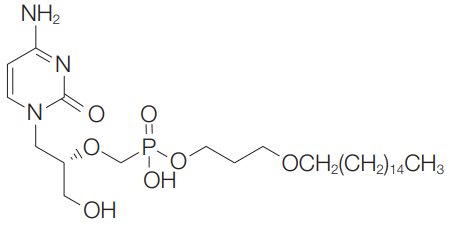
Brincidofovir is a prodrug that is converted intracellularly to cidofovir, which is subsequently phosphorylated to cidofovir diphosphate, the active antiviral moiety, following oral administration. Brincidofovir plasma exposures do not accumulate after repeat doses. The metabolite cidofovir diphosphate reaches maximum concentration at 47 hours (23 to 311 hours) following administration of the recommended dose, with a mean (CV%) half-life of 113 hours (34.2%). The pharmacokinetic properties of brincidofovir following administration of TEMBEXA are provided in Table 4. The pharmacokinetic parameters of brincidofovir and cidofovir diphosphate following administration of TEMBEXA at the recommended dose are provided in Table 5.
Table 4: Pharmacokinetic Properties of Brincidofoviraa. Healthy adults.
b. Administered under fasted conditions.
c. Low-fat meal: ~400 calories, with ~25% calories from fat. No clinically meaningful change in intracellular concentrations of cidofovir diphosphate were seen when TEMBEXA Tablet was administered with a low-fat meal. The effect of food on TEMBEXA oral suspension has not been studied.
d. Following administration of radiolabeled brincidofovir. |
Absorption |
Bioavailability | Oral suspension | 16.8% |
Tablet | 13.4% |
Tmaxb | 3 hours (2 to 8 hours) |
Effect of food on TEMBEXA Tablet (relative to fasting)c | - AUCinf decreased by 31%
- Cmax decreased by 49%
|
Distribution |
% Bound to human plasma proteins | >99.9% |
Blood-to-plasma ratio (drug or drug-related materials)d | 0.48 to 0.61 |
Apparent Volume of distribution, L | 1230 |
Elimination |
Apparent Clearance, L/hr | 44.1 |
Mean terminal half-life (t1/2), hr | 19.3 |
Metabolism |
Metabolic pathways | hydrolysis, CYP4F2 |
Metabolites | cidofovir and cidofovir diphosphate (active) |
Excretion |
% of dose excreted in urined | 51%, as metabolites |
% of dose excreted in fecesd | 40%, as metabolites |
Table 5: Single-Dose Pharmacokinetic Parameters of Brincidofovir and Cidofovir DiphosphateaAUC = area under the time concentration curve; Cmax = maximum concentration; CV = coefficient of variation.
a. Healthy adults. |
PK Parameter | Geometric Mean (%CV) |
Brincidofovir | Cidofovir diphosphate |
Cmax | 480 ng/mL (70%) | 9.7 pg/106 cells (75%) |
AUCtau | 3400 ng·hr/mL (58%) | 1200 pg·hr/106 cells (75%) |
Metabolism
Brincidofovir is metabolized by hydrolysis of the phosphoester bond to form cidofovir. Cidofovir is subsequently phosphorylated to form cidofovir diphosphate. Brincidofovir is also carboxylated at the terminal carbon by Cytochrome P450 (CYP) 4F2, followed by subsequent CYP-mediated oxidations and multiple cycles of fatty acid beta-oxidation. The major inactive metabolites formed via these pathways are CMX103 (3-hydroxypropyl ester of cidofovir) and CMX064 (4‑(3-propoxy)butanoic acid ester of cidofovir).
Genetic and chemical inhibition of acid sphingomyelinase enzyme activity in multiple human cell lines resulted in substantially lower concentrations of cidofovir and cidofovir diphosphate (the active drug), compared to controls with functional acid sphingomyelinase enzyme activity. Findings show acid sphingomyelinase plays a major role in the hydrolysis of brincidofovir to cidofovir in these cell lines. Based on in vitro data, acid sphingomyelinase deficiency may reduce the ability to convert brincidofovir to cidofovir and cidofovir diphosphate; however, the clinical relevance of this finding is unknown.
Comparison of Animal and Human Pharmacokinetic Data to Support Effective Human Dose Selection
Because the effectiveness of TEMBEXA cannot be tested in humans, a comparison of brincidofovir and cidofovir diphosphate exposures achieved in human subjects to those observed in animal models of orthopoxvirus infection (rabbits infected with rabbitpox virus, and mice infected with ectromelia virus) in efficacy studies was necessary to support the dose and regimen of 200 mg once a week for 2 doses for treatment of smallpox disease in humans. Humans achieve greater systemic exposures (AUC and Cmax) of brincidofovir and greater than or equal to intracellular concentrations of cidofovir diphosphate following a 200 mg once a week dose when compared with therapeutic exposure in the animal models [see Clinical Studies (14)].
Specific Populations
No clinically meaningful differences in the pharmacokinetics of brincidofovir were observed based on age, sex, race, reduced activity in the CYP4F2 enzyme, renal impairment including ESRD with or without dialysis (based on estimated glomerular filtration rate [GFR]), or hepatic impairment (Child-Pugh Class B, C).
Patients Requiring Hemodialysis
The AUC and Cmax of brincidofovir and its metabolite cidofovir were comparable between subjects requiring hemodialysis whether on- or off-dialysis.
Pediatric Patients
The pharmacokinetics of TEMBEXA suspension has been evaluated in pediatric individuals. Pharmacokinetic simulation was used to derive dosing regimens that are predicted to provide pediatric patients, including neonates, with exposures comparable to the observed exposure in adults receiving TEMBEXA tablets.
Drug Interaction Studies
Clinical Studies
OATP1B1 and 1B3 Inhibitors: A single 600 mg oral cyclosporine (OATP1B1 and 1B3 inhibitor) dose increased the mean brincidofovir AUC0-inf and Cmax by 374% and 269%, respectively, when administered concomitantly with TEMBEXA.
CYP Substrates: No clinically significant differences in the pharmacokinetics of midazolam (sensitive CYP3A substrate) were observed when administered concomitantly with TEMBEXA.
P-gp Substrates: No clinically significant differences in the pharmacokinetics of dabigatran etexilate (P-gp substrate) were observed when administered concomitantly with TEMBEXA.
In vitro Studies Where Drug Interaction Potential Was Not Further Evaluated Clinically
CYP Enzymes: Brincidofovir is a direct and reversible inhibitor of CYP1A2, CYP2B6, CYP2C8, CYP2C9, CYP2C19, CYP2D6, CYP4F2. Brincidofovir is not an inducer of CYP1A2, CYP2B6 or CYP3A.
Transporter Systems: Brincidofovir is an inhibitor of Breast Cancer Resistance Protein (BCRP), multidrug resistance-associated protein 2 (MRP2), bile salt export pump (BSEP), OATP1B1, Organic Anion Transporter 1 (OAT1), and OAT3. Brincidofovir is not an inhibitor of OATP1B3, Organic Cation Transporter 2 (OCT2), multidrug and toxin extrusion protein 1 (MATE1), or MATE2-K in vitro.