Other
Cefotaxime for injection, USP is a semisynthetic, broad spectrum cephalosporin antibiotic for parenteral administration. It is the sodium salt of 7-[2-(2-amino-4-thiazolyl) glyoxylamido]-3-(hydroxymethyl)-8-oxo-5-thia-1-azabicyclo [4.2.0] oct-2-ene-2-carboxylate 72 (Z)-(o-methyloxime), acetate (ester). Cefotaxime for injection, USP contains approximately 50.5 mg (2.2 mEq) of sodium per gram of cefotaxime activity. Solutions of cefotaxime for injection, USP range from very pale yellow to light amber depending on the concentration and the diluent used. The pH of the injectable solutions usually ranges from 5.0 to 7.5. The CAS Registry Number is 64485-93-4.

Structure (71b9b142 B1ec 400a 8bce 31aa71098747 01)
The molecular formula is C16H16N5NaO7S2 and the molecular weight is 477.45. Cefotaxime for injection, USP is supplied as a dry powder in conventional vials. Each vial contains cefotaxime sodium equivalent to 500 mg, 1 g or 2 g of cefotaxime.
Following IM administration of a single 500 mg or 1 g dose of cefotaxime for injection to normal volunteers, mean peak serum concentrations of 11.7 and 20.5 mcg/mL respectively were attained within 30 minutes and declined with an elimination half-life of approximately 1 hour. There was a dose-dependent increase in serum levels after the IV administration of 500 mg, 1 g, and 2 g of cefotaxime for injection (38.9, 101.7, and 214.4 mcg/mL respectively) without alteration in the elimination half-life. There is no evidence of accumulation following repetitive IV infusion of 1 g doses every 6 hours for 14 days as there are no alterations of serum or renal clearance. About 60% of the administered dose was recovered from urine during the first 6 hours following the start of the infusion.
Approximately 20 to 36% of an intravenously administered dose of 14C-cefotaxime is excreted by the kidney as unchanged cefotaxime and 15 to 25% as the desacetyl derivative, the major metabolite. The desacetyl metabolite has been shown to contribute to the bactericidal activity. Two other urinary metabolites (M2 and M3) account for about 20 to 25%. They lack bactericidal activity.
A single 50 mg/kg dose of cefotaxime for injection was administered as an intravenous infusion over a 10- to 15-minute period to 29 newborn infants grouped according to birth weight and age. The mean half-life of cefotaxime in infants with lower birth weights (≤1500 grams), regardless of age, was longer (4.6 hours) than the mean half-life (3.4 hours) in infants whose birth weight was greater than 1500 grams. Mean serum clearance was also smaller in the lower birth weight infants. Although the differences in mean half-life values are statistically significant for weight, they are not clinically important. Therefore, dosage should be based solely on age. (See DOSAGE AND ADMINISTRATION section.)
Cefotaxime for injection is contraindicated in patients who have shown hypersensitivity to cefotaxime sodium, or the cephalosporin group of antibiotics.
BEFORE THERAPY WITH CEFOTAXIME FOR INJECTION IS INSTITUTED, CAREFUL INQUIRY SHOULD BE MADE TO DETERMINE WHETHER THE PATIENT HAS HAD PREVIOUS HYPERSENSITIVITY REACTIONS TO CEFOTAXIME SODIUM, CEPHALOSPORINS, PENICILLINS, OR OTHER DRUGS. THIS PRODUCT SHOULD BE GIVEN WITH CAUTION TO PATIENTS WITH TYPE I HYPERSENSITIVITY REACTIONS TO PENICILLIN. ANTIBIOTICS SHOULD BE ADMINISTERED WITH CAUTION TO ANY PATIENT WHO HAS DEMONSTRATED SOME FORM OF ALLERGY, PARTICULARLY TO DRUGS. IF AN ALLERGIC REACTION TO CEFOTAXIME FOR INJECTION OCCURS, DISCONTINUE TREATMENT WITH THE DRUG. SERIOUS HYPERSENSITIVITY REACTIONS MAY REQUIRE EPINEPHRINE AND OTHER EMERGENCY MEASURES.
During post-marketing surveillance, a potentially life-threatening arrhythmia was reported in each of six patients who received a rapid (less than 60 seconds) bolus injection of cefotaxime through a central venous catheter. Therefore, cefotaxime should only be administered as instructed in the DOSAGE AND ADMINISTRATION section.
Clostridium difficile associated diarrhea (CDAD) has been reported with use of nearly all antibacterial agents, including cefotaxime for injection, and may range in severity from mild diarrhea to fatal colitis. Treatment with antibacterial agents alters the normal flora of the colon leading to overgrowth of C. difficile.
C. difficile produces toxins A and B which contribute to the development of CDAD. Hypertoxin producing strains of C. difficile cause increased morbidity and mortality, as these infections can be refractory to antimicrobial therapy and may require colectomy. CDAD must be considered in all patients who present with diarrhea following antibiotic use. Careful medical history is necessary since CDAD has been reported to occur over two months after the administration of antibacterial agents.
If CDAD is suspected or confirmed, ongoing antibiotic use not directed against C. difficile may need to be discontinued. Appropriate fluid and electrolyte management, protein supplementation, antibiotic treatment of C. difficile, and surgical evaluation should be instituted as clinically indicated.
The acute toxicity of cefotaxime was evaluated in neonatal and adult mice and rats. Significant mortality was seen at parenteral doses in excess of 6000 mg/kg/day in all groups. Common toxic signs in animals that died were a decrease in spontaneous activity, tonic and clonic convulsions, dyspnea, hypothermia, and cyanosis. Cefotaxime sodium overdosage has occurred in patients. Most cases have shown no overt toxicity. The most frequent reactions were elevations of BUN and creatinine. There is a risk of reversible encephalopathy in cases of administration of high doses of beta-lactam antibiotics including cefotaxime. No specific antidote exists. Patients who receive an acute overdosage should be carefully observed and given supportive treatment.
Adults
Dosage and route of administration should be determined by susceptibility of the causative organisms, severity of the infection, and the condition of the patient (see table for dosage guideline). Cefotaxime for injection may be administered IM or IV after reconstitution. The maximum daily dosage should not exceed 12 grams.
| GUIDELINES FOR DOSAGE OF CEFOTAXIME FOR INJECTION | ||
| Type of Infection | Daily Dose (grams) | Frequency and Route |
| Gonococcal urethritis/cervicitis in males and females | 0.5 | 0.5 gram IM (single dose) |
| Rectal gonorrhea in females | 0.5 | 0.5 gram IM (single dose) |
| Rectal gonorrhea in males | 1 | 1 gram IM (single dose) |
| Uncomplicated infections | 2 | 1 gram every 12 hours IM or IV |
| Moderate to severe infections | 3 to 6 | 1 to 2 grams every 8 hours IM or IV |
| Infections commonly needing antibiotics in higher dosage (e.g., septicemia) | 6 to 8 | 2 grams every 6 to 8 hours IV |
| Life-threatening infections | up to 12 | 2 grams every 4 hours IV |
If C. trachomatis is a suspected pathogen, appropriate anti-chlamydial coverage should be added, because cefotaxime sodium has no activity against this organism.
To prevent postoperative infection in contaminated or potentially contaminated surgery, the recommended dose is a single 1 gram IM or IV administered 30 to 90 minutes prior to start of surgery.
Cesarean Section Patients
The first dose of 1 gram is administered intravenously as soon as the umbilical cord is clamped. The second and third doses should be given as 1 gram intravenously or intramuscularly at 6 and 12 hours after the first dose.
Neonates, Infants, and Children
The following dosage schedule is recommended:
Neonates (birth to 1 month):
0 to 1 week of age 50 mg/kg per dose every 12 hours IV
1 to 4 weeks of age 50 mg/kg per dose every 8 hours IV
It is not necessary to differentiate between premature and normal-gestational age infants.
Infants and Children (1 month to 12 years):
For body weights less than 50 kg, the recommended daily dose is 50 to 180 mg/kg IM or IV body weight divided into four to six equal doses. The higher dosages should be used for more severe or serious infections, including meningitis. For body weights 50 kg or more, the usual adult dosage should be used; the maximum daily dosage should not exceed 12 grams.
Geriatric Use
This drug is known to be substantially excreted by the kidney, and the risk of toxic reactions to this drug may be greater in patients with impaired renal function. Because elderly patients are more likely to have decreased renal function, care should be taken in dose selection, and it may be useful to monitor renal function. (See PRECAUTIONS, General and PRECAUTIONS, Geriatric Use.)
Impaired Renal Function - see PRECAUTIONS, General.
NOTE: As with antibiotic therapy in general, administration of cefotaxime for injection should be continued for a minimum of 48 to 72 hours after the patient defervesces or after evidence of bacterial eradication has been obtained; a minimum of 10 days of treatment is recommended for infections caused by Group A beta-hemolytic streptococci in order to guard against the risk of rheumatic fever or glomerulonephritis; frequent bacteriologic and clinical appraisal is necessary during therapy of chronic urinary tract infection and may be required for several months after therapy has been completed; persistent infections may require treatment of several weeks and doses smaller than those indicated above should not be used.
Preparation of Cefotaxime for Injection Sterile
Cefotaxime for injection for IM or IV administration should be reconstituted as follows:
| Strength | Diluent (mL) | Withdrawable Volume (mL) | Approximate Concentration |
| (mg/mL) | |||
| 500 mg vial* (IM) | 2 | 2.2 | 230 |
| 1g vial* (IM) | 3 | 3.4 | 300 |
| 2g vial* (IM) | 5 | 6 | 330 |
| 500 mg vial* (IV) | 10 | 10.2 | 50 |
| 1g vial* (IV) | 10 | 10.4 | 95 |
| 2g vial* (IV) | 10 | 11 | 180 |
| (*) in conventional vials | |||
Shake to dissolve; inspect for particulate matter and discoloration prior to use. Solutions of cefotaxime for injection range from very pale yellow to light amber, depending on concentration, diluent used, and length and condition of storage.
For intramuscular use
Reconstitute VIALS with Sterile Water for Injection or Bacteriostatic Water for Injection as described above.
For intravenous use
Reconstitute VIALS with at least 10 mL of Sterile Water for Injection. For other diluents, see COMPATIBILITY AND STABILITY section.
NOTE: Solutions of cefotaxime for injection must not be admixed with aminoglycoside solutions. If cefotaxime for injection and aminoglycosides are to be administered to the same patient, they must be administered separately and not as mixed injection.
A SOLUTION OF 1 G CEFOTAXIME FOR INJECTION IN 14 ML OF STERILE WATER FOR INJECTION IS ISOTONIC.
IM Administration
As with all IM preparations, cefotaxime for injection should be injected well within the body of a relatively large muscle such as the upper outer quadrant of the buttock (i.e., gluteus maximus); aspiration is necessary to avoid inadvertent injection into a blood vessel. Individual IM doses of 2 grams may be given if the dose is divided and is administered in different intramuscular sites.
IV Administration
The IV route is preferable for patients with bacteremia, bacterial septicemia, peritonitis, meningitis, or other severe or life-threatening infections, or for patients who may be poor risks because of lowered resistance resulting from such debilitating conditions as malnutrition, trauma, surgery, diabetes, heart failure, or malignancy, particularly if shock is present or impending.
For intermittent IV administration, a solution containing 1 gram or 2 grams in 10 mL of Sterile Water for Injection can be injected over a period of three to five minutes. Cefotaxime should not be administered over a period of less than three minutes. (See WARNINGS). With an infusion system, it may also be given over a longer period of time through the tubing system by which the patient may be receiving other IV solutions. However, during infusion of the solution containing cefotaxime, it is advisable to discontinue temporarily the administration of other solutions at the same site.
For the administration of higher doses by continuous IV infusion, a solution of cefotaxime may be added to IV bottles containing the solutions discussed below.
Compatibility and Stability
Solutions of cefotaxime for injection reconstituted as described above (Preparation of cefotaxime for injection) remain chemically stable (potency remains above 90%) as follows when stored in original containers and disposable plastic syringes:
| Strength | Reconstituted Concentration | Stability at or below | Stability under Refrigeration (at or below 5°C) | |
| mg/mL | 22°C | Original Containers | Plastic Syringes | |
| 500 mg vial IM | 230 | 12 hours | 7 days | 5 days |
| 1 g vial IM | 300 | 12 hours | 7 days | 5 days |
| 2 g vial IM | 330 | 12 hours | 7 days | 5 days |
| 500 mg vial IV | 50 | 24 hours | 7 days | 5 days |
| 1 g vial IV | 95 | 24 hours | 7 days | 5 days |
| 2 g vial IV | 180 | 12 hours | 7 days | 5 days |
Reconstituted solutions stored in original containers and plastic syringes remain stable for 13 weeks frozen.
Reconstituted solutions may be further diluted up to 1000 mL with the following solutions and maintain satisfactory potency for 24 hours at or below 22°C, and at least 5 days under refrigeration (at or below 5°C): 0.9% Sodium Chloride Injection; 5 or 10% Dextrose Injection; 5% Dextrose and 0.9% Sodium Chloride Injection, 5% Dextrose and 0.45% Sodium Chloride Injection; 5% Dextrose and 0.2% Sodium Chloride Injection; Lactated Ringer's Solution; Sodium Lactate Injection (M/6); 10% Invert Sugar Injection, 8.5% Travasol® (Amino Acid) Injection without Electrolytes.
NOTE: Cefotaxime for injection solutions exhibit maximum stability in the pH 5 to 7 range. Solutions of cefotaxime for injection should not be prepared with diluents having a pH above 7.5, such as Sodium Bicarbonate Injection.
Parenteral drug products should be inspected visually for particulate matter and discoloration prior to administration, whenever solution and container permit.
Sterile Cefotaxime for injection, USP is a dry off-white to pale yellow crystalline powder supplied in vials containing cefotaxime sodium as follows:
500 mg cefotaxime (free acid equivalent) in vials in packages of:
Package of 1 NDC 64679-947-01
Package of 10 NDC 64679-947-02
1 g cefotaxime (free acid equivalent) in vials in packages of:
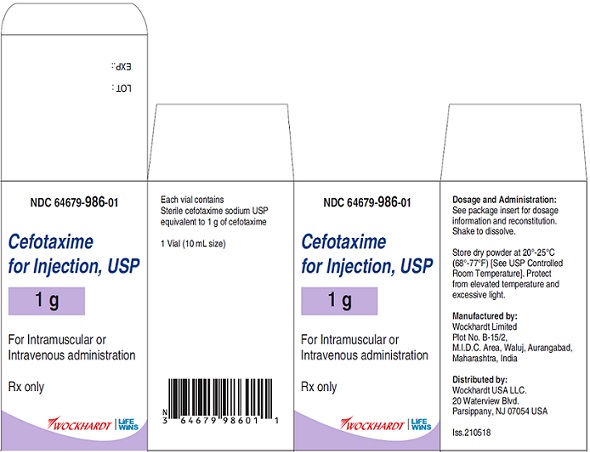
Package of 1 NDC 64679-986-01
Package of 10 NDC 64679-986-02
Package of 25 NDC 64679-986-03
Package of 50 NDC 64679-986-04
2 g cefotaxime (free acid equivalent) in vials in packages of:
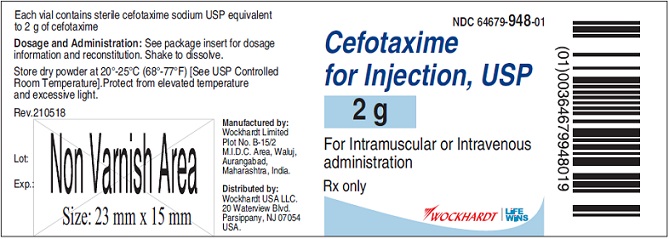
Package of 1 NDC 64679-948-01
Package of 10 NDC 64679-948-02
NOTE: Cefotaxime for injection, USP in the dry state, store at 20°-25°C (68°-77°F) [See USP Controlled Room Temperature]. The dry material as well as solutions tend to darken depending on storage conditions and should be protected from elevated temperatures and excessive light.
1. Cockcroft, D.W. and Gault, M.H.: Prediction of Creatinine Clearance from Serum Creatinine, Nephron 16:31-41, 1976.
Travasol® is registered trademark of Baxter International Inc.
Rx only
Manufactured by:
Wockhardt Limited
Plot No.B-15/2, M.I.D.C. Area,
Waluj, Aurangabad,
Maharashtra, India.
Distributed by:
Wockhardt USA LLC.
20 Waterview Blvd.
Parsippany, NJ 07054,
USA.
Rev.210518