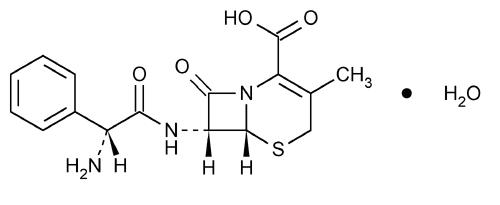
Human Pharmacology
Cephalexin is acid stable and may be given without regard to meals. It is rapidly absorbed after oral administration. Following doses of 250 mg, 500 mg, and 1 g, average peak serum levels of approximately 9, 18, and 32 µg/mL respectively were obtained at 1 hour. Measurable levels were present 6 hours after administration. Cephalexin is excreted in the urine by glomerular filtration and tubular secretion. Studies showed that over 90% of the drug was excreted unchanged in the urine within 8 hours. During this period, peak urine concentrations following the 250 mg, 500 mg, and 1g doses were approximately 1000, 2200, and 5000 µg/mL respectively.
Microbiology
tests demonstrate that the cephalosporins are bactericidal because of their inhibition of cell-wall synthesis. Cephalexin has been shown to be active against most strains of the following microorganisms both and in clinical infections as described in the section.
In vitroin vitroINDICATIONS AND USAGE
Aerobes, Gram-positive:
(including penicillinase-producing strains)
Staphylococcus aureus
(penicillin-susceptible strains)
Streptococcus pneumoniae
Streptococcus pyogenes
Aerobes, Gram-negative:
Escherichia coli
Haemophilus influenzae
Klebsiella pneumoniae
Moraxella (Branhamella) catarrhalis
Proteus mirabilis
Methicillin-resistant staphylococci and most strains of enterococci ( [formerly ]) are resistant to cephalosporins, including cephalexin. It is not active against most strains of spp., , and . It has no activity against spp. or . Penicillin-¬resistant is usually cross-resistant to beta-lactam antibiotics.
Note:Enterococcus faecalisStreptococcus faecalisEnterobacterMorganella morganiiProteus vulgarisPseudomonasAcinetobacter calcoaceticusStreptococcus pneumoniae
Susceptibility Tests
— Quantitative methods are used to determine antimicrobial minimal inhibitory concentrations (MIC’s). These MIC’s provide estimates of the susceptibility of bacteria to antimicrobial compounds. The MIC’s should be determined using a standardized procedure. Standardized procedures are based on a dilution
Dilution techniques
method (broth or agar) or equivalent with standardized inoculum concentrations and standardized concentrations of cephalothin powder. The MIC values should be interpreted according to the following criteria:
1-3
| MIC (µg/mL) | Interpretation | |
| ≤8 | Susceptible | (S) |
| 16 | Intermediate | (I) |
| ≥32 | Resistant | (R) |
A report of "Susceptible" indicates that the pathogen is likely to be inhibited if the antimicrobial compound in the blood reaches the concentrations usually achievable. A report of "Intermediate" indicates that the result should be considered equivocal, and, if the microorganism is not fully susceptible to alternative, clinically feasible drugs, the test should be repeated. This category implies possible clinical applicability in body sites where the drug is physiologically concentrated or in situations where high dosage of drug can be used. This category also provides a buffer zone which prevents small uncontrolled technical factors from causing major discrepancies in interpretation. A report of "Resistant" indicates that the pathogen is not likely to be inhibited if the antimicrobial compound in the blood reaches the concentrations usually achievable; other therapy should be selected.
Standardized susceptibility test procedures require the use of laboratory control microorganisms to control the technical aspects of the laboratory procedures. Standard cephalothin powder should provide the following MIC values:
|
Microorganism | MIC (µg/mL) |
| E. coli | ATCC 25922 | 4 to 16 |
| S. aureus | ATCC 29213 | 0.12 to 0.5 |
— Quantitative methods that require measurement of zone diameters also provide reproducible estimates of the susceptibility of bacteria to antimicrobial compounds. One such standardized procedure requires the use of standardized inoculum concentrations. This procedure uses paper disks impregnated with 30µg cephalothin to test the susceptibility of microorganisms to cephalexin.
Diffusion techniques2,3
Reports from the laboratory providing results of the standard single-disk susceptibility test with a 30 µg cephalothin disk should be interpreted according to the following criteria:
| Zone Diameter (mm) | Interpretation | |
| ≥18 | Susceptible | (S) |
| 15 to 17 | Intermediate | (I) |
| ≤14 | Resistant | (R) |
Interpretation should be as stated above for results using dilution techniques. Interpretation involves correlation of the diameter obtained in the disk test with the MIC for cephalexin.
As with standard dilution techniques, diffusion methods require the use of laboratory control microorganisms that are used to control the technical aspects of the laboratory procedures. For the diffusion technique, the 30µg cephalothin disk should provide the following zone diameters in these laboratory test quality control strains:
|
Microorganism | 15 to 21
Zone Diameter (mm) |
| E. coli | ATCC 25922 |
| S. aureus | ATCC 25923 | 29 to 37 |