The Outcome Reduction with Initial Glargine Intervention trial (i.e., ORIGIN) was an open-label, randomized, 2-by-2, factorial design study. One intervention in ORIGIN compared the effect of LANTUS to standard care on major adverse cardiovascular outcomes in 12,537 participants ≥ 50 years of age with abnormal glucose levels [i.e., impaired fasting glucose (IFG) and/or impaired glucose tolerance (IGT)] or early type 2 diabetes mellitus and established cardiovascular (i.e., CV) disease or CV risk factors at baseline.
The objective of the trial was to demonstrate that LANTUS use could significantly lower the risk of major cardiovascular outcomes compared to standard care. Two co-primary composite cardiovascular endpoints were used in ORIGIN. The first co-primary endpoint was the time to first occurrence of a major adverse cardiovascular event defined as the composite of CV death, nonfatal myocardial infarction and nonfatal stroke. The second co-primary endpoint was the time to the first occurrence of CV death or nonfatal myocardial infarction or nonfatal stroke or revascularization procedure or hospitalization for heart failure.
Participants were randomized to either LANTUS (N=6264) titrated to a goal fasting plasma glucose of ≤ 95 mg/dL or to standard care (N=6273). Anthropometric and disease characteristics were balanced at baseline. The mean age was 64 years and 8% of participants were 75 years of age or older. The majority of participants were male (65%). Fifty nine percent were Caucasian, 25% were Latin, 10% were Asian and 3% were Black. The median baseline BMI was 29 kg/m . Approximately 12% of participants had abnormal glucose levels (IGT and/or IFG) at baseline and 88% had type 2 diabetes. For patients with type 2 diabetes, 59% were treated with a single oral antidiabetic drug, 23% had known diabetes but were on no antidiabetic drug and 6% were newly diagnosed during the screening procedure. The mean HbA1c (SD) at baseline was 6.5% (1.0). Fifty nine percent of participants had had a prior cardiovascular event and 39% had documented coronary artery disease or other cardiovascular risk factors.
2
Vital status was available for 99.9% and 99.8% of participants randomized to LANTUS and standard care respectively at end of trial. The median duration of follow-up was 6.2 years [range: 8 days to 7.9 years]. The mean HbA1c (SD) at the end of the trial was 6.5% (1.1) and 6.8% (1.2) in the LANTUS and standard care group respectively. The median dose of LANTUS at end of trial was 0.45 U/kg. Eighty-one percent of patients randomized to LANTUS were using LANTUS at end of the study. The mean change in body weight from baseline to the last treatment visit was 2.2 kg greater in the LANTUS group than in the standard care group.
Overall, the incidence of major adverse cardiovascular outcomes was similar between groups (see ). All-cause mortality was also similar between groups.
Table 9
- Cancer
In the ORIGIN trial, the overall incidence of cancer (all types combined) or death from cancer (Table 10) was similar between treatment groups.
Table 10: Cancer Outcomes in ORIGIN - Time to First Event Analyses | LANTUS N=6264
| Standard Care N=6273
| LANTUS vs Standard Care |
|---|
n (Events per 100 PY)
| n (Events per 100 PY)
| Hazard Ratio (95% CI) |
|---|
| Cancer endpoints |
| Any cancer event (new or recurrent) | 559 (1.56)
| 561 (1.56)
| 0.99 (0.88, 1.11) |
| New cancer events | 524 (1.46)
| 535 (1.49)
| 0.96 (0.85, 1.09) |
| Death due to Cancer | 189 (0.51)
| 201 (0.54)
| 0.94 (0.77, 1.15) |
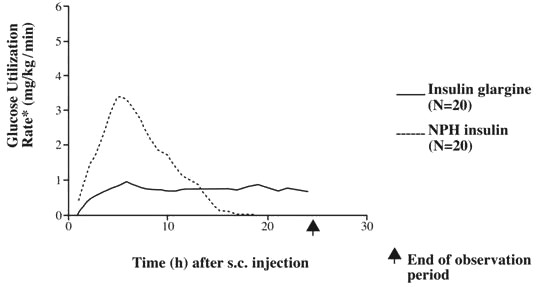
Absorption and Bioavailability. After subcutaneous injection of insulin glargine in healthy subjects and in patients with diabetes, the insulin serum concentrations indicated a slower, more prolonged absorption and a relatively constant concentration/time profile over 24 hours with no pronounced peak in comparison to NPH insulin. Serum insulin concentrations were thus consistent with the time profile of the pharmacodynamic activity of insulin glargine.
After subcutaneous injection of 0.3 Units/kg insulin glargine in patients with type 1 diabetes, a relatively constant concentration/time profile has been demonstrated. The duration of action after abdominal, deltoid, or thigh subcutaneous administration was similar.
Metabolism. A metabolism study in humans indicates that insulin glargine is partly metabolized at the carboxyl terminus of the B chain in the subcutaneous depot to form two active metabolites with in vitro activity similar to that of insulin, M1 (21 -Gly-insulin) and M2 (21 -Gly-des-30 -Thr-insulin). Unchanged drug and these degradation products are also present in the circulation.
AAB
Special Populations
Information on the effect of age, race, and gender on the pharmacokinetics of LANTUS is not available. However, in controlled clinical trials in adults (n=3890) and a controlled clinical trial in pediatric patients (n=349), subgroup analyses based on age, race, and gender did not show differences in safety and efficacy between insulin glargine and NPH insulin .
Age, Race, and Gender.[see ]
Clinical Studies (14)
The effect of smoking on the pharmacokinetics/pharmacodynamics of LANTUS has not been studied.
Smoking.
The effect of pregnancy on the pharmacokinetics and pharmacodynamics of LANTUS has not been studied [
Pregnancy.see ].
Use in Specific Populations (8.1)
. In controlled clinical trials, which included patients with Body Mass Index (BMI) up to and including 49.6 kg/m , subgroup analyses based on BMI did not show differences in safety and efficacy between insulin glargine and NPH insulin .
Obesity2[see ]
Clinical Studies (14)
The effect of renal impairment on the pharmacokinetics of LANTUS has not been studied. However, some studies with human insulin have shown increased circulating levels of insulin in patients with renal failure. Careful glucose monitoring and dose adjustments of insulin, including LANTUS, may be necessary in patients with renal impairment S
Renal Impairment.[ee ].
Warnings and Precautions (5.5)
. The effect of hepatic impairment on the pharmacokinetics of LANTUS has not been studied. However, some studies with human insulin have shown increased circulating levels of insulin in patients with liver failure. Careful glucose monitoring and dose adjustments of insulin, including LANTUS, may be necessary in patients with hepatic impairment
Hepatic Impairment[See ].
Warnings and Precautions (5.6)
(see ).
Type 1 Diabetes–AdultTable 11
In two clinical studies (Studies A and B), patients with type 1 diabetes (Study A; n=585, Study B; n=534) were randomized to 28 weeks of basal-bolus treatment with LANTUS or NPH insulin. Regular human insulin was administered before each meal. LANTUS was administered at bedtime. NPH insulin was administered once daily at bedtime or in the morning and at bedtime when used twice daily.
In another clinical study (Study C), patients with type 1 diabetes (n=619) were randomized to 16 weeks of basal-bolus treatment with LANTUS or NPH insulin. Insulin lispro was used before each meal. LANTUS was administered once daily at bedtime and NPH insulin was administered once or twice daily.
In these 3 studies, LANTUS and NPH insulin had similar effects on HbA1c (Table 11) with a similar overall rate of hypoglycemia .
[See ]
Adverse Reactions (6.1)
Table 11: Type 1 Diabetes Mellitus–Adult | Study A | Study B | Study C |
|---|
Treatment duration Treatment in combination with
| 28 weeks Regular insulin
| 28 weeks Regular insulin
| 16 weeks Insulin lispro
|
|---|
| LANTUS | NPH | LANTUS | NPH | LANTUS | NPH |
|---|
| Number of subjects treated | 292 | 293 | 264 | 270 | 310 | 309 |
| HbA1c | | | | | | |
| Baseline HbA1c | 8.0 | 8.0 | 7.7 | 7.7 | 7.6 | 7.7 |
| Adj. mean change from baseline | +0.2 | +0.1 | -0.2 | -0.2 | -0.1 | -0.1 |
| LANTUS – NPH | +0.1 | +0.1 | 0.0 |
| 95% CI for Treatment difference | (0.0; +0.2) | (-0.1; +0.2) | (-0.1; +0.1) |
| Basal insulin dose | | | | | | |
| Baseline mean | 21 | 23 | 29 | 29 | 28 | 28 |
| Mean change from baseline | -2 | 0 | -4 | +2 | -5 | +1 |
| Total insulin dose | | | | | | |
| Baseline mean | 48 | 52 | 50 | 51 | 50 | 50 |
| Mean change from baseline | -1 | 0 | 0 | +4 | -3 | 0 |
| Fasting blood glucose (mg/dL) | | | | | | |
| Baseline mean | 167 | 166 | 166 | 175 | 175 | 173 |
| Adj. mean change from baseline | -21 | -16 | -20 | -17 | -29 | -12 |
| Body weight (kg) | | | | | | |
| Baseline mean | 73.2 | 74.8 | 75.5 | 75.0 | 74.8 | 75.6 |
| Mean change from baseline | 0.1 | -0.0 | 0.7 | 1.0 | 0.1 | 0.5 |
Type 1 Diabetes–Pediatric (see ).
Table 12
In a randomized, controlled clinical study (Study D), pediatric patients (age range 6 to 15 years) with type 1 diabetes (n=349) were treated for 28 weeks with a basal-bolus insulin regimen where regular human insulin was used before each meal. LANTUS was administered once daily at bedtime and NPH insulin was administered once or twice daily. Similar effects on HbA1c (Table 12) and the incidence of hypoglycemia were observed in both treatment groups .
[See ]
Adverse Reactions (6.1)
Table 12: Type 1 Diabetes Mellitus–Pediatric | Study D |
|---|
| Treatment duration | 28 weeks |
|---|
| Treatment in combination with | Regular insulin |
|---|
| LANTUS | NPH |
|---|
| Number of subjects treated | 174 | 175 |
| HbA1c | | |
| Baseline mean | 8.5 | 8.8 |
| Adj. mean change from baseline | +0.3 | +0.3 |
| LANTUS – NPH | 0.0 |
| 95% CI for Treatment difference | (-0.2; +0.3) |
| Basal insulin dose | | |
| Baseline mean | 19 | 19 |
| Mean change from baseline | -1 | +2 |
| Total insulin dose | | |
| Baseline mean | 43 | 43 |
| Mean change from baseline | +2 | +3 |
| Fasting blood glucose (mg/dL) | | |
| Baseline mean | 194 | 191 |
| Adj. mean change from baseline | -23 | -12 |
| Body weight (kg) | | |
| Baseline mean | 45.5 | 44.6 |
| Mean change from baseline | 2.2 | 2.5 |
Type 2 Diabetes–Adult (see ).
Table 13
In a randomized, controlled clinical study (Study E) (n=570), LANTUS was evaluated for 52 weeks in combination with oral anti-diabetic medications (a sulfonylurea, metformin, acarbose, or combinations of these drugs). LANTUS administered once daily at bedtime was as effective as NPH insulin administered once daily at bedtime in reducing HbA1c and fasting glucose (Table 13). The rate of hypoglycemia was similar in LANTUS and NPH insulin treated patients .
[See ]
Adverse Reactions (6.1)
In a randomized, controlled clinical study (Study F), in patients with type 2 diabetes not using oral anti-diabetic medications (n=518), a basal-bolus regimen of LANTUS once daily at bedtime or NPH insulin administered once or twice daily was evaluated for 28 weeks. Regular human insulin was used before meals, as needed. LANTUS had similar effectiveness as either once- or twice-daily NPH insulin in reducing HbA1c and fasting glucose (Table 13) with a similar incidence of hypoglycemia .
[See ]
Adverse Reactions (6.1)
In a randomized, controlled clinical study (Study G), patients with type 2 diabetes were randomized to 5 years of treatment with once-daily LANTUS or twice-daily NPH insulin. For patients not previously treated with insulin, the starting dose of LANTUS or NPH insulin was 10 units daily. Patients who were already treated with NPH insulin either continued on the same total daily NPH insulin dose or started LANTUS at a dose that was 80% of the total previous NPH insulin dose. The primary endpoint for this study was a comparison of the progression of diabetic retinopathy by 3 or more steps on the Early Treatment Diabetic Retinopathy Study (ETDRS) scale. HbA1c change from baseline was a secondary endpoint. Similar glycemic control in the 2 treatment groups was desired in order to not confound the interpretation of the retinal data. Patients or study personnel used an algorithm to adjust the LANTUS and NPH insulin doses to a target fasting plasma glucose ≤100 mg/dL. After the LANTUS or NPH insulin dose was adjusted, other anti-diabetic agents, including pre-meal insulin were to be adjusted or added. The LANTUS group had a smaller mean reduction from baseline in HbA1c compared to the NPH insulin group, which may be explained by the lower daily basal insulin doses in the LANTUS group (Table 13). Both treatment groups had a similar incidence of reported symptomatic hypoglycemia. The incidences of severe symptomatic hypoglycemia are given in Table 6 .
[See ]
Adverse Reactions (6.1)
Table 13: Type 2 Diabetes Mellitus–Adult | Study E | Study F | Study G |
|---|
| Treatment duration | 52 weeks | 28 weeks | 5 years |
|---|
| Treatment in combination with | Oral agents | Regular insulin | Regular insulin |
|---|
| LANTUS | NPH | LANTUS | NPH | LANTUS | NPH |
|---|
| Number of subjects treated | 289 | 281 | 259 | 259 | 513 | 504 |
| HbA1c | | | | | | |
| Baseline mean | 9.0 | 8.9 | 8.6 | 8.5 | 8.4 | 8.3 |
| Adj. mean change from baseline | -0.5 | -0.4 | -0.4 | -0.6 | -0.6 | -0.8 |
| LANTUS – NPH | -0.1 | +0.2 | +0.2 |
| 95% CI for Treatment difference | (-0.3; +0.1) | (0.0; +0.4) | (+0.1, +0.4) |
| Basal insulin dose
In Study G, the baseline dose of basal or total insulin was the first available on-treatment dose prescribed during the study (on visit month 1.5). | | | | | | |
| Baseline mean | 14 | 15 | 44.1 | 45.5 | 39 | 44 |
| Mean change from baseline | +12 | +9 | -1 | +7 | +23 | +30 |
| Total insulin dose
| | | | | | |
| Baseline mean | 14 | 15 | 64 | 67 | 48 | 53 |
| Mean change from baseline | +12 | +9 | +10 | +13 | +41 | +40 |
| Fasting blood glucose (mg/dL) | | | | | | |
| Baseline mean | 179 | 180 | 164 | 166 | 190 | 180 |
| Adj. mean change from baseline | -49 | -46 | -24 | -22 | -45 | -44 |
| Body weight (kg) | | | | | | |
| Baseline mean | 83.5 | 82.1 | 89.6 | 90.7 | 100 | 99 |
| Adj. mean change from baseline | 2.0 | 1.9 | 0.4 | 1.4 | 3.7 | 4.8 |
LANTUS Timing of Daily Dosing (see ).
Table 14
The safety and efficacy of LANTUS administered pre-breakfast, pre-dinner, or at bedtime were evaluated in a randomized, controlled clinical study in patients with type 1 diabetes (study H, n=378). Patients were also treated with insulin lispro at mealtime. LANTUS administered at different times of the day resulted in similar reductions in HbA1c compared to that with bedtime administration (see ). In these patients, data are available from 8-point home glucose monitoring. The maximum mean blood glucose was observed just prior to injection of LANTUS regardless of time of administration.
Table 14
In this study, 5% of patients in the LANTUS-breakfast arm discontinued treatment because of lack of efficacy. No patients in the other two arms discontinued for this reason. The safety and efficacy of LANTUS administered pre-breakfast or at bedtime were also evaluated in a randomized, active-controlled clinical study (Study I, n=697) in patients with type 2 diabetes not adequately controlled on oral anti-diabetic therapy. All patients in this study also received glimepiride 3 mg daily. LANTUS given before breakfast was at least as effective in lowering HbA1c as LANTUS given at bedtime or NPH insulin given at bedtime (see ).
Table 14
Table 14: LANTUS Timing of Daily Dosing in Type 1 (Study H) and Type 2 (Study I) Diabetes Mellitus | Study H | Study I |
|---|
| Treatment duration | 24 weeks | 24 weeks |
|---|
| Treatment in combination with: | Insulin lispro | Glimepiride |
|---|
| LANTUS Breakfast
| LANTUS Dinner
| LANTUS Bedtime
| LANTUS Breakfast
| LANTUS Bedtime
| NPH Bedtime
|
|---|
| **total number of patients evaluable for safety |
| Number of subjects treated
Intent to treat | 112 | 124 | 128 | 234 | 226 | 227 |
| HbA1c | | | | | | |
| Baseline mean | 7.6 | 7.5 | 7.6 | 9.1 | 9.1 | 9.1 |
| Mean change from baseline | -0.2 | -0.1 | 0.0 | -1.3 | -1.0 | -0.8 |
| Basal insulin dose (U) | | | | | | |
| Baseline mean | 22 | 23 | 21 | 19 | 20 | 19 |
| Mean change from baseline | 5 | 2 | 2 | 11 | 18 | 18 |
| Total insulin dose (U) | | | | NA
Not applicable | NA | NA |
| Baseline mean | 52 | 52 | 49 | | | |
| Mean change from baseline | 2 | 3 | 2 | | | |
| Body weight (kg) | | | | | | |
| Baseline mean | 77.1 | 77.8 | 74.5 | 80.7 | 82 | 81 |
| Mean change from baseline | 0.7 | 0.1 | 0.4 | 3.9 | 3.7 | 2.9 |
Unopened Vial/ SoloStar disposable insulin device:
Unopened LANTUS vials, cartridge systems and SoloStar device should be stored in a refrigerator, 36°F – 46°F (2°C – 8°C). Discard after the expiration date.
Open (In-Use) Vial:
Vials must be discarded 28 days after being opened. If refrigeration is not possible, the open vial can be kept unrefrigerated for up to 28 days away from direct heat and light, as long as the temperature is not greater than 86°F (30°C).
Open (In-Use) SoloStar disposable insulin device:
The opened (in-use) SoloStar should NOT be refrigerated but should be kept at room temperature (below 86°F [30°C]) away from direct heat and light. The opened (in-use) SoloStar device must be discarded 28 days after being opened.
These storage conditions are summarized in the following table:
| Not in-use (unopened) Refrigerated
| Not in-use (unopened) Room Temperature
| In-use (opened) (See Temperature Below)
|
|---|
| 10 mL Vial | Until expiration date | 28 days | 28 days Refrigerated or room temperature
|
| 3 mL SoloStar disposable insulin device
® | Until expiration date | 28 days | 28 days Room temperature only (Do not refrigerate)
|
sanofi-aventis U.S. LLC
Bridgewater, NJ 08807
A SANOFI COMPANY
©2013 sanofi-aventis U.S. LLC