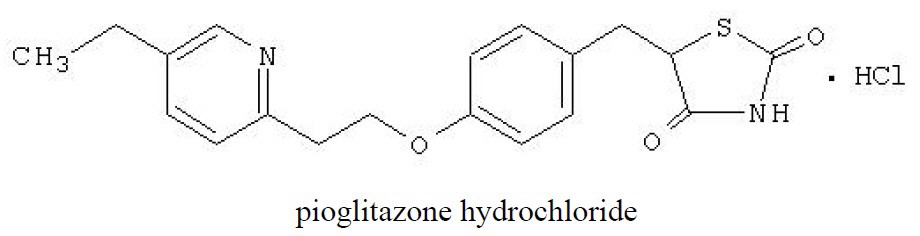
Absorption and Bioavailability:
DUETACT
Bioequivalence studies were conducted following a single dose of the DUETACT 30 mg/2 mg and 30 mg/4 mg tablets and concomitant administration of pioglitazone (30 mg) and glimepiride (2 mg or 4 mg) under fasting conditions in healthy subjects.
Based on the area under the curve (AUC) and maximum concentration (Cmax) of both pioglitazone and glimepiride, DUETACT 30 mg/2 mg and 30 mg/4 mg were bioequivalent to pioglitazone 30 mg concomitantly administered with glimepiride (2 mg or 4 mg, respectively).
Food did not change the systemic exposures of glimepiride or pioglitazone following administration of DUETACT. The presence of food did not significantly alter the time to peak serum concentration (Tmax) of glimepiride or pioglitazone and Cmax of pioglitazone. However, for glimepiride, there was a 22% increase in Cmax when DUETACT was administered with food.
Pioglitazone
Following once-daily administration of pioglitazone, steady-state serum concentrations of both pioglitazone and its major active metabolites, M-III (keto derivative of pioglitazone) and M-IV (hydroxyl derivative of pioglitazone), are achieved within seven days. At steady-state, M-III and M-IV reach serum concentrations equal to or greater than that of pioglitazone. At steady-state, in both healthy volunteers and patients with type 2 diabetes, pioglitazone comprises approximately 30% to 50% of the peak total pioglitazone serum concentrations (pioglitazone plus active metabolites) and 20% to 25% of the total AUC.
Cmax, AUC, and trough serum concentrations (Cmin) for pioglitazone and M-III and M-IV, increased proportionally with administered doses of 15 mg and 30 mg per day.
Following oral administration of pioglitazone, Tmax of pioglitazone was within two hours. Food delays Tmax to three to four hours but does not alter the extent of absorption (AUC).
Glimepiride
Studies with single oral doses of glimepiride in healthy subjects and with multiple oral doses in patients with type 2 diabetes showed peak drug concentrations (Cmax) two to three hours post-dose. When glimepiride was given with meals, the mean Cmax and AUC were decreased by 8% and 9%, respectively.
Glimepiride does not accumulate in serum following multiple dosing. The pharmacokinetics of glimepiride does not differ between healthy subjects and patients with type 2 diabetes. Clearance (CL/F) of glimepiride after oral administration does not change over the 1 mg to 8 mg dose range, indicating linear pharmacokinetics.
In healthy subjects, the intra- and inter-individual variabilities of glimepiride pharmacokinetic parameters were 15% to 23% and 24% to 29%, respectively.
Distribution
Pioglitazone
The mean apparent volume of distribution (Vd/F) of pioglitazone following single-dose administration is 0.63 ± 0.41 (mean ± SD) L/kg of body weight. Pioglitazone is extensively protein bound (>99%) in human serum, principally to serum albumin. Pioglitazone also binds to other serum proteins, but with lower affinity. M-III and M-IV are also extensively bound (>98%) to serum albumin.
Glimepiride
After intravenous (IV) dosing in healthy subjects, Vd/F was 8.8 L (113 mL/kg), and the total body clearance (CL) was 47.8 mL/min. Protein binding was greater than 99.5%.
Metabolism
Pioglitazone
Pioglitazone is extensively metabolized by hydroxylation and oxidation; the metabolites also partly convert to glucuronide or sulfate conjugates. Metabolites M-III and M-IV are the major circulating active metabolites in humans.
In vitro data demonstrate that multiple CYP isoforms are involved in the metabolism of pioglitazone which include CYP2C8 and, to a lesser degree, CYP3A4 with additional contributions from a variety of other isoforms including the mainly extrahepatic CYP1A1. In vivo study of pioglitazone in combination with gemfibrozil, a strong CYP2C8 inhibitor, showed that pioglitazone is a CYP2C8 substrate [see Dosage and Administration (2.3) and Drug Interactions (7.1)]. Urinary 6ß-hydroxycortisol/cortisol ratios measured in patients treated with pioglitazone showed that pioglitazone is not a strong CYP3A4 enzyme inducer.
Glimepiride
Glimepiride is completely metabolized by oxidative biotransformation after either an IV or oral dose. The major metabolites are the cyclohexyl hydroxy methyl derivative (M1) and the carboxyl derivative (M2). CYP2C9 is involved in the biotransformation of glimepiride to M1. M1 is further metabolized to M2 by one or several cytosolic enzymes. In animals, M1 possesses about one-third of the pharmacological activity of glimepiride, but it is unclear whether M1 results in clinically meaningful effects on blood glucose in humans. M2 is inactive.
Excretion and Elimination
Pioglitazone
Following oral administration, approximately 15% to 30% of the pioglitazone dose is recovered in the urine. Renal elimination of pioglitazone is negligible and the drug is excreted primarily as metabolites and their conjugates. It is presumed that most of the oral dose is excreted into the bile either unchanged or as metabolites and eliminated in the feces.
The mean serum half-life (t1/2) of pioglitazone and its metabolites (M-III and M-IV) range from three to seven hours and 16 to 24 hours, respectively. Pioglitazone has an apparent clearance, CL/F, calculated to be five to seven L/hr.
Glimepiride
When 14C-glimepiride was given orally to three healthy male subjects, approximately 60% of the total radioactivity was recovered in the urine in seven days. M1 and M2 accounted for 80% to 90% of the radioactivity recovered in the urine. The ratio of M1 to M2 in the urine was approximately 3:2 in two subjects and 4:1 in one subject. Approximately 40% of the total radioactivity was recovered in feces. M1 and M2 accounted for approximately 70% (ratio of M1 to M2 was 1:3) of the radioactivity recovered in feces. No parent drug was recovered from urine or feces. After IV dosing in patients, no significant biliary excretion of glimepiride or its M1 metabolite was observed.
Renal Impairment
Pioglitazone
The serum elimination half-life of pioglitazone, M-III, and M-IV remains unchanged in patients with moderate [creatinine clearance (CLcr) 30 to 50 mL/min] and severe (CLcr <30 mL/min) renal impairment when compared to subjects with normal renal function. Therefore, no dose adjustment in patients with renal impairment is required.
Glimepiride
In a single-dose, open-label study glimepiride 3 mg was administered to patients with mild, moderate and severe renal impairment as estimated by CLcr: Group I consisted of five patients with mild renal impairment (CLcr >50 mL/min), Group II consisted of 3 patients with moderate renal impairment (CLcr = 20 to 50 mL/min) and Group III consisted of seven patients with severe renal impairment (CLcr <20 mL/min). Although, glimepiride serum concentrations decreased with decreasing renal function, Group III had a 2.3-fold higher mean AUC for M1 and an 8.6-fold higher mean AUC for M2 compared to corresponding mean AUCs in Group I. The t½ for glimepiride did not change, while the t½ for M1 and M2 increased as renal function decreased. Mean urinary excretion of M1 plus M2 as a percentage of dose decreased from 44.4% for Group I to 21.9% for Group II and 9.3% for Group III.
Hepatic Impairment
Pioglitazone
Compared with healthy controls, subjects with impaired hepatic function (Child-Turcotte-Pugh Grade B/C) have an approximate 45% reduction in pioglitazone and total pioglitazone (pioglitazone, M-III, and M-IV) mean Cmax but no change in the mean AUC values. Therefore, no dose adjustment in patients with hepatic impairment is required.
There are postmarketing reports of liver failure with pioglitazone and clinical trials have generally excluded patients with serum ALT >2.5 times the upper limit of the reference range. Use DUETACT with caution in patients with liver disease [see Warnings and Precautions (5.5)].
Glimepiride
It is unknown whether there is an effect of hepatic impairment on glimepiride pharmacokinetics because the pharmacokinetics of glimepiride has not been adequately evaluated in patients with hepatic impairment.
Geriatric Patients
Pioglitazone
In healthy elderly subjects, Cmax of pioglitazone was not significantly different, but AUC values were approximately 21% higher than those achieved in younger subjects. The mean t½ of pioglitazone was also prolonged in elderly subjects (about 10 hours) as compared to younger subjects (about seven hours). These changes were not of a magnitude that would be considered clinically relevant.
Glimepiride
A comparison of glimepiride pharmacokinetics in patients with type 2 diabetes ≤65 years and those >65 years was evaluated in a multiple-dose study using 6 mg daily dose. There were no significant differences in glimepiride pharmacokinetics between the two age groups. The mean AUC at steady state for the older patients was approximately 13% lower than that for the younger patients; the mean weight-adjusted clearance for the older patients was approximately 11% higher than that for the younger patients.
Pediatric Patients
No pharmacokinetic studies of DUETACT were performed in pediatric patients.
Pioglitazone
Safety and efficacy of pioglitazone in pediatric patients have not been established. DUETACT is not recommended for use in pediatric patients [see Use in Specific Populations (8.4)].
Gender
Pioglitazone
The mean Cmax and AUC values of pioglitazone were increased 20% to 60% in women compared to men. In controlled clinical trials, HbA1c decreases from baseline were generally greater for females than for males (average mean difference in HbA1c 0.5%). Because therapy should be individualized for each patient to achieve glycemic control, no dose adjustment is recommended based on gender alone.
Glimepiride
There were no differences between males and females in the pharmacokinetics of glimepiride when adjustment was made for differences in body weight.
Ethnicity
Pioglitazone
Pharmacokinetic data among various ethnic groups are not available.
Glimepiride
No studies have been conducted to assess the effects of race on glimepiride pharmacokinetics but in placebo-controlled trials of glimepiride in patients with type 2 diabetes, the reduction in HbA1c was comparable in Caucasians (n=536), blacks (n=63), and Hispanics (n=63).
Obese Patients
The pharmacokinetics of glimepiride and its metabolites were measured in a single-dose study involving 28 patients with type 2 diabetes who either had normal body weight or were morbidly obese. While the Tmax, CL/F, and Vd/F of glimepiride in the morbidly obese patients were similar to those in the normal weight group, the morbidly obese had lower Cmax and AUC than those of normal body weight. The mean Cmax, AUC0-24, AUC0-∞ values of glimepiride in normal vs. morbidly obese patients were 547 ± 218 ng/mL vs. 410 ± 124 ng/mL, 3210 ± 1030 hours∙ng/mL vs. 2820 ± 1110 hours∙ng/mL and 4000 ± 1320 hours∙ng/mL versus 3280 ± 1360 hours∙ng/mL, respectively.
Drug-Drug Interactions
Coadministration of pioglitazone (45 mg) and a sulfonylurea (5 mg glipizide) administered orally once daily for seven days did not alter the steady-state pharmacokinetics of glipizide. Glimepiride and glipizide have similar metabolic pathways and are mediated by CYP2C9; therefore, drug-drug interaction between pioglitazone and glimepiride is considered unlikely. Specific pharmacokinetic drug interaction studies with DUETACT have not been performed, although such studies have been conducted with the individual pioglitazone and glimepiride components.
Pioglitazone
*Daily for 7 days unless otherwise noted
†% change (with/without coadministered drug and no change = 0%); symbols of ↑ and ↓ indicate the exposure increase and decrease, respectively
‡Pioglitazone had no clinically significant effect on prothrombin time |
Table 13. Effect of Pioglitazone Coadministration on Systemic Exposure of Other Drugs |
| Coadministered Drug |
Pioglitazone
Dosage
Regimen (mg)* | Name and Dose Regimens | Change
in AUC† | Change
in Cmax† |
45 mg
(N=12) | Warfarin‡ |
Daily loading then maintenance doses
based PT and INR values
Quick's Value = 35 ± 5% | R-Warfarin | ↓3% | R-Warfarin | ↓2% |
S-Warfarin | ↓1% | S-Warfarin | ↑1% |
45 mg
(N=12) | Digoxin |
0.250 mg twice daily (loading dose) then
0.250 mg daily (maintenance dose, 7 days) | ↑15% | ↑17% |
45 mg daily
for 21 days
(N=35) | Oral Contraceptive |
[Ethinyl Estradiol (EE) 0.035 mg plus
Norethindrone (NE) 1 mg] for 21 days | EE | ↓11% | EE | ↓13% |
NE | ↑3% | NE | ↓7% |
45 mg
(N=23) | Fexofenadine |
60 mg twice daily for 7 days | ↑30% | ↑37% |
45 mg
(N=14) | Glipizide |
5 mg daily for 7 days | ↓3% | ↓8% |
45 mg daily
for 8 days
(N=16) | Metformin |
1000 mg single dose on Day 8 | ↓3% | ↓5% |
45 mg
(N=21) | Midazolam |
7.5 mg single dose on Day 15 | ↓26% | ↓26% |
45 mg
(N=24) | Ranitidine |
150 mg twice daily for 7 days | ↑1% | ↓1% |
45 mg daily
for 4 days
(N=24) | Nifedipine ER |
30 mg daily for 4 days | ↓13% | ↓17% |
45 mg
(N=25) | Atorvastatin Ca |
80 mg daily for 7 days | ↓14% | ↓23% |
45 mg
(N=22) | Theophylline |
400 mg twice daily for 7 days | ↑2% | ↑5% |
Table 14. Effect of Coadministered Drugs on Pioglitazone Systemic Exposure| Coadministered Drug and Dosage Regimen | Pioglitazone |
|---|
Dose Regimen
(mg)Daily for 7 days unless otherwise noted | Change in AUC Mean ratio (with/without coadministered drug and no change = 1-fold) % change (with/without coadministered drug and no change = 0%); symbols of ↑ and ↓ indicate the exposure increase and decrease, respectively | Change in Cmax |
|---|
Gemfibrozil 600 mg
twice daily for 2 days
(N=12) | 15 mg single dose | ↑3.2-fold The half-life of pioglitazone increased from 8.3 hours to 22.7 hours in the presence of gemfibrozil [see Dosage and Administration (2.3) and Drug Interactions (7)] | ↑6% |
Ketoconazole 200 mg
twice daily for 7 days
(N=28) | 45 mg | ↑34% | ↑14% |
Rifampin 600 mg
daily for 5 days
(N=10) | 30 mg single dose | ↓54% | ↓5% |
Fexofenadine 60 mg
twice daily for 7 days
(N=23) | 45 mg | ↑ 1% | 0% |
Ranitidine 150 mg
twice daily for 4 days
(N=23) | 45 mg | ↓ 13% | ↓16% |
Nifedipine ER 30 mg
daily for 7 days
(N=23) | 45 mg | ↑5% | ↑4% |
Atorvastatin Ca 80 mg
daily for 7 days
(N = 24) | 45 mg | ↓24% | ↓31% |
Theophylline 400 mg
twice daily for 7 days
(N=22) | 45 mg | ↓4% | ↓2% |
Topiramate 96 mg
twice daily for 7 daysIndicates duration of concomitant administration with highest twice-daily dose of topiramate from Day 14 onwards over the 22 days of study
(N=26) | 30 mg | ↓15% Additional decrease in active metabolites; 60% for M-III and 16% for M-IV | 0% |
Glimepiride
Aspirin
In a randomized, double-blind, two-period, crossover study, healthy subjects were given either placebo or aspirin 1 gram three times daily for a total treatment period of 5 days. On Day 4 of each study period, a single 1 mg dose of glimepiride was administered. The glimepiride doses were separated by a 14-day washout period. Coadministration of aspirin and glimepiride resulted in a 34% decrease in the mean glimepiride AUC and a 4% decrease in the mean glimepiride Cmax.
Cimetidine and Ranitidine
In a randomized, open-label, 3-way crossover study, healthy subjects received either a single 4 mg dose of glimepiride alone, glimepiride with ranitidine (150 mg twice daily for 4 days; glimepiride was administered on Day 3), or glimepiride with cimetidine (800 mg daily for 4 days; glimepiride was administered on Day 3). Coadministration of cimetidine or ranitidine with a single 4 mg oral dose of glimepiride did not significantly alter the absorption and disposition of glimepiride.
Propranolol
In a randomized, double-blind, two-period, crossover study, healthy subjects were given either placebo or propranolol 40 mg three times daily for a total treatment period of five days. On Day 4 or each study period, a single 2 mg dose of glimepiride was administered. The glimepiride doses were separated by a 14-day washout period. Concomitant administration of propranolol and glimepiride significantly increased glimepiride Cmax, AUC, and t1/2 by 23%, 22%, and 15%, respectively, and decreased glimepiride CL/F by 18%. The recovery of M1 and M2 from urine was not changed.
Warfarin
In an open-label, two-way, crossover study, healthy subjects received 4 mg of glimepiride daily for 10 days. Single 25 mg doses of warfarin were administered six days before starting glimepiride and on Day 4 of glimepiride administration. The concomitant administration of glimepiride did not alter the pharmacokinetics of R- and S-warfarin enantiomers. No changes were observed in warfarin plasma protein binding. Glimepiride resulted in a statistically significant decrease in the pharmacodynamic response to warfarin. The reductions in mean area under the prothrombin time (PT) curve and maximum PT values during glimepiride treatment were 3.3% and 9.9%, respectively, and are unlikely to be clinically relevant.
Colesevelam
Concomitant administration of colesevelam and glimepiride resulted in reductions in glimepiride AUC0-∞ and Cmax of 18% and 8%, respectively. When glimepiride was administered 4 hours prior to colesevelam, there was not significant change in glimepiride AUC0-∞ and Cmax, -6% and 3%, respectively [see Dosage and Administration (2.4) and Drug Interactions (7.7)].