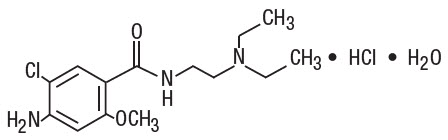
Limitations of Use:
Metoclopramide is not recommended for use in pediatric patients due to the risk of developing tardive dyskinesia (TD) and other extrapyramidal symptoms as well as the risk of methemoglobinemia in neonates [see Use in Specific Populations (8.4)].
Continuous Dosing
The recommended adult dosage of metoclopramide is 10 to 15 mg four times daily for 4 to 12 weeks. The treatment duration is determined by endoscopic response. Administer the dosage thirty minutes before each meal and at bedtime. The maximum recommended daily dosage is 60 mg.
Table 1 displays the recommended daily dosage and maximum daily dosage for adults and dosage adjustments for patients with moderate or severe hepatic impairment (Child-Pugh B or C), in patients with creatinine clearance less than 60 mL/minute, in cytochrome P450 2D6 (CYP2D6) poor metabolizers, and with concomitant use with strong CYP2D6 inhibitors.
Intermittent Dosing
If symptoms only occur intermittently or at specific times of the day, administer metoclopramide in single dose up to 20 mg prior to the provoking situation. Consider dosage reductions for the populations and situations in Table 1.
Table 1. Recommended Metoclopramide Dosage in Patients with Gastroesophageal Reflux | Recommended Dosage | Maximum Recommended Daily Dosage |
|---|
| Adult patients | 10 to 15 mg four times daily (thirty minutes before each meal and at bedtime) | 60 mg |
| Mild hepatic impairment (Child-Pugh A) |
| Elderly patients [see Use in Specific Populations (8.5)] | 5 mg Elderly patients may be more sensitive to the therapeutic or adverse effects of metoclopramide; therefore, consider a lower starting dosage of 5 mg four times daily with titration to the recommended adult dosage of 10 to 15 mg four times daily based upon response and tolerability. four times daily (thirty minutes before each meal and at bedtime) |
| Moderate or severe hepatic impairment (Child-Pugh B or C) [see Use in Specific Populations (8.7)] | 5 mg four times daily (thirty minutes before each meal and at bedtime), or 10 mg taken three times daily | 30 mg |
| CYP2D6 poor metabolizers [see Use in Specific Populations (8.9)] |
| Concomitant use with strong CYP2D6 inhibitors (e.g., quinidine, bupropion, fluoxetine, and paroxetine) [see Drug Interactions (7.1)] |
| Moderate or severe renal impairment (creatinine clearance less than or equal to 60 mL/minute) [see Use in Specific Populations (8.6)] |
| Patients with End-Stage Renal Disease (ESRD) including those treated with hemodialysis and continuous ambulatory peritoneal dialysis [see Use in Specific Populations (8.6)] | 5 mg four times daily (thirty minutes before each meal and at bedtime) or 10 mg twice daily | 20 mg |
Risk Summary
Published studies, including retrospective cohort studies, national registry studies, and meta-analyses, do not report an increased risk of adverse pregnancy-related outcomes with use of metoclopramide during pregnancy.
There are potential risks to the neonate following exposure in utero to metoclopramide during delivery [see Clinical Considerations]. In animal reproduction studies, no adverse developmental effects were observed with oral administration of metoclopramide to pregnant rats and rabbits at exposures about 6 and 12 times the maximum recommended human dose (MRHD) [see Data].
The estimated background risk of major birth defects and miscarriage for the indicated population is unknown. All pregnancies have a background risk of birth defects, loss or other adverse outcomes. In the U.S. general population, the estimated background risk of major birth defects and miscarriage in the clinically recognized pregnancies is 2 to 4% and 15 to 20%, respectively.
Clinical Considerations
Fetal/Neonatal Adverse Reactions
Metoclopramide crosses the placental barrier and may cause extrapyramidal signs and methemoglobinemia in neonates with maternal administration during delivery. Monitor neonates for extrapyramidal signs [see Warnings and Precautions (5.1, 5.2), Use in Specific Populations (8.4)].
Data
Animal Data
Reproduction studies have been performed following administration of oral metoclopramide during organogenesis in pregnant rats at about 6 times the MRHD calculated on body surface area and in pregnant rabbits at about 12 times the MRHD calculated on body surface area. No evidence of adverse developmental effects due to metoclopramide were observed.
Risk Summary
Limited published data report the presence of metoclopramide in human milk in variable amounts. Breastfed infants exposed to metoclopramide have experienced gastrointestinal adverse reactions, including intestinal discomfort and increased intestinal gas formation [see Data]. Metoclopramide elevates prolactin levels [see Warnings and Precautions (5.7)]; however, the published data are not adequate to support drug effects on milk production. The developmental and health benefits of breastfeeding should be considered along with the mother's clinical need for metoclopramide and any potential adverse effects on the breastfed child from metoclopramide or from the underlying maternal condition.
Clinical Considerations
Monitor breastfeeding neonates because metoclopramide may cause extrapyramidal signs (dystonias) and methemoglobinemia [see Warnings and Precautions (5.1, 5.2), Use in Specific Populations (8.4)].
Data
In published clinical studies, the estimated amount of metoclopramide received by the breastfed infant was less than 10% of the maternal weight-adjusted dose. In one study, the estimated daily amount of metoclopramide received by infants from breast milk ranged from 6 to 24 mcg/kg/day in early puerperium (3 to 9 days postpartum) and from 1 to 13 mcg/kg/day at 8 to 12 weeks postpartum.
Gastroesophageal Reflux
In patients with gastroesophageal reflux and low lower esophageal sphincter pressure (LESP), single oral doses of metoclopramide produced dose-related increases in LESP. Effects began at about 5 mg and increased through 20 mg. The increase in LESP from a 5 mg dose lasted about 45 minutes and that of 20 mg lasted between 2 and 3 hours. Increased rate of stomach emptying was observed with single oral doses of 10 mg.
Absorption
Relative to an intravenous dose of 20 mg, the absolute bioavailability of oral metoclopramide is 80% ± 15.5% as demonstrated in a crossover study of 18 subjects. Peak plasma concentrations occurred at about 1 to 2 hours after a single oral dose. Similar time to peak was observed after individual doses at steady state.
In a single dose study of 12 subjects, the area under the drug concentration-time curve increased linearly with doses from 20 to 100 mg (5 times the maximum recommended single dose). Peak concentrations increased linearly with dose; time to peak concentrations remained the same; whole body clearance was unchanged; and the elimination rate remained the same. The mean elimination half-life in subjects with normal renal function was 5 to 6 hours. Linear kinetic processes adequately describe the absorption and elimination of metoclopramide.
Distribution
Metoclopramide is not extensively bound to plasma proteins (about 30%). The whole body volume of distribution is high (about 3.5 L/kg), which suggests extensive distribution of drug to the tissues.
Elimination
Metabolism: Metoclopramide undergoes enzymatic metabolism via oxidation as well as glucuronide and sulfate conjugation reactions in the liver. Monodeethylmetoclopramide, a major oxidative metabolite, is formed primarily by CYP2D6, an enzyme subject to genetic variability [see Dosage and Administration (2.2, 2.3), Use in Specific Populations (8.9)].
Excretion: Approximately 85% of the radioactivity of an orally administered dose appeared in the urine within 72 hours. After oral administration of 10 or 20 mg, a mean of 18% and 22% of the dose, respectively, was recovered as free metoclopramide in urine within 36 hours.
Specific Populations
Patients with Renal Impairment: In a study of 24 patients with varying degrees of renal impairment (moderate, severe, and end-stage renal disease (ESRD) requiring dialysis), the systemic exposure (AUC) of metoclopramide in patients with moderate to severe renal impairment was about 2-fold the AUC in subjects with normal renal function. The AUC of metoclopramide in patients with ESRD on dialysis was about 3.5-fold the AUC in subjects with normal renal function [see Dosage and Administration (2.2, 2.3) and Use in Specific Populations (8.6)].
Patients with Hepatic Impairment: In a group of 8 patients with severe hepatic impairment (Child-Pugh C), the average metoclopramide clearance was reduced by approximately 50% compared to patients with normal hepatic function [see Dosage and Administration (2.2, 2.3) and Use in Specific Populations (8.7)].
Drug Interaction Studies
Effect of Metoclopramide on CYP2D6 Substrates
Although in vitro studies suggest that metoclopramide can inhibit CYP2D6, metoclopramide is unlikely to interact with CYP2D6 substrates in vivo at therapeutically relevant concentrations.
Effect of CYP2D6 Inhibitors on Metoclopramide
In healthy subjects, 20 mg of metoclopramide and 60 mg of fluoxetine (a strong CYP2D6 inhibitor) were administered, following prior exposure to 60 mg fluoxetine orally for 8 days. The patients who received concomitant metoclopramide and fluoxetine had a 40% and 90% increase in metoclopramide Cmax and AUC0-∞, respectively, compared to patients who received metoclopramide alone (see Table 5) [see Drug Interactions (7.1)].
Table 5. Metoclopramide Pharmacokinetic Parameters in Healthy Subjects with and without Fluoxetine| Parameter | Metoclopramide alone
(mean ± SD) | Metoclopramide with fluoxetine
(mean ± SD) |
|---|
| Cmax (ng/mL) | 44 ±15 | 62.7 ± 9.2 |
| AUC0-∞ (ng∙h/mL) | 313 ± 113 | 591 ± 140 |
| t1/2 (h) | 5.5 ± 1.1 | 8.5 ± 2.2 |
Carcinogenesis
A 77-week study was conducted in rats with oral metoclopramide doses up to 40 mg/kg/day (about six times the maximum recommended human dose on body surface area basis). Metoclopramide elevated prolactin levels and the elevation persisted during chronic administration. An increase in mammary neoplasms was found in rodents after chronic administration of metoclopramide [see Warnings and Precautions (5.7)]. In a rat model for assessing the tumor promotion potential, a 2-week oral treatment with metoclopramide at a dose of 260 mg/kg/day (about 35 times the maximum recommended human dose based on body surface area) enhanced the tumorigenic effect of N-nitrosodiethylamine.
Mutagenesis
Metoclopramide was positive in the in vitro Chinese hamster lung cell/HGPRT forward mutation assay for mutagenic effects and in the in vitro human lymphocyte chromosome aberration assay for clastogenic effects. It was negative in the in vitro Ames mutation assay, the in vitro unscheduled DNA synthesis assay with rat and human hepatocytes, and the in vivo rat micronucleus assay.
Impairment of Fertility
Metoclopramide at intramuscular doses up to 20 mg/kg/day (about three times the maximum recommended human dose based on body surface area) was found to have no effect on fertility and reproductive performance of male and female rats.
Distributed by:
Genus Lifesciences Inc.
Allentown, PA 18102
I0576C0524
R05/24