Ranitidine Tablet
Product Images NDC 64980-636

View Photos of Packaging, Regulatory Labels, and Product Appearance

Product Visual Gallery

This gallery contains 11 technical images submitted to the FDA as part of the official labeling for Ranitidine (NDC 64980-636). Unlike standard consumer photos, these assets often include clinical data figures, molecular chemical structures, and official manufacturer packaging layouts.

As provided by Rising Pharma Holdings, Inc., these visuals offer a comprehensive scientific overview of the product's physical and chemical identity, aiding pharmacists and researchers in product verification and study.

FDA Label Image

Ranitidine-150mg-30ct (Ranitidine 150mg 30ct)

Ranitidine-150mg-30ct (Ranitidine 150mg 30ct)
This is a description of Ranitidine Tablets, USP, containing 150 mg of Ranitidine per tablet. The tablets must be used within 3 months (90 days) after opening the bottle. A warning highlights the presence of FD&C Yellow No. 6 as a color additive. The tablets should be stored at 15°C to 30°C (59°F to 86°F) in a dry place, protected from light, and in the original container. The product meets FDA specifications for nitrosamine impurities and should not be used if the safety seal is broken.*
FDA Label Image

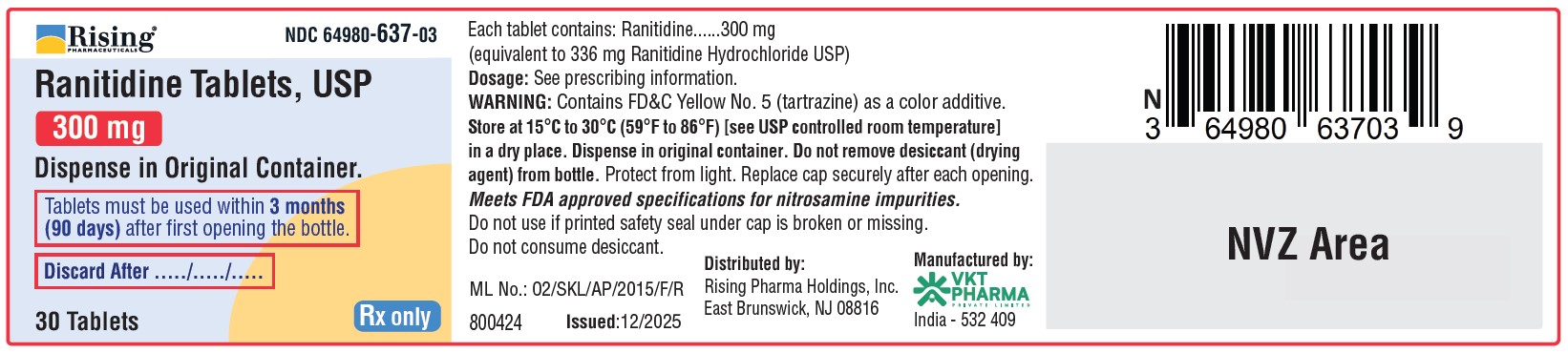
Ranitidine-300mg-30ct (Ranitidine 300mg 30ct)

Ranitidine-300mg-30ct (Ranitidine 300mg 30ct)
These are Ranitidine Tablets, each containing 300 mg of Ranitidine. The tablets need to be used within 3 months (90 days) after opening the bottle. Each tablet contains 336 mg of Ranitidine Hydrochloride USP. They must be stored in a dry place at a temperature between 15°C to 30°C (59°F to 86°F). The container should not be removed. The tablets meet FDA approved standards for nitrosamine impurities. Make sure the printed safety seal under the cap is intact before use. Not for use if seal is missing.*
FDA Label Image
FDA Label Image

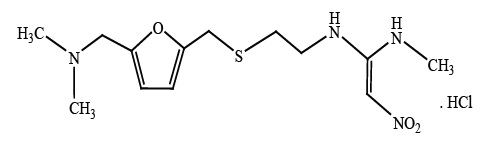
Ranitidine-hcl-struc (Ranitidine HCl Struc)

FDA Label Image

Ranitidine-table1 (Ranitidine Table1)

Ranitidine-table1 (Ranitidine Table1)
This text provides information on the pharmacokinetics of ranitidine in pediatric patients following oral dosing. The table includes data on the population size, dosage form, concentrations (ng/mL), and time (hours) for gastric or duodenal ulcer patients aged between 3.5 to 16 years receiving 1102 mg/kg of tablets.*
FDA Label Image

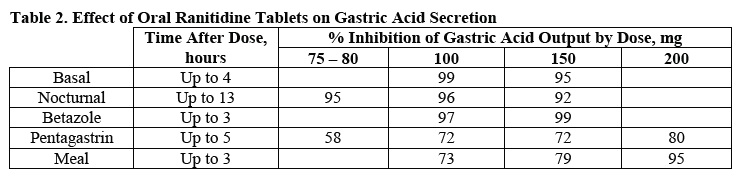
Ranitidine-table2 (Ranitidine Table2)

Ranitidine-table2 (Ranitidine Table2)
This is a table that shows the effect of oral ranitidine tablets on gastric acid secretion at different time increments after the dose in hours. The table displays the percentage inhibition of gastric acid output based on varying doses of ranitidine tablets ranging from 75mg to 200mg. The inhibition percentages are shown for different stimuli such as basal conditions, nocturnal conditions, betazole, pentagastrin, and after a meal.*
FDA Label Image

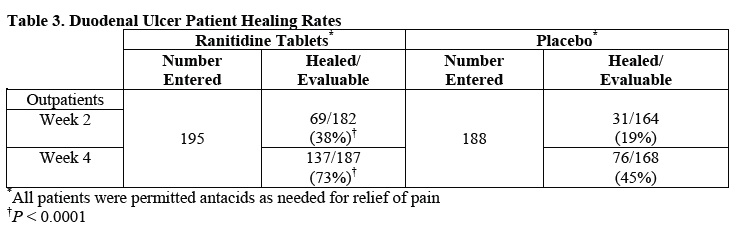
Ranitidine-table3 (Ranitidine Table3)

Ranitidine-table3 (Ranitidine Table3)
The text provides data on the duodenal ulcer patient healing rates for outpatients taking Ranitidine Tablets and Placebo. It includes the number of patients entered and evaluable at week 2 and week 4, along with the percentage healed in each group. The information suggests that Ranitidine Tablets show a significant healing effect compared to the Placebo, with a p-value of less than 0.0001. Additionally, it mentions that all patients were allowed to use antacids as required for pain relief during the study.*
FDA Label Image

Ranitidine-table4 (Ranitidine Table4)

Ranitidine-table4 (Ranitidine Table4)
This is a table showing the mean daily doses of antacid for ulcer patients. The data indicates that ulcer patients whose ulcers were healed took 0.06 tablets of Ranitidine daily, while those whose ulcers were not healed took 0.71 tablets daily. The placebo group took 0.71 tablets daily for the healed ulcers and 1.43 tablets daily for the not healed ulcers.*
FDA Label Image

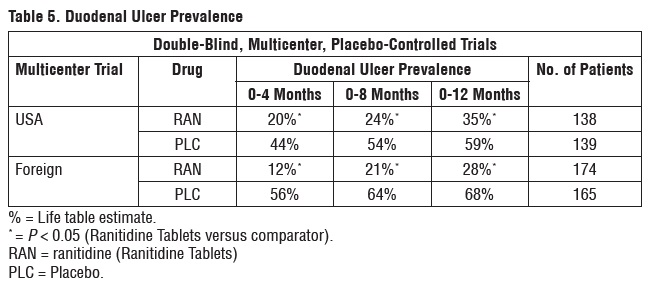
Ranitidine-table5 (Ranitidine Table5)

Ranitidine-table5 (Ranitidine Table5)
This is a table presenting the prevalence of duodenal ulcers in double-blind, multicenter, placebo-controlled trials with the drug ranitidine (Ranitidine Tablets) compared to a placebo. The table includes data on the prevalence of duodenal ulcers over different time periods (0-4 months, 0-8 months, and 0-12 months) for both USA and foreign regions, along with the number of patients in each category. The percentages represent life table estimates, and significant differences (P<0.05) are indicated for ranitidine tablets versus the comparator (placebo). It provides valuable information on the effectiveness of ranitidine in reducing duodenal ulcers compared to a placebo.*
FDA Label Image

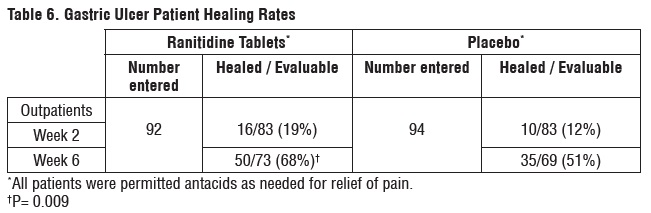
Ranitidine-table6 (Ranitidine Table6)

Ranitidine-table6 (Ranitidine Table6)
This text provides information on the healing rates of gastric ulcer patients treated with Ranitidine Tablets versus a Placebo. The healing rates are compared at different time points (Week 2 and Week 6) for both outpatient groups. Additionally, it is mentioned that all patients were allowed to use antacids as required for pain relief. The text also indicates a p-value of 0.009, suggesting statistical significance in the comparison between the two treatment groups.*
FDA Label Image

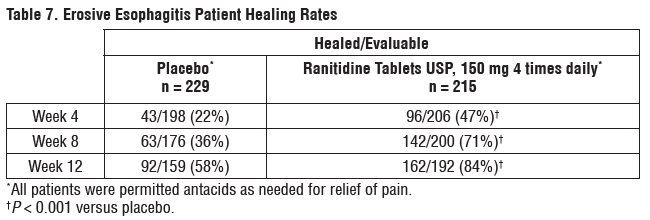
Ranitidine-table7 (Ranitidine Table7)

Ranitidine-table7 (Ranitidine Table7)
The text provides healing rates for erosive esophagitis patients treated with a placebo versus Ranitidine Tablets USP. The healing rates are shown at weeks 4, 8, and 12, with the percentage of patients healed/evaluable indicated for each time point. It mentions that all patients were allowed to use antacids for pain relief as needed. Additionally, it highlights that the effectiveness of the Ranitidine Tablets USP was statistically significant compared to the placebo, with a p-value of less than 0.001.*

* These product label images have been analyzed using experimental machine learning. Please verify findings with the primary label text.