Other
Rx only
Prescribing Information
COMT Activity in Erythrocytes: Studies in healthy volunteers have shown that entacapone reversibly inhibits human erythrocyte COMT activity after oral administration. There was a linear correlation between entacapone dose and erythrocyte COMT inhibition, the maximum inhibition being 82% following an 800 mg single dose. With a 200 mg single dose of entacapone, maximum inhibition of erythrocyte COMT activity is on average 65% with a return to baseline level within 8 hours.
Absorption: Entacapone is rapidly absorbed, with a T maxof approximately 1 hour. The absolute bioavailability following oral administration is 35%. Food does not affect the pharmacokinetics of entacapone.
Distribution: The volume of distribution of entacapone at steady state after intravenous injection is small (20 L). Entacapone does not distribute widely into tissues due to its high plasma protein binding. Based on in vitrostudies, the plasma protein binding of entacapone is 98% over the concentration range of 0.4 mcg/mL to 50 mcg/mL. Entacapone binds mainly to serum albumin.
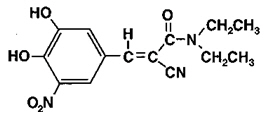
Metabolism and Elimination: Entacapone is almost completely metabolized prior to excretion, with only a very small amount (0.2% of dose) found unchanged in urine. The main metabolic pathway is isomerization to the cis-isomer, followed by direct glucuronidation of the parent and cis-isomer; the glucuronide conjugate is inactive. After oral administration of a 14C-labeled dose of entacapone, 10% of labeled parent and metabolite is excreted in urine and 90% in feces.
Special Populations: Entacapone pharmacokinetics are independent of age. No formal gender studies have been conducted. Racial representation in clinical studies was largely limited to Caucasians; therefore, no conclusions can be reached about the effect of entacapone on groups other than Caucasian.
Hepatic Impairment: A single 200 mg dose of entacapone, without levodopa and dopa decarboxylase inhibitor coadministration, showed approximately 2-fold higher AUC and C maxvalues in patients with a history of alcoholism and hepatic impairment (n=10) compared to normal subjects (n=10). All patients had biopsy-proven liver cirrhosis caused by alcohol. According to Child-Pugh grading seven patients with liver disease had mild hepatic impairment and three patients had moderate hepatic impairment. As only about 10% of the entacapone dose is excreted in urine as parent compound and conjugated glucuronide, biliary excretion appears to be the major route of excretion of this drug. Consequently, entacapone should be administered with care to patients with biliary obstruction.
Renal Impairment: The pharmacokinetics of entacapone have been investigated after a single 200 mg entacapone dose, without levodopa and dopa decarboxylase inhibitor coadministration, in a specific renal impairment study. There were three groups: normal subjects (n=7; creatinine clearance greater than 1.12 mL per sec per 1.73 m 2), moderate impairment (n=10; creatinine clearance ranging from 0.60 mL per sec per 1.73 m 2to 0.89 mL per sec per 1.73 m 2), and severe impairment (n=7; creatinine clearance ranging from 0.20 mL per sec per 1.73 m 2to 0.44 mL per sec per 1.73 m 2). No important effects of renal function on the pharmacokinetics of entacapone were found.
Rhabdomyolysis: Cases of severe rhabdomyolysis have been reported following the approval of entacapone. Although the reactions typically occurred while patients were treated with entacapone, the complicated nature of these cases makes it difficult to determine what role, if any, entacapone played in their pathogenesis. Severe prolonged motor activity including dyskinesia may account for rhabdomyolysis. Signs and symptoms include fever, alteration of consciousness, myalgia, increased values of creatine phosphokinase (CPK) and myoglobin.
Hyperpyrexia and Confusion: Cases of a symptom complex resembling neuroleptic malignant syndrome (NMS) characterized by elevated temperature, muscular rigidity, altered consciousness, and elevated CPK have been reported in association with the rapid dose reduction or withdrawal of other dopaminergic drugs. In most of these cases, symptoms began after abrupt discontinuation of treatment with entacapone or reduction of its dose, or after the initiation of treatment with entacapone. The complicated nature of these cases makes it difficult to determine what role, if any, entacapone may have played in their pathogenesis. No cases have been reported following the abrupt withdrawal or dose reduction of entacapone treatment during clinical studies.
Prescribers should exercise caution when discontinuing entacapone treatment. When considered necessary, withdrawal should proceed slowly. If the decision is made to discontinue treatment with entacapone, recommendations include monitoring the patient closely and adjusting other dopaminergic treatments as needed. This syndrome should be considered in the differential diagnosis for any patient who develops a high fever or severe rigidity. Tapering entacapone has not been systematically evaluated.
Fibrotic Complications: Cases of retroperitoneal fibrosis, pulmonary infiltrates, pleural effusion, and pleural thickening have been reported in some patients treated with ergot derived dopaminergic agents. These complications may resolve when the drug is discontinued, but complete resolution does not always occur. Although these adverse events are believed to be related to the ergoline structure of these compounds, whether other, nonergot derived drugs (e.g., entacapone) that increase dopaminergic activity can cause them is unknown. It should be noted that the expected incidence of fibrotic complications is so low that even if entacapone caused these complications at rates similar to those attributable to other dopaminergic therapies, it is unlikely that it would have been detected in a cohort of the size exposed to entacapone. Four cases of pulmonary fibrosis were reported during clinical development of entacapone; three of these patients were also treated with pergolide and one with bromocriptine. The duration of treatment with entacapone ranged from 7 months to 17 months.
Melanoma: Epidemiological studies have shown that patients with Parkinson's disease have a higher risk (2- to approximately 6-fold higher) of developing melanoma than the general population. Whether the increased risk observed was due to Parkinson's disease or other factors, such as drugs used to treat Parkinson's disease, is unclear.
For the reasons stated above, patients and providers are advised to monitor for melanomas frequently and on a regular basis when using entacapone for anyindication. Ideally, periodic skin examinations should be performed by appropriately qualified individuals (e.g., dermatologists).
Patients With Impaired Hepatic Function: Patients with hepatic impairment should be treated with caution. The AUC and C maxof entacapone approximately doubled in patients with documented liver disease, compared to controls. However, these studies were conducted with single-dose entacapone without levodopa and dopa decarboxylase inhibitor coadministration, and therefore the effects of liver disease on the kinetics of chronically administered entacapone have not been evaluated (see CLINICAL PHARMACOLOGY, Pharmacokinetics of Entacapone).
Withdrawing Patients from Entacapone: Rapid withdrawal or abrupt reduction in the entacapone dose could lead to emergence of signs and symptoms of Parkinson's disease (see CLINICAL PHARMACOLOGY, Clinical Studies), and may lead to hyperpyrexia and confusion, a symptom complex resembling NMS (see PRECAUTIONS, Other Events Reported With Dopaminergic Therapy). This syndrome should be considered in the differential diagnosis for any patient who develops a high fever or severe rigidity. If a decision is made to discontinue treatment with entacapone, patients should be monitored closely and other dopaminergic treatments should be adjusted as needed. Although tapering entacapone has not been systematically evaluated, it seems prudent to withdraw patients slowly if the decision to discontinue treatment is made.
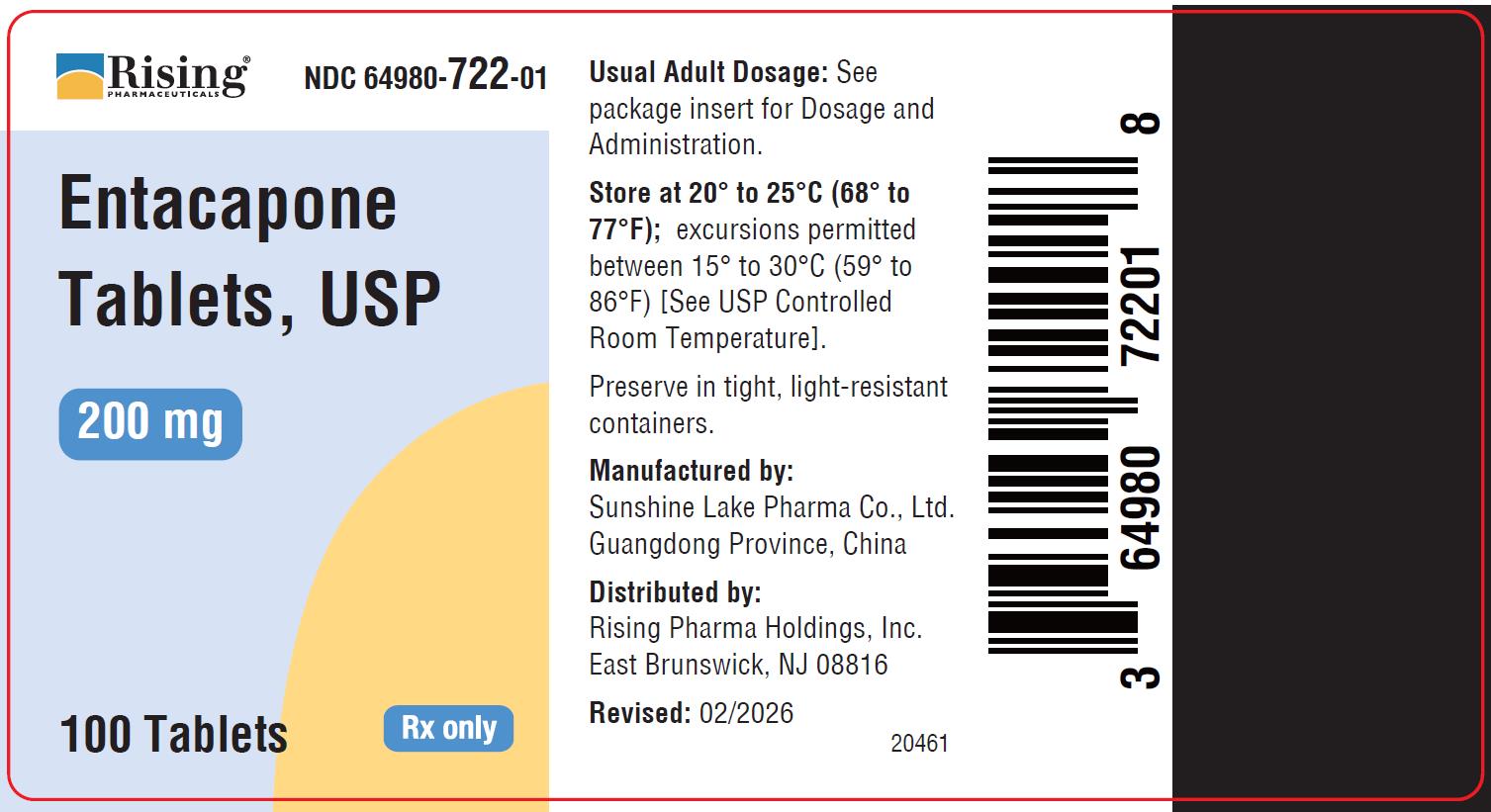
Entacapone tablets USP, 200 mg
Manufactured by:
Sunshine Lake Pharma Co., Ltd.
No. 1, Northern Industry Road,
Northern Industry Park of Song Shan Lake,
Dongguan, Guangdong 523808, China
Distributed by:
Rising Pharma Holdings, Inc.
East Brunswick, NJ 08816
Revised:02/2026
20451