2 Dosage And Administration
2.1 Preparation for Administration
Appearance is clear to slightly opalescent. Standardized mite extracts should be a yellowish to light brown solution. Parenteral drug products should be inspected visually for particulate matter and discoloration prior to administration, whenever solution and container permit. Discard solution if either of these conditions exist.
Standardized mite extracts diluted with Albumin Saline with Phenol (0.4 %) (stabilized diluent) may be more potent than standardized mite extracts diluted with diluents that do not contain albumin. When switching from non-stabilized to stabilized diluent, consider less concentrated initial dilutions for both intradermal testing and immunotherapy.
Different formulations, preparations, or new lots of standardized mite extracts are not interchangeable. Dosage should be adjusted appropriately when formulations, preparations, or lots of standardized mite extracts are changed [see Immunotherapy (2.3) and Dosage Forms and Strengths (3)].
Standardized mite extracts may be prepared for intradermal (diagnosis) or subcutaneous (immunotherapy) administration by diluting stock concentrates.
- For diluent, use sterile albumin saline with phenol or sterile normal saline with phenol.
- Dilute stock concentrates by a minimum of 100-fold for intradermal testing. Dilutions of 1,000-fold or greater are appropriate starting points for patients with a clinical history of adverse reaction.
To prepare dilutions for intradermal testing and immunotherapy, start with a stock concentrate, and prepare a ten-fold (1:10) dilution by adding 0.5 mL of concentrate to 4.5 mL of sterile aqueous diluent. Prepare subsequent dilutions in a similar manner (see Table 1).
Table 1: 10-fold Dilution Series for Standardized Mite Extracts Labeled 10,000 AU*/mL and 30,000 AU*/mL
Dilution** | Extract | Milliliters of Diluent | Dilution Strength AU/mL | Dilution Strength AU/mL |
0 | Concentrate | 0 | 10,000 | 30,000 |
1 | 0.5mL Concentrate | 4.5 | 1,000 | 3,000 |
2 | 0.5mL Dilution 1 | 4.5 | 100 | 300 |
3 | 0.5mL Dilution 2 | 4.5 | 10 | 30 |
4 | 0.5mL Dilution 3 | 4.5 | 1 | 3 |
5 | 0.5mL Dilution 4 | 4.5 | 0.1 | 0.3 |
6 | 0.5mL Dilution 5 | 4.5 | 0.01 | 0.03 |
7 | 0.5mL Dilution 6 | 4.5 | 0.001 | 0.003 |
* Allergy Units
** Store extract dilutions at 2 °C to 8 °C (36 °F to 46 °F).
2.2 Diagnostic Testing
For percutaneous and intradermal use only.
Use Standardized Mite Extract (Dermatophagoides farinae) or Standardized Mite Extract (Dermatophagoides pteronyssinus) to identify patients who exhibit an allergic response to either species of dust mite (D. farinae or D. pteronyssinus). False positive reactions may occur. A positive skin test reaction must be interpreted in the context of the individual’s clinical history and known exposure to the allergen.
- Administer percutaneous tests prior to administration of intradermal tests.
- Do not use Standardized Mite Mixture Extract (Dermatophagoides farinae and Dermatophagoides pteronyssinus) for diagnostic testing because a positive reaction would not permit identification of the specific mite allergen that elicited the reaction. In addition, a negative reaction would fail to indicate whether an individual component allergen would have elicited a positive reaction at full strength.
Percutaneous Skin Testing
Dose
Unless an individual is suspected to be at greater risk for anaphylaxis, the initial starting dose is 1 drop (approximately 0.05 mL) of concentrated standardized mite extract (30,000 AU/mL). For individuals suspected to be at greater risk for anaphylaxis (for example, as indicated by a history of allergen-induced anaphylaxis), initiate percutaneous testing with 1 drop of a diluted standardized mite extract, if negative retest with the next higher concentration(s). Doses should be administered 15‑20 minutes apart [see Preparation for Administration (2.1)].
Administration
Place one drop (approximately 0.05 mL) of standardized mite extract on the skin and using a skin test device, such as a sterile needle, lancet, or bifurcated needle, pierce through the drop into the skin with a slight lifting motion.
For self-loading devices refer to the manufacturer’s product instructions.
Include a positive histamine skin test control to identify patients whose recent use of drugs with antihistamine activity may result in a false negative skin test. [see Drug Interactions (7.1)].
Include a negative control to detect false positive responses, which can occur when the patient has a non-specific reaction to the diluent or due to dermographism. A 50% glycerin solution may be used as the negative control.
Interpreting Results
Measure and record skin test responses 15-20 minutes after exposure.22 Individual patient reactivity can vary with time, allergen potency, and/or immunotherapy, as well as testing technique. The most reliable method of recording a skin test reaction is to measure the largest diameter of both wheal and erythema. While some correlation exists between the size of the skin test reaction and the degree of sensitivity, other factors should be considered in the diagnosis of allergy to specific allergens (see Figure 1).
- The negative control (50 % glycerin solution) response should measure < 3 mm wheal and ≤ 10 mm flare.
- Response to the positive control should be at least 3 millimeters larger than the response to the negative control.
- If either the response to the histamine positive control or to the negative control do not meet the criteria above for acceptable wheal size, the results for the allergenic extracts tested at the same time should be considered invalid and be repeated.
Figure 1: Measurement of Wheal and Flare
Use a paper or plastic millimeter skin reaction guide as shown below.

Reaction Guide #1 (Standardized Mites 1)

Reaction Guide #2 (Standardized Mites 2)
Fifteen minutes after application of the skin test, measure the length and midpoint orthogonal width of each flare and wheal from the inner edge of the reaction.

Reaction Guide #3 (Standardized Mites 3)
The length of the skin test is defined as the largest diameter and the width of the skin test is defined as the diameter perpendicular to the length at its midpoint. Consider the wheal and flare as separate entities. First, measure the flare and then independently measure the wheal.
Measuring the Flare Measuring the Wheal

Reaction Guide #4 (Standardized Mites 4)

Reaction Guide #5 (Standardized Mites 5)
The average diameter measurement in the example above of the flare is (26 mm + 36 mm)/2 = 31 mm and the average diameter of the wheal is (10 mm + 16 mm)/2 = 13 mm.
Intradermal (Intracutaneous) Skin Testing
Always perform percutaneous tests prior to intradermal skin tests.22
Dose
For patients with negative or equivocal percutaneous testing for whom there is a high index of suspicion of dust mite allergy, intradermal testing may be performed with 0.02 to 0.05 mL of a 30 AU/mL extract solution. [see Preparation for Administration (2.1)]. If this test is negative, a second intradermal test may be performed with 0.02 to 0.05 mL of a 300 AU/mL extract solution.
Administration
Intradermally inject the dose of the diluted allergenic extract using a 1 mL syringe.
Include a positive histamine control at intradermal strength to identify patients whose recent use of drugs with antihistamine activity may result in a false negative skin test. [see Drug Interactions (7.1)].
Include an aqueous buffer negative control (Sterile Albumin Saline with Phenol, Sterile Buffered Saline with Phenol) to detect false positive responses, which can occur when the patient has a non-specific reaction to the diluent or due to dermographism.
Interpreting Results
Measure wheal responses for the histamine positive control test and allergen tests at 15‑20 minutes after injection. Refer to Figure 1 for the measurement of wheal and flare.
- Response to the positive control should be at least 3 millimeters larger than the response to the negative control.
- The negative control (sterile aqueous diluent) response should measure < 3 mm wheal and ≤ 10 mm flare (erythema).
- If either the response to the histamine positive control or to the negative control do not meet the criteria above for acceptable wheal size, the results for the allergenic extracts tested at the same time should be considered invalid and be repeated.
2.3 Immunotherapy
For subcutaneous use only.
Subcutaneous injections for immunotherapy should be prepared by dilution of stock concentrate. See Table 1 for dilution preparation.
Administration
Administer immunotherapy by subcutaneous injection in the lateral aspect of the arm or thigh. Do not inject directly into any blood vessels.
Most adverse reactions occur within 30 minutes after injection. Therefore, observe patients for at least 30 minutes.23
Dose Build-up
Dosing of standardized mite extracts for allergen immunotherapy is highly individualized. The initial dose should be based on the patient’s percutaneous skin test reactivity and clinical history. The initial dose is typically 0.05 mL of a 0.01 to 0.03 AU/mL dilution. In patients who appear to be exquisitely sensitive by skin test and history, consider a lower initial dose such as 0.05 mL of a 0.001 to 0.003 AU/mL dilution. The dose is increased at each injection by no more than 50% of the previous dose, and the next increment is governed by the response to the last injection. Dosing is increased in increments until 0.5 mL is reached, following which 0.05 mL is administered from the next most concentrated allergen extract or allergen mixture vial in the dilution series. Injections are typically given one or two times per week until the maintenance dose is reached.
- Any evidence of a systemic reaction to immunotherapy is an indication for a significant reduction (at least 75%) in the subsequent dose or the cessation of immunotherapy. Proceed cautiously in subsequent dosing if immunotherapy is continued.
- Repeated systemic reactions, even of a mild nature, are sufficient reason for the cessation of further attempts to increase the reaction-causing dose.
- The volume of solution for immunotherapy may produce increased discomfort in pediatric individuals. In order to achieve the total dose required, the volume of the dose may be divided into more than one injection per visit.
Maintenance Dose Selection and Intervals
Select a maintenance dose based on the patient's clinical response and tolerance.
- Typical maintenance dose is 500-2,000 AU.23 Occasionally, higher doses are necessary to relieve symptoms.
- The two mite species are highly cross-reactive. Therefore, consider the total Allergy Units when determining the target maintenance dose.
- Maintenance doses larger than 0.2 mL of undiluted allergen extract are rarely administered because an extract in 50% glycerin may cause patient discomfort upon injection.
- After the maintenance dose is achieved, increase the injection interval to 2 weeks, then 3 weeks, and finally 4 weeks as tolerated. The optimal interval between maintenance doses of allergenic extract varies among individuals. Administer the maintenance dose at a given interval three or four times before further increasing the interval to ensure that no reactions occur. Protection may be lost rapidly if the interval between doses is more than 4 weeks.
Dosage Modification for Immunotherapy
Withhold immunotherapy and/or reduce dosage, if any of the following conditions exist:
- Severe symptoms of rhinitis and/or asthma.
- Infection accompanied by fever.
Any evidence of a systemic reaction is an indication for a significant reduction (at least 75%) in the subsequent dose. Repeated systemic adverse reactions are sufficient reason for the cessation of further attempts to increase the dose.
In situations prompting dose reduction, a cautious increase in dose can be attempted once the reduced dose is tolerated. The dose should be reduced to the last level not causing the reaction and maintained at this level for two or three treatments before cautiously increasing again.
Prolonged period has elapsed since the last injection: Patients may lose tolerance for allergen injections during prolonged intervals (> 4 weeks) between doses. The duration of tolerance is an individual characteristic and varies from patient to patient. In general, the longer the lapse in the injection schedule, the greater dose reduction required.
Changing to a different lot of standardized extract: All extracts can lose allergenic activity over time and extracts vary in allergenic activity. Two different lots of extract could differ substantially in allergenic activity, even if they are the same formula and concentration. The volume of the first dose from the new vial should not exceed 50% of the previous dose. Do not use extracts beyond their expiry date.
Changing to an extract from a different manufacturer:Since manufacturing processes and sources of raw materials differ among manufacturers, the interchangeability of extracts from different manufacturers cannot be assured. Decrease the starting dose of the new extract when the extract is the same formula and dilution as the one previously used. In general, a volume dose reduction to 50% of the previous product dose is adequate, but each situation must be evaluated separately considering the patient's history of sensitivity, tolerance of previous injections, and other factors. If the patient tolerates the 50% decrease, then raise the next dose to the previous tolerated dose amount. To re‑establish the maintenance dose the starting interval between doses should not be greater than one week.
Changes made in the extract concentrate formula: Changes other than those listed above such as a difference in extracting fluid (e.g., change from non-glycerin extracts to 50% glycerin extracts), combining two or more stock concentrates, or any other change can affect a patient’s tolerance of the treatment. Extra dilutions are recommended whenever starting a revised formula. The greater the change, the greater the number of dilutions required.23
Duration of Treatment
The duration of treatment for immunotherapy has not been established. A period of three to five years of injection therapy constitutes an average minimum course of treatment. Evaluate patients for treatment response at least every 6 to 12 months while they receive immunotherapy. The decision to continue or stop immunotherapy must be individualized.23
7 Drug Interactions
7.1 Antihistamines
Do not perform skin testing with standardized mite extracts within 3 to 10 days of first-generation H1‑histamine receptor blockers (e.g., clemastine, diphenhydramine) and second-generation antihistamines (e.g., loratadine, fexofenadine) being used. These products suppress histamine skin test reactions and could mask a positive response.2, 22, 23
7.2 Topical Corticosteroids and Topical Anesthetics
Topical corticosteroids may suppress skin reactivity; therefore, discontinue use at the skin test site for at least 2 to 3 weeks before skin testing.2, 3 Avoid use of topical local anesthetics at skin test sites because they can suppress flare responses.4, 22, 23
7.3 Tricyclic Antidepressants
Tricyclic antidepressants, such as doxepin, can have potent antihistamine effects and may alter skin test results. Allow 7 to 14 days after discontinuation of tricyclic medication prior to skin testing.17, 22, 23
See 17 for PATIENT COUNSELING INFORMATION.
11 Description
Standardized mite extracts are injections for percutaneous, intradermal, or subcutaneous use labeled in Allergy Units per milliliter (AU/mL).5 Standardized Mite Extract (Dermatophagoides farinae), Standardized Mite Extract (Dermatophagoides pteronyssinus), and Standardized Mite Mixture Extract (Dermatophagoides farinae and Dermatophagoides pteronyssinus) are sterile solutions containing the extractables of D. farinae and/or D. pteronyssinus, 0.5 % sodium chloride, 0.275 % sodium bicarbonate, and 50 % glycerin by volume as a preservative. Source material for the extracts is the whole bodies of the mites. The mites are each grown on a medium of brine shrimp eggs and wheat germ, and are handled and cleaned in a manner such that the maximum carryover of the medium components is less than 1%. The medium contains no material of human origin.
Standardized Mite Extract (Dermatophagoides farinae) and Standardized Mite Extract (Dermatophagoides pteronyssinus) concentrates (stock concentrates) containing 30,000 AU/mL are supplied in dropper vials for percutaneous testing. Stock concentrates are also available in multiple-dose vials containing 10,000 AU/mL and 30,000 AU/mL to be diluted for intradermal testing and immunotherapy.
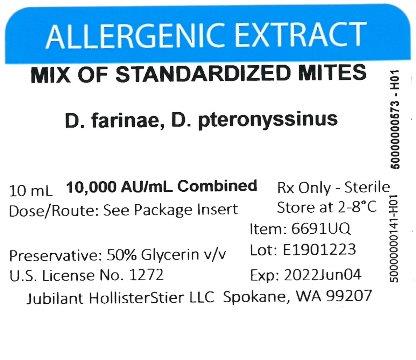
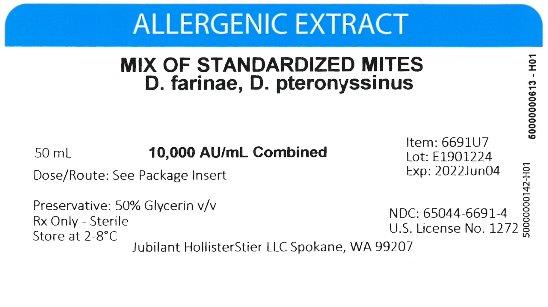
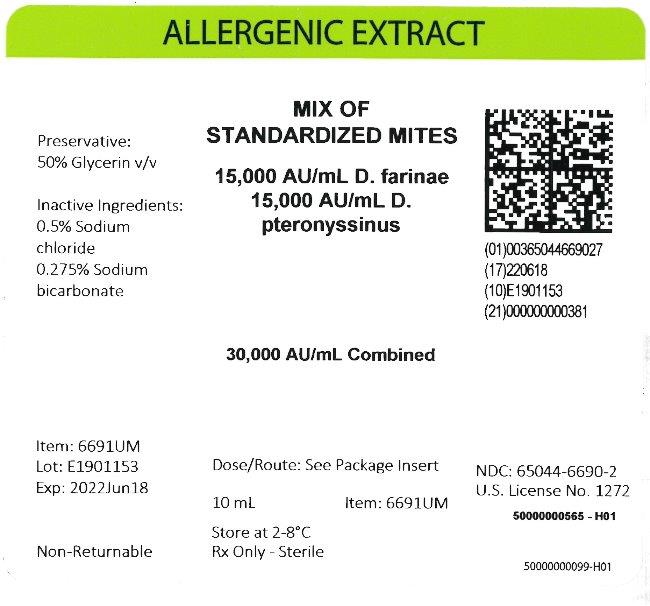
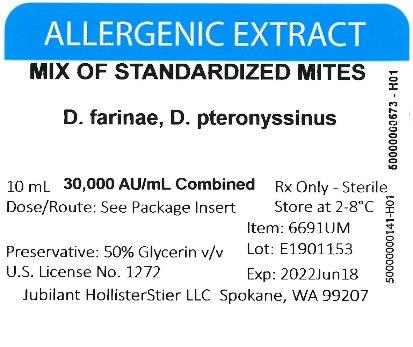
Standardized Mite Mixture Extract (Dermatophagoides farinae and Dermatophagoides pteronyssinus), is a mixture of the two mite species, in equal parts, resulting in D. pteronyssinus at 15,000 AU/mL and D. farinae at 15,000 AU/mL is available for therapeutic use. A mixture of the two species is also available at 5,000 AU/mL each species.
The potency of each lot of standardized mite extract is determined by comparison to the US reference preparation (10,000 AU/mL) provided by the Center for Biologics Evaluation and Research of the FDA. The relative potency of each extract is determined by ELISA inhibition and labeled in AU/mL.
Principal Display Panel
5mL Standardized Mite, Carton6720UP – 5mL 30,000 AU/mL, Standardized Mite, D. far Carton Label6720UP – 5mL 30,000 AU/mL, Standardized Mite, D. far Container Label6692UP – 5mL 30,000 AU/mL, Standardized Mite, D. pter Carton Label6692UP – 5mL 30,000 AU/mL, Standardized Mite, D. pter Container Label10mL Standardized Mite, Carton6720UN – 10mL 30,000 AU/mL, Standardized Mite, D. far. Carton Label6720UN – 10mL 30,000 AU/mL, Standardized Mite, D. far. Container Label6720UL – 10mL 10,000 AU/mL, Standardized Mite, D. far Carton Label6720UL – 10mL 10,000 AU/mL, Standardized Mite, D. far Container Label6692UN – 10mL 30,000 AU/mL, Standardized Mite, D. pter Carton Label6692UN – 10mL 30,000 AU/mL, Standardized Mite, D. pter Container Label6692UL – 10mL 10,000 AU/mL, Standardized Mite, D. pter Carton Label6692UL – 10mL 10,000 AU/mL, Standardized Mite, D. pter Container Label6691UM – 10mL 30,000 AU/mL, Mix of Standardized Mites Carton Label6691UM – 10mL 30,000 AU/mL, Mix of Standardized Mites Container Label6691UQ – 10mL 10,000 AU/mL, Mix of Standardized Mites Carton Label6691UQ – 10mL 10,000 AU/mL, Mix of Standardized Mites Container Label30mL Standardized Mite, Carton6720US – 30mL 30,000 AU/mL, Standardized Mite, D. far Carton Label6720US – 30mL 30,000 AU/mL, Standardized Mite, D. far Container Label6692US – 30mL 30,000 AU/mL, Standardized Mite, D. pter Carton Label6692US – 30mL 30,000 AU/mL, Standardized Mite, D. pter Container Label6691UT – 30mL 30,000 AU/mL, Mix of Standardized Mites Carton Label6691UT – 30mL 30,000 AU/mL, Mix of Standardized Mites Container Label50mL Standardized Mite, Carton6720U5 – 50mL 10,000 AU/mL Standardized Mite, D. far Carton Label6720U5 – 50mL 10,000 AU/mL Standardized Mite, D. far Container Label6692U5 – 50 mL 10,000 AU/mL, Standardized Mite, D. pter Carton Label6692U5 – 50 mL 10,000 AU/mL, Standardized Mite, D. pter Container Label6691U7– 50mL 10,000 AU/mL, Mix of Standardized Mites Carton Label6691U7– 50mL 10,000 AU/mL, Mix of Standardized Mites Container Label
* Please review the disclaimer below.