Description:
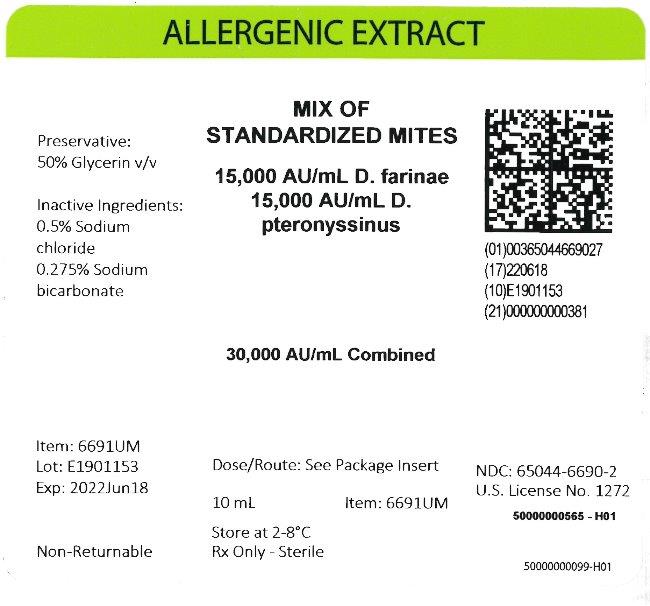
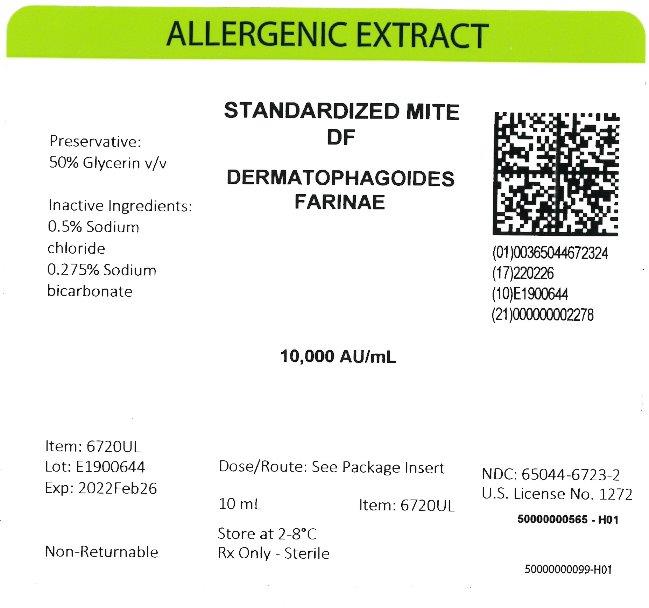
Mite extract is a sterile solution containing the extractables of Dermatophagoides farinae or Dermatophagoides pteronyssinus, 0.5% sodium chloride, 0.275% sodium bicarbonate, and 50% glycerin by volume as a preservative. Source material for the extract is the whole bodies of the mites. The mites are grown on a medium of brine shrimp eggs and wheat germ, and are handled and cleaned in a manner that the maximum carryover of the medium components is less than 1%. The medium contains no material of human origin.
Sterile, diluted mite extracts available for intradermal testing contain 0.9% sodium chloride, not more than 0.5% glycerin by volume, 0.03% albumin (human), not more than 0.003% sodium bicarbonate, and 0.4% phenol as a preservative.
Skin test trials were conducted to evaluate the skin reactivity of medium components mixed in the approximate proportion used for mite growth. Twenty-three individuals who were puncture test reactive (∑E≥40mm) to either D. farinae or D. pteronyssinus were tested with an extract of medium components at an estimated 1% carryover level. None of these patients had a ∑E response more than 3mm larger than the negative control by puncture test with the concentrate of the medium components extract. One of the 23 patients had a reaction with ∑E≥20mm when tested intradermally with a 1:100 (v/v) dilution of the concentrate of the medium components extracts.
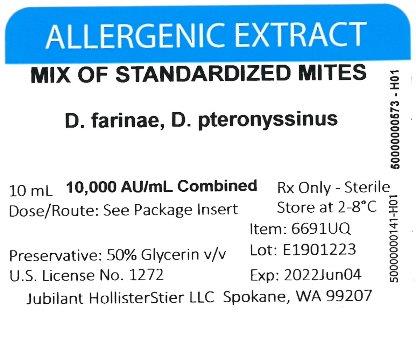
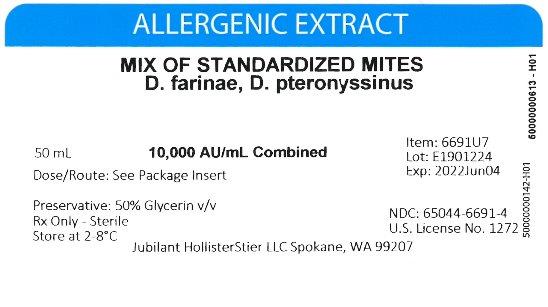
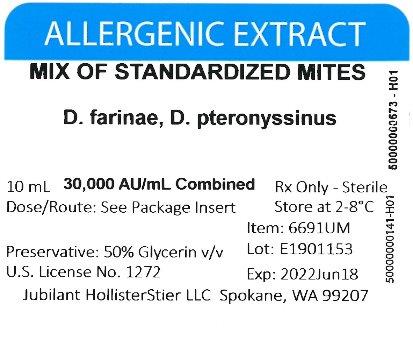
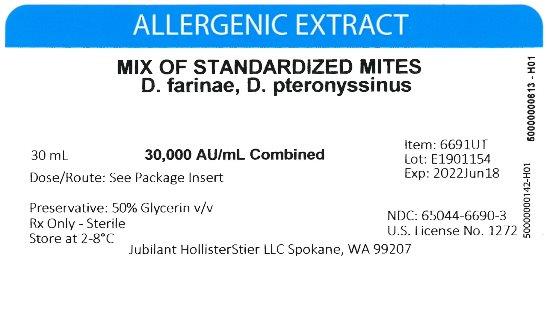
Standardized D. farinae and D. pteronyssinus extract concentrates (stock concentrates) containing 30,000 Allergy Units/mL (AU/mL) are supplied in dropper vials for scratch, prick or puncture tests. Stock concentrates are also available in multiple-dose vials containing 10,000 AU/mL and 30,000 AU/mL to be diluted for intradermal testing and immunotherapy.
Standardized D. farinae and D. pteronyssinus extract dilutions (at 30 AU/mL and 300 AU/mL) are supplied for intradermal diagnostic tests described in Section DOSAGE AND ADMINISTRATION, Diagnosis, Part 2.a.
Product Concentration:
1. Allergy Units (AU/mL). The potency of extracts labeled in Allergy Units (AU/mL) is determined by in vitro comparison to a reference standard established by the Center for Biologics Evaluation and Research (CBER) of the Food and Drug Administration.
2. Bioequivalent Allergy Units (BAU/mL).
Other standardized allergenic extracts are labeled in Bioequivalent Allergy Units/mL (BAU/mL) based on their comparison (by in vitro assay or major allergen content) to CBER, FDA Reference Preparations. The FDA reference extracts have been assigned Bioequivalent Allergy Units based on the CBER ID50EAL method.5 Briefly, highly sensitive patients are skin tested to the reference preparation using an intradermal technique employing 3-fold extract dilutions. Depending on the dilution which elicits a summation of erythema diameter of 50, Bioequivalent Allergy Units are assigned as follows:
| BAU/mL | D50 |
|---|---|
| 100,000 | 13-15 |
| 10,000 | 10.9-12.9 |
| 1,000 | 8.8-10.8 |
| 100 | 6.7-8.7 |
3. Concentrate Concentrate label terminology applies to allergenic extract mixtures where the individual allergens being combined vary in strength or the designation of strength.
| e.g. | Concentrate |
|---|---|
| 50% | Short Ragweed 1:20 w/v |
| 25% | Std Cat Hair 10,000 BAU/mL |
| 25% | Std Mite D. farinae 10,000 AU/mL |
Should the physician choose to calculate the actual strength of each component in the "Concentrate" mixture, the following formulation may be used:
| Actual Allergen Strength In concentrate Mixture | = | Allergen Manufacturing Strength | X | % allergen in Formulation (by volume or parts) |