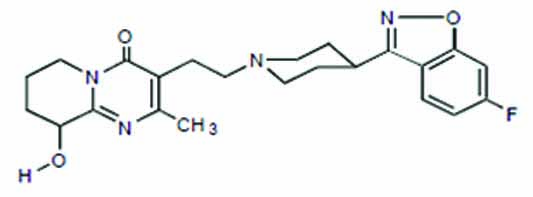
Atypical antipsychotic drugs have been associated with metabolic changes that may increase cardiovascular/cerebrovascular risk. These metabolic changes include hyperglycemia, dyslipidemia, and body weight gain. While all of the drugs in the class have been shown to produce some metabolic changes, each drug has its own specific risk profile.
Hyperglycemia and Diabetes Mellitus
Hyperglycemia and diabetes mellitus, in some cases extreme and associated with ketoacidosis or hyperosmolar coma or death, have been reported in patients treated with all atypical antipsychotics. These cases were, for the most part, seen in post-marketing clinical use and epidemiologic studies, not in clinical trials, and there have been few reports of hyperglycemia or diabetes in trial subjects treated with paliperidone. Assessment of the relationship between atypical antipsychotic use and glucose abnormalities is complicated by the possibility of an increased background risk of diabetes mellitus in patients with schizophrenia and the increasing incidence of diabetes mellitus in the general population. Given these confounders, the relationship between atypical antipsychotic use and hyperglycemia-related adverse events is not completely understood. However, epidemiological studies suggest an increased risk of treatment-emergent hyperglycemia-related adverse events in patients treated with the atypical antipsychotics. Because paliperidone was not marketed at the time these studies were performed, it is not known if paliperidone is associated with this increased risk.
Patients with an established diagnosis of diabetes mellitus who are started on atypical antipsychotics should be monitored regularly for worsening of glucose control. Patients with risk factors for diabetes mellitus (e.g., obesity, family history of diabetes) who are starting treatment with atypical antipsychotics should undergo fasting blood glucose testing at the beginning of treatment and periodically during treatment. Any patient treated with atypical antipsychotics should be monitored for symptoms of hyperglycemia including polydipsia, polyuria, polyphagia, and weakness. Patients who develop symptoms of hyperglycemia during treatment with atypical antipsychotics should undergo fasting blood glucose testing. In some cases, hyperglycemia has resolved when the atypical antipsychotic was discontinued; however, some patients required continuation of anti-diabetic treatment despite discontinuation of the suspect drug.
Pooled data from the three placebo-controlled, 6-week, fixed-dose studies in adult subjects with schizophrenia is presented in Table 1a.
Table 1a. Change in Fasting Glucose from Three Placebo-Controlled, 6-Week, Fixed-Dose Studies in Adult Subjects with Schizophrenia
| | Paliperidone |
| | Placebo | 3 mg/day | 6 mg/day | 9 mg/day | 12 mg/day |
| | Mean change from baseline (mg/dL) |
| | n=322 | n=122 | n=212 | n=234 | n=218 |
Serum Glucose
Change from baseline | 0.8 | -0.7 | 0.4 | 2.3 | 4.3 |
| | Proportion of Patients with Shifts |
Serum Glucose
Normal to High | 5.1% | 3.2% | 4.5% | 4.8% | 3.8% |
| (<100 mg/dL to ≥126 mg/dL) | (12/236) | (3/93) | (7/156) | (9/187) | (6/157) |
In the uncontrolled, longer-term open-label extension studies, paliperidone was associated with a mean change in glucose of +3.3 mg/dL at Week 24 (n=570) and +4.6 mg/dL at Week 52 (n=314).
Data from the placebo-controlled 6-week study in adolescent subjects (12 to 17 years of age) with schizophrenia are presented in Table 1b.
Table 1b. Change in Fasting Glucose from a Placebo-Controlled 6-Week Study in Adolescent Subjects (12 to 17 years of age) with Schizophrenia
| Paliperidone |
| Placebo | 1.5 mg/day | 3 mg/day | 6 mg/day | 12 mg/day |
| Mean change from baseline (mg/dL) |
| n=41 | n=44 | n=11 | n=28 | n=32 |
Serum Glucose
Change from baseline | 0.8 | -1.4 | -1.8 | -0.1 | 5.2 |
| Proportion of Patients with Shifts |
Serum Glucose
Normal to High | 3% | 0% | 0% | 0% | 11% |
(<100 mg/dL to ≥126 mg/dL) | (1/32) | (0/34) | (0/9) | (0/20) | (3/27) |
Dyslipidemia
Undesirable alterations in lipids have been observed in patients treated with atypical antipsychotics.
Pooled data from the three placebo-controlled, 6-week, fixed-dose studies in adult subjects with schizophrenia is presented in Table 2a.
Table 2a. Change in Fasting Lipids from Three Placebo-Controlled, 6-Week, Fixed-Dose Studies in Adult Subjects with Schizophrenia
| | Paliperidone |
| | Placebo | 3 mg/day | 6 mg/day | 9 mg/day | 12 mg/day |
| | Mean change from baseline (mg/dL) |
| Cholesterol | n=331 | n=120 | n=216 | n=236 | n=231 |
| Change from baseline | -6.3 | -4.4 | -2.4 | -5.3 | -4 |
| LDL | n=322 | n=116 | n=210 | n=231 | n=225 |
| Change from baseline | -3.2 | 0.5 | -0.8 | -3.9 | -2 |
| HDL | n=331 | n=119 | n=216 | n=234 | n=230 |
| Change from baseline | 0.3 | -0.4 | 0.5 | 0.8 | 1.2 |
| Triglycerides | n=331 | n=120 | n=216 | n=236 | n=231 |
| Change from baseline | -22.3 | -18.3 | -12.6 | -10.6 | -15.4 |
| | Proportion of Patients with Shifts |
Cholesterol
Normal to High | 2.6% | 2.8% | 5.6% | 4.1% | 3.1% |
| (<200 mg/dL to ≥240 mg/dL) | (5/194) | (2/71) | (7/125) | (6/147) | (4/130) |
LDL
Normal to High | 1.9% | 0% | 5% | 3.7% | 0% |
| (<100 mg/dL to ≥160 mg/dL) | (2/105) | (0/44) | (3/60) | (3/81) | (0/69) |
HDL
Normal to Low | 22% | 16.3% | 29.1% | 23.4% | 20% |
| (≥40 mg/dL to <40 mg/dL) | (44/200) | (13/80) | (39/134) | (32/137) | (27/135) |
Triglycerides
Normal to High | 5.3% | 11% | 8.8% | 8.7% | 4.3% |
| (<150 mg/dL to ≥200 mg/dL) | (11/208) | (9/82) | (12/136) | (13/150) | (6/139) |
In the uncontrolled, longer-term open-label extension studies, paliperidone was associated with a mean change in (a) total cholesterol of -1.5 mg/dL at Week 24 (n=573) and -1.5 mg/dL at Week 52 (n=317), (b) triglycerides of -6.4 mg/dL at Week 24 (n=573) and -10.5 mg/dL at Week 52 (n=317); (c) LDL of -1.9 mg/dL at Week 24 (n=557) and -2.7 mg/dL at Week 52 (n=297); and (d) HDL of +2.2 mg/dL at Week 24 (n=568) and +3.6 mg/dL at Week 52 (n=302).
Data from the placebo-controlled 6-week study in adolescent subjects (12 to 17 years of age) with schizophrenia are presented in Table 2b.
Table 2b. Change in Fasting Lipids from a Placebo-Controlled 6-Week Study in Adolescent Subjects (12 to 17 years of age) with Schizophrenia
| Paliperidone |
| Placebo | 1.5 mg/day | 3 mg/day | 6 mg/day | 12 mg/day |
| Mean change from baseline (mg/dL) |
Cholesterol | n=39 | n=45 | n=11 | n=28 | n=32 |
Change from baseline | -7.8 | -3.3 | 12.7 | 3.0 | -1.5 |
LDL | n=37 | n=40 | n=9 | n=27 | n=31 |
Change from baseline | -4.1 | -3.1 | 7.2 | 2.4 | 0.6 |
HDL | n=37 | n=41 | n=9 | n=27 | n=31 |
Change from baseline | -1.9 | 0.0 | 1.3 | 1.4 | 0.0 |
Triglycerides | n=39 | n=44 | n=11 | n=28 | n=32 |
Change from baseline | -8.9 | 3.2 | 17.6 | -5.4 | 3.9 |
| Proportion of Patients with Shifts |
Cholesterol
Normal to High | 7% | 4% | 0% | 6% | 11% |
(<170 mg/dL to ≥200 mg/dL) | (2/27) | (1/26) | (0/6) | (1/18) | (2/19) |
LDL
Normal to High | 3% | 4% | 14% | 0% | 9% |
(<110 mg/dL to ≥130 mg/dL) | (1/32) | (1/25) | (1/7) | (0/22) | (2/22) |
HDL
Normal to Low | 14% | 7% | 29% | 13% | 23% |
(≥40 mg/dL to <40 mg/dL) | (4/28) | (2/30) | (2/7) | (3/23) | (5/22) |
Triglycerides
Normal to High | 3% | 5% | 13% | 8% | 7% |
(<150 mg/dL to ≥200 mg/dL) | (1/34) | (2/38) | (1/8) | (2/26) | (2/28) |
Weight Gain
Weight gain has been observed with atypical antipsychotic use. Clinical monitoring of weight is recommended.
Schizophrenia Trials
Data on mean changes in body weight and the proportion of subjects meeting a weight gain criterion of ≥ 7% of body weight from the three placebo-controlled, 6-week, fixed-dose studies in adult subjects are presented in Table 3a.
Table 3a. Mean Change in Body Weight (kg) and the Proportion of Subjects with ≥ 7% Gain in Body Weight from Three Placebo-Controlled, 6-Week, Fixed-Dose Studies in Adult Subjects with Schizophrenia
| | | Paliperidone |
| | Placebo | 3 mg/day | 6 mg/day | 9 mg/day | 12 mg/day |
| | n=323 | n=112 | n=215 | n=235 | n=218 |
Weight (kg)
Change from baseline | -0.4 | 0.6 | 0.6 | 1 | 1.1 |
Weight Gain
≥ 7% increase from baseline | 5% | 7% | 6% | 9% | 9% |
In the uncontrolled, longer-term open-label extension studies, paliperidone was associated with a mean change in weight of +1.4 kg at Week 24 (n=63) and +2.6 kg at Week 52 (n=302).
Weight gain in adolescent subjects with schizophrenia was assessed in a 6-week, double-blind, placebo-controlled study and an open-label extension with a median duration of exposure to paliperidone of 182 days. Data on mean changes in body weight and the proportion of subjects meeting a weight gain criterion of ≥ 7% of body weight [see Clinical Studies (14.1)] from the placebo-controlled 6-week study in adolescent subjects (12 to 17 years of age) are presented in Table 3b.
Table 3b. Mean Change in Body Weight (kg) and the Proportion of Subjects with ≥ 7% Gain in Body Weight from a Placebo-Controlled 6-Week Study in Adolescent Subjects (12 to 17 years of age) with Schizophrenia
| | Paliperidone |
| Placebo | 1.5 mg/day | 3 mg/day | 6 mg/day | 12 mg/day |
| n=51 | n=54 | n=16 | n=45 | n=34 |
Weight (kg)
Change from baseline | 0.0 | 0.3 | 0.8 | 1.2 | 1.5 |
Weight Gain
≥ 7% increase from baseline | 2% | 6% | 19% | 7% | 18% |
In the open-label long-term study the proportion of total subjects treated with paliperidone with an increase in body weight of ≥ 7% from baseline was 33%. When treating adolescent patients with paliperidone, weight gain should be assessed against that expected with normal growth. When taking into consideration the median duration of exposure to paliperidone in the open-label study (182 days) along with expected normal growth in this population based on age and gender, an assessment of standardized scores relative to normative data provides a more clinically relevant measure of changes in weight. The mean change from open-label baseline to endpoint in standardized score for weight was 0.1 (4% above the median for normative data). Based on comparison to the normative data, these changes are not considered to be clinically significant.
Schizoaffective Disorder Trials
In the pooled data from the two placebo-controlled, 6-week studies in adult subjects with schizoaffective disorder, a higher percentage of paliperidone-treated subjects (5%) had an increase in body weight of ≥ 7% compared with placebo-treated subjects (1%). In the study that examined high- and low-dose groups, the increase in body weight of ≥ 7% was 3% in the low-dose group, 7% in the high-dose group, and 1% in the placebo group.