Information for Patients
NOTE: In addition to information provided below, a Patient Medication Guide providing instructions for proper use of tobramycin inhalation solution is contained inside the package.
Safety Information
Tobramycin inhalation solution is in a class of antibiotics that have caused hearing loss, dizziness, kidney damage, and harm to a fetus. Ringing in the ears and hoarseness were two symptoms that were seen in more patients taking tobramycin inhalation solution than placebo in research studies. Patients with cystic fibrosis can have many symptoms. Some of these symptoms may be related to your medications. If you have new or worsening symptoms, you should tell your doctor.
Hearing: You should tell your doctor if you have ringing in the ears, dizziness, or any changes in hearing.
Kidney Damage: Inform your doctor if you have any history of kidney problems.
Pregnancy: If you want to become pregnant or are pregnant while on tobramycin inhalation solution, you should talk with your doctor about the possibility of tobramycin inhalation solution causing any harm.
Nursing Mothers: If you are nursing a baby, you should talk with your doctor before using tobramycin inhalation solution.
Tobramycin Inhalation Solution Packaging
Tobramycin inhalation solution comes in a single dose, ready-to-use ampule containing 300 mg tobramycin. Each foil pouch contains 4 ampules, for 2 days of tobramycin inhalation solution therapy.
Dosage
The 300 mg dose of tobramycin inhalation solution is the same for patients regardless of age or weight. Tobramycin inhalation solution has not been studied in patients less than 6 years old. Doses should be inhaled as close to 12 hours apart as possible and not less than 6 hours apart.
You should not mix tobramycin inhalation solution with dornase alfa (PULMOZYME®, Genentech) in the nebulizer.
If you are taking several medications, the recommended order is as follows: bronchodilator first, followed by chest physiotherapy, then other inhaled medications and, finally, tobramycin inhalation solution.
Treatment Schedule
You should take tobramycin inhalation solution in repeated cycles of 28 days on drug followed by 28 days off drug. You should take tobramycin inhalation solution twice a day during the 28-day period on drug.
How To Administer Tobramycin Inhalation Solution for Inhalation
THIS INFORMATION IS NOT INTENDED TO REPLACE CONSULTATION WITH YOUR PHYSICIAN AND CF CARE TEAM ABOUT PROPERLY TAKING MEDICATION OR USING INHALATION EQUIPMENT.
Tobramycin inhalation solution is specifically formulated for inhalation using a PARI LC PLUS™ Reusable Nebulizer and a DeVilbiss® Pulmo-Aide® air compressor. Tobramycin inhalation solution can be taken at home, school, or at work. The following are instructions on how to use the DeVilbiss Pulmo-Aide air compressor and PARI LC PLUS Reusable Nebulizer to administer Tobramycin Inhalation Solution for Inhalation.
You will need the following supplies:
• Tobramycin inhalation solution plastic ampule (vial)
• DeVilbiss Pulmo-Aide air compressor
• PARI LC PLUS Reusable Nebulizer
• Tubing to connect the nebulizer and compressor
• Clean paper or cloth towels
• Nose clips (optional)
It is important that your nebulizer and compressor function properly before starting your tobramycin inhalation solution therapy.
Note: Please refer to the manufacturers’ care and use instructions for important information.
Preparing Your Tobramycin Inhalation Solution for Inhalation
1. Wash your hands thoroughly with soap and water.
2a. Tobramycin inhalation solution is packaged with 4 ampules per foil pouch.
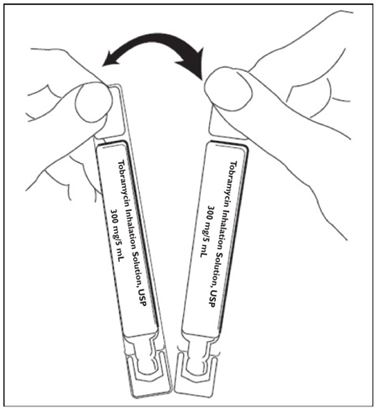
2b. Separate one ampule by gently pulling apart at the bottom tabs. Store all remaining ampules in the refrigerator as directed.
3. Lay out the contents of a PARI LC PLUS Reusable Nebulizer package on a clean, dry paper or cloth towel. You should have the following parts:
• Nebulizer Top and Bottom (Nebulizer Cup) Assembly
• Inspiratory Valve Cap
• Mouthpiece with Valve
• Tubing
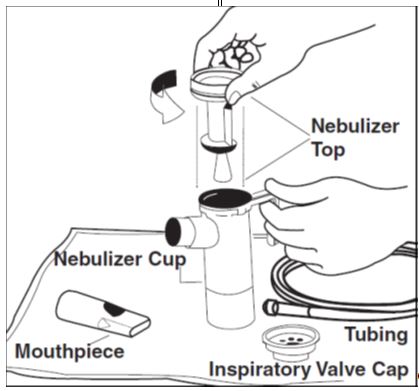
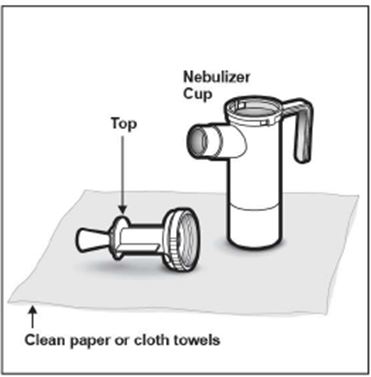
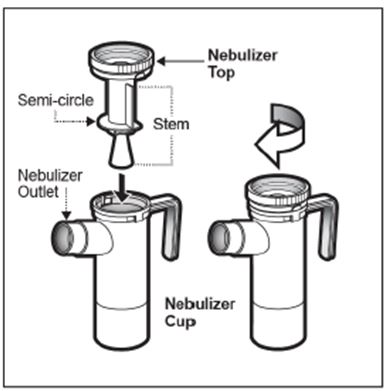
4. Remove the Nebulizer Top from the Nebulizer Cup by twisting the Nebulizer Top counter-clockwise, and then lifting off. Place the Nebulizer Top on the clean paper or cloth towel. Stand the Nebulizer Cup upright on the towel.
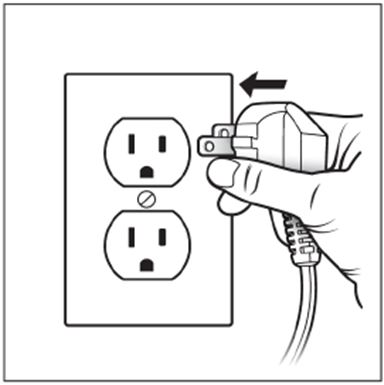
5. Connect one end of the tubing to the compressor air outlet. The tubing should fit snugly. Plug in your compressor to an electrical outlet.
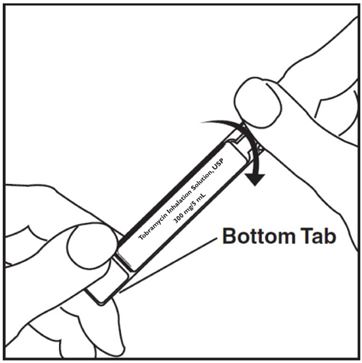
6. Open the tobramycin inhalation solution ampule by holding the bottom tab with one hand and twisting off the top of the ampule with the other hand. Be careful not to squeeze the ampule until you are ready to empty its contents into the Nebulizer Cup.
7. Squeeze all the contents of the ampule into the Nebulizer Cup.
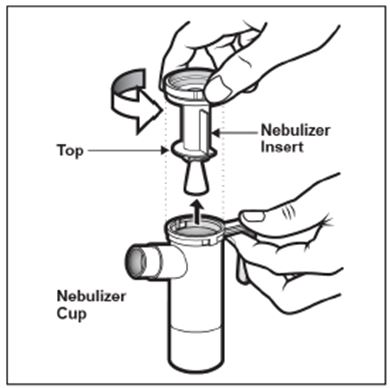
8. Replace the Nebulizer Top. Note: In order to insert the Nebulizer Top into the
Nebulizer Cup, the semi-circle halfway down the stem of the Nebulizer Top should face the Nebulizer Outlet.
9. Attach the Mouthpiece to the Nebulizer Outlet. Then firmly push the Inspiratory Valve Cap in place on the Nebulizer Top. Note: the Inspiratory Valve Cap will fit snugly.
10. Connect the free end of the tubing from the compressor to the Air Intake on the bottom of the nebulizer, making sure to keep the nebulizer upright. Press the tubing on the Air Intake firmly.
Tobramycin Inhalation Solution Treatment
1. Turn on the compressor.
2. Check for a steady mist from the Mouthpiece. If there is no mist, check all tubing connections and confirm that the compressor is working properly.
3. Sit or stand in an upright position that will allow you to breathe normally.
4. Place Mouthpiece between your teeth and on top of your tongue and breathe normally only through your mouth. Nose clips may help you breathe through your mouth and not through your nose. Do not block airflow with your tongue.
5. Continue treatment until all your tobramycin inhalation solution is gone, and there is no longer any mist being produced. You may hear a sputtering sound when the Nebulizer Cup is empty. The entire tobramycin inhalation solution treatment should take approximately 15 minutes to complete. Note: if you are interrupted, need to cough or rest during your tobramycin inhalation solution treatment, turn off the compressor to save your medication. Turn the compressor back on when you are ready to resume your therapy.
6. Follow the nebulizer cleaning and disinfecting instructions after completing therapy.
Cleaning Your Nebulizer
To reduce the risk of infection, illness or injury from contamination, you must thoroughly clean all parts of the nebulizer as instructed after each treatment. Never use a nebulizer with a clogged nozzle. If the nozzle is clogged, no aerosol mist is produced, which will alter the effectiveness of the treatment. Replace the nebulizer if clogging occurs.
1. Remove tubing from nebulizer and disassemble nebulizer parts.
2. Wash all parts (except tubing) with warm water and liquid dish soap.
3. Rinse thoroughly with warm water and shake out water.
4. Air dry or hand dry nebulizer parts on a clean, lint-free cloth. Reassemble nebulizer when dry, and store.
5. You can also wash all parts of the nebulizer in a dishwasher (except tubing). Place the nebulizer parts in a dishwasher basket, then place on the top rack of the dishwasher.
Remove and dry the parts when the cycle is complete.
Disinfecting Your Nebulizer
Your nebulizer is for your use only - Do not share your nebulizer with other people. You must regularly disinfect the nebulizer. Failure to do so could lead to serious or fatal illness.
Clean the nebulizer as described above. Every other treatment day, disinfect the nebulizer parts (except tubing) by boiling them in water for a full 10 minutes. Dry parts on a clean, lint-free cloth.
Care and Use of Your Pulmo-Aide Compressor
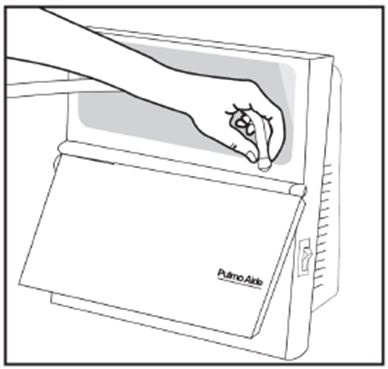
Follow the manufacturer’s instructions for care and use of your compressor.
Filter Change:
1. DeVilbiss Compressor filters should be changed every six months or sooner if filter turns completely gray in color.
Compressor Cleaning:
1. With power switch in the “Off” position, unplug power cord from wall outlet.
2. Wipe outside of the compressor cabinet with a clean, damp cloth every few days to keep dust free.
Caution: Do not submerge in water; doing so will result in compressor damage.
Storage Instructions
You should store tobramycin inhalation solution ampules in a refrigerator (2°C to 8°C or 36°F to 46°F). However, when you don’t have a refrigerator available (e.g., transporting your tobramycin inhalation solution), you may store the foil pouches (opened or unopened) at room temperature (up to 25°C/77°F) for up to 28 days.
Avoid exposing tobramycin inhalation solution ampules to intense light.
Unrefrigerated tobramycin inhalation solution, which is normally slightly yellow, may darken with age; however, the color change does not indicate any change in the quality of the product.
You should not use tobramycin inhalation solution if it is cloudy, if there are particles in the solution, or if it has been stored at room temperature for more than 28 days. You should not use tobramycin inhalation solution beyond the expiration date stamped on the ampule.
Additional Information
Nebulizer: 1-800-327-8632
Compressor: 1-800-338-1988
Tobramycin Inhalation Solution: 1-877-835-5472
Laboratory Tests
Audiograms
Clinical studies of tobramycin inhalation solution did not identify hearing loss using audiometric tests which evaluated hearing up to 8000 Hz. Physicians should consider an audiogram for patients who show any evidence of auditory dysfunction, or who are at increased risk for auditory dysfunction. Tinnitus may be a sentinel symptom of ototoxicity, and therefore the onset of this symptom warrants caution.