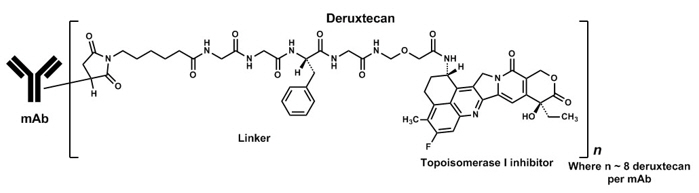
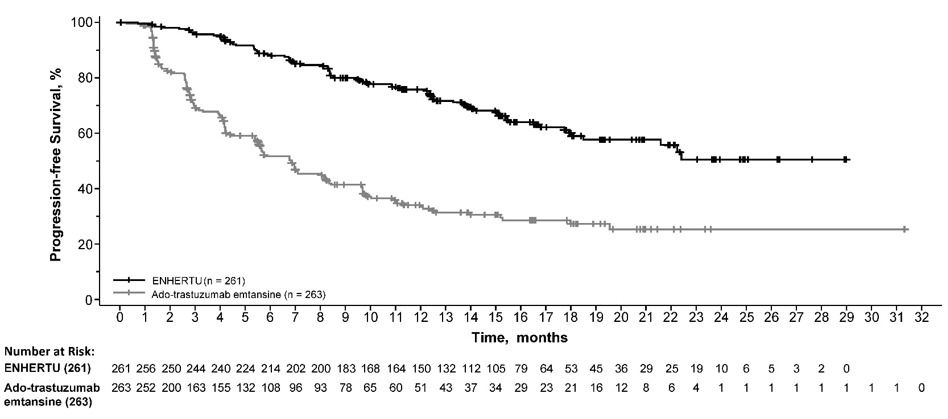
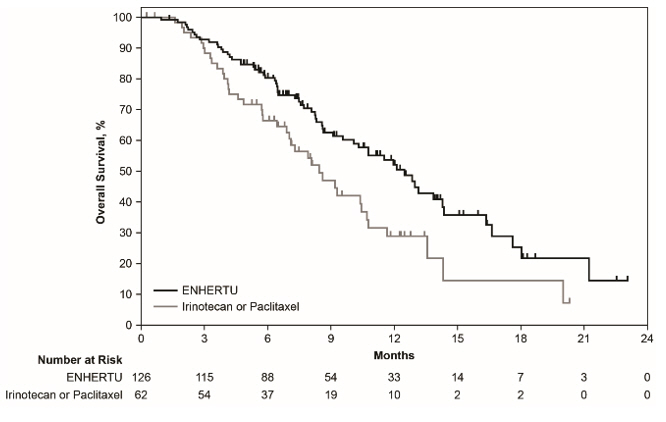
The safety of ENHERTU was evaluated in 187 patients with locally advanced or metastatic HER2-positive gastric or GEJ adenocarcinoma in DESTINY-Gastric01 [see Clinical Studies (14.2)]. Patients intravenously received at least one dose of either ENHERTU (N=125) 6.4 mg/kg once every three weeks or either irinotecan (N=55) 150 mg/m2 biweekly or paclitaxel (N=7) 80 mg/m2 weekly for 3 weeks. The median duration of treatment was 4.6 months (range: 0.7 to 22.3) in the ENHERTU group and 2.8 months (range: 0.5 to 13.1) in the irinotecan/paclitaxel group.
Serious adverse reactions occurred in 44% of patients receiving ENHERTU 6.4 mg/kg. Serious adverse reactions in >2% of patients who received ENHERTU were decreased appetite, ILD, anemia, dehydration, pneumonia, cholestatic jaundice, pyrexia, and tumor hemorrhage. Fatalities due to adverse reactions occurred in 2.4% of patients: disseminated intravascular coagulation, large intestine perforation, and pneumonia occurred in one patient each (0.8%).
ENHERTU was permanently discontinued in 15% of patients, of which ILD accounted for 6%. Dose interruptions due to adverse reactions occurred in 62% of patients treated with ENHERTU. The most frequent adverse reactions (>2%) associated with dose interruption were neutropenia, anemia, decreased appetite, leukopenia, fatigue, thrombocytopenia, ILD, pneumonia, lymphopenia, upper respiratory tract infection, diarrhea, and hypokalemia. Dose reductions occurred in 32% of patients treated with ENHERTU. The most frequent adverse reactions (>2%) associated with dose reduction were neutropenia, decreased appetite, fatigue, nausea, and febrile neutropenia.
The most common (≥20%) adverse reactions, including laboratory abnormalities, were hemoglobin decreased, white blood cell decreased, neutrophil count decreased, lymphocyte count decreased, platelet count decreased, nausea, decreased appetite, anemia, aspartate aminotransferase increased, fatigue, blood alkaline phosphatase increased, alanine aminotransferase increased, diarrhea, hypokalemia, vomiting, constipation, blood bilirubin increased, pyrexia, and alopecia.
Tables 5 and 6 summarize adverse reactions and laboratory abnormalities observed in patients receiving ENHERTU 6.4 mg/kg in DESTINY-Gastric01.
Other clinically relevant adverse reactions reported in less than 10% of patients were:
- Cardiac Disorders: asymptomatic left ventricular ejection fraction decrease (8%) [see Warnings and Precautions (5.3)]
- Infections and Infestations: pneumonia (6%)
- Injury, Poisoning and Procedural Complications: infusion-related reactions (1.6%)
Table 6: Selected Laboratory Abnormalities Occurring in Patients Receiving ENHERTU in DESTINY-Gastric01| Laboratory Parameter | ENHERTU 6.4 mg/kg
N=125 | Irinotecan or Paclitaxel
N=62 |
|---|
All Grades
% | Grades 3 or 4
% | All Grades
% | Grades 3 or 4
% |
|---|
Percentages were calculated using patients with worsening laboratory values from baseline and the number of patients with both baseline and post-treatment measurements as the denominator.
Frequencies were based on NCI CTCAE v.4.03 grade-derived laboratory abnormalities. |
| Hematology | | | | |
| Hemoglobin decreased | 75 | 38 | 55 | 23 |
| White blood cell count decreased | 74 | 29 | 53 | 13 |
| Neutrophil count decreased | 72 | 51 | 45 | 23 |
| Lymphocyte count decreased | 70 | 28 | 53 | 12 |
| Platelet count decreased | 68 | 12 | 12 | 5 |
| Chemistry | | | | |
| Aspartate aminotransferase increased | 58 | 9 | 32 | 8 |
| Blood alkaline phosphatase increased | 54 | 8 | 34 | 10 |
| Alanine aminotransferase increased | 47 | 9 | 17 | 1.7 |
| Hypokalemia | 30 | 4.8 | 18 | 8 |
| Blood bilirubin increased | 24 | 7 | 5 | 3.4 |
Risk Summary
Based on its mechanism of action, ENHERTU can cause fetal harm when administered to a pregnant woman. There are no available data on the use of ENHERTU in pregnant women. In postmarketing reports, use of a HER2-directed antibody during pregnancy resulted in cases of oligohydramnios manifesting as fatal pulmonary hypoplasia, skeletal abnormalities, and neonatal death (see Data). Based on its mechanism of action, the topoisomerase inhibitor component of ENHERTU, DXd, can also cause embryo-fetal harm when administered to a pregnant woman because it is genotoxic and targets actively dividing cells [see Clinical Pharmacology (12.1), Nonclinical Toxicology (13.1)]. Advise patients of the potential risks to a fetus.
There are clinical considerations if ENHERTU is used in pregnant women, or if a patient becomes pregnant within 7 months following the last dose of ENHERTU (see Clinical Considerations).
The estimated background risk of major birth defects and miscarriage for the indicated population is unknown. All pregnancies have a background risk of birth defect, loss, or other adverse outcomes. In the U.S. general population, the estimated background risk of major birth defects and miscarriage in clinically recognized pregnancies is 2-4% and 15-20%, respectively.
Clinical Considerations
Fetal/Neonatal Adverse Reactions
Monitor women who received ENHERTU during pregnancy or within 7 months prior to conception for oligohydramnios. If oligohydramnios occurs, perform fetal testing that is appropriate for gestational age and consistent with community standards of care.
Data
Human Data
There are no available data on the use of ENHERTU in pregnant women. In postmarketing reports in pregnant women receiving a HER2-directed antibody, cases of oligohydramnios manifesting as fatal pulmonary hypoplasia, skeletal abnormalities, and neonatal death have been reported. These case reports described oligohydramnios in pregnant women who received a HER2-directed antibody either alone or in combination with chemotherapy. In some case reports, amniotic fluid index increased after use of a HER2-directed antibody was stopped.
Animal Data
There were no animal reproductive or developmental toxicity studies conducted with fam-trastuzumab deruxtecan-nxki.
Risk Summary
There is no data regarding the presence of fam-trastuzumab deruxtecan-nxki in human milk, the effects on the breastfed child, or the effects on milk production. Because of the potential for serious adverse reactions in a breastfed child, advise women not to breastfeed during treatment with ENHERTU and for 7 months after the last dose.
Pregnancy Testing
Verify pregnancy status of females of reproductive potential prior to initiation of ENHERTU.
Contraception
Females
ENHERTU can cause fetal harm when administered to a pregnant woman [see Use in Specific Populations (8.1)]. Advise females of reproductive potential to use effective contraception during treatment with ENHERTU and for at least 7 months following the last dose.
Males
Because of the potential for genotoxicity, advise male patients with female partners of reproductive potential to use effective contraception during treatment with ENHERTU and for at least 4 months following the last dose [see Nonclinical Toxicology (13.1)].
Infertility
Based on findings in animal toxicity studies, ENHERTU may impair male reproductive function and fertility [see Nonclinical Toxicology (13.1)].
Cardiac Electrophysiology
The administration of multiple doses of ENHERTU 6.4 mg/kg every 3 weeks did not show a large mean effect (i.e. >20 ms) on the QTc interval in an open-label, single-arm study in 51 patients with metastatic HER2-positive cancer.
Metastatic Breast Cancer
At the recommended dosage of ENHERTU for patients with HER2-positive breast cancer, the geometric mean (coefficient of variation [CV]%) Cmax of fam-trastuzumab deruxtecan-nxki and DXd were 122 µg/mL (20%) and 4.4 ng/mL (40%), respectively, and the AUC of fam-trastuzumab deruxtecan-nxki and DXd were 735 µg∙day/mL (31%) and 28 ng∙day/mL (38%), respectively, based on population pharmacokinetic analysis. Accumulation of fam-trastuzumab deruxtecan-nxki was approximately 35% at steady-state (Cycle 3).
Locally Advanced or Metastatic Gastric Cancer
At the recommended dosage of ENHERTU for patients with HER2-positive gastric cancer, the geometric mean Cmax,ss of fam-trastuzumab deruxtecan-nxki and DXd were 126 µg/mL (18%) and 5.2 ng/mL (42%), respectively, and the AUCss of fam-trastuzumab deruxtecan-nxki and DXd were 743 µg∙day/mL (26%) and 33 ng∙day/mL (43%), respectively, based on population pharmacokinetic analysis. Accumulation of fam-trastuzumab deruxtecan-nxki was approximately 39% at steady-state (Cycle 3).
Distribution
Based on population pharmacokinetic analysis, the estimated volume of distribution of the central compartment (Vc) of fam-trastuzumab deruxtecan-nxki was 2.78 L.
For humans, DXd plasma protein binding is approximately 97% and the blood-to-plasma ratio is approximately 0.6, in vitro.
Elimination
The median elimination half-life (t1/2) of fam-trastuzumab deruxtecan-nxki in patients with HER2-positive metastatic breast cancer and gastric cancer was approximately 5.7-5.8 days. Based on population pharmacokinetic analysis, the estimated systemic clearance of fam-trastuzumab deruxtecan-nxki was 0.42 L/day.
The median apparent elimination half-life (t1/2) of DXd in patients with HER2-positive metastatic breast cancer and gastric cancer was approximately 5.5-5.8 days. Based on population pharmacokinetic analysis, the estimated apparent systemic clearance of DXd was 19.6 L/h.
Metabolism
The humanized HER2 IgG1 monoclonal antibody is expected to be degraded into small peptides and amino acids via catabolic pathways in the same manner as endogenous IgG.
In vitro, DXd is primarily metabolized by CYP3A4.
Specific Populations
No clinically significant differences in the pharmacokinetics of fam-trastuzumab deruxtecan-nxki or DXd were observed for age (23-96 years), race (Asian [n=563] and non-Asian [n=245]), sex, body weight (27.3-125.4 kg), mild (total bilirubin ≤ULN and any AST >ULN or total bilirubin >1 to 1.5 times ULN and any AST, n=312) hepatic impairment, mild (creatinine clearance [CLcr] ≥60 and <90 mL/min, n=292) or moderate (CLcr ≥30 and <60 mL/min, n=54) renal impairment based on population pharmacokinetic analysis.
The pharmacokinetics of fam-trastuzumab deruxtecan-nxki or DXd in patients with moderate to severe hepatic impairment (total bilirubin >1.5 ULN with any AST) or severe renal impairment (CLcr <30 mL/min) is unknown.
Drug Interaction Studies
Clinical Studies
Effect of CYP3A Inhibitors on DXd: Coadministration of itraconazole, a strong CYP3A inhibitor, with multiple doses of ENHERTU increased steady state AUC0-17 days of fam-trastuzumab deruxtecan-nxki by 11% and DXd by 18%. The impact of these changes is not clinically meaningful.
Effect of OATP Inhibitors on DXd: Coadministration of ritonavir, a dual inhibitor of OATP1B/CYP3A, with multiple doses of ENHERTU increased steady state AUC0-17 days of fam-trastuzumab deruxtecan-nxki by 19% and DXd by 22%. The impact of these changes is not clinically meaningful.
In Vitro Studies
Effects of DXd on CYP Enzymes: DXd does not inhibit CYP1A2, CYP2B6, CYP2C8, CYP2C9, CYP2C19, CYP2D6 and CYP3A nor induce CYP1A2, CYP2B6, or CYP3A.
Effects of DXd on Transporters: At clinically relevant concentrations (steady-state Cmax of ~0.2 μmol/L), DXd has a low potential to inhibit OAT1 (IC50 value of 12.7 μmol/L), OAT3, OCT1, OCT2, OATP1B1 (IC50 value of 14.4 μmol/L), OATP1B3, MATE1, MATE2-K, P-gp, BCRP, or BSEP transporters.
Effects of Other Drugs on DXd: DXd is a substrate of OATP1B1, OATP1B3, MATE2-K, P-gp, MRP1 and BCRP.
Interstitial Lung Disease