Limitations of Use
VANFLYTA is not indicated as maintenance monotherapy following allogeneic hematopoietic stem cell transplantation (HSCT); improvement in overall survival with VANFLYTA in this setting has not been demonstrated [see Clinical Studies (14)].
Newly Diagnosed FLT3-ITD positive AML
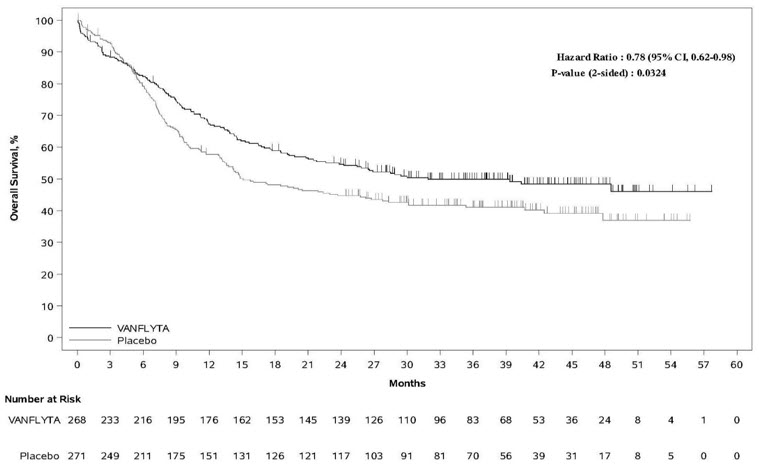
The safety of VANFLYTA (35.4 mg orally once daily with chemotherapy, 26.5 mg to 53 mg orally once daily as maintenance) in adult patients with newly diagnosed FLT3-ITD positive AML is based on QuANTUM-First, a randomized, double-blind clinical trial of VANFLYTA (n=265) or placebo (n=268) with chemotherapy [see Clinical Studies (14)]. Among patients who received VANFLYTA, 38% were exposed for 6 months or longer and 30% were exposed for greater than one year. On the VANFLYTA plus chemotherapy arm, 65% and 44% of patients completed induction and consolidation therapy, respectively, compared to 65% and 34% of patients in the placebo plus chemotherapy arm.
Serious adverse reactions in ≥5% of patients who received VANFLYTA plus chemotherapy were: febrile neutropenia (11%). Fatal adverse reactions occurred in 10% of patients who received VANFLYTA plus chemotherapy, including sepsis (5%), fungal infections (0.8%), brain edema (0.8%), and one case each of febrile neutropenia, pneumonia, cerebral infarction, acute respiratory distress syndrome, pulmonary embolism, ventricular dysfunction, and cardiac arrest.
Permanent discontinuation due to an adverse reaction in patients in the VANFLYTA plus chemotherapy arm occurred in 20% of patients. The most frequent (≥2%) adverse reaction which resulted in permanent discontinuation in the VANFLYTA arm was sepsis (5%).
Dosage interruptions of VANFLYTA due to an adverse reaction occurred in 34% of patients. Adverse reactions which required dosage interruption in ≥2% of patients in the VANFLYTA arm included neutropenia (11%), thrombocytopenia (5%), and myelosuppression (3%).
Dose reductions of VANFLYTA due to an adverse reaction occurred in 19% of patients. Adverse reactions which required dosage reductions in ≥2% of patients in the VANFLYTA arm were neutropenia (9%), thrombocytopenia (5%), and electrocardiogram QT prolonged (4%).
The most common adverse reactions (≥10% with a difference between arms of ≥2% compared to placebo), including laboratory abnormalities, were lymphocytes decreased, potassium decreased, albumin decreased, phosphorus decreased, alkaline phosphatase increased, magnesium decreased, febrile neutropenia, diarrhea, mucositis, nausea, calcium decreased, abdominal pain, sepsis, neutropenia, headache, creatine phosphokinase increased, vomiting, upper respiratory tract infections, hypertransaminasemia, thrombocytopenia, decreased appetite, fungal infections, epistaxis, potassium increased, herpesvirus infections, insomnia, electrocardiogram QT prolonged, magnesium increased, sodium increased, dyspepsia, anemia, and eye irritation.
Tables 5 and 6 summarize adverse reactions and laboratory abnormalities observed in patients receiving VANFLYTA in the clinical trial.
Table 5: Adverse Reactions (≥10%) in Patients with Newly Diagnosed FLT3-ITD positive AML Who Received VANFLYTA (with a Difference Between Arms of ≥2% Compared to Placebo) in the Clinical TrialBody System
Adverse Reaction | VANFLYTA + Chemotherapy
(N=265) | PLACEBO + Chemotherapy
(N=268) |
|---|
All Grades
% | Grade 3 or 4
% | All Grades
% | Grade 3 or 4
% |
|---|
| Blood and Lymphatic System Disorders |
| Febrile neutropenia Including fatalities. | 44 | 43 | 42 | 41 |
| Neutropenia Includes other related terms. | 29 | 26 | 14 | 12 |
| Thrombocytopenia | 18 | 13 | 13 | 12 |
| Anemia | 11 | 6 | 7 | 5 |
| Gastrointestinal Disorders |
| Diarrhea Diarrhea includes colitis, diarrhea, enteritis, enterocolitis, gastroenteritis, and neutropenic colitis. | 42 | 8 | 39 | 8 |
| Mucositis Mucositis includes anal inflammation, anal ulcer, anorectal discomfort, aphthous ulcer, laryngeal inflammation, laryngeal pain, mucosal inflammation, edema mucosal, esophageal pain, esophageal ulcer, esophagitis, oral blood blister, oral disorder, oral mucosa erosion, oral mucosal blistering, oral mucosal erythema, oral pain, oropharyngeal pain, pharyngeal inflammation, proctalgia, proctitis, stomatitis, tongue ulceration, and vaginal ulceration. | 38 | 5 | 33 | 4.1 |
| Nausea | 34 | 1.5 | 31 | 1.9 |
| Abdominal pain | 30 | 2.3 | 22 | 1.1 |
| Vomiting | 25 | 0 | 20 | 1.5 |
| Dyspepsia | 11 | 0.4 | 9 | 0.7 |
| Infections and Infestations |
| Sepsis Sepsis includes acinetobacter infection, bacteremia, bacterial sepsis, corynebacterium bacteremia, device related bacteremia, device related sepsis, enterobacter sepsis, enterococcal bacteremia, enterococcal sepsis, escherichia bacteremia, escherichia sepsis, klebsiella bacteremia, klebsiella sepsis, neutropenic sepsis, pseudomonal bacteremia, pulmonary sepsis, sepsis, septic shock, staphylococcal bacteremia, staphylococcal infection, staphylococcal sepsis, stenotrophomonas sepsis, streptococcal sepsis, and streptococcal bacteremia. , | 30 | 19 | 26 | 20 |
| Upper respiratory tract infection | 21 | 2.6 | 12 | 3 |
| Fungal infection Fungal infection includes aspergillosis oral, aspergillus infection, bronchopulmonary aspergillosis, candida infection, candida sepsis, fungal infection, fungal sepsis, fungal skin infection, fusarium infection, gastrointestinal candidiasis, hepatic infection fungal, hepatosplenic candidiasis, lower respiratory tract infection fungal, mucormycosis, oral candidiasis, oral fungal infection, oropharyngeal candidiasis, systemic candida, systemic mycosis, tinea cruris, and vulvovaginal candidiasis. , | 16 | 6 | 10 | 3 |
| Herpesvirus infection Herpesvirus infection includes disseminated varicella zoster virus infection, genital herpes, herpes simplex, herpesvirus infection, herpes zoster, oral herpes, and varicella zoster virus infection. | 14 | 2.6 | 8 | 1.9 |
| Nervous System Disorders |
| Headache | 28 | 0 | 20 | 0.7 |
| Hepatobiliary disorders |
| Hypertransaminasemia Hypertransaminasemia includes alanine aminotransferase increased, aspartate aminotransferase increased, transaminases increased, hepatic enzymes increased, and hypertransaminasemia. | 19 | 7 | 14 | 6 |
| Metabolism and Nutrition Disorders |
| Decreased appetite | 17 | 4.9 | 13 | 1.9 |
| Respiratory, Thoracic and Mediastinal Disorders |
| Epistaxis | 15 | 1.1 | 11 | 0.4 |
| Psychiatric Disorders |
| Insomnia | 14 | 0 | 11 | 0 |
| Investigations |
| Electrocardiogram QT prolonged | 14 | 3 | 4.1 | 1.1 |
| Eye Disorders |
| Eye irritation Eye irritation includes dry eye, eye inflammation, eye irritation, eye pain, eye pruritus, foreign body sensation in eyes, keratitis, and ulcerative keratitis. | 11 | 0 | 7 | 0 |
Laboratory Abnormalities
Prolonged thrombocytopenia or neutropenia in the absence of active leukemia lasting past cycle day 42 of induction cycle 1 were noted in 8% of patients on the VANFLYTA plus chemotherapy arm and 4% of patients in the placebo plus chemotherapy arm.
Table 6: Select Laboratory Abnormalities (≥10%) That Worsened from Baseline in Patients with Newly Diagnosed FLT3-ITD positive AML (with a Difference Between Arms of ≥2% Compared to Placebo) in the Clinical Trial| Laboratory Abnormality | VANFLYTA + Chemotherapy The denominator used to calculate the rate varied from 199 to 260 in VANFLYTA + Chemotherapy and from 187 to 267 in PLACEBO + Chemotherapy based on the number of patients with a baseline value and at least one post-treatment value. | PLACEBO + Chemotherapy |
|---|
| All Grades% | Grades 3 or 4% | All Grades% | Grades 3 or 4% |
|---|
| Lymphocytes decreased | 60 | 57 | 55 | 51 |
| Potassium decreased | 59 | 22 | 56 | 18 |
| Albumin decreased | 53 | 1.6 | 45 | 4.3 |
| Phosphorus decreased | 52 | 22 | 48 | 19 |
| Alkaline phosphatase increased | 51 | 1.6 | 47 | 1.9 |
| Magnesium decreased | 44 | 2 | 42 | 1.1 |
| Calcium decreased | 33 | 2.4 | 27 | 1.6 |
| Creatine phosphokinase increased | 26 | 2.5 | 7 | 0.5 |
| Potassium increased | 15 | 1.2 | 11 | 0.8 |
| Magnesium increased | 14 | 2.8 | 9 | 1.2 |
| Sodium increased | 13 | 0 | 10 | 0.4 |
Other Clinical Trials
Clinically relevant adverse reactions in <10% of patients who received quizartinib for relapsed or refractory FLT3-ITD positive AML, an indication for which VANFLYTA is not approved, included differentiation syndrome (5%) and acute febrile neutrophilic dermatosis (3%).
Risk Summary
Based on findings from animal studies and its mechanism of action, VANFLYTA can cause embryo-fetal harm when administered to a pregnant woman [see Clinical Pharmacology (12.1)].
There are no available data on VANFLYTA use in pregnant women to evaluate for a drug-associated risk. In animal reproduction studies, oral administration of quizartinib to pregnant rats during organogenesis resulted in adverse developmental outcomes including structural abnormalities and alterations to growth at maternal exposures approximately 3 times those in patients at the maximum recommended human dose (MRHD) of 53 mg/day (see Data). Advise pregnant women of the potential risk to a fetus.
The background risk in the U.S. general population of major birth defects is 2-4%, and of miscarriage is 15-20% of clinically recognized pregnancies.
Data
Animal Data
In an embryo-fetal development study in rats, pregnant animals received oral doses of quizartinib of 0, 0.6, 2, or 6 mg/kg/day during the period of organogenesis. Administration of quizartinib at the dose of 6 mg/kg/day was associated with adverse developmental outcomes including structural abnormalities (anasarca and edema) and alterations to growth (lower fetal weights and effects on skeletal ossification). At this dose, the maternal systemic exposures (AUC) were approximately 3 times the human exposure at the MRHD of 53 mg/day.
Risk Summary
There are no data on the presence of quizartinib or its metabolites in human milk, or the effects on the breastfed child or milk production. Because of the potential for serious adverse reactions in a breastfed child, advise women not to breastfeed during treatment with VANFLYTA and for one month after the last dose.
Pregnancy Testing
Verify pregnancy status in females of reproductive potential within seven days before starting treatment with VANFLYTA.
Contraception
Females
Advise female patients of reproductive potential to use effective contraception during treatment with VANFLYTA and for 7 months after the last dose.
Males
Based on genotoxicity findings, advise male patients with female partners of reproductive potential to use effective contraception during treatment with VANFLYTA and for 4 months after the last dose [see Nonclinical Toxicology (13.1)].
Infertility
Females
Based on findings from animal studies, VANFLYTA may impair female fertility. These effects on fertility were reversible [see Nonclinical Toxicology (13.1)].
Males
Based on findings from animal studies, VANFLYTA may impair male fertility. These effects on fertility were reversible [see Nonclinical Toxicology (13.1)].
Cardiac Electrophysiology
In vitro studies have shown that quizartinib is a predominant inhibitor of the slow delayed rectifier potassium current, IKs.
The exposure-response analysis predicted a concentration-dependent QTcF interval median prolongation of 18 and 24 ms [upper bound of 2-sided 90% confidence interval (CI): 21 and 27 ms] at the median steady-state Cmax of quizartinib at the 26.5 mg and 53 mg dose level during maintenance therapy [see Warnings and Precautions (5.1) and Drug Interactions (7)].
Absorption
The mean (SD) absolute bioavailability of quizartinib from the tablet formulation was 71% (±7%) in healthy subjects. After oral administration under fasted conditions, time to peak concentration (median Tmax) of quizartinib and AC886 measured post dose was approximately 4 hours (range 2 to 8 hours) and 5 to 6 hours (range 4 to 120 hours), respectively, in healthy subjects.
No clinically significant differences in the pharmacokinetics of quizartinib were observed when administered with a high-fat, high-calorie meal.
Distribution
Volume of distribution at steady state in healthy subjects was estimated to be 275 L (17%).
In vitro plasma protein binding of quizartinib and AC886 is 99% or greater.
In vitro blood-to-plasma ratio for quizartinib and AC886 ranges from 0.79-1.30 and 1.36-3.19, respectively.
Elimination
Total body clearance of quizartinib in healthy subjects was estimated to be 2.23 L/hour (29%).
The mean (SD) effective half-lives (t1/2) in patients with newly diagnosed AML for quizartinib and AC886 during maintenance therapy are 81 hours (±73) and 136 hours (±113), respectively.
Metabolism
In vitro quizartinib is primarily metabolized via oxidation by CYP3A4/5 and AC886 is formed and metabolized by CYP3A4/5.
Excretion
Following a single radiolabeled dose of quizartinib 53 mg to healthy subjects, 76.3% of the total radioactivity was recovered in feces (4% unchanged) and 1.64% in urine.
Specific Populations
There were no clinically significant differences in the exposure of quizartinib and AC886 based on age (range 18 to 91 years), sex, race (White 65%, Asian 18%, Black or African American 9%), or body weight (range 37 to 153 kg).
Patients with Renal Impairment
Mild or moderate renal impairment (i.e., estimated creatinine clearance [CLcr] by Cockcroft-Gault equation: 30 to 89 mL/min) were not associated with clinically significant differences in the exposure of quizartinib and AC886.
The impact of severe renal impairment (CLcr <30 mL/min) on the pharmacokinetics of quizartinib and AC886 is unknown [see Use in Specific Populations (8.6)].
Patients with Hepatic Impairment
Mild (total bilirubin ≤ upper limit of normal [ULN] and aspartate aminotransferase [AST] >ULN or total bilirubin >1 to 1.5 times ULN and any value for AST) or moderate (total bilirubin >1.5 to 3 times ULN and any value for AST) hepatic impairment were not associated with clinically significant differences in the exposure of quizartinib and AC886.
The impact of severe hepatic impairment (Child-Pugh Class C or total bilirubin >3 times ULN and any value for AST) on the pharmacokinetics of quizartinib and AC886 is unknown [see Use in Specific Populations (8.7)].
Drug Interaction Studies and Model-Informed Approaches
Clinical Studies
Strong CYP3A Inhibitors
The AUC of quizartinib increased by 94% and the Cmax by 17% following coadministration of a single 53 mg quizartinib dose with ketoconazole (a strong CYP3A inhibitor). The AUCinf of AC886 decreased by 94% and Cmax by 60%.
Moderate CYP3A Inhibitors
A clinically significant change in quizartinib and AC886 exposure (Cmax and AUCinf) was not observed following coadministration of a single quizartinib dose with fluconazole (a moderate CYP3A inhibitor).
Strong or Moderate CYP3A Inducers
The AUCinf of quizartinib decreased by 90% and Cmax by 45% following concomitant use of a single 53 mg dose of quizartinib with efavirenz (a moderate CYP3A inducer). The AUC of AC886 decreased by 96% and the Cmax by 68%. The effect of concomitant use with a strong CYP3A inducer may result in even greater effect on quizartinib pharmacokinetics based on mechanistic understanding of the drugs involved.
Gastric Acid Reducing Agents
No clinically significant differences in quizartinib pharmacokinetics were observed when used concomitantly with lansoprazole (a proton pump inhibitor that reduces gastric acid).
Other Drugs
There were no clinically significant differences in the pharmacokinetics of P-gp substrates (dabigatran etexilate) or UGT1A1 substrates (raltegravir) when used concomitantly with quizartinib.
In Vitro Studies
Cytochrome P450 (CYP) Enzymes
Quizartinib does not inhibit CYP1A2, CYP2B6, CYP2C8, CYP2C9, CYP2C19, CYP2D6, or CYP3A4. Quizartinib does not induce CYP3A4, CYP1A2, or CYP2B6.
AC886 does not inhibit CYP1A2, CYP2B6, CYP2C8, CYP2C9, CYP2D6, CYP2C19, or CYP3A4. AC886 does not induce CYP3A4, CYP1A2, or CYP2B6.
Quizartinib is a substrate for P-gp but not for BCRP, OATP1B1, OATP1B3, OCT1, OAT2, MATE1, or MRP2. AC886 is a substrate for BCRP but not for OATP1B1, OATP1B3, MATE1, or MRP2.
Other Metabolic Pathways: Quizartinib inhibits UGT1A1.
QT Prolongation, Torsades de Pointes, and Cardiac Arrest
Inform patients of symptoms that may be associated with significant QTc interval prolongation including dizziness, lightheadedness, and fainting. Advise patients to report these symptoms and the use of all medications to their healthcare provider [see Warnings and Precautions (5.1)].
VANFLYTA REMS
VANFLYTA is available only through a restricted program called the VANFLYTA REMS. Inform patients that they will be given a VANFLYTA Patient Wallet Card that they should carry with them at all times and show to all of their healthcare providers. This card describes signs and symptoms related to QT prolongation/cardiac arrhythmia which, if experienced, should prompt the patient to immediately seek medical attention [see Warnings and Precautions (5.2)].
Drug Interactions
Advise patients to inform their healthcare providers of all concomitant medications, including over-the-counter medications, vitamins, and herbal products. Advise patients to avoid concomitant use of St. John's wort as it is a strong CYP3A inducer [see Drug Interactions (7)].
Embryo-Fetal Toxicity and Use of Contraceptives
Advise pregnant women of the potential risk to the fetus. Advise female patients of reproductive potential to use effective contraception during treatment with VANFLYTA and for 7 months after the last dose. Advise patients to notify their healthcare provider immediately in the event of a pregnancy or if pregnancy is suspected during VANFLYTA treatment. Advise male patients with female partners of reproductive potential to use effective contraception during treatment with VANFLYTA and for 4 months after the last dose [see Warnings and Precautions (5.3) and Use in Specific Populations (8.1, 8.3)].
Infertility
Advise females and males of reproductive potential that VANFLYTA may impair fertility [see Use in Specific Populations (8.3) and Nonclinical Toxicology (13.1)].
Lactation
Advise women not to breastfeed during treatment with VANFLYTA and for one month after the last dose [see Use in Specific Populations (8.2)].
Dosing and Storage Instructions
- Advise patients that VANFLYTA should be taken once daily at approximately the same time each day and may be taken with or without food.
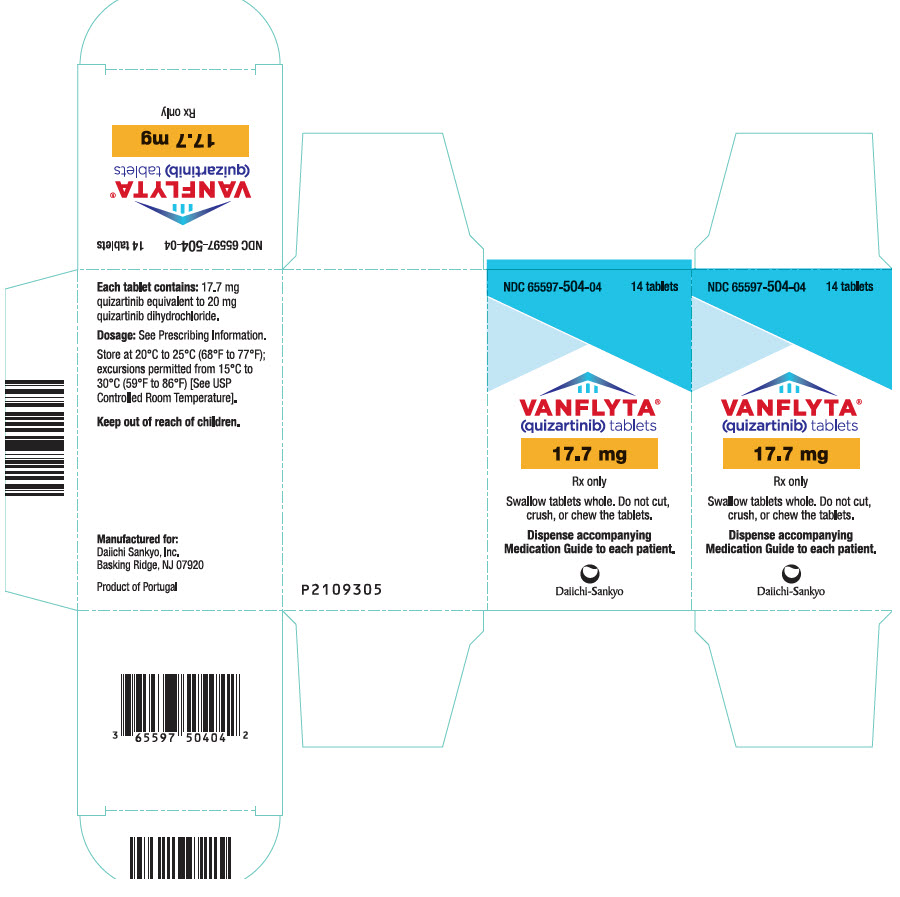
- Advise patients to swallow tablets whole. Advise patients not to cut, crush, or chew the tablets [see Dosage and Administration (2.2)].
- Instruct patients that if a dose of VANFLYTA is vomited, not to take an additional dose that day, and to wait until the next scheduled dose on the following day. If a dose of VANFLYTA is missed or not taken at the usual time, instruct patients to take the dose as soon as possible on the same day and return to the usual dosing schedule the following day.
- Store VANFLYTA at room temperature from 20°C to 25°C (68°F to 77°F).
Manufactured for:
Daiichi Sankyo, Inc., Basking Ridge, NJ 07920
VANFLYTA® is a registered trademark of Daiichi Sankyo Company, Ltd.
Copyright © 2023, Daiichi Sankyo, Inc.
USPI-VAN-C1-0723-r001