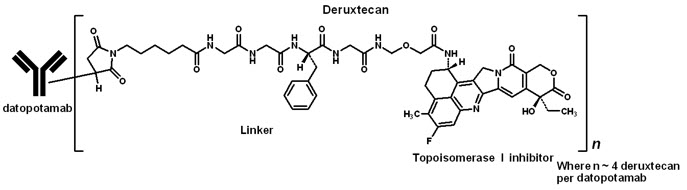
- The maximum time from reconstitution of the vial through the end of administration should not exceed 24 hours. Discard if storage time exceeds these limits.
- If the prepared infusion solution was stored refrigerated at 2°C to 8°C (36°F to 46°F), allow the solution to reach room temperature prior to administration, protected from light.
- Parenteral drug products should be inspected visually for particulate matter and discoloration prior to administration whenever solution and container permit.
- Administer DATROWAY as an intravenous infusion only with an infusion line and tubing set made of polyvinyl chloride, polybutadiene or low-density polyethylene.
- Administer DATROWAY with a 0.2-micron in-line polytetrafluoroethylene, polyethersulfone or nylon 66 filter.
- Do NOT administer as an intravenous push or bolus.
- Cover the infusion bag to protect from light during administration.
- Do not mix DATROWAY with other drugs or administer other drugs through the same intravenous line.
- Instruct the patient to hold ice chips or ice water in the mouth throughout the infusion of DATROWAY.
- First infusion: Administer infusion over 90 minutes. Observe patients during the infusion and for at least 1 hour following the initial dose for signs or symptoms of infusion-related reactions.
- Second Infusion: If first infusion was tolerated, administer second infusion over 30 minutes. Observe patients during the infusion and for at least 1 hour after infusion.
- Subsequent Infusions: Administer infusion over 30 minutes if prior infusions were tolerated. Observe patients during the infusion and for at least 30 min after infusion.
Unresectable or Metastatic, HR-Positive, HER2-Negative Breast Cancer
TROPION-Breast01
The safety of DATROWAY was evaluated in 360 patients with unresectable or metastatic HR-positive, HER2-negative (IHC 0, IHC1+ or IHC2+/ISH-) breast cancer who received at least one dose of DATROWAY 6 mg/kg in TROPION-Breast01 [see Clinical Studies (14.1)]. DATROWAY was administered by intravenous infusion once every three weeks. The median duration of treatment was 6.7 months (range: 0.7 months to 16.1 months) for patients who received DATROWAY.
Serious adverse reactions occurred in 15% of patients who received DATROWAY. Serious adverse reactions in >0.5% of patients who received DATROWAY were urinary tract infection (1.9%), COVID-19 infection (1.7%), ILD/pneumonitis (1.1%), acute kidney injury, pulmonary embolism, vomiting, diarrhea, hemiparesis, and anemia (0.6% each). Fatal adverse reactions occurred in 0.3% of patients who received DATROWAY and were due to ILD/pneumonitis.
Permanent discontinuation of DATROWAY due to an adverse reaction occurred in 3.1% of patients. Adverse reactions which resulted in permanent discontinuation of DATROWAY in >0.5% of patients included ILD/pneumonitis (1.7%) and fatigue (0.6%).
Dosage interruptions of DATROWAY due to an adverse reaction occurred in 22% of patients. Adverse reactions which required dosage interruption in >1% of patients included COVID-19 (3.3%), infusion-related reaction (1.4%), ILD/pneumonitis (1.9%), stomatitis (1.9%), fatigue (1.7%), keratitis (1.4%), acute kidney injury (1.1%), and pneumonia (1.1%).
Dose reductions of DATROWAY due to an adverse reaction occurred in 23% of patients. Adverse reactions which required dose reduction in >1% of patients included stomatitis (13%), fatigue (3.1%), nausea (2.5%), and weight decrease (1.9%).
The most common (≥20%) adverse reactions, including laboratory abnormalities, were stomatitis, nausea, fatigue, decreased leukocytes, decreased calcium, alopecia, decreased lymphocytes, decreased hemoglobin, constipation, decreased neutrophils, dry eye, vomiting, increased ALT, keratitis, increased AST, and increased alkaline phosphatase.
Table 4: Adverse Reactions (≥10%) in Patients Who Received DATROWAY in TROPION-Breast01| Adverse Reactions | DATROWAY
N=360 | Chemotherapy
N=351 |
|---|
All Grades
% | Grades 3 or 4
% | All Grades
% | Grades 3 or 4
% |
|---|
| Events were graded using NCI CTCAE v5.0. |
| Gastrointestinal Disorders |
| Stomatitis Includes other related terms. | 59 | 7 | 17 | 2.6 |
| Nausea | 56 | 1.4 | 27 | 0.6 |
| Constipation | 34 | 0.3 | 17 | 0 |
| Vomiting | 24 | 1.1 | 12 | 1.1 |
| Diarrhea | 11 | 0.6 | 19 | 1.4 |
| Abdominal pain | 11 | 0.6 | 15 | 1.4 |
| General Disorders and Administration Site Conditions |
| Fatigue Includes fatigue, asthenia, lethargy, malaise | 44 | 4.2 | 40 | 3.7 |
| Skin and Subcutaneous Tissue Disorders |
| Alopecia | 38 | 0 | 22 | 0 |
| Rash | 19 | 0 | 17 | 2.3 |
| Eye Disorders |
| Dry eye | 27 | 0.8 | 13 | 0 |
| Keratitis Includes corneal disorder, corneal erosion, corneal infiltrates, corneal lesion, corneal toxicity, injury corneal, keratitis, keratopathy, punctate keratitis, and ulcerative keratitis | 24 | 1.1 | 10 | 0 |
| Metabolism and Nutrition Disorders |
| Decreased appetite | 16 | 1.4 | 16 | 0.9 |
| Infections and Infestations |
| COVID-19 | 16 | 1.4 | 13 | 0.9 |
| Respiratory, Thoracic, and Mediastinal Disorders |
| Cough | 15 | 0 | 10 | 0 |
Clinically relevant adverse reactions occurring in <10% of patients who received DATROWAY included infusion-related reactions (including bronchospasm), ILD/pneumonitis, headache, pruritus, dry skin, dry mouth, conjunctivitis, blepharitis, meibomian gland dysfunction, blurred vision, increased lacrimation, photophobia, visual impairment, skin hyperpigmentation, and madarosis.
Table 5: Select Laboratory Abnormalities (≥20%) in Patients Who Received DATROWAY in TROPION-Breast01| Laboratory Abnormality | DATROWAY The denominator used to calculate the rate varied from 264 to 359 based on the number of patients with a baseline value and at least one post-treatment value. | Chemotherapy |
|---|
All Grades
% | Grades 3-4
% | All Grades
% | Grades 3-4
% |
|---|
| Frequencies were based on NCI CTCAE v5.0 grade-derived laboratory abnormalities. |
| Hematology |
| Decreased leukocytes | 41 | 1.1 | 63 | 18 |
| Decreased lymphocytes | 36 | 9 | 42 | 11 |
| Decreased hemoglobin | 35 | 2.8 | 51 | 4.4 |
| Decreased neutrophils | 30 | 1.6 | 61 | 35 |
| Chemistry |
| Decreased calcium | 39 | 1.4 | 43 | 1.2 |
| Increased AST | 23 | 1.9 | 28 | 0.9 |
| Increased ALT | 24 | 1.7 | 31 | 0.6 |
| Increased alkaline phosphatase | 23 | 0.6 | 20 | 0.6 |
Risk Summary
Based on its mechanism of action, DATROWAY can cause embryo-fetal harm when administered to a pregnant woman because the topoisomerase inhibitor component of DATROWAY, DXd, is genotoxic and affects actively dividing cells [see Clinical Pharmacology (12.1), Nonclinical Toxicology (13.1)]. There are no available data on the use of DATROWAY in pregnant women to inform a drug-associated risk. Advise patients of the potential risks to a fetus.
In the U.S. general population, the estimated background risk of major birth defects and miscarriage in clinically recognized pregnancies is 2 to 4% and 15 to 20%, respectively.
Data
Animal Data
There were no animal reproductive or developmental toxicity studies conducted with datopotamab deruxtecan-dlnk.
Risk Summary
There are no data regarding the presence of datopotamab deruxtecan-dlnk or its metabolites in human milk, the effects on the breastfed child, or the effects on milk production. Because of the potential for serious adverse reactions in a breastfed child, advise women not to breastfeed during treatment with DATROWAY and for 1 month after the last dose.
Pregnancy Testing
Verify pregnancy status of females of reproductive potential prior to initiation of DATROWAY.
Contraception
Females
Advise females of reproductive potential to use effective contraception during treatment with DATROWAY and for 7 months after the last dose.
Males
Because of the potential for genotoxicity, advise male patients with female partners of reproductive potential to use effective contraception during treatment with DATROWAY and for 4 months after the last dose [see Nonclinical Toxicology (13.1)].
Infertility
Based on findings in animal toxicity studies, DATROWAY may impair male and female reproductive function and fertility. The effects on reproductive organs in animals were irreversible [see Nonclinical Toxicology (13.1)].
Exposure-Response Relationships
A relationship between datopotamab deruxtecan-dlnk exposure and efficacy has not been fully characterized in breast cancer.
Higher datopotamab deruxtecan-dlnk systemic exposure is associated with a higher incidence rate of serious adverse reactions, dosage interruptions, dose reductions, stomatitis/oral mucositis, ocular adverse reactions, and Grade ≥3 adverse reactions.
Cardiac Electrophysiology
At datopotamab deruxtecan-dlnk doses up to 10 mg/kg (1.7 times the recommended dose), mean increase in the QTc interval >20 ms was not observed.
Distribution
Datopotamab deruxtecan-dlnk mean steady state volume of distribution is 3.5 (23%) L.
DXd plasma protein binding is approximately 98% and the blood-to-plasma concentration ratio is 0.6 in vitro.
Elimination
The datopotamab deruxtecan-dlnk median elimination half-life (t1/2) is 4.8 days (1.0, 8.2) and the released DXd median apparent t1/2 is approximately 5.5 days (3.2, 8.8). The estimated datopotamab deruxtecan-dlnk clearance is 0.6 (31.5%) L/day.
Metabolism
Datopotamab deruxtecan-dlnk undergoes intracellular cleavage by lysosomal enzymes to release DXd.
The humanized Trop-2 IgG1 monoclonal antibody is expected to be degraded into small peptides and amino acids via catabolic pathways in the same manner as endogenous IgG.
In vitro, DXd is primarily metabolized by CYP3A4.
Specific Populations
The mean volume of distribution and clearance of datopotamab deruxtecan-dlnk and DXd increase with increasing body weight (36 kg to 156 kg).
No clinically significant differences in the pharmacokinetics of datopotamab deruxtecan-dlnk or DXd were observed based on age (26 to 86 years), race (Asian, White, or Black), sex, mild hepatic impairment (total bilirubin ≤ULN and any AST >ULN or total bilirubin >1 to 1.5 times ULN and any AST), or mild to moderate renal impairment (CLcr 30 to <90 mL/min).
The pharmacokinetics of datopotamab deruxtecan-dlnk in patients with moderate hepatic impairment (total bilirubin >1.5 to 3 times ULN and any AST) was comparable to patients with normal hepatic function (total bilirubin and AST ≤ULN). The steady state average DXd AUC was 2.4-fold higher in patients with moderate hepatic impairment compared to patients with normal hepatic function. The effect of severe hepatic impairment (total bilirubin >3 times ULN and any AST) or severe renal impairment (CLcr <30 mL/min) on datopotamab deruxtecan-dlnk or DXd pharmacokinetics is unknown.
Drug Interaction Studies
Clinical Studies and Model-Informed Approaches
No clinically significant differences in DXd pharmacokinetics were predicted when used concomitantly with itraconazole (strong CYP3A inhibitor) or ritonavir (dual OATP1B and CYP3A inhibitor).
In Vitro Studies
CYP450 Enzymes: DXd does not inhibit CYP1A2, CYP2B6, CYP2C8, CYP2C9, CYP2C19, CYP2D6, or CYP3A and does not induce CYP1A2, CYP2B6, or CYP3A.
UDP-Glucuronosyltransferase (UGT): DXd does not undergo significant metabolism by UGT enzymes.
Transporters Systems: DXd is a substrate of OATP1B1, OATP1B3, MATE2-K, P-gp, MRP1, and BCRP. DXd does not inhibit OAT1, OAT3, OCT1, OCT2, OATP1B1, OATP1B3, MATE1, MATE2-K, P-gp, BCRP, or BSEP transporters.
TROPION-Breast01
The efficacy of DATROWAY was evaluated in TROPION-Breast01 (NCT05104866), a multicenter, open-label, randomized trial of 732 patients with unresectable or metastatic HR-positive, HER2-negative (IHC 0, IHC1+ or IHC2+/ISH-) breast cancer. Eligible patients must have progressed on and deemed not suitable for further endocrine therapy. Patients were required to have received 1 or 2 lines of prior chemotherapy in the unresectable or metastatic disease setting. Patients were excluded for a history of ILD/pneumonitis requiring treatment with steroids, ongoing ILD/pneumonitis, clinically active brain metastases, or clinically significant corneal disease at screening. Patients were also excluded for ECOG performance status >1. Randomization was stratified by previous lines of chemotherapy (one or two), prior treatment with a CDK4/6 inhibitor (yes or no), and geographical region.
A total of 732 patients were randomized 1:1 to receive either DATROWAY 6 mg/kg (N=365) by intravenous infusion every 3 weeks or investigator's choice of chemotherapy (N=367) until unacceptable toxicity or disease progression. Single agent chemotherapy was determined by the investigator before randomization from one of the following choices: eribulin (60%), capecitabine (21%), vinorelbine (10%), or gemcitabine (9%).
The major efficacy outcomes were progression-free survival (PFS) as assessed by blinded independent central review (BICR) based on Response Evaluation Criteria in Solid Tumors (RECIST) v.1.1 and overall survival (OS). Additional efficacy outcomes included confirmed objective response rate (ORR) and duration of response (DOR) by BICR.
The median age was 55 years (range 28-86); 22% were ≥65 years; 99% were female; 48% were White, 41% were Asian, 1.5% were Black or African American, and 11% were of Hispanic/Latino ethnicity; 57% had ECOG PS of 0 and 42% had ECOG PS of 1; 97% had visceral disease, 72% had liver metastases, and 8% had stable brain metastases.
Sixty percent (60%) of patients received prior endocrine therapy in the (neo)adjuvant setting, and 89% received prior endocrine therapy in the unresectable or metastatic setting. Eighty-three percent (83%) of patients had prior treatment with a CDK4/6 inhibitor. All patients received prior chemotherapy regimens in the unresectable or metastatic setting (81% received prior taxanes; 64% received prior anthracyclines). Sixty-two percent (62%) of patients had 1 prior chemotherapy regimen and 38% of patients had 2 prior chemotherapy regimens for treatment of unresectable or metastatic disease.
The study demonstrated a statistically significant improvement in PFS in patients randomized to DATROWAY compared to chemotherapy.
Efficacy results are shown in Table 7 and Figure 1.
Table 7: Efficacy Results in TROPION-Breast01 | DATROWAY
(n=365) | Chemotherapy
(n=367) |
|---|
| CI: Confidence interval; NS: not statistically significant |
| Progression-Free Survival Assessed by BICR |
| Number of events (%) | 212 (58) | 235 (64) |
| Progressive Disease | 201 (55) | 218 (59) |
| Death | 11 (3) | 17 (5) |
| Median, months (95% CI) | 6.9 (5.7, 7.4) | 4.9 (4.2, 5.5) |
| Hazard ratio (95% CI) Based on the stratified Cox proportional hazards model | 0.63 (0.52, 0.76) |
| p-value Two-sided p-value based on stratified log-rank test. , p-value is compared with the allocated alpha of 0.01. | < 0.0001 |
| Overall Survival |
| Number of events (%) | 223 (61) | 213 (58) |
| Median, months (95% CI) | 18.6 (17.3, 20.1) | 18.3 (17.3, 20.5) |
| Hazard ratio (95% CI) | 1.01 (0.83, 1.22) |
| p-value | NS |
| Confirmed Objective Response Rate |
| n (%) | 133 (36) | 84 (23) |
| (95% CI) | 31, 42 | 19, 28 |
| Complete Response n (%) | 2 (0.5) | 0 |
| Partial Response n (%) | 131 (36) | 84 (23) |
| Duration of Response |
| Median, months (95% CI) | 6.7 (5.6, 9.8) | 5.7 (4.9, 6.8) |
| Figure 1: Kaplan-Meier Plot of PFS by BICR in TROPION-Breast-01 |
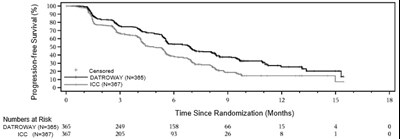 Figure 1 (Datopotamab 02) |
How Supplied
DATROWAY (datopotamab deruxtecan-dlnk) for injection is a white to yellowish white lyophilized powder supplied as:
| Carton Contents | NDC |
|---|
| One 100 mg single-dose vial | NDC 65597-801-01 |
Interstitial Lung Disease/Pneumonitis
- Inform patients of the risks of severe or fatal ILD. Advise patients to contact their healthcare provider immediately for any of the following: cough, shortness of breath, fever, or other new or worsening respiratory symptoms [see Warnings and Precautions (5.1)].
Ocular Adverse Reactions
- Inform patients about the need for eye exams at initiation and during treatment with DATROWAY [see Dosage and Administration (2.2)].
- Advise patients to contact their healthcare provider if they experience any eye symptoms [see Warnings and Precautions (5.2)].
- Advise patients to use preservative-free lubricating eye drops several times daily and to avoid use of contact lenses during treatment with DATROWAY [see Dosage and Administration (2.2, 2.3)].
Stomatitis
- Inform patients of the risk of stomatitis. Advise patients to contact their healthcare provider if they experience any symptoms.
- Inform patients to use a steroid-containing mouthwash for prophylaxis and treatment of stomatitis.
- Instruct patients to hold ice chips or ice water in their mouth throughout the infusion of DATROWAY [see Warnings and Precautions (5.3)].
Embryo-Fetal Toxicity
- Inform female patients of the potential risk to a fetus. Advise female patients to inform their healthcare provider of a known or suspected pregnancy [see Warnings and Precautions (5.4), Use in Specific Populations (8.1)].
- Advise females of reproductive potential to use effective contraception during treatment with DATROWAY and for 7 months after the last dose [see Use in Specific Populations (8.3)].
- Advise male patients with female partners of reproductive potential to use effective contraception during treatment with DATROWAY and for 4 months after the last dose [see Use in Specific Populations (8.3)].
Lactation
- Advise women not to breastfeed during treatment and for 1 month after the last dose of DATROWAY [see Use in Specific Populations (8.2)].
Infertility
- Advise males and females of reproductive potential that DATROWAY may impair fertility [see Use in Specific Populations (8.3)].
Manufactured by:
Daiichi Sankyo, Inc., Basking Ridge, NJ 07920
U.S. License No. 2128
Marketed by:
Daiichi Sankyo, Inc., Basking Ridge, NJ 07920 and AstraZeneca Pharmaceuticals LP, Wilmington, DE 19850
DATROWAY® is a registered trademark of Daiichi Sankyo Company, Ltd.
© 2025 Daiichi Sankyo Co., Ltd.
USPI-DAT-C6-0125-r001