Levetiracetam Tablet, Film Coated
Product Images NDC 65862-247

View Photos of Packaging, Regulatory Labels, and Product Appearance

Product Visual Gallery

This gallery contains 11 technical images submitted to the FDA as part of the official labeling for Levetiracetam (NDC 65862-247). Unlike standard consumer photos, these assets often include clinical data figures, molecular chemical structures, and official manufacturer packaging layouts.

As provided by Aurobindo Pharma Limited, these visuals offer a comprehensive scientific overview of the product's physical and chemical identity, aiding pharmacists and researchers in product verification and study.

FDA Label Image

Figure 1: Responder Rate (≥50% Reduction From Baseline) In Study 1 (Levetiracetam Fig1)

Figure 1: Responder Rate (≥50% Reduction From Baseline) In Study 1 (Levetiracetam Fig1)
The figure shows the responder rate in Study 1 with a 250% reduction from baseline. There was a statistically significant difference between treatment and placebo groups. The percentages of responder rate range from 0% to 39.6%. The text "et Leveiacl 100 ooy Leviaseam 000 oy" is not understandable and might be a result of error.*
FDA Label Image

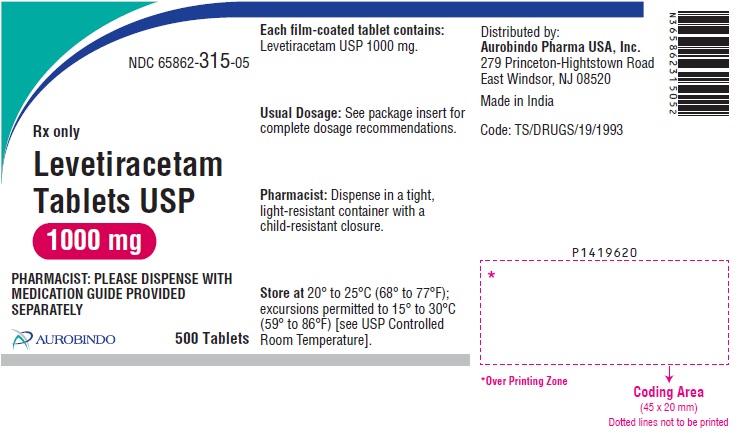
Package Label-principal Display Panel (1000 mg (500 Tablets Bottle))

Package Label-principal Display Panel (1000 mg (500 Tablets Bottle))
Each tablet of this medicine contains 1000 mg of Levetiracetam USP and it is distributed by Aurobindo Pharma USA, Inc. The tablets have a child-resistant closure and the usual dosage should be seen in the package insert. The medication guide provided should be stored separately at a temperature of 20° to 25°C (68° to 77°F), with excursions permitted to 15° to 30°C (59° to 86°F). This medicine is made in India and its NDC code is 65862-315-05. The code TS/DRUGS9/4993 is printed on it.*
FDA Label Image

Figure 2: Responder Rate (≥50% Reduction From Baseline) In Study 2: Period A (Levetiracetam Fig2)

Figure 2: Responder Rate (≥50% Reduction From Baseline) In Study 2: Period A (Levetiracetam Fig2)
The text suggests a figure depicting the "Responder Rate" in Study 2, during "Period A", which involves a comparison of the effects of a placebo treatment versus levetiracetam treatments of different dosages in patients. The text also indicates the percentages of patients who responded to each treatment (with a 250% reduction rate from baseline), and it notes that the response rate for the 2000 mg/day dosage of levetiracetam is "statistically significant versus placebo".*
FDA Label Image

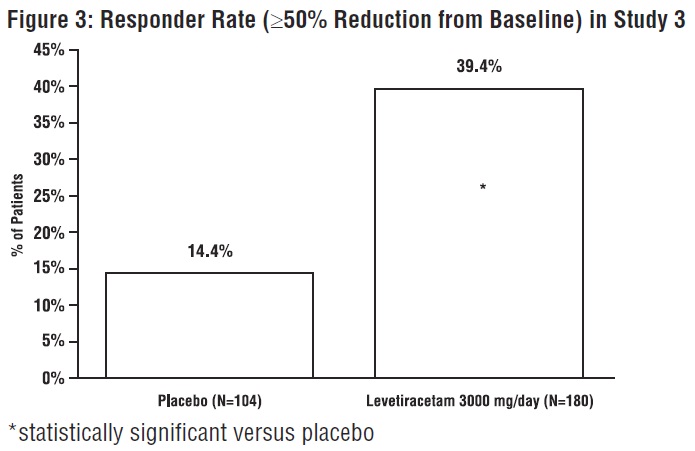
Figure 3: Responder Rate (≥50% Reduction From Baseline) In Study 3 (Levetiracetam Fig3)

Figure 3: Responder Rate (≥50% Reduction From Baseline) In Study 3 (Levetiracetam Fig3)
The figure shows the responder rates (>50% reduction from baseline) in Study 3. The responder rate for placebo was 14.4% while for levetiracetam 3000 mg/day, it was 39.4% which was statistically significant compared to placebo.*
FDA Label Image

Figure 4: Responder Rate (≥ 50% Reduction From Baseline) In Study 4 (Levetiracetam Fig4)

Figure 4: Responder Rate (≥ 50% Reduction From Baseline) In Study 4 (Levetiracetam Fig4)
The text describes the Responder Rate in Study 4, showing a 50% reduction from baseline in two groups. The placebo group had 97 participants and the levetiracetam group had 101 participants. A statistically significant difference was observed between the two groups. The percentage of responders in the levetiracetam group was 44.6% while in the placebo group it was 19.6%.*
FDA Label Image

Figure 5: Responder Rate For All Patients Ages 1 Month To < 4 Years (≥ 50% Reduction From Baseline) In Study 5 (Levetiracetam Fig5)

Figure 5: Responder Rate For All Patients Ages 1 Month To < 4 Years (≥ 50% Reduction From Baseline) In Study 5 (Levetiracetam Fig5)
The figure shows the Responder Rate for patients aged 1 month to less than 4 years in Study 5, indicating a greater than 50% reduction from baseline. The data suggests that Lovetracatam had a statistically significant effect compared to placebo.*
FDA Label Image

Figure 6: Responder Rate (≥50% Reduction From Baseline) In Pgtc Seizure Frequency Per Week In Study 7 (Levetiracetam Fig6)

Figure 6: Responder Rate (≥50% Reduction From Baseline) In Pgtc Seizure Frequency Per Week In Study 7 (Levetiracetam Fig6)
The figure shows the Responder Rate in PGTC Seizure Frequency, with a 250% Reduction from Baseline in Study 7. It indicates that 72.2% of patients had a positive response to treatment with Levetiracetam versus 45.2% in the Placebo group. The results are statistically significant.*
FDA Label Image

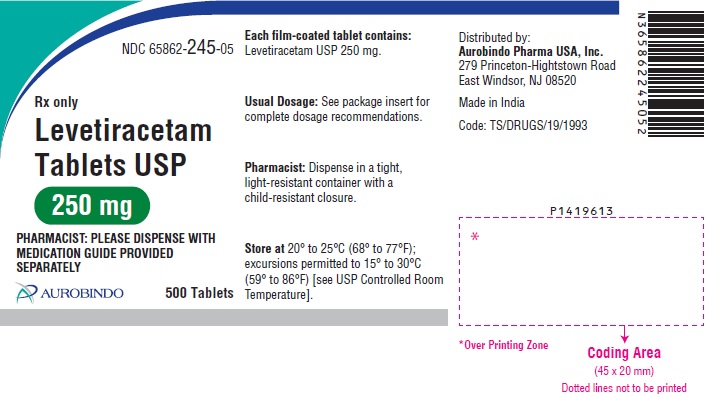
Package Label-principal Display Panel (250 mg (500 Tablets Bottle))

Package Label-principal Display Panel (250 mg (500 Tablets Bottle))
This is a description of Levetiracetam tablets, containing 250 mg of Levetiracetam USP. The package insert should be consulted for complete dosage recommendations. The tablets should be dispensed with a medication guide and stored in a tight, light-resistant container with child-resistant closure at room temperature. The tablets are distributed by Aurobindo Pharma USA, Inc. and manufactured in India. The code on the package is TS/DRUGS/19/1993. The packaging includes a coding area and overprinting zone.*
FDA Label Image

Package Label-principal Display Panel (500 mg (500 Tablets Bottle))

FDA Label Image

Package Label-principal Display Panel (750 mg (500 Tablets Bottle))

FDA Label Image

Chemical Structure (Levetiracetam Str)

* These product label images have been analyzed using experimental machine learning. Please verify findings with the primary label text.