Adults
The pharmacokinetic properties of FTC were evaluated in healthy subjects and HIV-1-infected subjects. Emtricitabine pharmacokinetics are similar between these populations.
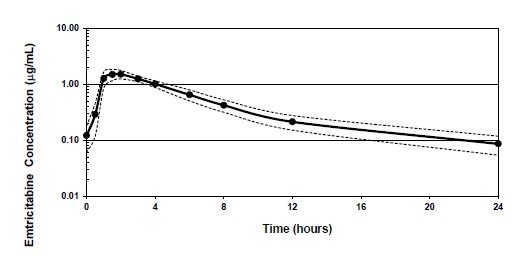
Figure 1 shows the mean steady-state plasma FTC concentration-time profile in 20 HIV‑1-infected subjects receiving emtricitabine capsules.
Figure 1 Mean (± 95% CI) Steady-State Plasma FTC Concentrations in HIV‑1 Infected Adults (N=20)
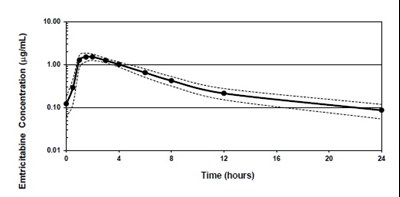
Fig1 (Emtricitabine Fig1)
Absorption
Emtricitabine is rapidly and extensively absorbed following oral administration, with peak plasma concentrations occurring at 1 to 2 hours postdose. Following multiple dose oral administration of emtricitabine capsules to 20 HIV-1 infected subjects, the (mean ± SD) steady-state plasma FTC peak concentration (Cmax) was 1.8 ± 0.7 mcg/mL and the area-under the plasma concentration-time curve over a 24-hour dosing interval (AUC) was 10.0 ± 3.1 mcg·hr/mL. The mean steady-state plasma trough concentration at 24 hours postdose was 0.09 mcg/mL. The mean absolute bioavailability of emtricitabine capsules was 93%, while the mean absolute bioavailability of emtricitabine oral solution was 75%. The relative bioavailability of emtricitabine oral solution was approximately 80% of emtricitabine capsules.
The multiple dose pharmacokinetics of FTC are dose proportional over a dose range of 25 to 200 mg.
Distribution
In vitro binding of FTC to human plasma proteins was less than 4% and independent of concentration over the range of 0.02 to 200 mcg/mL. At peak plasma concentration, the mean plasma to blood drug concentration ratio was ~1.0 and the mean semen to plasma drug concentration ratio was ~4.0.
Metabolism
Following administration of radiolabelled FTC, complete recovery of the dose was achieved in urine (~86%) and feces (~14%). Thirteen percent (13%) of the dose was recovered in urine as three putative metabolites. The biotransformation of FTC includes oxidation of the thiol moiety to form the 3’-sulfoxide diastereomers (~9% of dose) and conjugation with glucuronic acid to form 2’-O-glucuronide (~4% of dose). No other metabolites were identifiable.
Elimination
The plasma FTC half-life is approximately 10 hours. The renal clearance of FTC is greater than the estimated creatinine clearance, suggesting elimination by both glomerular filtration and active tubular secretion. There may be competition for elimination with other compounds that are also renally eliminated.
Effects of Food on Oral Absorption
Emtricitabine capsules and oral solution may be taken with or without food. Emtricitabine systemic exposure (AUC) was unaffected while Cmax decreased by 29% when emtricitabine capsules were administered with food (an approximately 1000 kcal high-fat meal). Emtricitabine systemic exposure (AUC) and Cmax were unaffected when 200 mg emtricitabine oral solution was administered with either a high-fat or low-fat meal.
Specific Populations
Geriatric Patients
The pharmacokinetics of FTC have not been fully evaluated in the elderly (65 years of age and older).
Pediatric Patients
The pharmacokinetics of FTC at steady state were determined in 77 HIV-1 infected pediatric subjects, and the pharmacokinetic profile was characterized in four age groups (Table 6). The FTC exposure achieved in pediatric subjects receiving a daily dose of 6 mg/kg up to a maximum of 240 mg oral solution or a 200 mg capsule is similar to exposures achieved in adult subjects receiving a once-daily dose of 200 mg.
The pharmacokinetics of FTC were studied in 20 neonates born to HIV-1 positive mothers. Each mother received prenatal and intrapartum combination antiretroviral therapy. Neonates received up to 6 weeks of AZT prophylactically after birth. The neonates were administered two short courses of FTC oral solution (each 3 mg/kg once daily × 4 days) during the first 3 months of life. The AUC observed in neonates who received a daily dose of 3 mg/kg of FTC was similar to the AUC observed in pediatric subjects aged 3 months to 17 years who received a daily dose of FTC as a 6 mg/kg oral solution up to 240 mg or as a 200 mg capsule (Table 6).
Table 6 Mean ± SD Pharmacokinetic Parameters by Age Groups for Pediatric Subjects and Neonates Receiving Emtricitabine Capsules or Oral Solutiona. Two pharmacokinetic evaluations were conducted in 20 neonates over the first 3 months of life. Median (range) age of infant on day of pharmacokinetic evaluation was 26 (5 to 81) days.
b. Mean (range).
|
| HIV-1- exposed Neonates
| HIV-1 Infected Pediatric Subjects
|
Age
| 0 to 3 mo (N=20)a
| 3 to 24 mo (N=14)
| 25 mo to 6 yr (N=19)
| 7 to 12 yr (N=17)
| 13 to 17 yr (N=27)
|
Formulation
| 0
| 0
| 0
| 10
| 26
|
Capsule (n)
|
Oral Solution (n)
| 20
| 14
| 19
| 7
| 1
|
Dose (mg/kg)b
| 3.1 (2.9 to 3.4)
| 6.1 (5.5 to 6.8)
| 6.1 (5.6 to 6.7)
| 5.6 (3.1 to 6.6)
| 4.4 (1.8 to 7.0)
|
Cmax (mcg/mL)
| 1.6 ± 0.6
| 1.9 ± 0.6
| 1.9 ± 0.7
| 2.7 ± 0.8
| 2.7 ± 0.9
|
AUC
(mcg·hr/mL)
| 11.0 ± 4.2
| 8.7 ± 3.2
| 9.0 ± 3.0
| 12.6 ± 3.5
| 12.6 ± 5.4
|
T1/2 (hr)
| 12.1 ± 3.1
| 8.9 ± 3.2
| 11.3 ± 6.4
| 8.2 ± 3.2
| 8.9 ± 3.3
|
Gender
FTC pharmacokinetics are similar in adult male and female subjects.
Race
No pharmacokinetic differences due to race have been identified.
Patients with Renal Impairment
The pharmacokinetics of FTC are altered in subjects with renal impairment [see Warnings and Precautions (5.4)]. In adult subjects with creatinine clearance below 50 mL/min or with end-stage renal disease (ESRD) requiring dialysis, Cmax and AUC of FTC were increased (Table 7). The effects of renal impairment on FTC pharmacokinetics in pediatric patients are not known.
Table 7 Pharmacokinetic Parameters (Mean ± SD) of FTC in Adult Subjects with Varying Degrees of Renal FunctionCreatinine Clearance (mL/min)
| >80 (N=6)
| 50 to 80 (N=6)
| 30 to 49 (N=6)
| <30 (N=5)
| ESRDa
<30 (N=5)
|
|---|
Baseline creatinine clearance (mL/min)
| 107 ± 21
| 59.8 ± 6.5
| 40.9 ± 5.1
| 22.9 ± 5.3
| 8.8 ± 1.4
|
Cmax (mcg/mL)
| 2.2 ± 0.6
| 3.8 ± 0.9
| 3.2 ± 0.6
| 2.8 ± 0.7
| 2.8 ± 0.5
|
AUC
(mcg.hr/mL)
| 11.8 ± 2.9
| 19.9 ± 1.2
| 25.1 ± 5.7
| 33.7± 2.1
| 53.2 ± 9.9
|
CL/F (mL/min)
| 302 ± 94
| 168 ± 10
| 138 ± 28
| 99 ± 6
| 64 ± 12
|
CLr (mL/min)
| 213 ± 89
| 121 ± 39
| 69 ± 32
| 30 ± 11
| NAb
|
a. ESRD subjects requiring dialysis
b. NA = Not Applicable
Patients with Hepatic Impairment
The pharmacokinetics of FTC have not been studied in subjects with hepatic impairment; however, FTC is not significantly metabolized by liver enzymes, so the impact of liver impairment should be limited.
Assessment of Drug Interactions
At concentrations up to 14-fold higher than those observed in vivo, FTC did not inhibit in vitro drug metabolism mediated by any of the following human CYP isoforms: CYP1A2, CYP2A6, CYP2B6, CYP2C9, CYP2C19, CYP2D6, and CYP3A4. FTC did not inhibit the enzyme responsible for glucuronidation (uridine-5’-disphosphoglucuronyl transferase). Based on the results of these in vitro experiments and the known elimination pathways of FTC, the potential for CYP-mediated interactions involving FTC with other medicinal products is low.
Emtricitabine has been evaluated in healthy volunteers in combination with TDF, AZT, indinavir, famciclovir, and d4T. Tables 8 and 9 summarize the pharmacokinetic effects of coadministered drug on FTC pharmacokinetics and effects of FTC on the pharmacokinetics of coadministered drug.
Table 8 Drug Interactions: Change in Pharmacokinetic Parameters for FTC in the Presence of the Coadministered Drugaa. All interaction trials conducted in healthy volunteers.
b. ↑ = Increase; ⇔ = No Effect; NA = Not Applicable
|
Coadministered Drug
| Dose of Coadministered Drug (mg)
| FTC
Dose (mg)
| N
| % Change of FTC Pharmacokinetic Parametersb (90% CI)
|
Cmax
| AUC
| Cmin
|
Famciclovir
| 500 × 1
| 200 × 1
| 12
| ⇔
| ⇔
| NA
|
Indinavir
| 800 × 1
| 200 × 1
| 12
| ⇔
| ⇔
| NA
|
Stavudine
| 40 × 1
| 200 × 1
| 6
| ⇔
| ⇔
| NA
|
Tenofovir DF
| 300 once daily × 7 days
| 200 once
daily × 7 days
| 17
| ⇔
| ⇔
| ↑ 20
(↑ 12 to ↑ 29)
|
Zidovudine
| 300 twice daily
× 7 days
| 200 once
daily × 7 days
| 27
| ⇔
| ⇔
| ⇔
|
Table 9 Drug Interactions: Change in Pharmacokinetic Parameters for Coadministered Drug in the Presence of FTCaa. All interaction trials conducted in healthy volunteers.
b. ↑ = Increase; ⇔ = No Effect; NA = Not Applicable
|
Coadministered Drug
| Dose of Coadministered Drug (mg)
| FTC
Dose (mg)
| N
| % Change of Coadministered Drug Pharmacokinetic Parametersb (90% CI)
|
Cmax
| AUC
| Cmin
|
Famciclovir
| 500 × 1
| 200 × 1
| 12
| ⇔
| ⇔
| NA
|
Indinavir
| 800 × 1
| 200 × 1
| 12
| ⇔
| ⇔
| NA
|
Stavudine
| 40 × 1
| 200 × 1
| 6
| ⇔
| ⇔
| NA
|
Tenofovir DF
| 300 once daily × 7 days
| 200 once
daily × 7 days
| 17
| ⇔
| ⇔
| ⇔
|
Zidovudine
| 300 twice daily
× 7 days
| 200 once
daily × 7 days
| 27
| ↑ 17
(↑ 0 to ↑ 38)
| ↑ 13
(↑ 5 to ↑ 20)
| ⇔
|