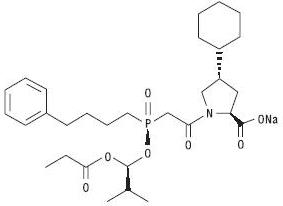
The absolute absorption of fosinopril averages 36% of an oral dose. The primary site of absorption is the proximal small intestine. While the rate of absorption may be slowed by the presence of food in the gastrointestinal tract, the extent of absorption of fosinopril is essentially unaffected.
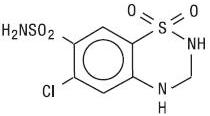
Following oral administration of hydrochlorothiazide, peak plasma concentrations are achieved in 1 to 2.5 hours, and the extent of absorption is 50 to 80%. The reported studies of food effects on hydrochlorothiazide absorption have been inconclusive. The absorption of hydrochlorothiazide is increased by agents that reduce gastrointestinal motility. It is reported to be decreased by 50% in patients with congestive heart failure.
Cleavage of the ester group (primarily in the liver) converts fosinopril to its active metabolite, fosinoprilat. The time to peak plasma concentrations of fosinoprilat is about 3 hours, independent of the administered dose of fosinopril. In patients with hepatic dysfunction due to cirrhosis, conversion of fosinopril to fosinoprilat may be slowed, but the extent of this conversion is unchanged.
Fosinoprilat is highly protein bound (95%), but has negligible binding to cellular components of blood. The peak serum concentration and the area under the concentration-time curve of fosinoprilat is directly proportional to the administered dose of fosinopril.
After an oral dose of radiolabeled fosinopril, 75% of radioactivity in plasma was present as active fosinoprilat, 20 to 30% as a glucuronide conjugate of fosinoprilat, and 1 to 5% as a p-hydroxy metabolite of fosinoprilat. Since fosinoprilat is not biotransformed after intravenous administration, fosinopril, not fosinoprilat, appears to be the precursor for the glucuronide and p-hydroxy metabolites. In rats, the p-hydroxy metabolite of fosinoprilat is as potent an inhibitor of ACE as fosinoprilat; the glucuronide conjugate is devoid of ACE inhibitory activity.
Studies in animals indicate that fosinopril and fosinoprilat do not cross the blood-brain barrier, but fosinoprilat does cross the placenta of pregnant animals. In humans, hydrochlorothiazide crosses the placenta freely, and levels in umbilical-cord blood are similar to those in the maternal circulation.
Hydrochlorothiazide is not metabolized. Its apparent volume of distribution is 3.6 to 7.8 L/kg, and its measured plasma protein binding is 67.9%. The drug also accumulates in red blood cells, so that whole blood levels are 1.6 to 1.8 times those measured in plasma.
After intravenous administration, fosinoprilat is eliminated approximately equally by the liver and kidney. After oral administration of radiolabeled fosinopril, approximately half of the absorbed dose is excreted in the urine and the remainder is excreted in the feces. In two studies involving healthy subjects, the mean body clearance of intravenous fosinoprilat was between 26 and 39 mL/min.
In hypertensive patients with normal renal and hepatic function, the effective half-life of accumulation of fosinoprilat following multiple dosing of fosinopril sodium is 11.5 hours. Thus, steady-state concentrations of fosinoprilat should be reached after 2 or 3 doses of fosinopril sodium and hydrochlorothiazide given once daily.
In patients with renal insufficiency (creatinine clearance <80 mL/min/1.73 m2), the total body clearance of fosinoprilat is approximately one half of that in patients with normal renal function, while absorption, bioavailability, and protein binding are not appreciably altered. The clearance of fosinoprilat does not differ appreciably with the degree of renal insufficiency, because the diminished renal elimination is offset by increased hepatobiliary elimination. A modest increase in plasma AUC levels (less than two times that in normals) was observed in patients with various degrees of renal insufficiency, including end-stage renal failure (creatinine clearance <10 mL/min/1.73 m2). (See DOSAGE AND ADMINISTRATION.)
Fosinopril is not well dialyzed. Clearance of fosinoprilat by hemodialysis and peritoneal dialysis averages 2% and 7%, respectively, of urea clearances.
In patients with hepatic insufficiency (alcoholic or biliary cirrhosis), the apparent total body clearance of fosinoprilat is approximately one half of that in patients with normal hepatic function.
In elderly (male) subjects (65 to 74 years old) with clinically normal renal and hepatic function, there appear to be no significant differences in pharmacokinetic parameters for fosinoprilat compared to those of younger subjects (20 to 35 years old).
Thiazide diuretics are eliminated by the kidney, with a terminal half-life of 5 to 15 hours. In a study of patients with impaired renal function (mean creatinine clearance of 19 mL/min), the half-life of hydrochlorothiazide elimination was lengthened to 21 hours.
When fosinopril and hydrochlorothiazide are administered concomitantly, the pharmacokinetics of hydrochlorothiazide are essentially unaffected. Serum levels of fosinoprilat are increased after several weeks of coadministration of hydrochlorothiazide and fosinopril, but the increase is not sufficient to warrant any change in dosing.