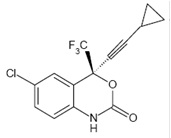
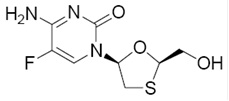
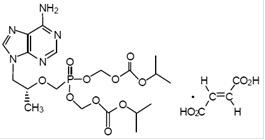
Efavirenz, Emtricitabine and Tenofovir Disoproxil Fumarate: One efavirenz, emtricitabine and tenofovir disoproxil fumarate tablet is bioequivalent to one Sustiva tablet (600 mg) plus one EMTRIVA® capsule (200 mg) plus one VIREAD® tablet (300 mg) following single-dose administration to fasting healthy subjects (N=45).
Efavirenz: In HIV-1 infected subjects time-to-peak plasma concentrations were approximately 3 to 5 hours and steady-state plasma concentrations were reached in 6 to 10 days. In 35 HIV-1 infected subjects receiving EFV 600 mg once daily, steady-state Cmax was 12.9 ± 3.7 µM (mean ± SD), Cmin was 5.6 ± 3.2 µM, and AUC was 184 ± 73 µM•hr. EFV is highly bound (approximately 99.5 to 99.75%) to human plasma proteins, predominantly albumin. Following administration of 14C-labeled EFV, 14 to 34% of the dose was recovered in the urine (mostly as metabolites) and 16 to 61% was recovered in feces (mostly as parent drug). In vitro studies suggest CYP3A and CYP2B6 are the major isozymes responsible for EFV metabolism. EFV has been shown to induce CYP enzymes, resulting in induction of its own metabolism. EFV has a terminal half-life of 52 to 76 hours after single doses and 40 to 55 hours after multiple doses.
Emtricitabine: Following oral administration, FTC is rapidly absorbed, with peak plasma concentrations occurring at 1 to 2 hours postdose. Following multiple dose oral administration of FTC to 20 HIV-1 infected subjects, the steady-state plasma FTC Cmax was 1.8 ± 0.7 mcg/mL (mean ± SD) and the AUC over a 24-hour dosing interval was 10.0 ± 3.1 mcg•hr/mL. The mean steady-state plasma trough concentration at 24 hours postdose was 0.09 mcg/mL. The mean absolute bioavailability of FTC was 93%. Less than 4% of FTC binds to human plasma proteins in vitro, and the binding is independent of concentration over the range of 0.02 to 200 mcg/mL. Following administration of radiolabelled FTC, approximately 86% is recovered in the urine and 13% is recovered as metabolites. The metabolites of FTC include 3′-sulfoxide diastereomers and their glucuronic acid conjugate. FTC is eliminated by a combination of glomerular filtration and active tubular secretion with a renal clearance in adults with normal renal function of 213 ± 89 mL/min (mean ± SD). Following a single oral dose, the plasma FTC half-life is approximately 10 hours.
Tenofovir DF: Following oral administration of a single 300 mg dose of TDF to HIV-1 infected subjects in the fasted state, maximum serum concentrations (Cmax) were achieved in 1.0 ± 0.4 hrs (mean ± SD) and Cmax and AUC values were 296 ± 90 ng/mL and 2287 ± 685 ng•hr/mL, respectively. The oral bioavailability of tenofovir from TDF in fasted subjects is approximately 25%. Less than 0.7% of tenofovir binds to human plasma proteins in vitro, and the binding is independent of concentration over the range of 0.01 to 25 mcg/mL. Approximately 70 to 80% of the intravenous dose of tenofovir is recovered as unchanged drug in the urine. Tenofovir is eliminated by a combination of glomerular filtration and active tubular secretion, with a renal clearance in adults with normal renal function of 243 ± 33 mL/min (mean ± SD). Following a single oral dose, the terminal elimination half-life of tenofovir is approximately 17 hours.
Effects of Food on Oral Absorption
Efavirenz, emtricitabine and tenofovir disoproxil fumarate has not been evaluated in the presence of food. Administration of EFV tablets with a high-fat meal increased the mean AUC and Cmaxof EFV by 28% and 79%, respectively, compared to administration in the fasted state. Compared to fasted administration, dosing of TDF and FTC in combination with either a high-fat meal or a light meal increased the mean AUC and Cmax of tenofovir by 35% and 15%, respectively, without affecting FTC exposures [see Dosage and Administration (2.2) and Patient Counseling Information (17)].
Specific Populations
Race
Efavirenz: The pharmacokinetics of EFV in HIV-1 infected subjects appear to be similar among the racial groups studied.
Emtricitabine: No pharmacokinetic differences due to race have been identified following the administration of FTC.
Tenofovir DF: There were insufficient numbers from racial and ethnic groups other than Caucasian to adequately determine potential pharmacokinetic differences among these populations following the administration of TDF.
Gender
Efavirenz, Emtricitabine, and Tenofovir DF: EFV, FTC, and tenofovir pharmacokinetics are similar in male and female subjects.
Pediatric Patients
Efavirenz: In an open-label trial in NRTI-experienced pediatric subjects (mean age 8 years, range 3 to 16 years), the pharmacokinetics of EFV in pediatric subjects were similar to the pharmacokinetics in adults who received a 600 mg daily dose of EFV. Based on mean steady-state predicted population pharmacokinetic modeling in pediatric subjects weighing >40 kg receiving the 600 mg dose of EFV, Cmax was 6.57 mcg/mL, Cmin was 2.82 mcg/mL, and AUC(0-24) was 254.78 μM•hr.
Emtricitabine: The pharmacokinetics of FTC at steady state were determined in 27 HIV-1 infected pediatric subjects 13 to 17 years of age receiving a daily dose of 6 mg/kg up to a maximum dose of 240 mg oral solution or a 200 mg capsule; 26 of 27 subjects in this age group received the 200 mg capsule. Mean ± SD Cmax and AUC were 2.7 ± 0.9 mcg/mL and 12.6 ± 5.4 mcg•hr/mL, respectively. Exposures achieved in pediatric subjects 12 to less than 18 years of age were similar to those achieved in adults receiving a once daily dose of 200 mg.
Tenofovir DF: Steady-state pharmacokinetics of tenofovir were evaluated in 8 HIV-1 infected pediatric subjects (12 to less than 18 years). Mean ± SD Cmax and AUCtau are 0.38 ± 0.13 mcg/mL and 3.39 ± 1.22 mcg•hr/mL, respectively. Tenofovir exposure achieved in these pediatric subjects receiving oral daily doses of TDF 300 mg was similar to exposures achieved in adults receiving once-daily doses of TDF 300 mg.
Geriatric Patients
Pharmacokinetics of EFV, FTC, and tenofovir have not been fully evaluated in the elderly (65 years of age and older) [see Use in Specific Populations (8.5)].
Patients with Impaired Renal Function
Efavirenz: The pharmacokinetics of EFV have not been studied in subjects with renal insufficiency; however, less than 1% of EFV is excreted unchanged in the urine, so the impact of renal impairment on EFV elimination should be minimal.
Emtricitabine and Tenofovir DF: The pharmacokinetics of FTC and TDF are altered in subjects with renal impairment. In subjects with creatinine clearance below 50 mL/min, Cmax and AUC0-∞ of FTC and tenofovir were increased [see Warnings and Precautions (5.7)].
Patients with Hepatic Impairment
Efavirenz: A multiple-dose trial showed no significant effect on EFV pharmacokinetics in subjects with mild hepatic impairment (Child-Pugh Class A) compared with controls. There were insufficient data to determine whether moderate or severe hepatic impairment (Child-Pugh Class B or C) affects EFV pharmacokinetics [see Warnings and Precautions (5.3) and Use in Specific Populations (8.7)].
Emtricitabine: The pharmacokinetics of FTC have not been studied in subjects with hepatic impairment; however, FTC is not significantly metabolized by liver enzymes, so the impact of liver impairment should be limited.
Tenofovir DF: The pharmacokinetics of tenofovir following a 300 mg dose of TDF have been studied in non-HIV infected subjects with moderate to severe hepatic impairment. There were no substantial alterations in tenofovir pharmacokinetics in subjects with hepatic impairment compared with unimpaired subjects.
Assessment of Drug Interactions
The drug interaction trials described were conducted with either efavirenz, emtricitabine and tenofovir disoproxil fumarate or the components of efavirenz, emtricitabine and tenofovir disoproxil fumarate (EFV, FTC, or TDF) as individual agents.
Efavirenz: The steady-state pharmacokinetics of EFV and tenofovir were unaffected when EFV and TDF were administered together versus each agent dosed alone. Specific drug interaction trials have not been performed with EFV and NRTIs other than tenofovir, lamivudine, and zidovudine. Clinically significant interactions would not be expected based on NRTIs elimination pathways.
Efavirenz has been shown in vivo to cause hepatic enzyme induction, thus increasing the biotransformation of some drugs metabolized by CYP3A and CYP2B6. In vitro studies have shown that EFV inhibited CYP isozymes 2C9 and 2C19 with Ki values (8.5 to 17 µM) in the range of observed EFV plasma concentrations. In in vitro studies, EFV did not inhibit CYP2E1 and inhibited CYP2D6 and CYP1A2 (Ki values 82 to 160 µM) only at concentrations well above those achieved clinically. Coadministration of EFV with drugs primarily metabolized by CYP2C9, CYP2C19, CYP3A or CYP2B6 isozymes may result in altered plasma concentrations of the coadministered drug. Drugs which induce CYP3A and CYP2B6 activity would be expected to increase the clearance of EFV resulting in lowered plasma concentrations.
Drug interaction trials were performed with EFV and other drugs likely to be coadministered or drugs commonly used as probes for pharmacokinetic interaction. There was no clinically significant interaction observed between EFV and zidovudine, lamivudine, azithromycin, fluconazole, lorazepam, cetirizine, or paroxetine. Single doses of famotidine or an aluminum and magnesium antacid with simethicone had no effects on EFV exposures. The effects of coadministration of EFV on Cmax, AUC, and Cmin are summarized in Table 4 (effect of other drugs on EFV) and Table 5 (effect of EFV on other drugs) [see Drug Interactions (7)].
Table 4 Drug Interactions: Changes in Pharmacokinetic Parameters for EFV in the Presence of the Coadministered Drug
NA = not available
a. Increase = ↑; Decrease = ↓; No Effect = ↔
b. Parallel-group design; N for EFV + lopinavir/ritonavir, N for EFV alone.
c. 95% CI
d. 90% CI not available
e. Relative to steady-state administration of EFV (600 mg once daily for 9 days).
|
| Mean % Change of EFV Pharmacokinetic
Parametersa (90% CI)
|
Coadministered Drug
| Dose of Coadministered Drug (mg)
| EFV Dose (mg)
| N
| Cmax
| AUC
| Cmin
|
Lopinavir/
ritonavir
| 400/100 mg q12h x 9 days
| 600 mg qd x 9 days
| 11, 12b
| ↔
| ↓ 16
(↓ 38 to ↑ 15)
| ↓ 16
(↓ 42 to ↑ 20)
|
Nelfinavir
| 750 mg q8h x 7 days
| 600 mg qd x 7 days
| 10
| ↓ 12
(↓ 32 to ↑ 13)c
| ↓ 12
(↓ 35 to ↑ 18)c
| ↓ 21
(↓ 53 to ↑ 33)
|
Ritonavir
| 500 mg q12h x 8 days
| 600 mg qd x 10 days
| 9
| ↑ 14
(↑ 4 to ↑ 26)
| ↑ 21
(↑ 10 to ↑ 34)
| ↑ 25
(↑ 7 to ↑ 46)c
|
Boceprevir
| 800 mg tid x 6 days
| 600 mg qd x 16 days
| NA
| ↑11
(↑ 2 to ↑ 20)
| ↑ 20
(↑ 15 to ↑ 26)
| NA
|
Rifabutin
| 300 mg qd x 14 days
| 600 mg qd x 14 days
| 11
| ↔
| ↔
| ↓ 12
(↓ 24 to ↑ 1)
|
Rifampin
| 600 mg x 7 days
| 600 mg qd x 7 days
| 12
| ↓ 20
(↓ 11 to ↓ 28)
| ↓ 26
(↓ 15 to ↓ 36)
| ↓ 32
(↓ 15 to ↓ 46)
|
Artemether/ lumefantrine
| Artemether
20 mg/ lumefantrine 120 mg tablets (6 4-tablet doses
over 3 days)
| 600 mg qd ×
26 days
| 12
| ↔
| ↓17
| NA
|
Simvastatin
| 40 mg qd × 4 days
| 600 mg qd x 15 days
| 14
| ↓ 12
(↓ 28 to ↑ 8)
| ↔
| ↓ 12
(↓ 25 to ↑ 3)
|
Carbamazepine
| 200 mg qd x 3 days,
200 mg bid x 3 days,
then 400 mg qd x 15 days
| 600 mg qd x 35 days
| 14
| ↓ 21
(↓ 15 to ↓ 26)
| ↓ 36
(↓ 32 to ↓ 40)
| ↓ 47
(↓ 41 to ↓ 53)
|
Diltiazem
| 240 mg x 14 days
| 600 mg qd x 28 days
| 12
| ↑ 16
(↑ 6 to ↑ 26)
| ↑ 11
(↑ 5 to ↑ 18)
| ↑ 13
(↑ 1 to ↑ 26)
|
Voriconazole
| 400 mg po q12h x 1 day then 200 mg po q12h x 8 days
| 400 mg qd x 9 days
| NA
| ↑ 38d
| ↑ 44d
| NA
|
300 mg po q12h days 2 to 7
| 300 mg qd x 7 days
| NA
| ↓ 14e
(↓ 7 to ↓ 21)
| ↔e
| NA
|
400 mg po q12h days 2 to 7
| 300 mg qd x 7 days
| NA
| ↔e
| ↑ 17e
(↑ 6 to ↑ 29)
| NA
|
No effect on the pharmacokinetic parameters of EFV was observed with the following coadministered drugs: indinavir, saquinavir soft gelatin capsule, simeprevir, ledipasvir/sofosbuvir, sofosbuvir, clarithromycin, itraconazole, atorvastatin, pravastatin, or sertraline.
Table 5 Drug Interactions: Changes in Pharmacokinetic Parameters for Coadministered Drug in the Presence of EFV
NA = not available
a. Increase = ↑; Decrease = ↓; No Effect = ↔
b. Compared with atazanavir 400 mg qd alone.
c. Comparator dose of indinavir was 800 mg q8h × 10 days.
d. Parallel-group design; N for EFV + lopinavir/ritonavir, N for lopinavir/ritonavir alone.
e. Values are for lopinavir. The pharmacokinetics of ritonavir 100 mg q12h are unaffected by concurrent EFV.
f. 95% CI
g. Soft Gelatin Capsule
h. Not available because of insufficient data.
i. 90% CI not available.
j. Relative to steady-state administration of voriconazole (400 mg for 1 day, then 200 mg po q12h for 2 days).
k. Study conducted with efavirenz, emtricitabine and tenofovir disoproxil fumarate coadministered with HARVONI.
l. The predominant circulating nucleoside metabolite of sofosbuvir.
m. Study conducted with efavirenz, emtricitabine and tenofovir disoproxil fumarate coadministered with SOVALDI® (sofosbuvir).
n. Study conducted with efavirenz, emtricitabine and tenofovir disoproxil fumarate coadministered with EPCLUSA.
|
| Mean % Change of Coadministered Drug Pharmacokinetic
Parametersa (90% CI)
|
Coadministered Drug
| Dose of Coadministered Drug (mg)
| EFV Dose (mg)
| N
| Cmax
| AUC
| Cmin
|
Atazanavir
| 400 mg qd with a light meal d 1 to 20
| 600 mg qd with a light meal d 7 to 20
| 27
| ↓ 59
(↓ 49 to ↓ 67)
| ↓ 74
(↓ 68 to ↓ 78)
| ↓ 93
(↓ 90 to ↓ 95)
|
400 mg qd d 1 to 6, then 300 mg qd d 7 to 20 with ritonavir 100 mg qd and a light meal
| 600 mg qd 2 h after atazanavir and ritonavir
d 7 to 20
| 13
| ↑ 14
(↓ 17 to ↑ 58)
| ↑ 39b
(↑ 2 to ↑ 88)
| ↑ 48b
(↑ 24 to ↑ 76)
|
300 mg qd/ritonavir 100 mg qd d 1 to 10 (pm), then 400 mg qd/ritonavir 100 mg qd d 11 to 24 (pm) (simultaneous with EFV)
| 600 mg qd with a light snack d 11 to 24 (pm)
| 14
| ↑ 17
(↑ 8 to ↑ 27)
| ↔
| ↓ 42
(↓ 31 to ↓ 51)
|
Indinavir
| 1000 mg q8h × 10 days
| 600 mg qd × 10 days
| 20
|
|
|
|
After morning dose
|
| ↔c
| ↓ 33c
(↓ 26 to ↓ 39)
| ↓ 39c
(↓ 24 to ↓ 51)
|
After afternoon dose
|
| ↔c
| ↓ 37c
(↓ 26 to ↓ 46)
| ↓ 52c
(↓ 47 to ↓ 57)
|
After evening dose
|
| ↓ 29c
(↓ 11 to ↓ 43)
| ↓ 46c
(↓ 37 to ↓ 54)
| ↓ 57c
(↓ 50 to ↓ 63)
|
Lopinavir/
ritonavir
| 400/100 mg q12h x 9 days
| 600 mg qd x 9 days
| 11, 7d
| ↔e
| ↓ 19e
(↓ 36 to ↑ 3)
| ↓ 39e
(↓ 3 to ↓ 62)
|
Nelfinavir
Metabolite
AG-1402
|
750 mg q8h x 7 days
|
600 mg qd x 7 days
|
10
| ↑ 21
(↑ 10 to ↑ 33)
↓ 40
(↓ 30 to ↓ 48)
| ↑ 20
(↑ 8 to ↑ 34)
↓ 37
(↓ 25 to ↓ 48)
|
↔
↓ 43
(↓ 21 to ↓ 59)
|
Ritonavir
| 500 mg q12h x 8 days
| 600 mg qd x 10 days
| 11
|
|
|
|
After AM dose
|
| ↑ 24
(↑ 12 to ↑ 38)
| ↑ 18
(↑ 6 to ↑ 33)
| ↑ 42
(↑ 9 to ↑ 86)f
|
After PM dose
|
| ↔
| ↔
| ↑ 24
(↑ 3 to ↑ 50)f
|
Saquinavir
SGC
| 1200 mg q8h x 10 days
| 600 mg qd x 10 days
| 12
| ↓ 50
(↓ 28 to ↓ 66)
| ↓ 62
(↓ 45 to ↓ 74)
| ↓ 56
(↓ 16 to ↓ 77)f
|
Maraviroc
| 100 mg bid
| 600 mg qd
| 12
| ↓ 51
(↓ 37 to ↓ 62)
| ↓ 45
(↓ 38 to ↓ 51)
| ↓ 45
(↓ 28 to ↓ 57)
|
Raltegravir
| 400 mg single
dose
| 600 mg qd
| 9
| ↓ 36
(↓ 2 to ↓ 59)
| ↓ 36
(↓ 20 to ↓ 48)
| ↓ 21
(↓ 51 to ↑ 28)
|
Boceprevir
| 800 mg tid x 6 days
| 600 mg qd
x 16 days
| NA
| ↓ 8
(↓ 22 to ↑ 8)
| ↓ 19
(↓ 11 to ↓ 25)
| ↓ 44
(↓ 26 to ↓ 58)
|
Simeprevir
| 150 mg qd × 14 days
| 600 mg qd
× 14 days
| 23
| ↓ 51
(↓ 46
to ↓ 56)
| ↓ 71
(↓ 67
to ↓ 74)
| ↓ 91
(↓ 88
to ↓ 92)
|
Ledipasvir/ sofosbuvirk
Ledipasvir
Sofosbuvir
GS-331007l |
90/400 mg qd x 14 days
|
600 mg qd
x 14 days
| 15
|
↓ 34
(↓ 25 to ↓ 41)
↔
↔
|
↓ 34
(↓ 25 to ↓ 41)
↔
↔
|
↓ 34
(↓ 24 to ↓ 43)
NA
↔
|
Sofosbuvirm
GS-331007l
| 400 mg qd
single dose
| 600 mg qd x 14 days
|
16 | ↓ 19
(↓ 40 to ↑ 10)
↓ 23
(↓ 16 to ↓ 30)
| ↔
↓ 16
(↓ 24 to ↓ 8)
|
NA
NA
|
Sofosbuvir/
velpatasvirn
Sofosbuvir
GS-331007l
Velpatasvir
| 400/100 mg qd × 14 days
| 600 mg qd ×
14 days
|
14
|
↑ 38
(↑ 14 to ↑ 67)
↓ 14
(↓ 20 to ↓ 7)
↓ 47
(↓ 57 to ↓ 36)
|
↔
↔
↓ 53
(↓ 61 to ↓ 43)
|
NA
↔
↓ 57
(↓ 64 to ↓ 48)
|
Clarithromycin
14-OH metabolite
| 500 mg q12h x 7 days
| 400 mg qd x 7 days
| 11
| ↓ 26
(↓ 15 to ↓ 35)
↑ 49
(↑ 32 to ↑ 69)
| ↓ 39
(↓ 30 to ↓ 46)
↑ 34
(↑ 18 to ↑ 53)
| ↓ 53
(↓ 42 to ↓ 63)
↑ 26
(↑ 9 to ↑ 45)
|
Itraconazole
Hydroxy-itraconazole
| 200 mg q12h x 28 days
| 600 mg qd x 14 days
| 18
| ↓ 37
(↓ 20 to ↓ 51)
↓ 35
(↓ 12 to ↓ 52)
| ↓ 39
(↓ 21 to ↓ 53)
↓ 37
(↓ 14 to ↓ 55)
| ↓ 44
(↓ 27 to ↓ 58)
↓ 43
(↓ 18 to ↓ 60)
|
Posaconazole
| 400 mg (oral suspension) bid × 10 and 20 days
| 400 mg qd × 10 and 20 days
| 11
| ↓ 45 (↓ 34 to ↓ 53)
| ↓ 50 (↓ 40 to ↓ 57)
| NA
|
Rifabutin
|
300 mg qd x 14 days
|
600 mg qd x 14 days
| 9
| ↓ 32
(↓ 15 to ↓ 46)
| ↓ 38
(↓ 28 to ↓ 47)
| ↓ 45
(↓ 31 to ↓ 56)
|
Artemether/ lumefantrine
Artemether dihydroartemisinin lumefantrine
|
Artemether 20 mg/lumefantrine 120 mg tablets (6 4-tablet doses over 3 days)
|
600 mg qd × 26 days
| 12
|
↓ 21
↓ 38
↔
|
↓ 51
↓ 46
↓ 21
|
NA
NA
NA
|
Atorvastatin
Total active
(including metabolites)
| 10 mg qd x 4 days
| 600 mg qd x 15 days
| 14
| ↓ 14
(↓ 1 to ↓ 26)
↓ 15
(↓ 2 to ↓ 26)
| ↓ 43
(↓ 34 to ↓ 50)
↓ 32
(↓ 21 to ↓ 41)
| ↓ 69
(↓ 49 to ↓ 81)
↓ 48
(↓ 23 to ↓ 64)
|
Pravastatin
| 40 mg qd x 4 days
| 600 mg qd x 15 days
| 13
| ↓ 32
(↓ 59 to ↑ 12)
| ↓ 44
(↓ 26 to ↓ 57)
| ↓ 19
(↓ 0 to ↓ 35)
|
Simvastatin
Total active (including metabolites)
| 40 mg qd x 4 days
| 600 mg qd x 15 days
|
14 | ↓ 72
(↓ 63 to ↓ 79)
↓ 68
(↓ 55 to ↓ 78)
| ↓ 68
(↓ 62 to ↓ 73)
↓ 60
(↓ 52 to ↓ 68)
| ↓ 45
(↓ 20 to ↓ 62)
NAh
|
Carbamazepine
Epoxide metabolite
| 200 mg qd x 3 days, 200 mg bid x 3 days, then 400 mg qd x 29 days
| 600 mg qd x 14 days
| 12
| ↓ 20
(↓ 15 to ↓ 24)
↔
| ↓ 27
(↓ 20 to ↓ 33)
↔
| ↓ 35
(↓ 24 to ↓ 44)
↓ 13
(↓ 30 to ↑ 7)
|
Diltiazem
Desacetyl diltiazem
N-monodesmethyl diltiazem | 240 mg x 21 days
| 600 mg qd x 14 days
| 13
| ↓ 60
(↓ 50 to ↓ 68)
↓ 64
(↓ 57 to ↓ 69)
↓ 28
(↓ 7 to ↓ 44)
| ↓ 69
(↓ 55 to ↓ 79)
↓ 75
(↓ 59 to ↓ 84)
↓ 37
(↓ 17 to ↓ 52)
| ↓ 63
(↓ 44 to ↓ 75)
↓ 62
(↓ 44 to ↓ 75)
↓ 37
(↓ 17 to ↓ 52)
|
Ethinyl estradiol/ norgestimate
Ethinyl estradiol
Norelgestromin
Levonorgestrel
| 0.035 mg/0.25 mg x 14 days
| 600 mg qd x 14 days
|
|
|
|
|
21
| ↔
| ↔
| ↔
|
21
| ↓ 46
(↓ 39 to ↓ 52)
| ↓ 64
(↓ 62 to ↓ 67)
| ↓ 82
(↓ 79 to ↓ 85)
|
6
| ↓ 80
(↓ 77 to ↓ 83)
| ↓ 83
(↓ 79 to ↓ 87)
| ↓ 86
(↓ 80 to ↓ 90)
|
Methadone
| Stable maintenance
35 to 100 mg daily
| 600 mg qd
x
14 to 21
days
| 11
| ↓ 45
(↓ 25 to ↓ 59)
| ↓ 52
(↓ 33 to ↓ 66)
| NA
|
Bupropion
Hydroxybupropion
| 150 mg single
dose
(sustained-
release)
| 600 mg qd
×
14 days
| 13
| ↓ 34
(↓ 21 to ↓ 47)
↑ 50
(↑ 20 to ↑ 80)
| ↓ 55
(↓ 48 to ↓ 62)
↔
| NA
NA
|
Sertraline
| 50 mg qd x 14 days
| 600 mg qd x 14 days
| 13
| ↓ 29
(↓ 15 to ↓ 40)
| ↓ 39
(↓ 27 to ↓ 50)
| ↓ 46
(↓ 31 to ↓ 58)
|
Voriconazole
| 400 mg po q12h x 1 day then 200 mg po q12h x 8 days
| 400 mg qd
x
9 days
| NA
| ↓ 61i
| ↓ 77i
| NA
|
300 mg po q12h days
2 to 7
| 300 mg qd
x
7 days
| NA
| ↓ 36j
(↓ 21 to ↓ 49)
| ↓ 55j
(↓ 45 to ↓ 62)
| NA
|
400 mg po q12h days
2 to 7
| 300 mg qd
x
7 days
| NA
| ↑ 23j
(↓ 1 to ↑ 53)
| ↓ 7j
(↓ 23 to ↑ 13)
| NA
|
Emtricitabine and Tenofovir DF: The steady-state pharmacokinetics of FTC and tenofovir were unaffected when FTC and TDF were administered together versus each agent dosed alone.
In vitro and clinical pharmacokinetic drug-drug interaction studies have shown that the potential for CYP mediated interactions involving FTC and tenofovir with other medicinal products is low.
TDF is a substrate of P-glycoprotein (P-gp) and breast cancer resistance protein (BCRP) transporters. When TDF is coadministered with an inhibitor of these transporters, an increase in absorption may be observed.
No clinically significant drug interactions have been observed between FTC and famciclovir, indinavir, sofosbuvir/velpatasvir, stavudine, TDF, and zidovudine. Similarly, no clinically significant drug interactions have been observed between TDF and abacavir, EFV, FTC, entecavir, indinavir, lamivudine, lopinavir/ritonavir, methadone, nelfinavir, oral contraceptives, ribavirin, saquinavir/ritonavir, sofosbuvir, or tacrolimus in trials conducted in healthy volunteers.
Following multiple dosing to HIV-negative subjects receiving either chronic methadone maintenance therapy, oral contraceptives, or single doses of ribavirin, steady-state tenofovir pharmacokinetics were similar to those observed in previous trials, indicating a lack of clinically significant drug interactions between these agents and TDF.
The effects of coadministered drugs on the Cmax, AUC, and Cmin of tenofovir are shown in Table 6. The effects of coadministration of TDF on Cmax, AUC, and Cmin of coadministered drugs are shown in Table 7.
Table 6 Drug Interactions: Changes in Pharmacokinetic Parameters for Tenofovir in the Presence of the Coadministered Druga,b
a. All interaction trials conducted in healthy volunteers.
b. Subjects received TDF 300 mg once daily.
c. Increase = ↑; Decrease = ↓; No Effect = ↔
d. Reyataz Prescribing Information.
e. Prezista Prescribing Information.
f. Subjects received didanosine buffered tablets.
g. Aptivus Prescribing Information.
|
Coadministered Drug
| Dose of Coadministered Drug (mg)
| N
| Mean % Change of Tenofovir Pharmacokinetic Parametersc
(90% CI)
|
Cmax
| AUC
| Cmin
|
Atazanavird | 400 once daily x 14 days
| 33
| ↑ 14
(↑ 8 to ↑ 20)
| ↑ 24
(↑ 21 to ↑ 28)
| ↑ 22
(↑ 15 to ↑ 30)
|
Atazanavir/ ritonavird | 300/100 once
daily
| 12
| ↑ 34
(↑ 20 to ↑ 51)
| ↑ 37
(↑ 30 to ↑ 45)
| ↑ 29
(↑ 21 to ↑ 36)
|
Darunavir/ ritonavire | 300/100 twice
daily
| 12
| ↑ 24 (↑ 8 to ↑ 42)
| ↑ 22 (↑ 10 to ↑ 35)
| ↑ 37 (↑ 19 to ↑ 57)
|
Didanosinef | 250 or 400 once daily × 7 days
| 14
| ↔
| ↔
| ↔
|
Ledipasvir/ sofosbuvir | 90/400 once daily
| 15
| ↑ 79
(↑ 56 to ↑ 104)
| ↑ 98
(↑ 77 to ↑ 123)
| ↑ 163
(↑ 132 to ↑ 197)
|
Lopinavir/ ritonavir | 400/100 twice
daily × 14 days
| 24
| ↔
| ↑ 32
(↑ 25 to ↑ 38)
| ↑ 51
(↑ 37 to ↑ 66)
|
Sofosbuvir | 400 once daily
| 16
| ↑ 25
(↑ 8 to ↑ 45)
| ↔
| ↔
|
Sofosbuvir/ velpatasvir | 400/100 once daily
| 15
| ↑ 77
(↑ 53 to ↑ 104)
| ↑ 81
(↑ 68 to ↑ 94)
| ↑ 121
(↑ 100 to ↑ 143)
|
Tipranavir/ ritonavirg | 500/100 twice
daily
| 22
| ↓ 23
(↓ 32 to ↓ 13)
| ↓ 2
(↓ 9 to ↑ 5)
| ↑ 7
(↓ 2 to ↑ 17)
|
750/200 twice
daily (23 doses)
| 20
| ↓ 38
(↓ 46 to ↓ 29)
| ↑ 2
(↓ 6 to ↑ 10)
| ↑ 14
(↑ 1 to ↑ 27)
|
Table 7 Drug Interactions: Changes in Pharmacokinetic Parameters for Coadministered Drug in the Presence of TDFa,ba. All interaction trials conducted in healthy volunteers.
b. Subjects received TDF 300 mg once daily.
c. Increase = ↑; Decrease = ↓; No Effect = ↔
d. Reyataz Prescribing Information.
e. In HIV-infected patients, addition of TDF to atazanavir 300 mg plus ritonavir 100 mg, resulted in AUC and Cmin values of atazanavir that were 2.3- and 4-fold higher than the respective values observed for atazanavir 400 mg when given alone.
f. Prezista Prescribing Information.
g. Videx EC Prescribing Information. Subjects received didanosine enteric-coated capsules.
h. 373 kcal, 8.2 g fat.
i. Compared with didanosine (enteric-coated) 400 mg administered alone under fasting conditions.
j. Aptivus Prescribing Information. |
Coadministered Drug
| Dose of Coadministered Drug (mg)
| N
| Mean % Change of Coadministered Drug Pharmacokinetic Parametersc
(90% CI)
|
Cmax
| AUC
| Cmin
|
Atazanavird
| 400 once daily x 14 days
| 34
| ↓ 21
(↓ 27 to ↓ 14)
| ↓ 25
(↓ 30 to ↓ 19)
| ↓ 40
(↓ 48 to ↓ 32)
|
Atazanavir/ritonavir
300/100 once daily x 42 days
| 10
| ↓ 28
(↓ 50 to ↑ 5)
| ↓ 25e
(↓ 42 to ↓ 3)
| ↓ 23e
(↓ 46 to ↑ 10)
|
Darunavirf
| Darunavir/ritonavir 300/100 once daily
| 12
| ↑ 16
(↓ 6 to ↑ 42)
| ↑ 21
(↓ 5 to ↑ 54)
| ↑ 24
(↓ 10 to ↑ 69)
|
Didanosineg
| 250 once, simultaneously with TDF and a light mealh
| 33
| ↓ 20i
(↓ 32 to ↓ 7)
| ↔i
| NA
|
Lopinavir
Ritonavir
| Lopinavir/ritonavir 400/100 twice daily x 14 days
| 24
| ↔
| ↔
| ↔
|
Lopinavir/ritonavir 400/100 twice daily x 14 days
| 24
| ↔
| ↔
| ↔
|
Tipranavirj
| Tipranavir/ritonavir 500/100 twice daily
| 22
| ↓ 17
(↓ 26 to ↓ 6)
| ↓ 18
(↓ 25 to ↓ 9)
| ↓ 21
(↓ 30 to ↓ 10)
|
Tipranavir/ritonavir 750/200 twice daily (23 doses)
| 20
| ↓ 11
(↓ 16 to ↓ 4)
| ↓ 9
(↓ 15 to ↓ 3)
| ↓ 12
(↓ 22 to 0)
|