Primary Hyperlipidemia in Adults
Study with Atorvastatin (Study 301)
Pitavastatin was compared with atorvastatin calcium tablets (referred to as atorvastatin) in a randomized, multicenter, double-blind, double-dummy, active-controlled, non-inferiority study of 817 adult patients with primary hyperlipidemia or mixed dyslipidemia. Patients entered a 6- to 8-week wash-out/dietary lead-in period and then were randomized to a 12-week treatment with either pitavastatin or atorvastatin (Table 5). Non-inferiority of pitavastatin to a given dose of atorvastatin was considered to be demonstrated if the lower bound of the 95% CI for the mean treatment difference was greater than -6% for the mean percent change in LDL-C.
Lipid results are shown in Table 5. For the percent change from baseline to endpoint in LDL-C, pitavastatin was non-inferior to atorvastatin for the two pairwise comparisons: Pitavastatin 2 mg vs. atorvastatin 10 mg and pitavastatin 4 mg vs. atorvastatin 20 mg. Mean treatment differences (95% CI) were 0% (-3%, 3%) and 1% (-2%, 4%), respectively.
Table 5. Lipid Response by Dose of Pitavastatin and Atorvastatin in Adult Patients with Primary Hyperlipidemia or Mixed Dyslipidemia in Study 301 (Mean % Change from Baseline at Week 12)
Treatment
| N
| LDL-C
| Apo-B
| TC
| TG
| HDL-C
| non-HDL-C
|
Pitavastatin
2 mg daily
| 315
| -38
| -30
| -28
| -14
| 4
| -35
|
Pitavastatin
4 mg daily
| 298
| -45
| -35
| -32
| -19
| 5
| -41
|
Atorvastatin
10 mg daily
| 102
| -38
| -29
| -28
| -18
| 3
| -35
|
Atorvastatin
20 mg daily
| 102
| -44
| -36
| -33
| -22
| 2
| -41
|
Study with Simvastatin (Study 302)
Pitavastatin was compared with simvastatin tablets (referred to as simvastatin) in a randomized, multicenter, double-blind, double-dummy, active-controlled, non-inferiority study of 843 adult patients with primary hyperlipidemia or mixed dyslipidemia. Patients entered a 6- to 8-week wash-out/dietary lead-in period and then were randomized to a 12 week treatment with either pitavastatin or simvastatin (Table 6). Non-inferiority of pitavastatin to a given dose of simvastatin was considered to be demonstrated if the lower bound of the 95% CI for the mean treatment difference was greater than -6% for the mean percent change in LDL-C.
Lipid results are shown in Table 6. For the percent change from baseline to endpoint in LDL-C, pitavastatin was non-inferior to simvastatin for the two pairwise comparisons: pitavastatin 2 mg vs. simvastatin 20 mg and pitavastatin 4 mg vs. simvastatin 40 mg. Mean treatment differences (95% CI) were 4% (1%, 7%) and 1% (-2%, 4%), respectively.
Table 6. Lipid Response by Dose of Pitavastatin and Simvastatin in Adult Patients with Primary Hyperlipidemia or Mixed Dyslipidemia in Study 302 (Mean % Change from Baseline at Week 12)
Treatment
| N
| LDL-C
| Apo-B
| TC
| TG
| HDL-C
| non-HDL-C
|
Pitavastatin
2 mg daily
| 307
| -39
| -30
| -28
| -16
| 6
| -36
|
Pitavastatin
4 mg daily
| 319
| -44
| -35
| -32
| -17
| 6
| -41
|
Simvastatin
20 mg daily
| 107
| -35
| -27
| -25
| -16
| 6
| -32
|
Simvastatin
40 mg daily
| 110
| -43
| -34
| -31
| -16
| 7
| -39
|
Study with Pravastatin in Geriatric Patients (Study 306)
Pitavastatin was compared with pravastatin sodium tablets (referred to as pravastatin) in a randomized, multicenter, double-blind, double-dummy, parallel group, active-controlled non-inferiority study of 942 geriatric patients (≥65 years) with primary hyperlipidemia or mixed dyslipidemia. Patients entered a 6- to 8-week wash-out/dietary lead-in period, and then were randomized to a once daily dose of pitavastatin or pravastatin for 12 weeks (Table 7). Non-inferiority of pitavastatin to a given dose of pravastatin was assumed if the lower bound of the 95% CI for the treatment difference was greater than -6% for the mean percent change in LDL-C.
Lipid results are shown in Table 7. Pitavastatin significantly reduced LDL-C compared to pravastatin as demonstrated by the following pairwise dose comparisons: Pitavastatin 1 mg vs. pravastatin 10 mg, pitavastatin 2 mg vs. pravastatin 20 mg and pitavastatin 4 mg vs. pravastatin 40 mg. Mean treatment differences (95% CI) were 9% (6%, 12%), 10% (7%, 13%) and 10% (7%, 13% ), respectively.
Table 7. Lipid Response by Dose of Pitavastatin and Pravastatin in Geriatric Patients with Primary Hyperlipidemia or Mixed Dyslipidemia in Study 306 (Mean % Change from Baseline at Week 12)
Treatment
| N
| LDL-C
| Apo-B
| TC
| TG
| HDL-C
| non-HDL-C
|
Pitavastatin
1 mg daily
| 207
| -31
| -25
| -22
| -13
| 1
| -29
|
Pitavastatin
2 mg daily
| 224
| -39
| -31
| -27
| -15
| 2
| -36
|
Pitavastatin
4 mg daily
| 210
| -44
| -37
| -31
| -22
| 4
| -41
|
Pravastatin
10 mg daily
| 103
| -22
| -17
| -15
| -5
| 0
| -20
|
Pravastatin
20 mg daily
| 96
| -29
| -22
| -21
| -11
| -1
| -27
|
Pravastatin
40 mg daily
| 102
| -34
| -28
| -24
| -15
| 1
| -32
|
Study with Simvastatin in Patients with ≥2 Risk Factors for Coronary Heart Disease (Study 304)
Pitavastatin was compared with simvastatin tablets (referred to as simvastatin) in a randomized, multicenter, double-blind, double-dummy, active-controlled, non-inferiority study of 351 adult patients with primary hyperlipidemia or mixed dyslipidemia with ≥2 risk factors for coronary heart disease. After a 6- to 8-week wash-out/dietary lead-in period, patients were randomized to a 12-week treatment with either pitavastatin or simvastatin (Table 8). Non-inferiority of pitavastatin to simvastatin was considered to be demonstrated if the lower bound of the 95% CI for the mean treatment difference was greater than -6% for the mean percent change in LDL-C.
Lipid results are shown in Table 8. Pitavastatin 4 mg was non-inferior to simvastatin 40 mg for percent change from baseline to endpoint in LDL-C. The mean treatment difference (95% CI) was 0% (-2%, 3%).
Table 8. Lipid Response by Dose of Pitavastatin and Simvastatin in Adult Patients with Primary Hyperlipidemia or Mixed Dyslipidemia with ≥2 Risk Factors for Coronary Heart Disease in Study 304 (Mean % Change from Baseline at Week 12)
Treatment
| N
| LDL-C
| Apo-B
| TC
| TG
| HDL-C
| non-HDL-C
|
|---|
Pitavastatin
4 mg daily
| 233
| -44
| -34
| -31
| -20
| 7
| -40
|
Simvastatin
40 mg daily
| 118
| -44
| -34
| -31
| -15
| 5
| -39
|
Study with Atorvastatin in Patients with Type 2 Diabetes Mellitus (Study 305)
Pitavastatin was compared with atorvastatin calcium tablets (referred to as atorvastatin) in a randomized, multicenter, double-blind, double-dummy, parallel group, active-controlled, non-inferiority study of 410 adult patients with type 2 diabetes mellitus and mixed dyslipidemia. Patients entered a 6- to 8-week washout/dietary lead-in period and were randomized to a once daily dose of pitavastatin or atorvastatin for 12 weeks. Non-inferiority of pitavastatin was considered to be demonstrated if the lower bound of the 95% CI for the mean treatment difference was greater than -6% for the mean percent change in LDL-C.
Lipid results are shown in Table 9. The treatment difference (95% CI) for LDL-C percent change from baseline was -2% (-6.2%, 1.5%). The two treatment groups were not statistically different on LDL-C. However, the lower limit of the CI was -6.2%, slightly exceeding the -6% non-inferiority limit. The study failed to demonstrate that pitavastatin was not significantly different than atorvastatin in lowering LDL-C in patients with type 2 diabetes mellitus and mixed dyslipidemia.
Table 9. Lipid Response by Dose of Pitavastatin and Atorvastatin in Adult Patients with Type 2 Diabetes Mellitus and Mixed Dyslipidemia in Study 305 (Mean % Change from Baseline at Week 12)
Treatment
| N
| LDL-C
| Apo-B
| TC
| TG
| HDL-C
| non-HDL-C
|
Pitavastatin
4 mg daily
| 274
| -41
| -32
| -28
| -20
| 7
| -36
|
Atorvastatin
20 mg daily
| 136
| -43
| -34
| -32
| -27
| 8
| -40
|
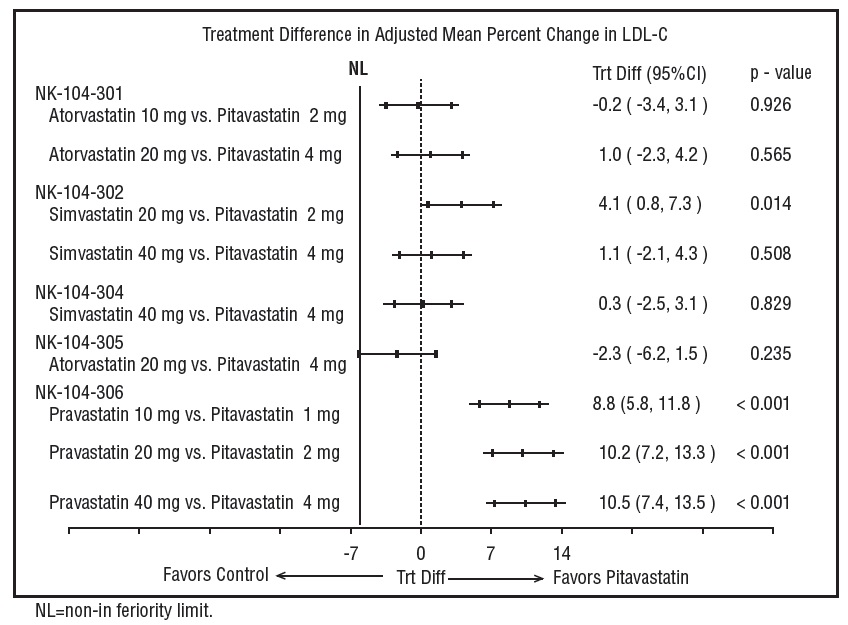
The treatment differences in efficacy in LDL-C change from baseline between pitavastatin and active controls (i.e., atorvastatin, simvastatin, or pravastatin) in the in the active-controlled studies described above are summarized in Figure 1.
Figure 1. Treatment Difference in Adjusted Mean Percent Change in LDL-C between Pitavastatin and the Comparator (Atorvastatin, Simvastatin, or Pravastatin)
Figure (Pitavastatin Fig1)
HeFH in Pediatric Patients
In a double-blind, placebo-controlled, 12-week trial, 82 pediatric patients (36 boys and 46 girls), 8 to 16 years of age with genetically confirmed HeFH, fasting low-density lipoprotein cholesterol (LDL-C) ≥190 mg/dL or LDL-C ≥160 mg/dL with an additional cardiovascular risk factor (male gender, a family history of premature CV disease, presence of low HDL (<45 mg/dL) or high TG (>150 mg/dL), presence of high lipoprotein (a) (>75 nmol/L), presence of type 2 diabetes mellitus or presence of hypertension) were randomized to pitavastatin 1 mg, 2 mg, and 4 mg. Mean LDL-C at baseline was 235 mg/dL (range 160.5 mg/dL to 441mg/dL). Approximately 39% of patients were Tanner Stage 1 at baseline.
Pitavastatin significantly reduced plasma LDL-C, non-HDL-C, TC, and Apo-B compared to placebo. The reductions in LDL-C, Apo-B, TC, and non-HDL-C were dose dependent. There was no statistically significant improvement in HDL-C or TG at any pitavastatin dose. See the lipid results in Table 10.
Table 10. Lipid Response in Pediatric Patients with HeFH (Mean % Change from Baseline at Week 12)
Treatment
| N
| LDL-C
| Apo-B
| TC
| TG*#
| HDL-C*
| non-HDL-C
|
Placebo
| 19
| -1
| -3
| -1
| -3
| -1
| -1
|
Pitavastatin
1 mg daily
| 20
| -21
| -20
| -16
| -14
| 7
| -21
|
Pitavastatin
2 mg daily
| 24
| -30
| -25
| -25
| -15
| -3
| -29
|
Pitavastatin
4 mg daily
| 19
| -38
| -28
| -30
| 5
| -2
| -36
|
*Difference from placebo not statistically significant
# Median Percent Change from Baseline at Week 12