Use after reconstitution and immediate dilution to final concentration
Use at room temperature (77°F/25°C)
VELETRI solution reconstituted with 5 mL of Sterile Water for Injection, USP or Sodium Chloride 0.9% Injection, and immediately diluted to the final concentration in the drug delivery reservoir can be administered at room temperature per the conditions of use as outlined in Table 1.
Table 1: Maximum duration of administration (hours) at room temperature (77°F/ 25°C) of fully diluted solutions in the drug delivery reservoirShort excursions at 104°F (40°C) are permitted for up to:
2 hours for concentrations below 15,000 ng/mL
4 hours for concentrations between 15,000 ng/mL and 60,000 ng/mL
8 hours for concentrations above 60,000 ng/mL
| Final concentration range | Immediate administration | If stored for up to 8 days at 36° to 46°F (2° to 8°C) |
|---|
| 0.5mg vial |
| ≥3,000 ng/mL and <15,000 ng/mL | 48 hours | 24 hours |
| 1.5mg vial |
| ≥15,000 ng/mL and < 60,000 ng/mL | 48 hours | 48 hours |
| ≥60,000 ng/mL | 72 hours | 48 hours |
Use at higher temperatures >77°F up to 104°F (>25° to 40°C)
Temperatures greater than 77°F and up to 86°F (>25°C to 30°C): A single reservoir of fully diluted solution of 60,000 ng/mL or above of VELETRI prepared as directed can be administered (either immediately or after up to 8 days storage at 36° to 46°F (2° to 8°C))for up to 48 hours. For diluted solutions of less than 60,000 ng/mL, pump reservoirs should be changed every 24 hours.
Temperatures up to 104°F (40°C): Fully diluted solutions of 60,000 ng/mL or above of VELETRI, prepared as directed, can be immediately administered for periods up to 24 hours.
Do not expose this solution to direct sunlight.
A concentration for the solution of VELETRI should be selected that is compatible with the infusion pump being used with respect to minimum and maximum flow rates, reservoir capacity, and the infusion pump criteria listed above. VELETRI, when administered chronically, should be prepared in a drug delivery reservoir appropriate for the infusion pump. Outlined in Table 2 are directions for preparing different concentrations of VELETRI. Each vial is for single use only; discard any unused solution.
Table 2: Reconstitution and Dilution Instructions| To make 100 mL of solution with Final Concentration (ng/mL) of: | Directions: |
|---|
| Using the 0.5 mg vial |
| 3,000 ng/ml | Dissolve contents of one 0.5 mg vial with 5 mL of Sterile Water for Injection, USP or Sodium Chloride 0.9% Injection, USP. Withdraw 3 mL of the vial contents and add to a sufficient volume of the identical diluent to make a total of 100 mL. |
| 5,000 ng/mL | Dissolve contents of one 0.5 mg vial with 5 mL of Sterile Water for Injection, USP, or Sodium Chloride 0.9% Injection, USP. Withdraw entire vial contents and add to a sufficient volume of the identical diluent to make a total of 100 mL. |
| 10,000 ng/ml | Dissolve contents of two 0.5 mg vials each with 5 mL of Sterile Water for Injection, USP, or Sodium Chloride 0.9% Injection, USP.
Withdraw entire vial contents and add to a sufficient volume of the identical diluent to make a total of 100 mL. |
| Using the 1.5 mg vial |
| 15,000 ng/mL Higher concentrations may be prepared for patients who receive VELETRI long-term. | Dissolve contents of one 1.5 mg vial with 5 mL of Sterile Water for Injection, USP, or Sodium Chloride 0.9% Injection, USP.
Withdraw entire vial contents and add to a sufficient volume of the identical diluent to make a total of 100 mL. |
| 30,000 ng/mL | Dissolve contents of two 1.5 mg vials each with 5 mL of Sterile Water for Injection, USP, or Sodium Chloride 0.9% Injection, USP.
Withdraw entire vial contents and add to a sufficient volume of the identical diluent to make a total of 100 mL. |
Infusion rates may be calculated using the following formula:
| Infusion Rate (mL/hr) = | [Dose (ng/kg/min) × Weight (kg) × 60 min/hr] |
| Final Concentration (ng/mL) |
Tables 3 to 7 provide infusion delivery rates for doses up to 16 ng/kg/min based upon patient weight, drug delivery rate, and concentration of the solution of VELETRI to be used. These tables may be used to select the most appropriate concentration of VELETRI that will result in an infusion rate between the minimum and maximum flow rates of the infusion pump and that will allow the desired duration of infusion from a given reservoir volume. For infusion/dose rates lower than those listed in Tables 3 to 7, it is recommended that the pump rate be set by a healthcare professional such that steady state is achieved in the patient, keeping in mind the half life of epoprostenol is no more than six minutes. Higher infusion rates, and therefore, more concentrated solutions may be necessary with long-term administration of VELETRI.
Table 3: Infusion Rates for VELETRI at a Concentration of 3,000 ng/mL | Dose or Drug Delivery Rate (ng/kg/min) |
|---|
Patient weight
(kg) | 2 | 3 | 4 | 5 |
|---|
| Infusion Delivery Rate (mL/hr) |
| 20 | --- | 1.2 | 1.6 | 2.0 |
| 30 | 1.2 | 1.8 | 2.4 | 3.0 |
| 40 | 1.6 | 2.4 | 3.2 | 4.0 |
| 50 | 2.0 | 3.0 | 4.0 | --- |
| 60 | 2.4 | 3.6 | --- | --- |
| 70 | 2.8 | --- | --- | --- |
| 80 | 3.2 | --- | --- | --- |
| 90 | 3.6 | --- | --- | --- |
| 100 | 4.0 | --- | --- | --- |
Table 4: Infusion Rates for VELETRI at a Concentration of 5,000 ng/mL | Dose or Drug Delivery Rate (ng/kg/min) |
|---|
Patient weight
(kg) | 2 | 4 | 6 | 8 | 10 | 12 | 14 |
|---|
| Infusion Delivery Rate (mL/hr) |
| 20 | --- | 1.0 | 1.4 | 1.9 | 2.4 | 2.9 | 3.4 |
| 30 | --- | 1.4 | 2.2 | 2.9 | 3.6 | --- | --- |
| 40 | 1.0 | 1.9 | 2.9 | 3.8 | --- | --- | --- |
| 50 | 1.2 | 2.4 | 3.6 | --- | --- | --- | --- |
| 60 | 1.4 | 2.9 | --- | --- | --- | --- | --- |
| 70 | 1.7 | 3.4 | --- | --- | --- | --- | --- |
| 80 | 1.9 | 3.8 | --- | --- | --- | --- | --- |
| 90 | 2.2 | --- | --- | --- | --- | --- | --- |
| 100 | 2.4 | --- | --- | --- | --- | --- | --- |
Table 5: Infusion Rates for VELETRI at a Concentration of 10,000 ng/mL | Dose or Drug Delivery Rate (ng/kg/min) |
|---|
Patient weight
(kg) | 4 | 6 | 8 | 10 | 12 | 14 | 16 |
|---|
| Infusion Delivery Rate (mL/hr) |
| 20 | --- | --- | 1.0 | 1.2 | 1.4 | 1.7 | 1.9 |
| 30 | --- | 1.1 | 1.4 | 1.8 | 2.2 | 2.5 | 2.9 |
| 40 | 1.0 | 1.4 | 1.9 | 2.4 | 2.9 | 3.4 | 3.8 |
| 50 | 1.2 | 1.8 | 2.4 | 3.0 | 3.6 | --- | --- |
| 60 | 1.4 | 2.2 | 2.9 | 3.6 | --- | --- | --- |
| 70 | 1.7 | 2.5 | 3.4 | --- | --- | --- | --- |
| 80 | 1.9 | 2.9 | 3.8 | --- | --- | --- | --- |
| 90 | 2.2 | 3.2 | --- | --- | --- | --- | --- |
| 100 | 2.4 | 3.6 | --- | --- | --- | --- | --- |
Table 6: Infusion Rates for VELETRI at a Concentration of 15,000 ng/mL | Dose or Drug Delivery Rate (ng/kg/min) |
|---|
| Patient weight (kg) | 4 | 6 | 8 | 10 | 12 | 14 | 16 |
|---|
| Infusion Delivery Rate (mL/hr) |
| 20 | --- | --- | --- | --- | 1.0 | 1.1 | 1.3 |
| 30 | --- | --- | 1.0 | 1.2 | 1.4 | 1.7 | 1.9 |
| 40 | --- | 1.0 | 1.3 | 1.6 | 1.9 | 2.2 | 2.6 |
| 50 | --- | 1.2 | 1.6 | 2.0 | 2.4 | 2.8 | 3.2 |
| 60 | 1.0 | 1.4 | 1.9 | 2.4 | 2.9 | 3.4 | 3.8 |
| 70 | 1.1 | 1.7 | 2.2 | 2.8 | 3.4 | 3.9 | --- |
| 80 | 1.3 | 1.9 | 2.6 | 3.2 | 3.8 | --- | --- |
| 90 | 1.4 | 2.2 | 2.9 | 3.6 | --- | --- | --- |
| 100 | 1.6 | 2.4 | 3.2 | 4.0 | --- | --- | --- |
Table 7: Infusion Rates for VELETRI at a Concentration of 30,000 ng/mL | Dose or Drug Delivery Rate (ng/kg/min) |
|---|
| Patient weight (kg) | 6 | 8 | 10 | 12 | 14 | 16 |
|---|
| |
| 30 | --- | --- | --- | --- | --- | 1.0 |
| 40 | --- | --- | --- | 1.0 | 1.1 | 1.3 |
| 50 | --- | --- | 1.0 | 1.2 | 1.4 | 1.6 |
| 60 | --- | 1.0 | 1.2 | 1.4 | 1.7 | 1.9 |
| 70 | --- | 1.1 | 1.4 | 1.7 | 2.0 | 2.2 |
| 80 | 1.0 | 1.3 | 1.6 | 1.9 | 2.2 | 2.6 |
| 90 | 1.1 | 1.4 | 1.8 | 2.2 | 2.5 | 2.9 |
| 100 | 1.2 | 1.6 | 2.0 | 2.4 | 2.8 | 3.2 |
Adverse Events during Dose Initiation and Escalation
During early clinical trials, epoprostenol was increased in 2-ng/kg/min increments until the patients developed symptomatic intolerance. The most common adverse events and the adverse events that limited further increases in dose were generally related to vasodilation, the major pharmacologic effect of epoprostenol. The most common dose-limiting adverse events (occurring in ≥1% of patients) were nausea, vomiting, headache, hypotension, and flushing, but also include chest pain, anxiety, dizziness, bradycardia, dyspnea, abdominal pain, musculoskeletal pain, and tachycardia. Table 8 lists the adverse events reported during dose initiation and escalation in decreasing order of frequency.
Table 8: Adverse Events during Dose Initiation and EscalationAdverse Events Occurring
in ≥1% of Patients | Epoprostenol
(n = 391) |
|---|
| Flushing | 58% |
| Headache | 49% |
| Nausea/vomiting | 32% |
| Hypotension | 16% |
| Anxiety, nervousness, agitation | 11% |
| Chest pain | 11% |
| Dizziness | 8% |
| Bradycardia | 5% |
| Abdominal pain | 5% |
| Musculoskeletal pain | 3% |
| Dyspnea | 2% |
| Back pain | 2% |
| Sweating | 1% |
| Dyspepsia | 1% |
| Hypesthesia/paresthesia | 1% |
| Tachycardia | 1% |
Adverse Events during Chronic Administration:
Interpretation of adverse events is complicated by the clinical features of PAH, which are similar to some of the pharmacologic effects of epoprostenol (e.g., dizziness, syncope). Adverse events which may be related to the underlying disease include dyspnea, fatigue, chest pain, edema, hypoxia, right ventricular failure, and pallor. Several adverse events, on the other hand, can clearly be attributed to epoprostenol. These include hypotension, bradycardia, tachycardia, pulmonary edema, bleeding at various sites, thrombocytopenia, headache, abdominal pain, pain (unspecified), sweating, rash, arthralgia, jaw pain, flushing, diarrhea, nausea and vomiting, flu-like symptoms, anxiety/nervousness, and agitation. In addition, chest pain, fatigue, and pallor have been reported during epoprostenol therapy, and a role for the drug in these events cannot be excluded.
Adverse Events during Chronic Administration for Idiopathic or Heritable PAH:
In an effort to separate the adverse effects of the drug from the adverse effects of the underlying disease, Table 9 lists adverse events that occurred at a rate at least 10% greater on epoprostenol than on conventional therapy in controlled trials for idiopathic or heritable PAH.
Table 9: Adverse Events Regardless of Attribution Occurring in Patients with Idiopathic or Heritable PAH with ≥ 10% Difference between Epoprostenol and Conventional Therapy Alone| Adverse Event | Epoprostenol
(n = 52) | Conventional Therapy
(n = 54) |
|---|
| Occurrence More Common With Epoprostenol |
|---|
| General | | |
| Chills/fever/sepsis/flu-like symptoms | 25% | 11% |
| Cardiovascular | | |
| Tachycardia | 35% | 24% |
| Flushing | 42% | 2% |
| Gastrointestinal | | |
| Diarrhea | 37% | 6% |
| Nausea/vomiting | 67% | 48% |
| Musculoskeletal | | |
| Jaw pain | 54% | 0% |
| Myalgia | 44% | 31% |
| Nonspecific musculoskeletal pain | 35% | 15% |
| Neurological | | |
| Anxiety/nervousness/tremor | 21% | 9% |
| Dizziness | 83% | 70% |
| Headache | 83% | 33% |
| Hypesthesia, hyperesthesia, paresthesia | 12% | 2% |
Thrombocytopenia has been reported during uncontrolled clinical trials in patients receiving epoprostenol.
Adverse Events during Chronic Administration for PAH/SSD
In an effort to separate the adverse effects of the drug from the adverse effects of the underlying disease, Table 10 lists adverse events that occurred at a rate at least 10% greater on epoprostenol in the controlled trial.
Table 10: Adverse Events Regardless of Attribution Occurring in Patients with PAH/SSD With ≥10% Difference Between Epoprostenol and Conventional Therapy Alone| Adverse Event | Epoprostenol
(n = 56) | Conventional Therapy
(n = 55) |
|---|
| Cardiovascular | | |
| Flushing | 23% | 0% |
| Hypotension | 13% | 0% |
| Gastrointestinal | | |
| Anorexia | 66% | 47% |
| Nausea/vomiting | 41% | 16% |
| Diarrhea | 50% | 5% |
| Musculoskeletal | | |
| Jaw pain | 75% | 0% |
| Pain/neck pain/arthralgia | 84% | 65% |
| Neurological | | |
| Headache | 46% | 5% |
| Skin and Appendages | | |
| Skin ulcer | 39% | 24% |
| Eczema/rash/urticaria | 25% | 4% |
Although the relationship to epoprostenol administration has not been established, pulmonary embolism has been reported in several patients taking epoprostenol and there have been reports of hepatic failure.
Adverse Events Attributable to the Drug Delivery System
Chronic infusions of epoprostenol are delivered using a small, portable infusion pump through an indwelling central venous catheter. During controlled PAH trials of up to 12 weeks' duration, the local infection rate was about 18%, and the rate for pain was about 11%. During long-term follow-up, sepsis was reported at a rate of 0.3 infections/patient per year in patients treated with epoprostenol. This rate was higher than reported in patients using chronic indwelling central venous catheters to administer parenteral nutrition, but lower than reported in oncology patients using these catheters. Malfunctions in the delivery system resulting in an inadvertent bolus of or a reduction in epoprostenol were associated with symptoms related to excess or insufficient epoprostenol, respectively.
Acute Hemodynamic Effects: Acute intravenous infusions of epoprostenol for up to 15 minutes in patients with idiopathic or heritable PAH or PAH associated with scleroderma spectrum of diseases (PAH/SSD) produce dose-related increases in cardiac index (CI) and stroke volume (SV) and dose-related decreases in pulmonary vascular resistance (PVR), total pulmonary resistance (TPR), and mean systemic arterial pressure (SAPm). The effects of epoprostenol on mean pulmonary arterial pressure (PAPm) were variable and minor.
Chronic Infusion in Idiopathic or Heritable PAH:
Hemodynamic Effects: Chronic continuous infusions of epoprostenol in patients with idiopathic or heritable PAH were studied in 2 prospective, open, randomized trials of 8 and 12 weeks' duration comparing epoprostenol plus conventional therapy to conventional therapy alone. Dosage of epoprostenol was determined as described in DOSAGE AND ADMINISTRATION (2) and averaged 9.2 ng/kg/min at study's end. Conventional therapy varied among patients and included some or all of the following: anticoagulants in essentially all patients; oral vasodilators, diuretics, and digoxin in one half to two thirds of patients; and supplemental oxygen in about half the patients. Except for 2 New York Heart Association (NYHA) functional Class II patients, all patients were either functional Class III or Class IV. As results were similar in the 2 studies, the pooled results are described.
Chronic hemodynamic effects were generally similar to acute effects. Increases in CI, SV, and arterial oxygen saturation and decreases in PAPm, mean right atrial pressure (RAPm), TPR, and systemic vascular resistance (SVR) were observed in patients who received epoprostenol chronically compared to those who did not. Table 11 illustrates the treatment-related hemodynamic changes in these patients after 8 or 12 weeks of treatment.
Table 11: Hemodynamics during Chronic Administration of Epoprostenol in Patients with Idiopathic or Heritable PAH |
Baseline | Mean Change from Baseline at End of Treatment Period At 8 weeks: Epoprostenol N = 10, conventional therapy N = 11
(N is the number of patients with hemodynamic data).
At 12 weeks: Epoprostenol N = 38, conventional therapy N = 30
(N is the number of patients with hemodynamic data). |
|---|
| Hemodynamic Parameter | Epoprostenol
(N = 52) | Standard Therapy
(N = 54) | Epoprostenol
(N = 48) | Standard Therapy
(N = 41) |
|---|
CI
(L/min/m2) | 2.0 | 2.0 | 0.3 Denotes statistically significant difference between Epoprostenol and conventional therapy groups. CI = cardiac index, PAPm = mean pulmonary arterial pressure, PVR = pulmonary vascular resistance, SAPm = mean systemic arterial pressure, SV = stroke volume, TPR = total pulmonary resistance. | -0.1 |
PAPm
(mm Hg) | 60 | 60 | -5 | 1 |
PVR
(Wood U) | 16 | 17 | -4 | 1 |
SAPm
(mm Hg) | 89 | 91 | -4 | -3 |
SV
(mL/beat) | 44 | 43 | 6 | -1 |
TPR
(Wood U) | 20 | 21 | -5 | 1 |
These hemodynamic improvements appeared to persist when epoprostenol was administered for at least 36 months in an open, nonrandomized study.
Clinical Effects: Statistically significant improvement was observed in exercise capacity, as measured by the 6-minute walk test in patients receiving continuous intravenous epoprostenol plus conventional therapy (N = 52) for 8 or 12 weeks compared to those receiving conventional therapy alone (N = 54). Improvements were apparent as early as the first week of therapy. Increases in exercise capacity were accompanied by statistically significant improvement in dyspnea and fatigue, as measured by the Chronic Heart Failure Questionnaire and the Dyspnea Fatigue Index.
Survival was improved in NYHA functional Class III and Class IV patients with idiopathic or heritable PAH treated with epoprostenol for 12 weeks in a multicenter, open, randomized, parallel study. At the end of the treatment period, 8 of 40 (20%) patients receiving conventional therapy alone died, whereas none of the 41 patients receiving epoprostenol died (p = 0.003).
Chronic Infusion in PAH/Scleroderma Spectrum of Diseases (SSD):
Hemodynamic Effects: Chronic continuous infusions of epoprostenol in patients with PAH/SSD were studied in a prospective, open, randomized trial of 12 weeks' duration comparing epoprostenol plus conventional therapy (N = 56) to conventional therapy alone (N = 55). Except for 5 NYHA functional Class II patients, all patients were either functional Class III or Class IV. Dosage of epoprostenol was determined as described in DOSAGE AND ADMINISTRATION (2) and averaged 11.2 ng/kg/min at study's end. Conventional therapy varied among patients and included some or all of the following: anticoagulants in essentially all patients, supplemental oxygen and diuretics in two thirds of the patients, oral vasodilators in 40% of the patients, and digoxin in a third of the patients. A statistically significant increase in CI, and statistically significant decreases in PAPm, RAPm, PVR, and SAPm after 12 weeks of treatment were observed in patients who received epoprostenol chronically compared to those who did not. Table 12 illustrates the treatment-related hemodynamic changes in these patients after 12 weeks of treatment.
Table 12: Hemodynamics during Chronic Administration of Epoprostenol in Patients with PAH/SSD | Baseline | Mean Change from Baseline at 12 Weeks |
|---|
Hemodynamic
Parameter | Epoprostenol
(N = 56) | Conventional
Therapy (N = 55) | Epoprostenol
(N = 50) | Conventional
Therapy (N = 48) |
|---|
CI
(L/min/m2) | 1.9 | 2.2 | 0.5 Denotes statistically significant difference between Epoprostenol and conventional therapy groups (N is the number of patients with hemodynamic data).
CI = cardiac index, PAPm = mean pulmonary arterial pressure, RAPm = mean right atrial pressure, PVR = pulmonary vascular resistance, SAPm = mean systemic arterial pressure. | -0.1 |
PAPm
(mm Hg) | 51 | 49 | -5 | 1 |
RAPm
(mm Hg) | 13 | 11 | -1 | 1 |
PVR
(Wood U) | 14 | 11 | -5 | 1 |
SAPm
(mm Hg) | 93 | 89 | -8 | -1 |
Clinical Effects: Statistically significant improvement was observed in exercise capacity, as measured by the 6-minute walk, in patients receiving continuous intravenous epoprostenol plus conventional therapy for 12 weeks compared to those receiving conventional therapy alone. Improvements were apparent in some patients at the end of the first week of therapy. Increases in exercise capacity were accompanied by statistically significant improvements in dyspnea and fatigue, as measured by the Borg Dyspnea Index and Dyspnea Fatigue Index. At week 12, NYHA functional class improved in 21 of 51 (41%) patients treated with epoprostenol compared to none of the 48 patients treated with conventional therapy alone. However, more patients in both treatment groups (28/51 [55%] with epoprostenol and 35/48 [73%] with conventional therapy alone) showed no change in functional class, and 2/51 (4%) with epoprostenol and 13/48 (27%) with conventional therapy alone worsened. Of the patients randomized, NYHA functional class data at 12 weeks were not available for 5 patients treated with epoprostenol and 7 patients treated with conventional therapy alone.
No statistical difference in survival over 12 weeks was observed in PAH/SSD patients treated with epoprostenol as compared to those receiving conventional therapy alone. At the end of the treatment period, 4 of 56 (7%) patients receiving epoprostenol died, whereas 5 of 55 (9%) patients receiving conventional therapy alone died.
No controlled clinical trials with epoprostenol have been performed in patients with pulmonary hypertension associated with other diseases.
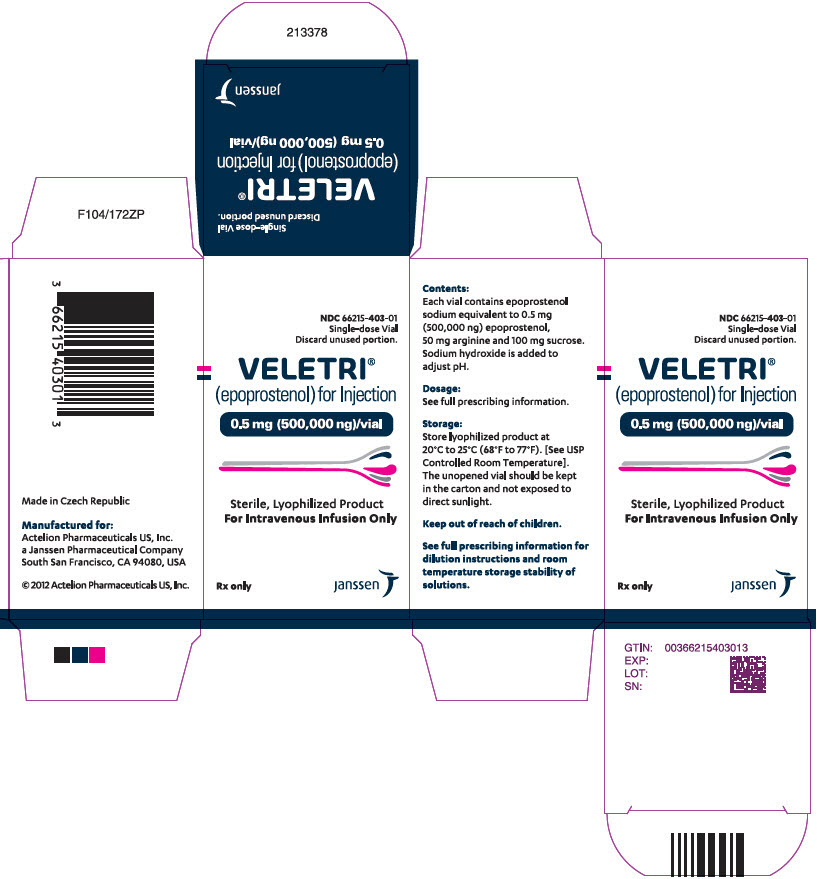
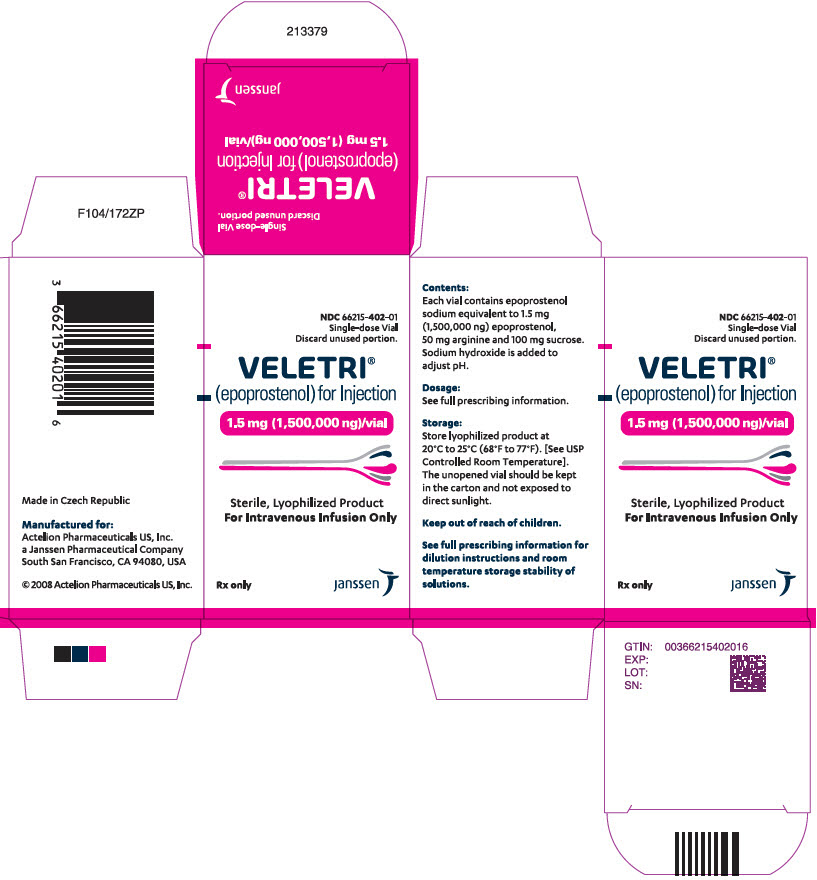
Store the vials of VELETRI at 68° to 77°F (20° to 25°C) [see USP Controlled Room Temperature].