Preparation
Remodulin is administered by subcutaneous or intravenous infusion at a calculated rate based on a patient's dose (ng/kg/min), weight (kg), and the Remodulin concentration (mg/mL).
For administration of Undiluted Remodulin the rate is calculated using the following formula:
| Undiluted Infusion Rate (mL/hour) | = | Dose (ng/kg/min) | × | Weight (kg) | × | 0.00006 Conversion factor of 0.00006 = 60 min/hour × 0.000001 mg/ng |
| Remodulin Vial Strength (mg/mL) |
For administration of Diluted Remodulin, the concentration is calculated using the following formula:
Step 1
| Diluted Remodulin Concentration
(mg/mL) | | Dose (ng/kg/min) | × | Weight (kg) | × | 0.00006 |
| = |
| Infusion Rate
(mL/hour) |
The volume of Remodulin Injection needed to make the required diluted Remodulin concentration for the given reservoir size can then be calculated using the following formula:
Step 2
Volume of Remodulin Injection
(mL) | = | Diluted Remodulin Concentration
(mg/mL) | × | Total Volume of Diluted Remodulin Solution in Reservoir
(mL) |
Remodulin Vial Strength
(mg/mL) |
The calculated volume of Remodulin Injection is then added to the reservoir along with the sufficient volume of diluent to achieve the desired total volume in the reservoir.
Subcutaneous Infusion
Remodulin is administered subcutaneously by continuous infusion, via a subcutaneous catheter, using an infusion pump designed for subcutaneous drug delivery. The infusion pump should: (1) be adjustable to approximately 0.002 mL/hour, (2) have occlusion/no delivery, low battery, programming error and motor malfunction alarms, (3) have delivery accuracy of ±6% or better, (4) be positive pressure-driven, and (5) have a reservoir made of polyvinyl chloride, polypropylene or glass. Alternatively, use an infusion pump cleared for use with Remodulin. To avoid potential interruptions in drug delivery, the patient must have immediate access to a backup infusion pump and subcutaneous infusion sets.
Intravenous Infusion
External Intravenous Infusion Pump:
Remodulin is administered intravenously by continuous infusion via a surgically placed indwelling central venous catheter using an external infusion pump designed for intravenous drug delivery. If clinically necessary, a temporary peripheral intravenous cannula, preferably placed in a large vein, may be used for short term administration of Remodulin. Use of a peripheral intravenous infusion for more than a few hours increases the risk of thrombophlebitis. The infusion pump used to administer Remodulin should: (1) have occlusion/no delivery, low battery, programming error and motor malfunction alarms, (2) have delivery accuracy of ±6% or better, (3) be positive pressure driven, and (4) have a reservoir made of polyvinyl chloride, polypropylene or glass. Alternatively, use an infusion pump cleared for use with Remodulin. To avoid potential interruptions in drug delivery, the patient must have immediate access to a backup infusion pump and infusion sets.
Infusion sets with an in-line 0.22- or 0.2-micron pore size filter should be used.
Implantable Intravenous Infusion Pump:
Use an implantable intravenous infusion pump approved for use with Remodulin, such as the Implantable System for Remodulin® (ISR). Refer to the pump manufacturer's manual for specific instructions regarding preparation, programing, implantation, and refilling.
Adverse Events with Subcutaneously Administered Remodulin
Patients receiving Remodulin as a subcutaneous infusion reported a wide range of adverse events, many potentially related to the underlying disease (dyspnea, fatigue, chest pain, right ventricular heart failure, and pallor). During clinical trials with subcutaneous infusion of Remodulin, infusion site pain and reaction were the most common adverse events among those treated with Remodulin. Infusion site reaction was defined as any local adverse event other than pain or bleeding/bruising at the infusion site and included symptoms such as erythema, induration, or rash. Infusion site reactions were sometimes severe and could lead to discontinuation of treatment.
Table 3: Percentages of Subjects Reporting Subcutaneous Infusion Site Adverse Events | Reaction | Pain |
|---|
| Placebo | Remodulin | Placebo | Remodulin |
|---|
| Severe | 1 | 38 | 2 | 39 |
| Requiring narcotics based on prescriptions for narcotics, not actual use | NA medications used to treat infusion site pain were not distinguished from those used to treat site reactions | NA | 1 | 32 |
| Leading to discontinuation | 0 | 3 | 0 | 7 |
Other adverse events included diarrhea, jaw pain, edema, vasodilatation, and nausea, and these are generally considered to be related to the pharmacologic effects of Remodulin, whether administered subcutaneously or intravenously.
Adverse Reactions during Chronic Dosing
Table 4 lists adverse reactions that occurred at a rate of at least 3% more frequent in patients treated with subcutaneous Remodulin than with placebo in controlled trials in PAH.
Table 4: Adverse Reactions in Controlled 12-Week Studies of Subcutaneous Remodulin and at least 3% more frequent than on Placebo| Adverse Reaction | Remodulin
(N=236)
Percent of Patients | Placebo
(N=233)
Percent of Patients |
|---|
| Infusion Site Pain | 85 | 27 |
| Infusion Site Reaction | 83 | 27 |
| Headache | 27 | 23 |
| Diarrhea | 25 | 16 |
| Nausea | 22 | 18 |
| Rash | 14 | 11 |
| Jaw Pain | 13 | 5 |
| Vasodilatation | 11 | 5 |
| Edema | 9 | 3 |
Reported adverse reactions (at least 3% more frequent on drug than on placebo) are included with the exception of those too general to be informative, and those not plausibly attributable to the use of the drug, because they were associated with the condition being treated or are very common in the treated population.
While hypotension occurred in both groups, the event was experienced twice as frequently in the Remodulin group as compared to the placebo group (4% in Remodulin treatment group versus 2% in placebo-controlled group). As a potent vasodilator, hypotension is possible with the administration of Remodulin.
The safety of Remodulin was also studied in a long-term, open-label extension study in which 860 patients were dosed for a mean duration of 1.6 years, with a maximum exposure of 4.6 years. Twenty-nine (29%) percent achieved a dose of at least 40 ng/kg/min (max: 290 ng/kg/min). The safety profile during this chronic dosing study was similar to that observed in the 12-week placebo-controlled study except for the following suspected adverse drug reactions (occurring in at least 3% of patients): anorexia, vomiting, infusion site infection, asthenia, and abdominal pain.
Adverse Events Attributable to the Drug Delivery System
In controlled studies of Remodulin administered subcutaneously, there were no reports of infection related to the drug delivery system. There were 187 infusion system complications reported in 28% of patients (23% Remodulin, 33% placebo); 173 (93%) were pump related and 14 (7%) related to the infusion set. Eight of these patients (4 Remodulin, 4 placebo) reported non-serious adverse events resulting from infusion system complications. Adverse events resulting from problems with the delivery systems were typically related to either symptoms of excess Remodulin (e.g., nausea) or return of PAH symptoms (e.g., dyspnea). These events were generally resolved by correcting the delivery system pump or infusion set problem, such as replacing the syringe or battery, reprogramming the pump, or straightening a crimped infusion line. Adverse events resulting from problems with the delivery system did not lead to clinical instability or rapid deterioration. In addition to these adverse events due to the drug delivery system during subcutaneous administration, the following adverse events may be attributable to the IV mode of infusion including arm swelling, paresthesia, hematoma, and pain [see Warnings and Precautions (5.1)].
Risk Summary
Limited case reports of treprostinil use in pregnant women are insufficient to inform a drug-associated risk of adverse developmental outcomes. However, there are risks to the mother and the fetus associated with pulmonary arterial hypertension (see Clinical Considerations). In animal studies, no adverse reproductive and developmental effects were seen in rats at about 123 and 48 times the human exposure based on Cmax and AUC, respectively. In rabbits, external fetal and soft tissue malformations and skeletal malformations were observed at about 7 and 5 times the human exposure based on Cmax and AUC, respectively (see Data).
The estimated background risk of major birth defects and miscarriage for the indicated populations is unknown. All pregnancies have a background risk of birth defect, loss, or other adverse outcomes. In the U.S. general population, the estimated background risk of major birth defects and miscarriage in clinically recognized pregnancies is 2 to 4% and 15 to 20%, respectively.
Clinical Considerations
Disease-associated maternal and embryo-fetal risk
Pulmonary arterial hypertension is associated with an increased risk of maternal and fetal mortality.
Data
Animal reproduction studies have been conducted with treprostinil via continuous subcutaneous administration and with treprostinil diolamine administered orally. In pregnant rats, continuous subcutaneous infusions of treprostinil during organogenesis and late gestational development, at doses as high as 900 ng treprostinil/kg/min (about 117 times the starting human subcutaneous infusion rate, on a ng/m2 basis and about 16 times the average rate achieved in clinical trials), resulted in no evidence of harm to the fetus. In pregnant rabbits, effects of continuous subcutaneous infusions of treprostinil during organogenesis were limited to an increased incidence of fetal skeletal variations (bilateral full rib or right rudimentary rib on lumbar 1) associated with maternal toxicity (reduction in body weight and food consumption) at a dose of 150 ng treprostinil/kg/min (about 41 times the starting human subcutaneous infusion rate, on a ng/m2 basis, and 5 times the average rate used in clinical trials). In rats, continuous subcutaneous infusion of treprostinil from implantation to the end of lactation, at doses of up to 450 ng treprostinil/kg/min, did not affect the growth and development of offspring. In studies with orally administered treprostinil diolamine, no adverse effect doses for fetal viability/growth, fetal development (teratogenicity), and postnatal development were determined in rats. In pregnant rats, no evidence of harm to the fetus was observed following oral administration of treprostinil diolamine at the highest dose tested (20 mg/kg/day), which represents about 123 and 48 times the human exposure, when based on Cmax and AUC of the average subcutaneous infusion rate achieved in clinical trials, respectively. In pregnant rabbits, external fetal and soft tissue malformations and fetal skeletal malformation occurred. The dose at which no adverse effects were seen (0.5 mg/kg/day) represents about 7 and 5 times the human exposure, when based on Cmax and AUC of the average subcutaneous infusion rate achieved in clinical trials, respectively. No treprostinil treatment-related effects on labor and delivery were seen in animal studies. Animal reproduction studies are not always predictive of human response.
Risk Summary
There are no data on the presence of treprostinil in human milk, the effects on the breastfed infant, or the effects on milk production.
Absorption
Remodulin is relatively rapidly and completely absorbed after subcutaneous infusion, with an absolute bioavailability approximating 100%. Steady-state concentrations occurred in approximately 10 hours. Concentrations in patients treated with an average dose of 9.3 ng/kg/min were approximately 2,000 ng/L.
Distribution
The volume of distribution of the drug in the central compartment is approximately 14 L/70 kg ideal body weight. Remodulin at in vitro concentrations well above what is clinically relevant was 91% bound to human plasma protein.
Metabolism and Excretion
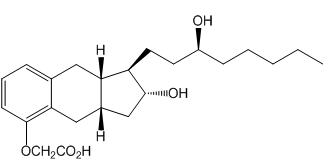
Treprostinil is substantially metabolized by the liver, primarily by CYP2C8. In a study conducted in healthy volunteers using [14C] treprostinil, 79% and 13% of the subcutaneous dose was recovered in the urine and feces, respectively, over 10 days. Only 4% was excreted as unchanged treprostinil in the urine. Five metabolites were detected in the urine, ranging from 10% to 16% and representing 64% of the dose administered. Four of the metabolites are products of oxidation of the 3-hydroxyloctyl side chain and one is a glucuroconjugated derivative (treprostinil glucuronide). The identified metabolites do not appear to have activity.
The elimination of treprostinil (following subcutaneous administration) is biphasic, with a terminal elimination half-life of approximately 4 hours using a two-compartment model. Systemic clearance is approximately 30 L/hour for a 70 kg person.
Based on in vitro studies treprostinil does not inhibit or induce major CYP enzymes.
Specific Populations
Hepatic Insufficiency
In patients with portopulmonary hypertension and mild (n=4) or moderate (n=5) hepatic insufficiency, Remodulin at a subcutaneous dose of 10 ng/kg/min for 150 minutes had a Cmax that was 2-fold and 4-fold, respectively, and an AUC 0-∞ that was 3-fold and 5-fold, respectively, values observed in healthy subjects. Clearance in patients with hepatic insufficiency was reduced by up to 80% compared to healthy adults.
Renal Impairment
In patients with severe renal impairment requiring dialysis (n=8), administration of a single 1 mg dose of orally administered treprostinil pre- and post-dialysis resulted in an AUC0-inf that was not significantly altered compared to healthy subjects.
Drug Interaction Studies
Effect of CYP2C8 Inhibitors and Inducers on Treprostinil
Co-administration of an oral formulation of treprostinil (treprostinil diolamine) with gemfibrozil (600 mg twice a day), a CYP2C8 enzyme inhibitor, doubles the AUC and Cmax of treprostinil in healthy adults. Co-administration of an oral formulation of treprostinil (treprostinil diolamine) with rifampin (600 mg/day), a CYP2C8 enzyme inducer, decreases AUC of treprostinil by 22%.
Effect of Treprostinil on Cytochrome P450 Enzymes
In vitro studies of human hepatic microsomes showed that treprostinil does not inhibit cytochrome P450 (CYP) isoenzymes CYP1A2, CYP2A6, CYP2C8, CYP2C9, CYP2C19, CYP2D6, CYP2E1, and CYP3A. Additionally, treprostinil does not induce CYP1A2, CYP2B6, CYP2C9, CYP2C19, and CYP3A isoenzymes.
Effect of Other Drugs on Treprostinil
Human pharmacokinetic studies with an oral formulation of treprostinil (treprostinil diolamine) indicated that co-administration of the cytochrome P450 (CYP) 2C8 enzyme inhibitor gemfibrozil increases exposure (both Cmax and AUC) to treprostinil. Co-administration of the CYP2C8 enzyme inducer rifampin decreases exposure to treprostinil.
Drug interaction studies have been carried out with treprostinil (oral or subcutaneous) co-administered with acetaminophen (4 g/day), esomeprazole (40 mg/day), bosentan (250 mg/day), sildenafil (60 mg/day), warfarin (25 mg/day), and fluconazole (200 mg/day), respectively, in healthy volunteers. These studies did not show a clinically significant effect on the pharmacokinetics of treprostinil. Treprostinil does not affect the pharmacokinetics or pharmacodynamics of warfarin. The pharmacokinetics of R- and S- warfarin and the INR in healthy subjects given a single 25 mg dose of warfarin were unaffected by continuous subcutaneous infusion of treprostinil at an infusion rate of 10 ng/kg/min.
Hemodynamic Effects
As shown in Table 5, chronic therapy with Remodulin resulted in small hemodynamic changes consistent with pulmonary and systemic vasodilation.
Table 5: Hemodynamics during Chronic Administration of Remodulin in Patients with PAH in 12-Week Studies| Hemodynamic Parameter | Baseline | Mean change from baseline at Week 12 |
|---|
Remodulin
(N=204-231) | Placebo
(N=215-235) | Remodulin
(N=163-199) | Placebo
(N=182-215) |
|---|
| CI, cardiac index; PAPm, mean pulmonary arterial pressure; PVRI, pulmonary vascular resistance indexed; RAPm, mean right atrial pressure; SAPm, mean systemic arterial pressure; SVRI, systemic vascular resistance indexed; SvO2, mixed venous oxygen saturation; HR, heart rate |
| CI (L/min/m2) | 2.4 ± 0.88 | 2.2 ± 0.74 | +0.12 ± 0.58 Denotes statistically significant difference between Remodulin and placebo, p<0.05. | -0.06 ± 0.55 |
| PAPm (mmHg) | 62 ± 17.6 | 60 ± 14.8 | -2.3 ± 7.3 | +0.7 ± 8.5 |
| RAPm (mmHg) | 10 ± 5.7 | 10 ± 5.9 | -0.5 ± 5.0 | +1.4 ± 4.8 |
| PVRI (mmHg/L/min/m2) | 26 ± 13 | 25 ± 13 | -3.5 ± 8.2 | +1.2 ± 7.9 |
| SVRI (mmHg/L/min/m2) | 38 ± 15 | 39 ± 15 | -3.5 ± 12 | -0.80 ± 12 |
| SvO2 (%) | 62 ± 100 | 60 ± 11 | +2.0 ± 10 | -1.4 ± 8.8 |
| SAPm (mmHg) | 90 ± 14 | 91 ± 14 | -1.7 ± 12 | -1.0 ± 13 |
| HR (bpm) | 82 ± 13 | 82 ± 15 | -0.5 ± 11 | -0.8 ± 11 |
Clinical Effects
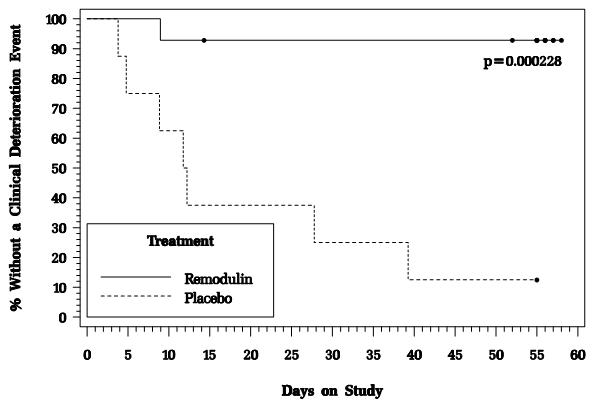
The effect of Remodulin on 6-minute walk, the primary endpoint of the 12-week studies, was small and did not achieve conventional levels of statistical significance. For the combined populations, the median change from baseline on Remodulin was 10 meters and the median change from baseline on placebo was 0 meters from a baseline of approximately 345 meters. Although it was not the primary endpoint of the study, the Borg dyspnea score was significantly improved by Remodulin during the 6-minute walk, and Remodulin also had a significant effect, compared with placebo, on an assessment that combined walking distance with the Borg dyspnea score. Remodulin also consistently improved indices of dyspnea, fatigue, and signs and symptoms of pulmonary hypertension, but these indices were difficult to interpret in the context of incomplete blinding to treatment assignment resulting from infusion site symptoms.
Interruption of Therapy
Advise patients and caregivers to seek medical attention if they experience signs or symptoms of abrupt withdrawal of therapy or suspect a pump malfunction [see Warnings and Precautions (5.2)].
Overdose
Inform patients and their caregivers to seek medical attention if they experience signs or symptoms of Remodulin overdose [see Overdosage (10)].
©Copyright 2026 United Therapeutics Corp. All rights reserved.
REMODULIN manufactured for:
United Therapeutics Corp.
Durham, NC 27713